Cutlery is, above all, a tool for eating. A simple and familiar household object that needs no superfluous elements to fulfil its function.
Losko has gathered 10 cutlery sets whose design not only makes them more comfortable to use, but also inspires.
Dune — andreaponti.com
Dune is an aluminium cutlery set created in Hong Kong by Italian designer Andrea Ponti.


The influence of Italy's heritage and China's futuristic environment are both reflected in this refined and contemporary cutlery collection.
Clean design and an emphasis on functionality are the defining characteristics of the Dune set. It takes its name from its form: the straight handle of each piece flows smoothly into a steep curve that recalls a sand dune.
Ponti chose aluminium for its construction, making the set exceptionally lightweight and more elegant than its steel or titanium counterparts. Each set is delivered in a dedicated box that can also serve as everyday home storage.
You can find more photographs and details in our feature on the Dune collection.
Piattona — eliserijnberg.nl
Piattona is an all-metal cutlery set designed by Elise Rijnberg, a designer and photographer based in Rotterdam, the Netherlands.


This is a minimalist silver cutlery collection designed to help people slow down and savour their food. Piattona is an Italian word introduced by the businessman and writer Pellegrino Artusi. It refers to the unhurried act of eating — relishing each cut morsel. With this set, the designer responds to our age of rushed, mindless consumption. The streamlined silver pieces are conceived to make people pause and bring genuine attention to the act of eating.
Hang Around & Toss Around — kibisi.com
Hang Around & Toss Around is a set of wooden kitchen utensils created by design studio KiBiSi in Copenhagen for Danish brand Muuto.


The studio drew inspiration for this white beech wood utensil set from Bhutanese woodcraft — a tradition refined over centuries. The meeting of Bhutanese craft and Scandinavian heritage found its expression in the design of Hang Around & Toss Around.
Each utensil has a notch on its underside that allows it to rest on the rim of a pot or pan. This simple yet considered detail makes the pieces noticeably more practical to use.
Recto Verso — ora-ito.com
The Recto Verso set was designed by French designer Ora-Ito (Ora ïto) in 2008.


Recto Verso is a play of curves and straight lines, a dialogue between flatness and volume. The name references a term used in printing, publishing and archaeology to describe a leaf bearing text on both sides — recto being the front and verso the back. In French, the idiom le mode recto verso carries a meaning close to "two sides of the same coin."
15.0% Ice Cream Spoon — odetothings.com
Designed by Japanese designer Naoki Terada (Naoki Terada) and produced by Japanese brand Lemnos, this unassuming utensil unites visual appeal with genuine functionality.


The spoon is made from solid aluminium, which conducts heat well enough that the warmth of the hand gently melts the ice cream.
The designer created three spoon models for different types of ice cream, each named after a classic flavour: vanilla for the oval tip, chocolate for the angled tip, and strawberry for the fork-shaped tip. Every spoon is hand-polished in Takaoka, Japan's metallurgical heartland.
The name is a reference to a Japanese standard stipulating that the fat content of ice cream must be no less than 15.0%.
Masanori cutlery — o-ji.jp
Japanese designer Oji Masanori created a cutlery series in collaboration with the brass foundry Futagami, established in the city of Takaoka, Japan.


The set is made from lead-free brass with silver-plated tips and includes several types of spoons and forks, a knife, and cutlery rests. Brass pieces change colour over the years through oxidation. The longer they are used, the more unique and rich they look, taking on the appearance of an ancient artefact unearthed during excavation.
The combination of copper and silver, the delicacy of the handles — reminiscent of chopsticks — all speak of Japan.
Arne Jacobsen Cutlery — architonic.com
A cutlery set by the leading Danish architect and designer of the 20th century Arne Jacobsen (Arne Jacobsen).


This set, simple in form, was created in 1957 for the SAS Royal Hotel in Copenhagen. It still looks contemporary and innovative today. The set is made from brushed stainless steel. Arne Jacobsen's cutlery was revolutionary. His "less is more" approach perfectly explains why the set is known as "cutlery without excess".
Orbit Scoop — kampstudio.com
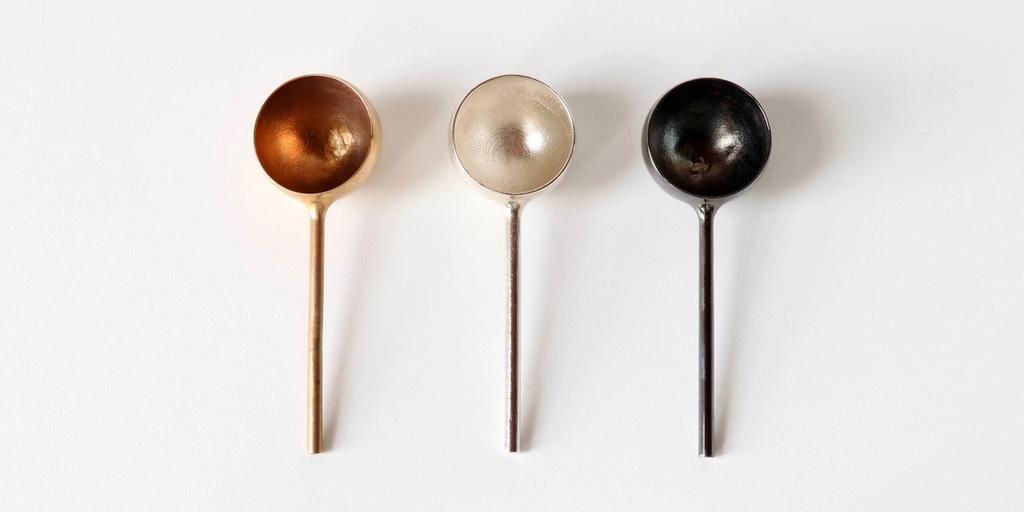
The Orbit Scoop collection was designed by Daniel Kamp from New Zealand and is handmade in Brussels and New York.


The elegant Orbit Scoop line is a collection of tea and coffee scoops produced through a unique fabrication process. Each scoop is made using high-precision three-dimensional wax printing; the wax forms are then cast in bronze, silver, or brass. The pieces are carefully hand-polished to a smooth, lustrous exterior finish that contrasts with the interior surface. The texture inside evokes fingerprints and reveals the growth layers formed during 3D printing.
The limited-edition Orbit Scoop collection is inspired by the orbits along which celestial bodies travel. It is Daniel Kamp's attempt to bring a cosmic elegance into everyday life.
Ribrand — ribrand.si
Ribrand is the result of a collaboration between design studio Mashoni and the Ribnica craft centre in Slovenia.


The Ribnica valley in Slovenia has a centuries-old tradition of woodworking. The Ribrand collection represents Slovenia's heritage while opening the door to modern, simple and functional products. Lead designer Janez Mesaric was guided by geometric motifs and conceived each piece as part of a unified whole. The set consists of a spoon, a fork and a spatula; each item features a concealed magnet for storage.
"Wood is a living material that transforms and reflects the way it is used. If you treat it with care, it will stay with you for many years," says Janez Mesaric.
Malmö — miguelsoeiro.com
Portuguese designer Miguel Soeiro (Miguel Soeiro) took ordinary cutlery and transformed it with a single trick for Herdmar.

Malmö is a stainless-steel flatware set with a streamlined form and a subtle yet dynamic curve. The handles are bent at a 90-degree angle to the head of each piece. The tips of the knife, spoon and fork are slightly rounded, creating a contrast with the straight lines and right angles of the handles.
The pieces are produced by cold-forming, with no casting required. Titanium coatings are available in copper, gold, chocolate or black, with a matte or gloss finish.
The set is named after the Swedish city of Malmö, home to the twisted skyscraper HSB Turning Torso, whose form inspired Miguel to create the collection.
If you enjoyed this collection of designer cutlery, take a look at our selection of homeware that would sit perfectly in a minimalist interior.