Andreas Gursky is the highest-paid photographer in the world, whose large-scale photographic canvases are sought after by the leading museums of contemporary art.
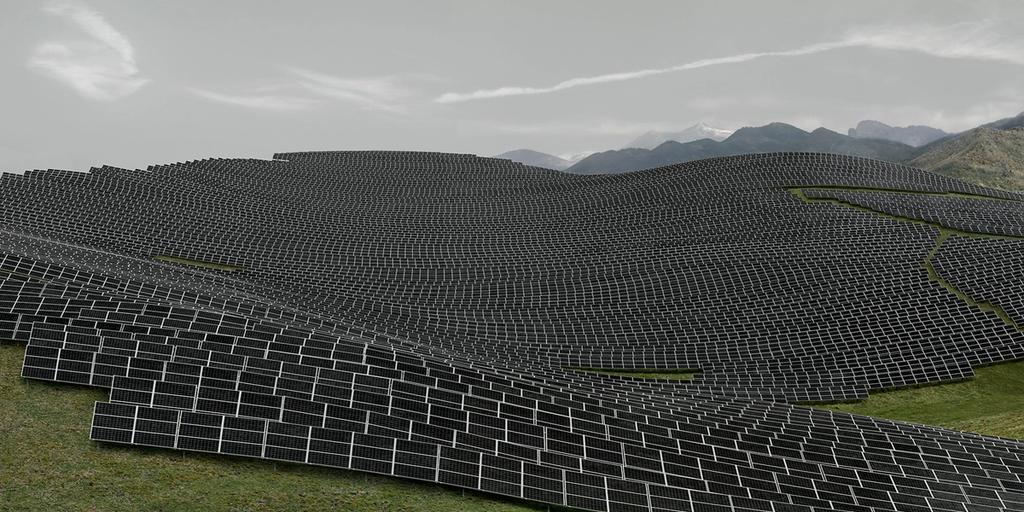
His photographs offer a singular view, as if through the eyes of an extraterrestrial being possessed of keener sight — one capable of perceiving what lies beyond the reach of the human eye. Through his camera, he has come to see society as a single, finely organised structure operating in perfect rhythm. The quality of his work rivals that of serious painting, which is why his pieces are more often described as art canvases than as photographs.
From this article you will learn the key facts of Gursky's biography and discover the 7 core principles the photographer employs when creating his arresting images.

Brief biography
1955
Gursky was born in East Germany in 1955; two years later his family moved to the western part of the country — to the city of Düsseldorf. Andreas's parents ran a photography studio, and his father had also built a successful career as a commercial photographer, becoming his son's first teacher. Before he had even finished secondary school, Andreas had already mastered his father's technical skills and photographic secrets.
1977 – 1981
Gursky studied at the University of Essen, regarded as a cradle of avant-garde art. His teacher there was the noted German photographer Otto Steinert, who had made his name with his "psychological portraits" and who created a new style of "subjective photography" that went on to influence many photographers across Europe and America.
In 1980 he photographed his kitchen stove. Gursky would later include this image in exhibitions devoted to his early work.

Graduating from a prestigious university and studying under a celebrated teacher did not help Gursky find work in his chosen field. While driving a taxi, Andreas met the renowned contemporary photographer Thomas Struth, who helped him gain entry to an art academy.
1981 – 1987
Andreas Gursky enrolled at the Düsseldorf Academy, widely regarded as the forge of Europe's greatest photographers and artists. There he came under the wing of the celebrated German conceptualist masters Bernd and Hilla Becher, who had achieved fame through their serial documentation of industrial structures. Gursky's fellow students included photographers who would go on to great success:Thomas Ruff, Candida Höfer, Jörg Sasse and Thomas Struth.
In 1982 Andreas Gursky produced a series of photographs of office workers for his project Desk Attendants.
From 1983 to 1987, his work focused on people in motion.
1988 – 1989
Andreas held his first solo exhibition at the Berlin galleryGalerie Johnen & Schöttle. A year later his work was shown at the museumMuseum Haus Lange in the German city of Krefeld.
During this period Gursky's commercial success grew rapidly, driven by a surge in international interest in the art of photography and the peak of fame enjoyed by his teachers Bernd and Hilla Becher.
Around the same time, Andreas began experimenting with the scale of his photographs, gradually increasing their size.
In these years he turned his attention more closely to nature.
1990
Gursky travelled to cities across Asia, Europe and America, photographing residential buildings, factories, hotels and office blocks. He planned the trip in meticulous detail: before arriving in any city he already knew precisely which buildings he would photograph and from which angle.
When printing his photographs, he began using the largest format of photographic paper then available on the market.
1991
In his photographs, Gursky captured the atmosphere of the Siemens factories, combining machinery, people and their working environment within a single frame.


1994, 1998, 2001
In those years, Andreas Gursky held solo exhibitions of his complete body of work at museums in Amsterdam and Düsseldorf.
The world of the 1990s is vast and all-encompassing — a rapidly evolving world of high technology and globalisation, in which the anonymous individual is no more than one among thousands of his kind.
2000
Gursky began joining sheets of photographic paper to produce images larger than the maximum standard size of 183 × 457 cm.
Around this time he began processing his photographs digitally in order to achieve finer detail, adjust colour palettes, introduce new elements and remove unwanted ones.

2001
That year, Andreas Gursky made a photograph of the Rhine that was subsequently sold at auction for a record sum of $4.3 million. The sale placed Gursky among the most expensive photographers in the world.
Andreas used digital retouching to achieve the landscape's sense of emptiness. In the original version, a power station appeared in the background and a man walking a dog in the foreground.

2007
A travelling exhibition was organised, allowing Gursky's photographs to be seen across numerous countries.
The present day
In recent years, Gursky has focused primarily on photographing architecture, landscapes and crowds in a variety of situations.
Andreas Gursky: 7 Essential Rules of Photography
1. Shoot from the highest vantage point available
Andreas named the angle of his photographs the 'God's Eye View.' To achieve it, he hires helicopters and tall cranes, climbs hills and scales skyscrapers, always seeking a perspective that no one else can replicate.
In 2010, for his series Ocean, Gursky used high-resolution satellite imagery. The series sparked considerable debate over whether such photographs could be considered works of art.
2. Approach the act of photography as a documentation of human life
When photographing, one must awaken an inner scientist — one who uses images to record the vital activity of the human species.
I photograph from the perspective of a kind of researcher who observes the world from a distance, studies it and tries to understand its structure and the logic of its development.
3. Prioritise high image quality
Gursky's photographs teem with the finest details — it is these that breathe life into the image. Looking at the photograph of the apartment building in full size, you can peer into every window, admire the flowers on the windowsills, examine the variety of desk lamps, and count at least four easels standing by the windows.
What makes this photograph particularly interesting is that Gursky separately shot the ends of the building and 'attached' them to the façade, allowing the viewer to see the building from three sides at once.

4. Using multiple frames to create a single photograph
Stitching several frames together makes it possible to print photographs of enormous size. The number of shots can range from two, as in the apartment-building photograph 'Montparnasse' (above), to several dozen, as in the series 'F1 Boxenstopp'.
5. Editing colour
Gursky pays close attention to colour. He does not allow a multitude of shades of the same colour to coexist within a single image. The colour palette in his work is deliberately limited.

6. 'Cleaning' the image of distracting details and adding new ones
A key part of his editing process is the addition and removal of details. In the photograph '99 Cent II Diptychon', for instance, Gursky added a reflection of the merchandise on the ceiling, creating an effect of infinite repetition.
The history of this photograph is not without irony: Gursky conceived this image of an American 99-cent store as a metaphor for the problem of contemporary consumer society. The work was recently sold for 2.2 million dollars — a metaphor, in turn, for the global art market.

7. What should interest a photographer is not the place, but the space
In Gursky's own words, a space need not be picturesque or exotic — it simply has to function like a working battery from which one can draw energy. That charge must be strong enough to be transmitted to the viewer through the photograph.
All of these principles serve Gursky's central idea: to reflect the impact of globalisation on contemporary life. It matters to Andreas to show both the finest details and the complete picture of whatever he is photographing — to grant the viewer a 'God's-eye view' that takes in the full sweep of the panorama while simultaneously allowing them to fix their gaze on each tiny element within it.
More photographs
More monumental photographs taken from unusual angles can be found in our article on the architecture of Belgrade in Mirko Nahmijas's project.