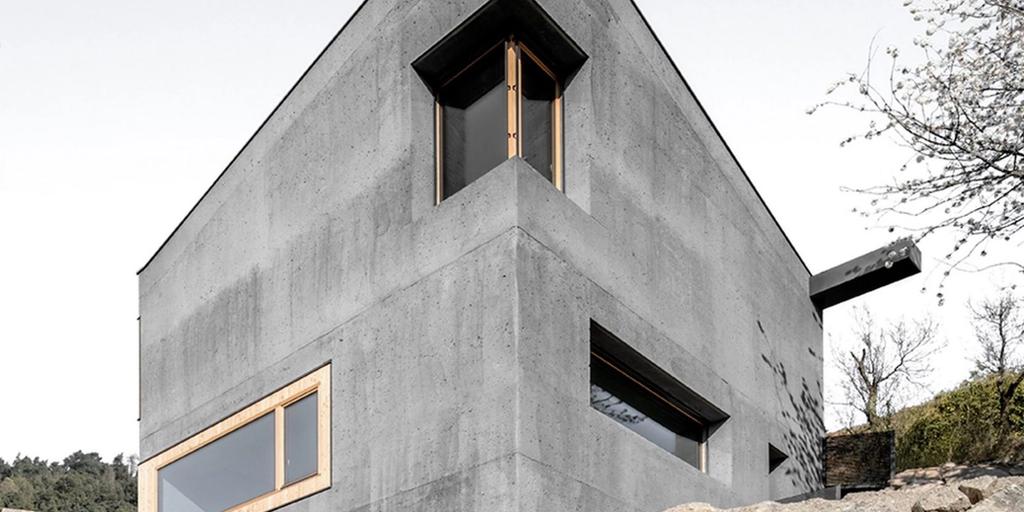
Habitat Andergassen Urthaler is an Alpine house in concrete by architect Andreas Gruber (Andreas Gruber). Originally conceived as an experiment, the building ultimately became a fully realised home with a magnificent view of the Italian Alps.

The building is located in South Tyrol, an autonomous Italian province in the north of the country, where the Alpine peaks rise above the landscape. The territory was annexed by Italy in 1919 under the Treaty of Saint-Germain-en-Laye following the First World War, and the majority of its residents still speak German today. The provincial capital is the city of Bolzano.
Andreas Gruber is an architect from the municipality of Natz-Schabs in South Tyrol. He is an expert in urbanism, advises public bodies and institutions, runs seminars and takes part in architectural competitions.
Gruber specialises in designing residential buildings, hotels, agricultural facilities and industrial spaces. He constructs new buildings, transforms existing ones and works on interior design. In his projects, Andreas Gruber draws inspiration from the characteristics and qualities of the surrounding environment. His buildings respond to the culture and landscape of their locality.
For him, architecture is an expression of a place's identity and history.

For him, architecture is an expression of a place's identity and history. Gruber pays particular attention to interior design, which, in his view, should convey emotion and create a living, inspiring atmosphere. He places people's needs and ecology at the top of his list of priorities.
The Habitat AU concrete house, designed by Gruber, is situated in the western part of the Eisacktal valley in South Tyrol. The surrounding mountain ridges are rich in granite and porphyry, which weathers to a deep grey over time through erosion. Habitat AU was built with the cultural and natural landscape of the Eisacktal in mind. Following the natural conditions of the site and national energy-efficiency requirements, Gruber approached the construction of this house as a kind of experiment.
He also wanted to create a building that could be fully recycled. To that end, he constructed Habitat AU from Dämmbeton — a thermal insulating concrete — without the use of polyurethane or plastics.
The building was conceived as an experiment but ultimately became a fully realised home. Its windows open onto breathtaking views of the Dolomites, where human presence sits quietly alongside nature. The budget for a house of this kind ranges from $100,000 to $500,000.


We also put together a full feature:Wood and Concrete: 10 Rare Examples of Brutalist and Stylish Interiors — concrete, wood and glass are used not merely as building materials but as the central element of each building's aesthetic. Also worth noting is a church in Seoul constructed entirely from this material.