Today, more and more city dwellers are turning to mindful consumption, and the model of the shopping centre as the main focal point of any neighbourhood is becoming a thing of the past. Even so, among these buildings it is possible to find structures that engage thoughtfully with urban space and may even stand a chance of one day becoming architectural landmarks.
Losko has selected five such unusual shopping centres.
Westside Bruennen

Location: Bern, Switzerland
Date: 2008
Architecture firm
The Westside Bruennen shopping centre was built by Studio Libeskind in 2008. The studio is led by American architect Daniel Libeskind, one of the originators of deconstructivism. The majority of Libeskind's works take the form of architectural interventions into existing buildings. The most striking examples include the new wing of the Military History Museum in Dresden and the expansion of the Royal Ontario Museum. Through these projects, the architect seeks to create a dialogue between past and future. Other hallmarks of Libeskind's style are an abundance of sharp angles, a fragmented rhythm of volumes, and a deliberate rejection of tectonics.
Structure and site
With its fractured, deliberately intricate surfaces and sharply projecting volumes, the building is a prime example of deconstructivism. Nevertheless, it does not engage in the open confrontation with the urban environment that is typical of deconstructivist architecture. On the contrary — the shopping centre is conceived as a connecting link between the city and the surrounding countryside. Positioned on the boundary between two territories, it fits naturally into both the urban fabric and the natural landscape. The timber facade and horizontal massing allow the centre to avoid any conflict with the suburban scenery. Westside Bruennen has become a transitional point between the city and the adjacent rural area.
What else to look out for
The building's diagonal strip glazing is an interpretation of one of Le Corbusier's five points — the one stating that windows can be extended across the entire length of a facade. "The latest means have liberated the window; reinforced concrete has brought about a true revolution in its history," wrote the great architect.
Markthal Rotterdam

Location: Rotterdam, the Netherlands
Date: 2014
Architecture firm
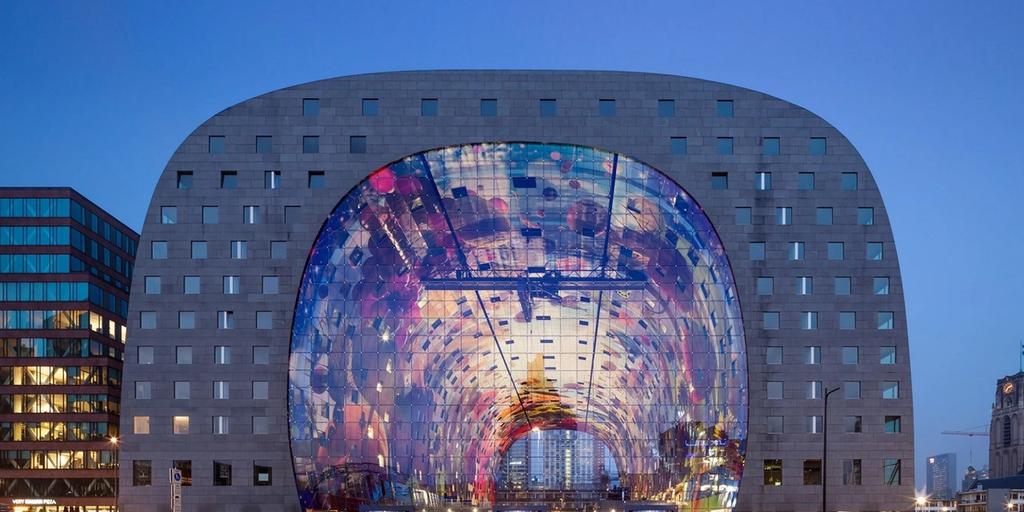
The Markthal shopping centre was designed by the Dutch firm MVRDV It was founded in 1993 by architects and urbanists Winy Maas, Jacob van Rijs and Nathalie de Vries. The studio developed a manifesto setting out the core principles of its practice: the creation of urban spaces that foster active social interaction and meet the fundamental needs of residents.
MVRDV pays particular attention to the problem of urban development, and frequently designs buildings that combine several functions within a single structure. This is how the studio achieves spatial efficiency. Markthal, for example, brings together shops, restaurants, a residential complex, a covered urban market and even an art installation.
Structure and Site
Markthal is located in the centre of Rotterdam, in the Laurenskwartier district. The building takes the form of a large arch whose supports house a residential complex of 228 apartments, a car park and retail spaces. The vault of the structure forms an urban square. During the day it functions as a market; in the evening it becomes a place to relax, with restaurants and bars. This architectural solution made it possible to save space while creating a new focal point for the city's residents.
Other Things to Note
The inner vault of Markthal is adorned with a work by artists Arno Coenen and Iris Roskam. The digital composition Horn of Plenty depicts freely floating images of fruit, flowers and insects. The animation studio Pixar contributed to its creation. The work references the tradition of seventeenth-century Dutch still-life painting and forges a historical connection with the city.
Location: Gdańsk, Poland
Date: 2018
Architectural Practice
The concept for the Forum Gdańsk shopping centre was conceived and realised by the Polish division of the French architecture studio SUD Architectes. The practice sees its mission as the creation of a compact urban complex that exists in harmony with its surroundings.
Structure and Site
The shopping centre is situated in the historic centre of Gdańsk, on the site of the former Hay Market and Crab Market. In this way, Forum Gdańsk continues the long-standing trading tradition of the area. The building consists of a chain of several low-rise volumes connected to one another. According to the architects, this approach frees the shopping centre from the bulk typical of buildings of this kind and brings it closer in character to the rest of the city.
The project's authors not only took the history of the site into account but also considered how to integrate the shopping centre into its immediate surroundings. The building incorporates the Radunia Canal, dug as far back as the fourteenth century. One bank of the canal is paved with cobblestones recovered from the site of the old Hay Market, a gesture through which the architects underscored the building's historical continuity with the place.
Other Things to Note
Forum Gdańsk plays on elements drawn from Gdańsk's historic buildings. The structure uses a material that recalls red ceramic brick in colour and texture — a material characteristic of traditional Polish architecture.
Morocco Mall
Location: Casablanca, Morocco
Date: 2011
Architectural Practice
Morocco Mall was designed by the studio Design International, which specialises in commercial and business centre projects. The practice was founded in Toronto in 1965.
Structure and Site
Morocco Mall in Casablanca became the second-largest shopping centre in Africa. The building on the shore of the Atlantic Ocean occupies a site of more than 10 hectares. The architect David Padoa, who developed the project, gave careful consideration to the terrain on which the shopping centre sits. The structure, 628 metres long, runs along the coastline, accentuating its extent without disturbing the natural relief. The building's silhouette is dominated by smooth lines and rounded volumes with no sharp angles, which harmonise with the irregular contour of the shoreline.
Other Things to Note
Inside Morocco Mall sits another retail space — a branch of the celebrated Parisian Galeries Lafayette. The structure has its own entrance, which entered the Guinness World Records as the largest façade within a shopping venue. It is lined with illuminated circular openings that recreate the pattern of the dome of the original Galeries Lafayette.
Sony Center
Location: Berlin, Germany
Date: 2000
Architect
Sony Center was designed by Helmut Jahn, a pupil of Ludwig Mies van der Rohe — one of the founding figures of architectural modernism. In his projects, Helmut Jahn pursues technological sophistication and functional clarity, with particular attention paid to a building's structural logic.
Structure and Site
Sony Center is one of Berlin's foremost new landmarks. It stands on Potsdamer Platz, a square that was devastated during the Second World War and then split in two by the Berlin Wall. In 1989, after the Wall fell, the city reclaimed one of its great central spaces. In 1996, the city authorities decided to erect a new building there and transform Potsdamer Platz into a symbol of reunited Berlin.
Sony Center is a complex of seven free-standing buildings arranged around a permeable triangular space. One side of this triangle follows the axis of Potsdamerstrasse; another follows the axis of Ben-Gurion-Strasse. Helmut Jahn wove remnants of the pre-war cityscape into the ensemble — among them a section of the Hotel Esplanade. The surviving fragment of the building was relocated some 70 metres and installed in the northern part of Sony Center.
What Else to Look Out For
The defining feature of Sony Center is its tent roof — a steel ring supporting glass panels — which rests on the buildings that make up the complex.
Follow us on social media so you never miss a new piece: VKontakte, Telegram — @loskomagazine.