Why was the power station known as the 'tram station', why did Shekhtel rebuild the cinema, and how did archival photographs help uncover the Istomin family's winter garden?
We gathered several Moscow landmarks where this process of documentation has been carried out — or is still under way — at various stages, and asked architectural photographer Gleb Leonov to speak about why building one's own archive matters and how long it takes to capture the perfect shot.
GES-2 House of Culture

The history of the building
GES-2 — a former power station built in 1907 on Bolotnaya Embankment in central Moscow. The Neo-Russian style was chosen by the station's architect, Vasily Bashkirov, and the engineers included Vladimir Shukhov. For its first ten years it was known as the Tramway Station, as it supplied power to the tram line that had replaced the city's horse-drawn railway. After being connected to the general grid, GES-2 supplied electricity to, among other consumers, the Kremlin, and one of its boilers was repurposed to provide steam to the laundry of the House on the Embankment. The station closed in 2005, and four years later the building was granted the status of a cultural heritage site.
Architects and the contemporary concept
GES-2 is set to become a new cultural space. In 2015 the V–A–C Foundation purchased the building and the surrounding grounds, and the reconstruction project was entrusted to Renzo Piano Building Workshop. The interior will house galleries, a learning centre, a library, a canteen, a café, a restaurant, the Svody artist residency building, and a multipurpose auditorium that doubles as a cinema with 360 seats, a glass wall, and views over a birch grove.

The purpose of photographic documentation
"When you have something this vast, you don't always have a full picture of how it will live on afterwards, what will be needed and what won't — because the project will outlast everyone involved. What will be there in a hundred years, we don't know. I think the right approach is to document as much as possible," says photographer Gleb Leonov.
Points of interest:
- Architectural photographer Gleb Leonov has been shooting for the archive for six years, visiting the construction site three or four times a month.
- GES-2 will not be a museum — it will be a contemporary House of Culture.
- The roof of the building already has five thousand square metres of solar panels installed, in keeping with the concept of rational energy consumption. Their purpose is to save up to 10% of the building's electricity.
- The GES-2 site encompasses more than just the former power station building itself — the surrounding grounds, including the Svody arts production centre, a green zone with a grove, a waterfront descent, and a viewing platform are all part of the project.
- Opening in 2021
Khudozhestvenny Cinema

History of the building
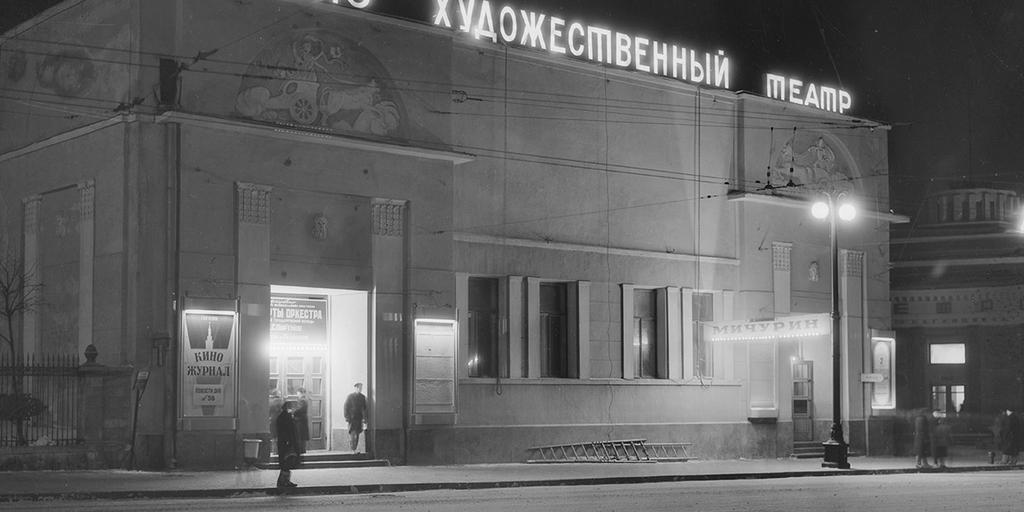
Khudozhestvenny, which opened in 1909, is one of the oldest cinemas in Moscow and indeed in the world. The building was designed by architect Nikolai Blagoveshchensky and later, in 1912, redesigned by Fyodor Shekhtel. Leo Tolstoy, Sergei Yesenin, and other legendary figures of culture and the arts watched films here. In 1926 Khudozhestvenny hosted the premiere of Sergei Eisenstein's Battleship Potemkin, and in the 1930s it screened The Road to Life and Grunia Kornakova — the first Soviet sound and colour films. The current restoration began in autumn 2019 and was completed in December 2020.
Architects and the contemporary concept
The renovated Khudozhestvenny will operate as a premiere and festival venue with a curatorial approach to its programme. The architectural concept was developed by the German practice merz merz, which has extensive experience working with historic buildings (the Berlin State Opera and the Alte Nationalgalerie in Berlin). The interiors were handled by the Spanish studio Lazaro Rosa-Violan, which regularly features in rankings of Europe's leading designers. The appearance of the main façade was reconstructed from Fyodor Shekhtel's original drawings. Bricked-up window openings were uncovered and the historic decorative elements restored: the inscriptions "Vkhod" (Entrance) and "Vykhod" (Exit) above the main doors, the sign reading "Khudozhestvenny Electro-Theatre", the bas-reliefs of Helios and Selene, and the male and female mascarons. Historic lanterns illuminating the main entrance were also recreated from the architect's sketches.


Why photographic documentation?
As Khudozhestvenny is a significant cultural heritage site and architectural landmark, the team commissioned a photographer to document the process. Much of the construction fell during the pandemic period, which meant that photographs were essential for tracking progress together with German and Spanish colleagues.
Interesting facts:
- During the restoration of Khudozhestvenny Cinema, a number of archaeological finds came to light: fragments of antique ceramics and glassware, lipstick jars, a faience figurine, and pieces of tableware services. "All the glassware uncovered during the cinema's restoration dates from the late nineteenth to the early twentieth century. It includes bottles of various sizes — among them flasks andshtofs (a distinctive four-sided bottle with a short neck, used for storing and serving spirits) — as well as inkwells, medicine phials, test tubes, perfume bottles, shot glasses and wine glasses," said Alexei Emelyanov, head of the Moscow Department of Cultural Heritage.
- Working from developed project documentation and archival materials, the team preserved and restored lost elements of the original décor. In the main hall, work was carried out to reinforce the balcony, which had fallen into a dangerous state of disrepair; the ornamental plasterwork and the ventilation grille on the ceiling were also restored. In the foyer, specialists restored the historic staircase designed by Fyodor Shekhtel, along with the partially surviving ceiling cornice and frieze. Wooden window frames that had previously been lost were reinstated, and oak doors were recreated from early-twentieth-century photographs.
- Opening in 2021
The Istomin Mansion at Prechistenka 8

History of the building
Before the Revolution, the house belonged to the Istomin merchant family, who owned one of the largest textile mills in the Russian Empire. The first stone chambers were built in 1751; each successive owner added something of their own, and by 1883 the house had taken on the appearance we see today. Vacated in 1997, the mansion passed from owner to owner, and it was not until 2014 that discussions about a restoration project began. Among those who lived here were the Protasovs, the Arkharovs and Princess Volkonskaya; the ballerina Istomina was a guest, while Tsvetaeva, Ozhegov and Aseev held parties in a carriage house that no longer survives. In 2018, the Kleinewelt bureau drew up a cultural heritage conservation project on the basis of a historical and cultural assessment, and the company Insolver took on its realisation.
The architects and the contemporary concept
Prechistenka 8 is a unique project combining the restoration and adaptive reuse of an urban estate. Recognised as a cultural heritage site, the house will be reconstructed to a design by Kleinewelt Architekten. Interior finishes have survived throughout much of the building and are characterised by the stylistic variety of ornament typical of eclecticism, executed in 1883 and 1898. In the apartments, the architects have placed the emphasis on historic interior features: the original tiled stoves, marble fireplaces with copper fireboxes, brass ventilation grilles, pre-revolutionary decorative parquet, tall double doors, baroque-style plasterwork with foliate ornament, marble window sills and the grand staircase will all be preserved.

Why photographic documentation?
At the initial stage, every detail of the mansion that falls within the listed heritage protection was photographed — details that would also form the foundation of the future mid-century interior. These elements became a central part of the product. The entire marketing strategy for a project so rich in cultural heritage was built on the premise that what is being sold is genuinely authentic. In developing the project's brand identity, the team studied archival materials, including photographs, in order to gain a fuller sense of the building — the means available for this are limited, and photography is one of the most accessible and legible of them.
Points of interest:
- Photogrammetric surveys were carried out on site: specialist camera equipment was set up in each room to capture several thousand images of the space, generating a point cloud that allows us to obtain all dimensions and other parameters in 3D without returning to the site. If, for example, the height of a particular cornice needs to be measured, one can simply open the point cloud in the appropriate software. All the stucco work and other decorative elements featured in the marketing materials were sourced from this photogrammetry.
- The Istomin merchant family lived and worked in the same era as the Morozovs, Tretyakovs, Ryabushinskys and Shchukins, shaping the tastes and mores of their time. In pre-revolutionary Russia they donated more to charitable causes and orphanages than the imperial family, and the buildings of their manufactories still stand today — among them the substantial complex of the Golutvin Manufactory, a monument of industrial Art Nouveau, situated on the far side of the Patriarshy Bridge.
- Historical records, cross-referenced with the restored volume of the building, revealed that the estate once contained a winter garden — a highly fashionable feature of the nineteenth century — which has been incorporated into the contemporary design. It was also discovered that the house originally had a different, central staircase; this will now be reinstated to complement the expansive entrance hall, which can be reached from the rear courtyard.
- Opening in 2023
Photo documentation and record photography
Construction photography is generally assumed to serve a purely utilitarian purpose. Images become progress reports for investors who cannot always visit the site in person, or serve as evidence that restoration work is genuinely under way and being carried out to the proper standards. But there is another purpose: photographers who gain access to a construction site document a large-scale process — and do so beautifully.
In time, these images will in all likelihood enter archives and become an important resource for future architects, conservators, local historians and curators.
Architectural photographer Gleb Leonov on why building a personal archive matters and how long it takes to get the right shot:
Gleb Leonov: On the construction sites where I shoot, someone is periodically walking around photographing things on their phone — a deputy site manager or some kind of supervisor. Usually those photos are sent to the boss who wants to stay up to date, to a contractor who is physically far away and cannot oversee the process directly, to an investor, or to anyone else who needs to be kept in the loop: 'Look, we poured the foundations today' or 'Look, we dug this many pits today.' Construction photography is, for the most part, a purely technical exercise — but not in my case. I've been shooting the GES there for several years now, starting from the demolition phase.
Photographs like these are also needed for PR purposes: the project runs for a long time and content is required continuously — you can't post something on Instagram saying 'We've started building' and then leave it up for four years before swapping it for 'We've finished.' It helps for people to understand how the process is unfolding and what comes next. The GES is a significant landmark for Moscow — it is very much in the public eye and generates a great deal of discussion. The team naturally needs material to engage with the public through the media. Laying the first stone or glazing the entire building — all of it needs to be communicated on social media. PR needs a news hook, and it finds one; and news hooks need striking photographs.
Gleb Leonov: Maybe they aren't needed in the volume I produce them. Nobody is going to use 100 general-view photographs taken two weeks apart, but one of them might be picked up by some project. On 1 January 2015 everything looked like this, and some time later — like this. The difference really is striking; I opened photographs from 2014 of the spot where the grove now stands, and there's a shot where the whole place is practically clad in vinyl siding. That's the kind of thing you want to photograph — to feel connected to it, to have your own archive — it becomes something personal to the photographer: 'Here, I have the first shoot.' A museum or pavilion opens, and you have the first shoot. Some people have shots like that sitting around from when they were laying the foundations of the Ostankino Tower. The same will be true of every landmark construction project.
I often look back at my own photographs — already archival now — and feel a quiet satisfaction: knowing that I was there, that I climbed around in those places, that I was there from the beginning. Stories with a cultural-heritage or historical dimension don't come along all that often, but shoots of such subjects have a greater chance of resurfacing later. Every major construction project inevitably produces books, exhibitions and foundation museums. About BAM, for instance, films with archival photographs are still coming out to this day.
Gleb Leonov: Any documentation implies a certain duration and regularity. For example, you need to record something once a week over the course of a year. A sense of the scale of the hydroelectric station shoots came to me gradually. Apart from significant events — like the installation of the blue pipes or the planting of the birch grove — I usually have no idea what is happening and simply turn up when it suits me: three or four times a month, sometimes more. I know the site well by now; I know what used to stand behind every wall, as though I carry a 3D model of it in my head.
Every time I visit, my first priority is to make genuinely strong images — they take precedence over the ordinary ones — but sometimes that simply doesn't happen. You need a particular view or angle, and there are lorries unloading in the way, or something else is obstructing it: you have to wait, or try your luck next time.
On a small construction site there may be no artistic value at all, because the photographer came only once, was hungry, had bad weather, and mostly wanted to go home — the brief was fulfilled, everything is sharp, clean, fine, and that's that. When you have the chance to visit a site many times, a certain freedom opens up: you can catch different weather and times of day, an extraordinarily beautiful sunset or sunrise. It just happens that way. You climb up to the same vantage point for the tenth time to shoot a general view, and from up there the sky is incredible, the light is extraordinary; and on top of that I've eaten at home, I don't need the bathroom, nothing is bothering me, I have all the time in the world — and even though the shoot is scheduled for an hour, I can wander around for three hours, shooting, simply because I'm enjoying myself.
Archival shoots are genuinely necessary — the only question is how often. I go three times a month; some might say that's too frequent, but perhaps it isn't — what if I miss something, some important moment, or on that particular trip I take a beautiful photograph that ends up on the poster announcing the opening? Why not?
Follow us on social media so you never miss new content: Telegram.