The attribution of works of art is a delicate and lengthy process. It can take decades to establish the true authorship of a work, and it sometimes happens that a painting gathers dust in an attic for years before being recognised as a legendary original. The reverse is equally possible: a museum's prized possession may turn out to be a second-rate copy — or an outright forgery.
Joy and disappointment are the two defining emotions that specialists experience when reattributing famous paintings. A portrait long ascribed to El Greco turns out to be the work of a less celebrated contemporary. A canvas by an unknown painter proves to be a Rubens. Or a picture bought for £45 sells at auction for $450.3 million after restoration and research. Losko has selected ten of the most compelling and significant reattributions — ones that have changed our understanding of artists and their work.
Lady in a Fur Wrap
The history of Lady in a Fur Wrap would make a fine novel: painted in the second half of the sixteenth century, the canvas arrived at the Louvre two and a half centuries later, before being acquired by the Scottish baronet Sir William Stirling Maxwell, who brought it back to his homeland.

When in 1967 William's granddaughter donated the family home to the city of Glasgow along with its collection of Spanish paintings, Lady in a Fur Wrap became known to the wider world. The canvas was subsequently attributed to El Greco — an attribution that art historians challenged from time to time, though never with compelling evidence.
In 2014, Lady in a Fur Wrap travelled to the Museo del Prado for an exhibition marking the four-hundredth anniversary of El Greco's death, and then remained there for a further four years. During that time, experts from Madrid and Glasgow examined the work using both technical means and their own knowledge of the painterly subtleties of the past.
The findings were announced in 2018 and astonished specialists: the painting's creator was not El Greco but Alonso Sánchez Coello, the court painter to Philip II. In his day this artist produced grand ceremonial portraits of the nobility and enjoyed considerable renown, but was largely forgotten after his death.
Who the sitter was remains a mystery: in all likelihood she was one of Philip II's daughters, though debate on the subject has never fully subsided. New and intriguing discoveries about the identity of the Lady in a Fur Wrap may yet lie ahead.
Salvator Mundi
Attributing works to Leonardo da Vinci is a complex and, more often than not, contentious undertaking. Debates periodically break out in the art world over whether a given painting was created not by the Renaissance genius himself but by his pupils. The reverse also occurs: many museums and collectors are eager to establish that their collections contain canvases by the master.

The most enigmatic and contested Leonardo to appear on the art market in the twenty-first century is the Salvator Mundi (also known by that same title in Italian). The work is believed to have been painted for the French royal house, passing from one generation of rulers to the next. By 1763, however, all references to the panel disappear from the documents known to us, and its subsequent history can only be traced from the early twentieth century onwards.
In 1958, the Salvator Mundi was sold at Sotheby's for £45 as a copy of a lost Leonardo. In 2005 it was acquired by old master specialist Robert Simon, who set about researching and restoring it with a team of professionals. What they discovered was remarkable: once the painting had been cleaned of the marks of time and later layers of paint, the specialists established that it was indeed by Leonardo's own hand.
After passing through a small number of private hands, the Salvator Mundi came to Christie's in 2017 with a starting price of $100 million — not bad for a canvas that had fetched £45 just sixty years earlier. It ultimately sold for $450.3 million, making it the most expensive work of art ever sold. After that, it simply vanished from public view.
According to various accounts, Salvator Mundi currently belongs either to a member of the ruling family of Abu Dhabi (UAE) or to the Louvre Abu Dhabi, yet the painting is not on display at the museum. In 2019, when galleries around the world marked the 500th anniversary of Leonardo da Vinci's death, the work did not appear at a single exhibition.
Today, art historians are increasingly questioning the attribution of Salvator Mundi, suggesting that the painting may have been executed by one of Leonardo's pupils or, at the very least, by the master himself in collaboration with artists from his workshop. A thorough investigation will only be possible once the canvas becomes accessible to scholars again.
Man of Sorrows
Works by Sandro Botticelli are extremely rare on the art market, and every newly discovered painting by the artist generates enormous excitement and lively debate. In just the past few years, experts have recognised the hand of the master in an old Portrait of a Young Man and in the sketch Madonna of the Pomegranate. And in January 2022, yet another painting by the artist — Man of Sorrows — appeared at Sotheby's.

The history of the painting, created around 1500, is known to us from the mid-nineteenth century: at that time it was held in the collection of the English opera singer Adelaide Kemble Sartoris and was considered the work of Botticelli's pupils or followers. In 1963 Adelaide's great-granddaughter sold Man of Sorrows for £10,000, and in 2009 the painting appeared at an exhibition of the artist's work in Frankfurt am Main — where specialists first began to doubt the accuracy of its attribution.
Following the exhibition, the work was examined by the expert Laurence Kanter, who was the first to declare that Man of Sorrows was a work by the great master. Some scholars still question whether the painting is by Botticelli's hand, but the auction house Sotheby's describes it as a defining masterpiece of the artist's late period.
If Kanter and the specialists at Sotheby's are correct, Man of Sorrows is an exceptionally rare work from Botticelli's final years. In light of the reattribution, the preliminary estimate for Man of Sorrows stands at over $40 million — and it has every chance of breaking the price records set by other works by the painter.
The Fall of Icarus
Paintings attributed to Pieter Bruegel the Elder periodically find themselves at the centre of attention: since only around forty works by the master are known to us, every newly discovered canvas becomes a sensation.

In 2010, for instance, the Prado Museum acquired Wine at the Feast of Saint Martin from private owners and established that it was the work of Bruegel. Before becoming a jewel of the Madrid collection, the painting had gathered dust for many years in a dark corridor at its previous owners' home.
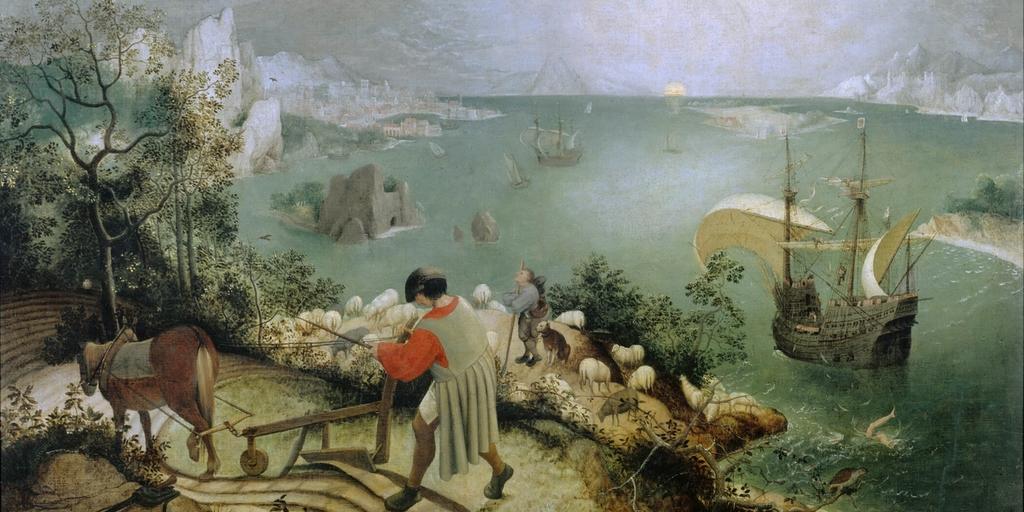
However, attributions can also bring less welcome news: two versions of Landscape with the Fall of Icarus, on display in Brussels museums, underwent technical examination in 1996 and turned out to be late copies of the master's painting.
Before the canvases were subjected to technical analysis, they were considered among Bruegel's most brilliant works — and the only variations by the artist on a mythological subject. Regrettably, analysis revealed that beneath the layer of paint lay a clumsy underdrawing that could not have belonged either to the painter himself or to his elder son and namesake.
We now know that both versions of Landscape with the Fall of Icarus were created in the second half of the sixteenth century and were possibly copied from a now-lost painting by Bruegel.
The Triumph of Silenus
It is disheartening when paintings long thought to be originals turn out to be copies — but how gratifying it is when a canvas listed as a copy proves to be a 'lost' authentic work. Just such a miracle occurred with Nicolas Poussin's Triumph of Silenus.

The artist painted this canvas on commission for Cardinal de Richelieu in 1635–1636. It formed part of a series of three large-scale works that adorned the cardinal's château in Poitou, the other two being The Triumph of Pan and The Triumph of Bacchus. In the early twentieth century the painting entered the collection of the National Gallery in London, but before long the gallery's staff began to question its authenticity. By the 1940s, The Triumph of Silenus was definitively regarded as a copy of a lost Poussin original.
Fortunately, technological progress does not stand still, and in 2021 the gallery's specialists were able to carry out a thorough analysis of the painting, proving that it is indeed the work of the great master. Experts established that he had made changes to the composition during the course of painting — itself a mark of the work's originality — and a comparison of the pigments used across the three Triumphs showed that all three contain remarkably similar components.
The three Triumphs played a significant role in Nicolas Poussin's career: they were the reason he was summoned from Italy to France to paint for King Louis XIII — a turn of events that ultimately led to his being regarded as the founder of the French school of painting.
Today The Triumph of Silenus is considered one of the jewels of the London gallery's collection and featured in an exhibition dedicated to the theme of dance in Poussin's work.
Portrait of King Philip IV
Some paintings have fared even better than Poussin's Triumph of Silenus: Portrait of King Philip IV, for instance, was reattributed several times by art historians before Velázquez's authorship was finally confirmed. The tangled history of this work began in the nineteenth century, when New York collector and philanthropist Benjamin Altman purchased the portrait of the young Philip from the dealer Joseph Duveen.

Duveen was well known in the art world for his business acumen, though certainly not for any reverence towards the works themselves: before selling paintings he would engage restorers to conceal all damage to the canvases and to tone down their colours. This gave the pictures a more expensive appearance — and made them far more profitable to sell.
Sadly, Duveen's methods cost several works their correct attribution, among them Portrait of King Philip IV, which entered the Metropolitan Museum of Art in New York in 1913. In 1973 the museum undertook a large-scale review of its collection, in the course of which some 45 works were deemed copies or fakes. The portrait of Philip IV was among them: experts concluded it had been made by a pupil or imitator of Velázquez, and the canvas was sent to storage.
The painting might well have continued to languish in obscurity had Keith Christiansen not become head of European paintings at the Metropolitan. At his initiative, restorers first turned their attention to Portrait of a Man, which had been attributed to a pupil of Velázquez in 1979, and then moved on to Portrait of King Philip IV.
Both canvases had suffered considerably — from the passage of time as well as from physical intervention — but thanks to the painstaking work of the museum's staff they were brought back into good condition, and it was confirmed that both were by the hand of Velázquez.
The story of the portrait of Philip IV matters not only because Velázquez produced just around 110 works in total, each one priceless, but also because this painting is the earliest known official likeness of the king. It is quite possible that this very canvas made such an impression on Philip that for all forty years of his subsequent reign the royal family's portraits were painted exclusively by Velázquez.
Carousing Couple
In 1893 the Louvre acquired a painting titled Carousing Couple, attributed to the seventeenth-century Dutch painter Frans Hals. The canvas was intended to be a highlight of the Paris collection, but things did not go to plan when the museum's specialists discovered that beneath the fabricated Hals signature on the canvas there lay a monogram: JL.

The initials belonged to the artist Judith Leyster — a contemporary of the Dutch genre painter and possibly his pupil. She was a professional who enjoyed considerable success among her peers, but was forgotten after her death.
The incident gave rise to a series of legal disputes between former owners and sellers of the work, and also prompted the reattribution of numerous other paintings previously attributed to Frans Hals or to Judith's husband, Jan Miense Molenaer.
Was anyone pleased that art historians had 'discovered' a new master capable of rivalling Hals? Quite the opposite: the owners of Leyster's paintings were dismayed, since their canvases were now considered less valuable.
Fortunately, in the twentieth century, driven by growing interest in women's art, Judith's works came to be valued far more highly than before. Today we know of around 35 paintings by the artist held in public and private collections around the world. The most expensive canvas by this woman painter sold for $2.31 million — and it is entirely possible that this is not the ceiling, and that many more of Leyster's misattributed works have yet to be identified.
David and Goliath
Judith Leyster is far from the only female artist whose paintings were attributed to male masters for centuries and whose name has only recently become widely known. The same fate befell many of her peers, among them the Baroque painter Artemisia Gentileschi.

A succession of reattributions of paintings 'in favour of' Gentileschi began in the mid-twentieth century. Like other followers of Caravaggio, the artist made skilful use of chiaroscuro, but her work had other distinguishing features as well. She frequently depicted powerful heroines, drawing on violent mythological and biblical subjects.
Specialists began suggesting as early as the 1990s that David and Goliath was the work of Artemisia rather than her contemporary Giovanni Francesco Guerrieri. In 2018 the painting appeared at a Hampel Fine Art auction attributed to the artist, though no material or technical evidence had yet been produced to support this.
The attribution was finally confirmed in 2020, when the painting was restored at the National Gallery in London. Experts carried out a thorough examination and, among other evidence, discovered a barely visible signature — 'Artemisia' — on the blade of David's sword. The canvas was thus able to take its rightful place in an exhibition devoted to the artist's work, and her catalogue raisonné was enriched by a remarkable addition.
Portrait of Charlotte du Val d'Ognes
The last but by no means least significant work by a female artist in our list is the Portrait of Charlotte du Val d'Ognes. It entered the Metropolitan Museum of Art in New York in 1917 as a work by Jacques-Louis David, the most celebrated exponent of French Neoclassicism.

The painting immediately became iconic: a museum press release described it as 'one of the master's masterpieces' and compared it to Raphael's Sistine Madonna. It carried a considerable price tag — two hundred thousand dollars, equivalent to many millions in today's money.
All would have been well were it not for one discovery: in 1947 the art historian Charles Sterling came across an engraving depicting the Paris Salon of 1801. Among the miniature reproductions it contained, he noticed the very portrait attributed to David — and was horrified.
A dramatic pause is warranted here, with an explanation: in 1801, Jacques-Louis David did not exhibit at the Salon. Every art historian who has ever worked with his oeuvre knows this. Charles Sterling, of course, knew it too — and leapt to a hasty conclusion: the Portrait of Charlotte du Val d'Ognes had been painted by the artist Constance Charpentier.
At this point a chorus of male voices rose up: 'That explains all the painting's weaknesses and shortcomings!' Perhaps it does. Only, before the reattribution, no one had somehow noticed those 'weaknesses' and 'shortcomings' at all.
But the confusion over the painting's authorship did not end there: in 1996, art historian Margaret Oppenheimer reattributed it as the work of the little-known artist Marie-Denise Villers (née Lemoine). And in 2014, art historian Anne Higonnet established that the Portrait had been painted while Villers and du Val d'Ognes were attending classes together at the Louvre.
Has the reattribution made this work any less valuable? That is for you to decide. The Portrait of Charlotte du Val d'Ognes still hangs in the Metropolitan's galleries alongside canvases by the great neoclassicists, and the museum has no plans to sell it — which means it may be some time before we learn what a portrait by Marie-Denise Villers is actually worth.
Portrait of a Lady
It sometimes happens that works remain in the hands of owners who have no idea they are holding an original by a celebrated artist. This was the case with Pieter Bruegel's Landscape with the Fall of Icarus, and with another work featured in our article — Peter Paul Rubens's Portrait of a Lady.

The provenance of this painting is known from 1890, when it was held in a private collection, but following an exhibition at the Royal Academy of Arts in 1902 its authorship was somehow forgotten. The portrait passed to another owner and remained with his family for more than a century, until in 2017 the collector's heirs decided to sell the work for £78,000 as the painting of an unknown artist from the circle of Rubens.
The new owner of the Portrait of a Lady decided to find out how much the painting might fetch, and handed it over to Sotheby's specialists for assessment. When the restorers cleaned the canvas of layers of grime and old varnish, they were astonished — before them was a magnificent original by the Flemish master. The work ultimately sold at auction for four million dollars.
It is worth noting that portraits by Rubens rarely come to the art market. Although the painter made a considerable contribution to freeing the genre from the schematic formality that had characterised it in the sixteenth century, and possessed an innate gift for revealing a sitter's character through his brushwork, he always preferred the creation of large-scale history paintings to portraiture.
Also read our article on the most famous paintings in the history of world art.
Follow us on social media so you never miss new content: VKontakte and Telegram — @loskomagazine.