Even if you have wandered through the Tretyakov Gallery with an audio guide more than once, read this article to the end. You will discover who painted these outstanding canvases and how, what is encoded within them — and in quiet surroundings with a cup of tea, art will become both accessible and moving. No time to waste — let's go!
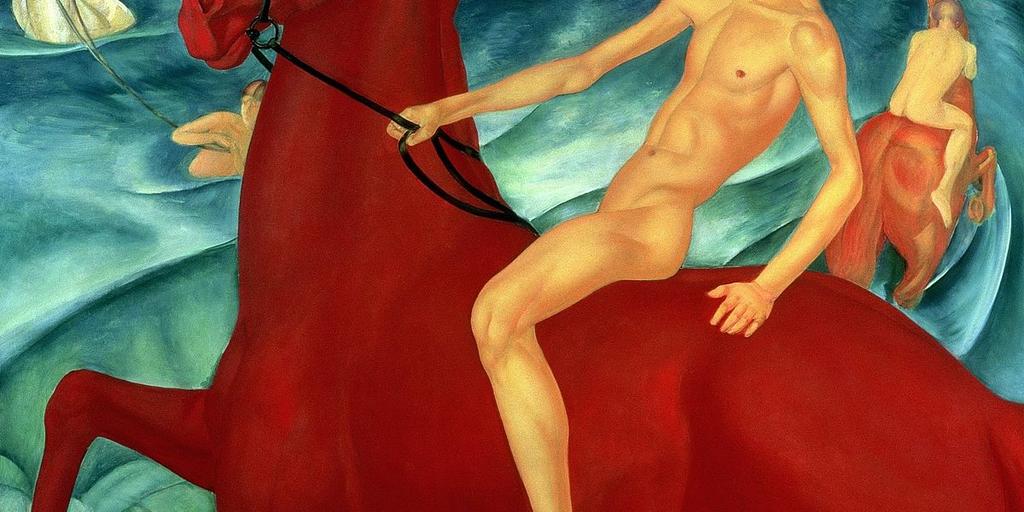
Bathing the Red Horse, Kuzma Petrov-Vodkin, 1912

Who was Petrov-Vodkin?
Kuzma was born in 1878 into the family of a housemaid and a cobbler. The boy painted his first picture on a tin can: flashes of lightning, a boat, and people drowning. The young artist signed the work: 'Perished for others. May your memory be eternal!'
Petrov-Vodkin initially wanted to paint icons and as a child studied the techniques of church masters. Yet he was not destined to become an icon painter: priests refused to bless his works on the grounds that they were 'too painterly'. One monk even remarked that the Virgin Mary he had depicted looked like a dancer. Petrov-Vodkin thereupon abandoned icon painting and resolved to be an artist.
How did Bathing the Red Horse come about?
Before the Revolution and the First World War, Bathing the Red Horse was regarded as a scene from everyday life. When bloodshed began in Russia, both the public and Petrov-Vodkin came to understand that the Red Horse was a prophecy, and that its creator was a visionary. How did the horse come to be painted, and how should we interpret it?
In the summer of 1912, Petrov-Vodkin noticed a horse with a striking face. Despite the animal being old and worn, it inspired the artist to create the painting. He initially worked out several compositional variants — Kuzma was persistent in his desire to elaborate the subject in detail and to imbue the canvas with meaning.
Critics argued over who Petrov-Vodkin had depicted on the horse. From the artist's letters it is possible to infer that it was his cousin. Others maintain that the figure bears no resemblance to Kuzma's brother, and that what we see in the painting is a composite image.
At its first exhibition in 1912, the painting was met with public acclaim — it was a triumph. The canvas was hung above a doorway like a banner, and critics declared that it had united everyone present. New beginnings, renewal, and victory: that was what audiences saw in the work.
What style is the painting executed in?
The Bathing of the Red Horse is a vivid example of Symbolism in painting. Artists working in this tradition took objects from the real world as their starting point, investing them with hidden meaning. The depicted image, colour and form conceal biblical narratives, legends, myths and ancient scriptures.
Interesting facts
- The rider is compared to Saint George the Victorious, heralding the triumph of good over evil. He bears no resemblance to a village dweller: his fine features suggest either a saint or someone from the bohemian world.
- The red horse is a symbol of life's unbridled force and grandeur. Petrov-Vodkin brought together the traditional colour of icon painting and a beloved image from folklore.
- The pink shoreline is associated with the Garden of Eden.
- The body of water is not a geographical location. Petrov-Vodkin painted an ethereal space where earthly life meets the higher realms. The artist combined symbolic colours: green — the colour of life, blue — an image of the heavenly kingdom.
The Swan Princess, Mikhail Vrubel, 1900

Who was Mikhail Vrubel?
Vrubel was an artist by calling, not by training. After completing a law degree, he was a dandy and the life of the party — until he recognised his true purpose: he was born to paint. He never finished at the Academy of Fine Arts, and by the age of thirty had no achievements in art to speak of. Yet the young man sensed he was on the right path. Vrubel changed dramatically: he traded his polished appearance for a greasy suit and, instead of socialising, spent fourteen hours a day drawing. His friends barely recognised him.
In 1885, when Mikhail Vrubel was still an unknown student, he painted The Descent of the Holy Spirit. Taking the painting of ancient Rus and Byzantium as his model, the young artist had no desire to introduce anything new. Yet his personal hand could not be concealed — Vrubel's Mary and apostles are tender and delicate in a way no one had depicted them before.
This episode from his life reads as a prophecy. Vrubel painted his first significant work in a psychiatric hospital — and it was to one that he returned at the end of his life. Mikhail suffered from depression, madness and a sense of connection with 'other worlds'. He believed that the devil distorted his paintings because the artist was unworthy of depicting Christ. His most celebrated works are devoted to the Demon — a genderless, suffering spirit endowed with power on earth.
Mikhail Vrubel's technique is enigmatic and unique. Some critics argue that Russian art has seen no artist like him before, and will not again. He lived in a world inaccessible to ordinary people. Mikhail painted heroes from folklore — the Sea Princess, the Thirty-Three Bogatyrs, the Swan Princess. These figures are familiar even to children, yet in his paintings they acquire a mystical depth and an air of mystery.
Mikhail Vrubel's last work was Portrait of V. Ya. Bryusov. Shortly after completing it, the artist went blind and died in a psychiatric clinic.
How did The Swan Princess come to be?
Vrubel had wanted to marry several times but never did. Everything changed when he met the opera singer Nadezhda Zabela. She became both guardian angel and muse to Mikhail. Historians believe it is she who is depicted in The Swan Princess.
True, the opera singer and the woman in the painting bear little obvious resemblance, but the artist was not aiming for a portrait. The Swan Princess is a painting born of impression — inspired by the way Zabela performed her role in the opera The Tale of Tsar Saltan.
What style is the painting executed in?
The Swan Princess is an example of Russian Symbolism. A fairy-tale image suffused with mysticism and inner feeling, it is an expression of the artist's emotional experience rather than a conventional portrait.
Interesting facts
- The Swan Princess was the poet Blok's favourite painting. He even hung a reproduction of it in his study.
- Remember Serov's Girl with Peaches? Vrubel once proposed to Vera Mamontova, but she turned him down.
- Critics suggest that the Swan Princess resembles not Zabela but Vrubel's former love, Emilia Prakhova. His first muse was the wife of his supervisor — a woman he could not be with, and on whose account he cut himself with a knife. Perhaps the artist did carry some features from his past into the work, but with Nadezhda he knew true happiness in love.
Composition VII, Vasily Vasilyevich Kandinsky, 1913

Who was Vasily Kandinsky?
Vasily Kandinsky is one of the founding fathers of abstraction. He believed that figurative subject matter obstructs the experience of art; for Kandinsky, colour was the instrument through which the soul could be reached. He was the first abstract painter to offer a theoretical account of why painting exists beyond figuration. Kandinsky was a synaesthete — he "heard colours" and "saw sounds".
When Vasily was five, his parents divorced and he was raised by his aunt. Notably, Kandinsky was not born with a brush in his hand — he came to painting only at the age of thirty. Before that, he studied law and spent four years teaching it at Moscow University. Monet's painting Haystacks and the operas of Wagner changed his outlook for ever. Turning down a career advancement, Kandinsky left for Munich to study painting.
Vasily Kandinsky and his avant-garde colleagues formed a group in Munich called Der Blaue Reiter — the Blue Rider. Its members produced a large body of work and organised exhibitions until the outbreak of the First World War.
Kandinsky's Sketch for Improvisation No. 8 sold at auction in 2012 for 23 million dollars.
How did Composition VII come about?
Kandinsky created Composition VII at a time when he had found his mature style. Lines, patches, colours, shifting forms — he employed invented combinations to awaken intuition and imagination in the viewer.
Where did Vasily Kandinsky find his subjects? They came to him of their own accord the moment he closed his eyes. He would reach for a pencil and sketch out the vision before it could fade. Working in paint, he allowed an inner voice to guide the transformation of forms.
Composition VII did not emerge in a single evening. Kandinsky refined the image to its perfect pitch through dozens of pencil and ink sketches, studies and watercolours. Once the details and palette had become clear, Vasily transferred the composition to canvas piece by piece over the course of a few days.
What style is the painting painted in?
Composition VII is abstract art in its purest form. It set a new goal: the image must penetrate the soul of the viewer. Objects from the real world are excluded, freeing the human mind to roam without constraint. There is no need to analyse — only to feel. Kandinsky's lines, patches and colours, like an abstract melody, lay bare beauty at the micro level and open a stream of philosophical thought.
Interesting facts
- More than thirty preliminary studies in a range of techniques and media — drawings, oil sketches and watercolours — stand behind Composition VII. The final version was completed in four days in November 1913.
- Art historians believe that Composition VII contains references to biblical narratives. Kandinsky encoded the Last Judgement, the Great Flood, the Garden of Eden and the Resurrection. The painting bears traces of the artist's earlier figurative themes, bound up with the end of the world and otherworldly battles between good and evil.
- Kandinsky had a distinctive painterly handwriting, clearly visible in Composition VII. He applied oil paint in structured strokes arranged in vertical columns or zigzag patterns. Curling marks were produced when he transferred thick, viscous paint using the flat end of the brush.
Ashram, Nikolai Konstantinovich Roerich, 1931

Who was Nikolai Roerich?
Roerich contained several personalities in one: painter, designer, archaeologist, historian and lawyer. His wealth of talents and inclinations made the choice of profession a torment — Nikolai studied simultaneously in the history and law faculties. As a student he had a playful nickname, "Snow White", because Roerich would flush scarlet whenever he heard profanity. Later, as both lawyer and artist, Roerich created the Roerich Pact — the first document dedicated to the protection of cultural heritage.
Nicholas Roerich was a frugal ascetic who travelled to dozens of countries with a single toiletry bag and one tailcoat reserved for important occasions. His passion for archaeology is visible in his paintings: Roerich conducted excavations himself, sketched ancient rock formations and recorded folk legends. The public took to his style immediately — his graduation piece, The Messenger. Clan Rose Against Clan, was purchased by Tretyakov.
Roerich fulfilled his life's dream by journeying through the wild regions of Central Asia along the route India – China – Altai – Mongolia – Tibet – India. There he produced a vast number of canvases, gathered unique material for science and founded the high-altitude Urusvati Institute in India.
An artist and explorer of cosmic evolution, Roerich foresaw much. Seek your answers in his canvases, books and theatrical productions.
How did the painting Ashram come to be?
Roerich painted Ashram while travelling through Asia. The canvas has kindred works bearing the same title that are scattered across Russia. What did the artist have in mind when he conceived the name?
In ancient India, an ashram was a place of solitude and prayer for sages. Few knew the way there — it was hidden from civilisation in a gorge or a forest. In Ashram, Roerich allows the viewer to glimpse this sacred place as if from behind the scenes. The calm surface of the water and a boat are tucked safely behind majestic bamboos, which conceal the Kingdom of the Spirit. The journey towards Truth and the mystery of the ages begins here.
In what style is the painting executed?
Roerich's works, Ashram among them, belong to the Art Nouveau movement. It is easy to gather that the style represents a new vision of painting. Do not confuse Art Nouveau with the related term modernism, which encompasses the avant-garde and experimental techniques in art. Art Nouveau painters drew on the traditions of the past, taking from them their ideals of Beauty. The hallmarks of Russian Art Nouveau are decorativeness, a cosmic sensibility and an engagement with the achievements of science and technology.
Interesting facts
- The canvas depicts a landscape of Ceylon. Remarkably, Roerich painted views of Sri Lanka, yet there are no historical records to confirm that he ever stopped on the island.
- The other canvases in the Ashram series are held at the Roerich Museum in New York and at the State Museum of Oriental Art in Moscow.
- Roerich rarely painted in oils, finding them too dense and dark for his taste. He preferred light-bodied tempera made by the German brand Wurm. The airy paint dried quickly, which made travelling with finished works far easier.
Pavel Varfolomeevich Kuznetsov, Evening in the Steppe, 1912

Who was Pavel Kuznetsov?
Kuznetsov was an artist from Saratov. He was born and raised in a creative environment, in the family of an icon painter. From childhood he studied at a painting studio where gifted mentors shaped the artistic youth around him. A particularly formative teacher for Kuznetsov was Borisov-Musatov, whose works are also held in the Tretyakov Gallery.
Pavel Kuznetsov collaborated with Petrov-Vodkin on a joint project — the frescoes in the Church of Our Lady of Kazan in Saratov. Unfortunately, the work was destroyed not long after its completion, as it strayed too far from ecclesiastical canons.
In 1907, Kuznetsov, Saryan, Utkin and other painters — colleagues of Borisov-Musatov — came together under the name The Blue Rose. The group was unique and earned a lasting place in the history of Russian painting. Its artists worked in the Symbolist manner, frequently in blue-toned palettes, and their imagery was romantic, ethereal and mystical. Yet as Kuznetsov grew older, he turned increasingly to the Art Nouveau style.
Kuznetsov received recognition in his own lifetime. His works were exhibited and acquired not only in Russia but also in Paris, and from 1906 until the end of his life he was a participant in the Salon d'Automne.
How did the painting Evening in the Steppe come to be?
In 1912, Pavel Kuznetsov spent nearly a year travelling through Central Asia, acquainting himself with the traditions of Eastern peoples and observing nomadic life. He came to understand that the simple, slightly untamed existence of the steppe concealed a cosmic mystery and a deep stillness. The subject for the canvas suggested itself naturally.
Kuznetsov reaches for a canvas, his beloved tempera and brushes, and thinks through his palette. The decision is made: sky blue and its gradations will be the dominant colour — the colour of clean steppe air, of stillness and balance. Vivid orange provides a harmonious contrast to the transparent blue; it is exactly the shade of a blazing steppe sunset.
Kuznetsov's tempera painting, unlike his work in oils, is light and airy. In Evening in the Steppe, mood is set by colour and composition rather than by the texture of brushwork. The artist relies on smooth lines and gentle curves, and pays close attention to rhythm — the backs of the sheep echo the consonant blue hills. Pavel Kuznetsov's paintings from the Kyrgyz series have the quality of a fairy tale about an ideal life on earth, one the viewer finds entirely believable. One even glances at the canvas furtively, as if peering in from outside, so as not to disturb the peace of its inhabitants.
In what style is the painting executed?
While in Asia, Pavel Kuznetsov produced a series of works associated with Orientalism. Evening in the Steppe opens up everyday scenes from life in Kyrgyzstan through the lens of the artist's own perception. Orientalist painters depicted imagined or real scenes of the East — as it was, or as they wished it to appear. Evening in the Steppe is also an example of Russian Art Nouveau, assigned to that style for its fluid, organic lines, flowing forms and pronounced compositional rhythm.
Interesting facts
- Kuznetsov chose tempera for the canvas in order to achieve a matte light. He believed the work could not afford the superfluous sheen and texture of oil paint. The orange contrast calls to mind a fiery sunset over the Caucasus mountains.
- Pavel Kuznetsov observed his subjects closely but never transcribed them literally into his work. He deliberately excluded ethnic detail from his compositions, embracing bold generalisation. Why? To speak, as Gauguin did, through scenes of everyday life in the language of the Cosmos.
- To understand the mystery of birth, Kuznetsov worked for a time as an obstetrician. He believed that shades of blue captured most precisely the spiritual dimension of that enigmatic moment of arrival on earth.
The virtual tour of the Tretyakov Gallery has come to an end. It is wonderful that you stayed with us to the last, and that you found it worthwhile. Pavel Tretyakov's investment has paid off in full. You are now more than equipped to hold your own in a conversation about art over a glass of prosecco, lead a tour for friends, or shine in an art knowledge quiz.
Losko has published a fascinating biography of Rem Koolhaas — the architect overseeing the reconstruction of the New Tretyakov Gallery, which will become the largest museum and exhibition space in Moscow. If you enjoy curated selections, take a look at our roundup of celebrated works in Surrealism and our piece on 5 masterpieces of world painting.
Follow us on social media so you never miss new content: VKontakte, Telegram.