The Russian avant-garde was a movement of enormously diverse artists united by one idea: to fuse art with life. The avant-gardists wanted to make creativity the supreme human value. They were convinced that art should manifest itself not only on canvas but in everyday objects and daily reality. These artists were radicals who sought to overturn the existing order and free themselves from the academic canons of painting.
This article introduces five works of the Russian avant-garde, the theoretical principles of their creators, and the nature of their artistic innovation.
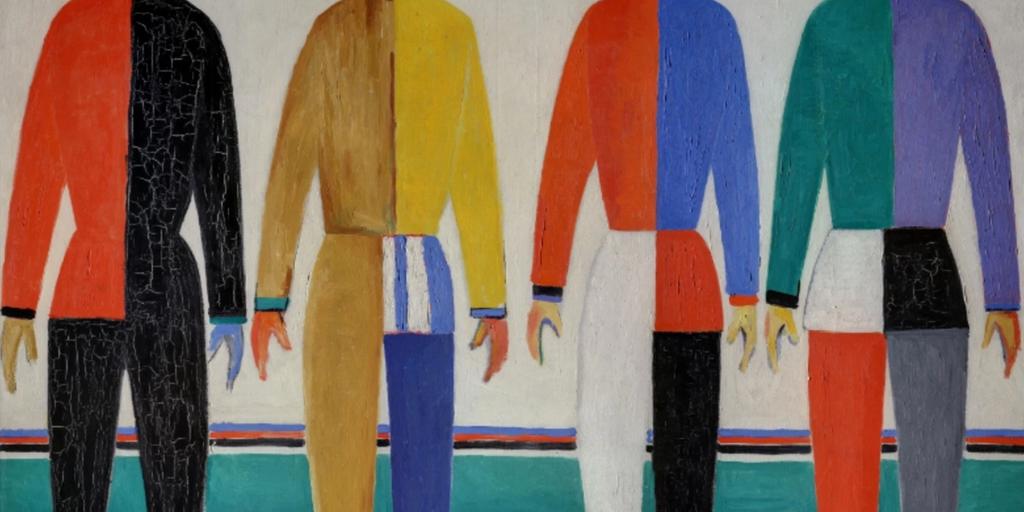
Kazimir Malevich, Sportsmen

About the Artist
Kazimir Malevich was born in Kyiv and spent his childhood in a Ukrainian village. At sixteen he moved with his family to Kursk, where he organised an art circle while continuing to paint. In 1904 Malevich decided to move to Moscow and twice attempted to gain entry to the Moscow School of Painting, Sculpture and Architecture — and was rejected both times. Despite this, it was in Moscow that his creative path truly began.
Kazimir Malevich is one of the central figures of the Russian avant-garde. His Black Square gave rise to a new direction in art — Suprematism. The Suprematists sought to reveal a world of abstract and geometric forms. Malevich devoted himself to theoretical work, searching for a scientific foundation for this direction.
About the Work
Athletes is a painting from Malevich's late period, which art historians subsequently termed his 'new figuration' phase. From 1918 until the late 1920s, Malevich devoted himself primarily to theoretical and scholarly work, producing very few paintings. Towards the end of the 1920s, however, following a journey through Europe, he radically revised his theoretical principles. He returned to painting, and recognisable figures began to reappear in his work. He revisited the peasant-life motifs he had explored in 1911–1913. The paintings of the 'new figuration' period are static and monumental: Malevich places his figures frontally, positions them at the centre of the composition, and employs symmetry.
The painting's organisation of colour and rhythm, together with its depersonalised athletic figures, conveys a sense of detachment from earthly reality. Malevich's aim in this work was indeed to express the union of humanity with the cosmos. In her study Malevich and De Chirico, art historian Charlotte Douglas notes that during this phase of his career the artist drew inspiration from his contemporaries — Giorgio de Chirico and Willi Baumeister — as well as from the wooden religious sculpture of the Perm and Arkhangelsk regions.
El Lissitzky, Beat the Whites with the Red Wedge

About the Artist
For a long time El Lissitzky worked on illustrations for Jewish folk tales and book design. In 1918 he was invited to teach at the Vitebsk People's Art School, and in the autumn of 1919 he met Kazimir Malevich — an encounter that proved decisive for his career. It led him to Suprematism and helped him find his own artistic direction. Lissitzky began working in the field of non-objective art and developed a unique visual language of his own: in 1920 he invented his celebrated Prouns — geometric compositions reminiscent of architectural drawings.
About the Work
The Political Directorate of the Red Army's Western Front commissioned Lissitzky to create the propaganda poster Beat the Whites with the Red Wedge in 1920. The poster calls for the unification of Red Army forces in the struggle against the White Guards during the Civil War. Its dynamic composition and spare geometric forms give striking visual form to the military confrontation, while the combination of white, black and red conveys the tension of battle. Beat the Whites with the Red Wedge established foundational traditions of modern design — the use of abstract forms and geometric composition.
Vladimir Tatlin, Monument to the Third International

About the Artist
Vladimir Tatlin was born in Moscow into the family of a railway engineer. When he was eleven, his family moved to Ukraine, and he enrolled at the Kharkiv Real School, where he first showed a talent for drawing. At fourteen, Tatlin ran away from home and, after lengthy wanderings across Russia, ended up in Moscow. He found work in an icon-painting workshop and took on additional jobs in the decorative workshops of the Solodovnikov Opera Theatre. In 1902 he entered the Moscow School of Painting, Sculpture and Architecture — the same institution that would, some years later, reject Malevich — though he was expelled after a year for poor academic performance. Tatlin attended classes at private art studios in Moscow and Petrograd. These studios played an important role in the birth of the Russian avant-garde movement: it was there that Tatlin met Mayakovsky, Khlebnikov and Larionov. From 1911 he began participating in exhibitions and collaborating with other artists. Tatlin worked in the Constructivist tradition, whose defining characteristics are geometric rigour and economy of form.
About the Work
In 1920, the artist was granted permission to build a model of the tower and display it during the October celebrations. Tatlin succeeded in drawing attention to his work not only from the European artistic community but also from the Soviet authorities. At Lunacharsky's invitation, Lenin came to view the model of the tower. However, from 1921 onwards the Bolsheviks began their campaign against Futurism, and the construction project for the Monument to the Third International was never realised.
The tower was conceived as an open structure of metal framework. Inside, four glazed volumes were to be suspended: a cube, a hemisphere, a cylinder and a pyramid, each intended to house various institutions. Each of these volumes was to rotate on its own axis, much like celestial bodies. Tatlin's Tower is often compared to the architecture of the East; El Lissitzky, for instance, writes in his book Russia: An Architecture for World Revolution that Tatlin drew on the spiral form of the monument, inspired by the pyramid of the Assyrian king Sargon II at Khorsabad, which stands on the territory of present-day Iran.
Natalia Goncharova, Mystical Images of War

About the Artist
Natalia Goncharova grew up in Tula Province and moved to Moscow at the age of ten, where she completed her studies at a women's secondary school. She went on to enrol at the Moscow School of Painting, Sculpture and Architecture. For many years Goncharova worked primarily as a sculptor, but from 1904 onwards she became increasingly devoted to painting. The artist was one of the founders of the Russian Neo-Primitivist movement. The Neo-Primitivists were Slavophiles who believed that Russian art had its own distinct path; they accordingly rejected the ideals of Western painting and turned instead to the motifs of traditional Russian art, the lubok and folk ornament. In 1914 Sergei Diaghilev invited Goncharova to Paris to design sets and costumes for his productions. In 1915 Goncharova and her companion Mikhail Larionov decided to remain in France permanently.
About the Work
Mystical Images of War is a series of lithographs devoted to the horrors of the First World War. Goncharova sets unsettling, destructive images of war against religious and peaceful ones. The artist draws on traditional Russian art forms — the lubok, folk ornament and icon painting. Most striking in this series, however, is her adherence to the conventions of religious painting: the use of contour lines and geometric silhouettes.
Wassily Kandinsky, Composition 8

About the Artist
Wassily Kandinsky trained as a lawyer and devoted many years to law and political economy, but at the age of thirty decided to abandon academia and take up painting. He graduated from the Munich Academy of Fine Arts and worked in both Russia and Germany. Kandinsky began his career in the tradition of German Expressionism, during which period he painted chiefly landscapes that show the influence of the Fauves and the French Post-Impressionists. From 1910 onwards he turned to abstraction. Kandinsky took part in exhibitions organised by the Moscow artistic group Knave of Diamonds and the Munich group Der Blaue Reiter. From 1918 to 1921 he taught at the VKhUTEMAS and from 1922 worked at the Bauhaus until the school's closure. Wassily Kandinsky is also well known for his theoretical writings on painting.
About the Work
Composition VIII is the best-known work from Kandinsky's cold period. The paintings of this period are distinguished by abstract geometric forms and compositional rigour. While completing Composition VIII, Kandinsky was writing his celebrated treatise Point and Line to Plane, in which he sets out his artistic principles in detail. He describes the point and the line as the most basic material elements underlying all works of art. Kandinsky also explores the emotional qualities of these elements. He speaks of point, line and plane first and foremost as emotional objects rather than geometric ones — noting, for instance, that the point is 'a union of silence and speech'. In this way, Composition VIII stands as the embodiment of the theoretical ideas Kandinsky articulates in Point and Line to Plane.
Follow us on social media so you never miss new content: VKontakte, Telegram — @loskomagazine.