Surrealism in painting emerged in France in the 1920s and then spread rapidly across the world. Its best-known practitioners include Salvador Dalí, René Magritte, Joan Miró and Max Ernst. Here we present five of the most compelling Surrealist works.
A Brief History of the Genre
The movement began in literature but almost immediately crossed into the visual arts. Drawing on the psychoanalysis that was so much in vogue at the time, the Surrealists sought to show that creative energy resides in the unconscious, manifesting itself in states of sleep, hypnosis, feverish delirium and automatic, uncontrolled actions. In their work they combined familiar everyday imagery with allusions and paradoxes drawn from dreams.
Inspired by left-wing ideas, the movement's adherents called for liberation from imposed rationality through art, and argued that our perception is profoundly illusory, distorted as it is by unconscious processes. Surrealist works carry a consistent message: we often see something quite different from what we imagine we see.
René Magritte, The Treachery of Images

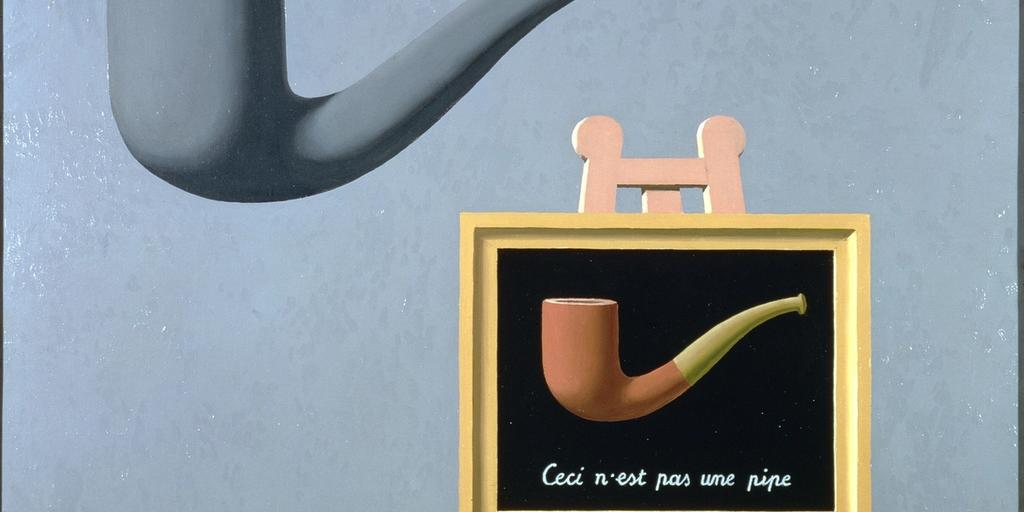
The painting by René MagritteThe Treachery of Images, painted in the second half of the 1920s, depicts a smoking pipe rendered with an almost unsettling sense of realism — delicate curves, highlights and shadows all meticulously observed. The work might never have sparked much debate in the art world were it not for one detail: an inscription written in the careful, childlike hand of «Ceci n'est pas une pipe» — French for «This is not a pipe».
«A pipe with the words 'this is not a pipe' written beneath it?» you might ask, frowning in bewilderment. Here is what Magritte would have replied, with a shrug: «Can you fill this pipe with tobacco? No — it is merely a representation, is it not? So if I had written 'This is a pipe' on the canvas, I would have been lying.»
That is the essence of Surrealism: our perception of a thing — in this case rendered on canvas — and the thing itself are not the same. How can we be certain that what we see is truly what we see? Think of a time you mistook an object for something else in the dark — what if we are making that mistake all the time?
In 1966 Magritte created a work entitled The Two Mysteries, in which the smoking pipe appears once again. The artist develops his earlier ideas further: if we cannot be sure that our perception corresponds to reality, how can we verify the truth of that very judgement without falling into our own trap?

This concept went on to influence the subsequent development of art and literature. The philosopher Michel Foucault, for instance, wrote an essay entitled This Is Not a Pipe, in which he examined and elaborated on Magritte's ideas at length. The formulation «This is not a…» was also taken up by advertisers. Perhaps the most inventive example is the campaign by the insurance company Allianz, whose posters depict a smoking pipe, a hammer and a banana peel, accompanied respectively by the captions «This is not a pipe — it is a bronchial pollutant», «This is not a hammer — it is an eternal finger-flattener» and «This is not a banana peel — it is a vicious enemy of backs».


Marcel Duchamp, L.H.O.O.Q.
The Surrealists insisted on the need to reassess traditional art. This impulse found its most vivid expression in Marcel Duchamp who, in 1919, presented the work L.H.O.O.Q., for which he drew a moustache and goatee onto the Mona Lisa. This technique — the modification of existing, often everyday objects with minor additions that transform them into works of art — became known as the «readymade» and was used by Duchamp throughout his subsequent career.
The title is of particular interest: the letters L.H.O.O.Q., read aloud in French, sound like «elle a chaud au cul» — roughly «she has a hot ass» — and it is unlikely that Duchamp chose this combination of letters by accident. He returned to the designation many times afterwards; L.H.O.O.Q. appears in various forms across his body of work more than thirty times.
Duchamp, who was deeply engaged with questions of sexual identity, also touched on gender in his experiment with the Mona Lisa, adding masculine features to the very embodiment of femininity. Some of his works he even signed under the female pseudonym Rose Sélavy — a name that echoes the phrase «Eros, c'est la vie» (French for «Eros, that is life»). Several photo sessions of Duchamp dressed as a woman have also survived.
Despite the apparent irreverence of the 'bearded' Mona Lisa, the public received it with curiosity. Experiments with the Gioconda continued — parodies of the parody began to appear. The work remains popular to this day: in 2017 it was sold at auction for $743,000. In 2000, the Marcel Duchamp Prize was established in France; it is now considered one of the most prestigious awards in contemporary art.
Salvador Dalí, The Persistence of Memory

Salvador Dalí's The Persistence of Memory proves that a masterpiece does not always require years of painstaking work — Dalí needed just two hours. When his wife Gala saw the painting, she said: 'Anyone who has seen it once will never forget it.'
Dalí jokingly called the work his 'camembert of time,' recounting that he decided to paint it after noticing a piece of cheese melting in the sun — left over from a lunch he and Gala had not finished.
The work is built from symbols: three melting clock faces represent a rejection of linear time divided into past, present and future; the sleeping creature in the foreground is a self-portrait in profile; ants on the orange watch are a symbol of decay and decomposition; the distant cliffs are a reference to the artist's native Catalonia; and the egg — a favourite motif Dalí returned to throughout his career — stands for life. Reality and dream exist side by side throughout: a bare tree and melting watches, the sea and an enormous rectangular mirror, a fly and its humanoid shadow. The artist sought to show that actuality and our perception of it are inextricably intertwined in the human mind.
Many have speculated that in The Persistence of Memory Dalí was drawing on Einstein's theory of relativity, illustrating the interconnectedness and mutability of space and time. Yet the artist himself claimed his inspiration was the ancient Greek philosopher Heraclitus, who held that 'you cannot step into the same river twice,' because everything is in flux: the river as it is now and the river half an hour later are two different rivers, not one and the same, however they may appear to us.
Pablo Picasso, The Dream

Like many artists, Picasso drew inspiration from the experience of love, channelling it into his work. In The Dream he depicted his new passion — Marie-Thérèse Walter, whom he affectionately called his Valkyrie.
Marie-Thérèse Walter was 17 when she met Pablo Picasso, who was 28 years her senior and, moreover, married. Their relationship nevertheless developed with remarkable intensity and passion, giving rise to an entire series of Surrealist portraits that Picasso painted in 1932.
In The Dream, painted in a single day, Picasso employs a striking device: the face, shown full-on, is split into two halves in such a way that the line of the profile is simultaneously visible. This combination of incompatible viewpoints marked the beginning of a new direction in portrait painting. Picasso abandons any realistic depiction of the sleeping girl, deploying form and colour instead to evoke emotion and convey an overall sense of stillness and peace.
In 2006, the owner decided to sell the painting and had already agreed a price of $139 million with the buyer — only to accidentally puncture the canvas with his elbow. The work then underwent restoration, which cost the hapless owner $90,000, followed by a new appraisal by experts and several rounds of insurance litigation. In 2013, the buyer finally acquired Picasso's Le Rêve, paying $155 million for it — at the time the most expensive work of art ever sold.
Max Ernst, The Elephant Celebes

The Elephant Celebes is Max Ernst's first large-scale work and one of the defining paintings of Surrealism. Created in the aftermath of the First World War, it sets out to convey the full horror of militarism. The artist himself wrote: 'On 1 August 1914, Max Ernst died. He was resurrected on 11 November 1918 as a young man who aspired to find the myths of his time.' Here he appears to be dismantling any faith in human rationality — for how can reason be trusted when it led humanity to war?
Celebes is an island in Indonesia (now known as Sulawesi) whose outline resembles an elephant. Ernst also said the title was prompted by a rude rhyme popular among German schoolchildren, which included the phrase 'the elephant from Celebes, who looks like the devil himself.'
Ernst recounted that the painting's composition came to him when he came across a photograph in an anthropological journal of a large grain storage basket used by tribes in South Sudan. This also accounts for the ritual posts depicted in the picture. The artist may have been suggesting that the deities before whom people trembled and which they worshipped at the dawn of humanity had not disappeared, but had simply been reborn in new, militaristic and technological, forms.
The mechanical elephant — evoking images of a tank, a gas mask, a furnace — looms enormous beside the pale female figure in the foreground, who seems to beckon it forward with an unnaturally twisted arm. The woman has no head: does this imply that a creation can destroy its own creator?
Read about other artists who worked in the style of magic realism on Losko — for instance, about Edward Hopper and his architecture of solitude, or René Magritte and his enigmatic paintings.
Follow us on social media so you never miss new content: VKontakte, Telegram — @loskomagazine.