It is hard to find anyone who has gone through life without watching a single film. Yet the deeper one's knowledge of cinema, the more meaningful each viewing becomes: you begin to notice new details, understand the reasons behind particular techniques, and unpick the subtext of a film's dialogue. If you have decided to explore this realm of art, we offer a selection that gathers books on cinema for every kind of reader.
Why is it better to watch films in the original language, how are capitalism and cinema connected, and what psychological character types appear in film? The titles in our new selection address all of these questions. It includes books for both newcomers and seasoned students of cinema.
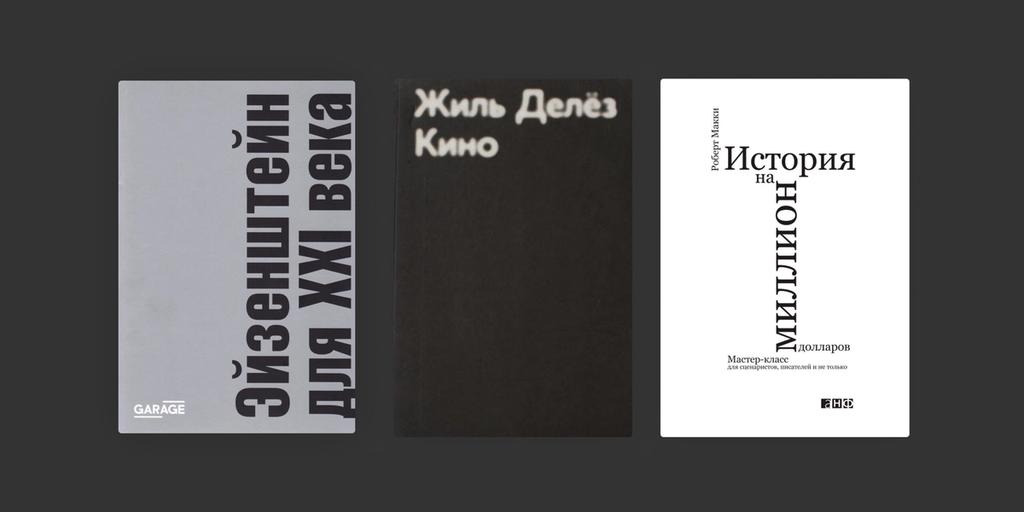
The anthology Eisenstein for the 21st Century, 2020

Sergei Eisenstein was a great Soviet theatre and film director, screenwriter, Doctor of Art History, and educator. His iconic historical film Battleship Potemkin has repeatedly been named one of the greatest motion pictures ever made in international polls of critics, film scholars, and audiences.
Naum Kleiman, together with the Garage Museum of Contemporary Art's programme, compiled an anthology to mark the 120th birthday of Sergei Eisenstein. The texts were contributed by specialists from Russia, the United States, and other countries. The researchers explored aspects of Eisenstein's work and personality that extend beyond cinema: dialectics, painting and film, the psychotechnics of art, pedology in film theory, and much more.
Buy: ChitayGorod
Anton Dolin, How to Watch Cinema, 2019

Anton Dolin is a Russian film critic, journalist, writer, and editor-in-chief of the magazine Iskusstvo Kino.
The critic wrote the book for children, so it explains the fundamentals in plain, accessible language. Reading it, you will learn about the history of cinema, how to watch films, why we watch them, and how to read subtext on screen (it is said that Anton Dolin tested the book on his own children before publication, and they loved it!). That said, the fact that it was written for younger readers does not mean it is unsuitable for adults — far from it. The book is excellent for anyone who is just starting out. Particularly useful are the short lists of films to try, organised by genre and historical period.
Read: LitRes
Buy: ChitayGorod
Igor Belenky, A History of Cinema: Filmmaking, the Film Industry, Film Art, 2019

Igor Belenky is a film historian and lecturer in screen arts at the Humanitarian Institute of Cinema and Television.
A History of Cinema is a book for those who wish to deepen their foundational knowledge of filmmaking. The author offers a concise account of cinema's development — how it strove to become an art form, how sound emerged, and how film moved beyond the short format. Igor Belenky addresses these questions by tracing the relationship between historical events and shifts in cinema: he analyses films in relation to the time and place of their creation, and illuminates unusual techniques and distinctive approaches to editing. He also presents his own lists of cinematic geniuses, explains why each has earned that distinction, and describes their contributions to the art of film. In the final chapter, Belenky recommends further reading on the subject.
Read: LitRes
Buy: ChitayGorod
Robert McKee, Story: Substance, Structure, Style and the Principles of Screenwriting, 2012

Robert McKee is an American author, lecturer, storytelling specialist, and screenwriting teacher.
Story is a book the author describes as a manual for screenwriters — and, more broadly, for anyone who wants to write and tell stories persuasively. From McKee's text you will learn about the art of storytelling, its constituent elements, the dramatic structure of a narrative, hero archetypes, the challenges a screenwriter may face, and how to overcome them. What sets Story apart is that McKee illustrates every theoretical point with concrete examples, breaking down films according to their screenplay logic and explaining why a particular technique was used and what drives a character's behaviour.
Read: LitRes
Buy: ChitayGorod
Tatiana Salakhieva-Talal, Psychology in Cinema, 2019

Tatiana Salakhieva-Talal is a practising psychologist, Gestalt therapist, and lecturer at MIGTiK. She also teaches her own course, Psychology for Screenwriters, at the Moscow Film School.
In this book you will discover how cinema is explored through the lens of psychology and psychoanalysis, how it expresses the psychological tendencies of its time, and what psychological foundations underlie the creation of a screenplay and a protagonist — including types of heroes, their development and internal conflicts. Tatyana Salakhieva-Talal argues that a knowledge of psychology is essential to the authentic and resonant stories of contemporary screenwriting. The psychologist examines cinema through Freud's structural model of the psyche, Jungian analytical psychology and Truby's evolution of myth, drawing on examples from films and television series.
Read: LitRes
Buy: ChitaiGorod
Alexei Tsvetkov, Cinemarxism, 2019

Alexei Tsvetkov is a poet, writer and political activist.
In the first part of the book the author addresses the theoretical aspects of the Marxist understanding of cinema and Marxist cultural theory. Tsvetkov concludes that film today can be seen simultaneously as a mass social ritual, a form of ideology and a source of revenue. The second part brings together reviews of films that Tsvetkov analyses through a Marxist framework. For example, he reads Spirited Away as an exploration of people's corruption by advertising and their dependence on employers. Beyond this, Tsvetkov raises a wide range of pressing questions: inequality, revolution, consumer society, the structure of power. Despite the abundance of political and sociological terminology, the author writes without unnecessary complexity, offering many examples and frequent references to works of cinema.
Read: LitRes
Buy: ChitaiGorod
Gilles Deleuze, Cinema, 2013

Gilles Deleuze was a French postmodernist philosopher. Time was one of the central preoccupations of his research.
Deleuze's book is a philosophical study of the phenomenon of cinema. In the original it was written in two volumes in different years (1983 and 1985). In these essays the thinker draws on Matter and Memory by fellow philosopher Henri Bergson. In Matter and Memory, Bergson develops a theory of images on which Deleuze builds his own work. Deleuze approaches cinema as the unity of two kinds of image, which give each of his volumes its title: the movement-image and the time-image. In the movement-image, he argues that editing techniques — such as the close-up or the change of angle — reveal more about the workings of human perception and thought than any theoretical attempt to explain cinema. In the time-image, Deleuze shows that an understanding of cinema cannot be reduced to the dialogue of its characters (he goes further, insisting that a language of cinema does not exist), but that its non-verbal images can be read. For Deleuze, cinema is an instrument of philosophical logic. He insists that film is not a means of conveying information — whether emotional, symbolic or technical — but rather reflects the thinking of a collective spectator (not of each individual person!), whose perception has been shaped by cinema itself. The text may prove challenging for the unprepared reader.
Read: LitRes
Buy: ChitaiGorod
A further reading list on cinema by subject
More books for beginners:
- Adam Boardman. How Cinema Is Made. A History of Filmmaking
- Ian Smith. The Essential History of Cinema: Films, Genres, Techniques, Movements
- Philip Kemp. Cinema: A World History
- Edward Ross. How Cinema Works: Theory and History of Filmmaking
Books on how cinema is made:
- Andrei Tarkovsky. Lessons in Directing
- Danila Kuznetsov. The Language of Cinema: How to Understand Film and Enjoy Watching It
- Sidney Lumet. Making Movies
- Steven Katz. Shot by Shot: From Concept to Screen
On a deeper understanding of the various aspects of cinema:
- Alexander Pavlov. Guilty Pleasures: Philosophical and Socio-Political Interpretations of Popular Cinema
- Alexander Talal. Myth and Life in Cinema: The Meanings and Tools of Dramatic Language
- Vadim Rudnev. The Psychology of Cinema
- Dmitry Olshansky. Scenes of Sexual Life: Psychoanalysis and the Semiotics of Theatre and Cinema
- Kamil Akhmetov. Cinema as a Universal Language
- Linda Seger. Making a Good Script Great: Creating Subtext in Film
- Mikhail Zhabsky. The Sociology of Cinema
- Oleg Aronson. Metacinema
- Pavel Rodkin. Cinepolitics: 13 Essays on the Hermeneutics of Contemporary Cinema
- Roman Perelshtein. The Conflict Between the 'Inner' and 'Outer' Person in Cinema
- Thomas Elsaesser and Malte Hagener. Film Theory: An Introduction Through the Senses
On the history of cinema:
- Adam Boardman. How Films Are Made: A History of Cinema
- Georges Sadoul. General History of Cinema
- Mikhail Trofimenov. Cinema and History: 100 of the Most Discussed Historical Films
- Nikolai Nikulin: From the Lumière Brothers to Hollywood Blockbusters: The Essentials of Cinema History
On specific periods in cinema:
- Anton Dolin. The Twenty-First Century Gambit: Essays on the Cinema of the New Age
- Brian Raftery. Best. Movie. Year. Ever.: How 1999 Changed Everything
- Valery Fomin. The History of Russian Cinema, 1941–1968
- Vasily Novikov. Twenty-First-Century Cinema: The Influence of Virtual Innovations
- Evgeny Margolit. The Living and the Dead: Notes Toward a History of Soviet Cinema, 1920s–1960s
Books on film genres and categories:
- Anton Dolin. Shades of Russian: Essays on Domestic Cinema
- Valery Turitsyn. Little-Known Cinema Masterpieces
- Dmitry Komm. Formulas of Fear: An Introduction to the History and Theory of Horror Film
- Don B. Soova. 125 Banned Films: A Censorship History of World Cinema
- Mikhail Trofimenov. Cult Cinema
- Ronald Bergen. Film: A Genre Guide
- Jurgen Muller. 100 All-Time Favorite Movies
Directorial practice:
- Andrei Plakhov. Directors of the Present and Directors of the Future.
- David Mamet. On Directing Film
- Robert Bresson. Notes on the Cinematograph
- Roger Crittenden. Fine Cuts: Interviews on the Practice of European Film Editing
Other connections with cinema:
- Andrei Tarkovsky. Martyrolog
- Osip Brik. Photo and Cinema
- Emilie Bickerton. A Short History of Cahiers du Cinéma
If you are interested in the subject of cinema, you might also enjoy reading a biography of the Danish film director Lars von Trier or browse our list of ten black-and-white filmsmade in the era of colour cinema.
We also have curated book selections on design topics, fine art and photography.