One could talk about world art for hours and fill thousands of books. Behind every artist's name lies a difficult life; behind every canvas, the voice of an era; behind every brushstroke, the desire to express something greater.
The Losko editorial team has chosen five paintings that moved them deeply. They span different periods and movements in art. In this article you will learn where Van Gogh painted the "
Starry Night," how the idea for the Black Square came about, and what the girl in Girl with a Pearl Earring is actually wearing.
The Starry Night, 1889

The Artist
The Dutch painter Vincent van Gogh was a sensitive, withdrawn child from an early age. As a young man he spent seven years appraising and selling paintings at his uncle's firm, where he discovered his passion for drawing. Yet commerce and art were irreconcilable for him. As the son of a pastor, he decided to follow in his father's footsteps, making three attempts to obtain a theological education — but his acute sense of beauty and justice made it impossible for him to get along with people.
After yet another failure, Van Gogh turned his full attention to his art and resolved to set up a studio together with Paul Gauguin. But the repeated clashes between the sensitive Vincent and a harsh reality ultimately pushed him over the edge: in 1889 he was admitted to a psychiatric hospital. He spent a year there and painted the greater part of his work during that time. A few months after leaving the hospital, Van Gogh — according to the prevailing account — took his own life, shooting himself with a revolver.
History
In May 1889, during one of his recurring arguments with Gauguin over their plans, Van Gogh suddenly flew into a frenzy and lunged at his friend with a razor. Exactly what happened remains unclear, but later that night Vincent cut off his own earlobe. He was taken to the psychiatric hospital in Arles, where, a month after the incident, he painted The Starry Night. Although Van Gogh depicted the view from his hospital window, much of the composition is imagined: all he could actually see was a wheat field and the sky.
Style
Van Gogh was a Post-Impressionist. Artists of this movement sought to move away from precise representation and from the Impressionist capture of the fleeting moment. Their primary aim was to convey fundamental meanings through colour and form. Fidelity to real objects was no longer required — what mattered was the expression of an idea.
Van Gogh himself never explained the thinking behind The Starry Night. Art historians suggest that the enormous swirling stars refer to religious feeling: reflections on the end of existence, on eternity. It is worth noting that the painting was made on the eve of Van Gogh's acute episode in July 1889 — he may well have been working in a state of heightened perception.
Interesting facts
- Although the painting became one of Van Gogh's most celebrated works, he described it in his correspondence with the artist Émile Bernard as a "failure." Van Gogh strived to paint from life and to avoid abstract elements such as the swirling halos of starlight.
- The brightest star in the painting, positioned to the right of the cypresses, is Venus — which researchers believe was indeed the brightest object in the Provençal sky at that time.
Black Square, 1915

The Artist
Kazimir Malevich was born in Kyiv and was Polish by descent. He took up drawing in childhood and completed his first large-scale painting at the age of sixteen. He applied twice to the Moscow School of Painting, Sculpture and Architecture and was rejected both times.
Malevich created a unique movement within abstraction — Suprematism. He worked to develop the theoretical foundations of this movement, wrote philosophical treatises, and taught painting.
History
The idea for the work, and for Suprematism as a whole, took shape in December 1913, when Kazimir Malevich was sketching stage sets for a Futurist opera and depicted a black square as the counterpart to the solar circle. He later painted Black Square in 1915, alongside other canvases for a Futurist exhibition. Malevich himself dated the work to 1913 and called it 'the fundamental Suprematist element', considering the year of its conception to be the year of its creation.
The simplicity of the image reflected the essence of the painting: Black Square signified a new milestone in art, a zero point, a 'zero of forms'. Alongside this canvas, Malevich also painted Black Circle and Black Cross, which likewise became cornerstones of the Suprematist system.
Style
Suprematism grew out of abstraction and was an attempt to break definitively with the world of objects. In Malevich's view, painting from life was no less primitive than cave painting.
Suprematism sought to place the artist on equal footing with nature — neither copies; both create from nothing. The artist's sole instruments became colour and the most basic geometric forms.
Interesting Facts
- Beyond the original Black Square of 1915, Malevich produced three further autograph versions of the composition. The original canvas remains in the collection of the Tretyakov Gallery to this day.
- In 2015, researchers discovered and deciphered an inscription on Black Square. It reads: 'A battle of Negroes in a dark cave.' The inscription is believed to have been dashed off by Malevich himself, and alludes to the black canvas by the artist Alphonse Allais, Combat de Nègres dans une cave, pendant la nuit, 1882.
Girl with Peaches, 1887

The Artist
Valentin Serov was born in St Petersburg into an educated family of composers. He showed a talent for drawing from an early age. His first teacher was Ilya Repin, who recognised in his pupil an intense passion for painting.
An accomplished portraitist, Serov painted Nikolai Rimsky-Korsakov, Ilya Repin, Nikolai Leskov, Emperor Alexander III with his family, and Nicholas II. Until the final years of his life, Serov taught at the Moscow School of Painting, Sculpture and Architecture and served on the board of the Tretyakov Gallery.
History
Serov painted Girl with Peaches at the Mamontov family estate, where he was a frequent guest — his mother had first brought him there when he was ten. For many years he stayed there regularly and was a close friend of the family. The painting was made from life with eleven-year-old Vera Mamontova, the owner's daughter. On the day of the sitting, the other guests had finished lunch and left the dining room, leaving Vera and Serov alone. Vera was animatedly telling the artist something — the two were good friends. Valentin, with the sensitivity of an astute painter, caught Vera's childlike spontaneity and asked her to pose for ten sessions.
In the end, Serov worked on the painting for more than a month. 'All I was after was freshness — that particular freshness you always feel before nature and never see in paintings. I worked for more than a month and wore the poor girl out completely; I was so determined to preserve the freshness of the paint alongside full finish — just as the old masters had it,' the artist later recalled of that period.
Style
Serov's portraits are associated with Russian Impressionism — a style inspired by the flourishing French Impressionism of the period, with its dynamism and apparent incompleteness, as though the image had been caught on the fly.
Russian Impressionism, however, reflected national characteristics: a certain measured, contemplative quality — Russia's rural rhythms lagged behind the pace of European life. In the portrait, Vera Mamontova sits at the table in an unhurried, relaxed pose; only the flush on her cheeks hints at the girl's liveliness.
Interesting Facts
- The tablecloth covering the table in the painting would itself go on to acquire a kind of fame: all visitors to the Mamontov estate would sign it in chalk, and Vera later embroidered over their marks. The cloth became a unique collection of autographs from the Mamontov artistic circle.
- The artist Mikhail Nesterov was deeply fond of Serov's Girl with Peaches and described the portraits by Repin and Vasnetsov as "lifeless" by comparison. He believed the painting would make Serov famous in Paris, but "here, for now, such a phenomenon is unthinkable: they would take him for a madman and remove it from the exhibition — it is that new and original" — so he writes in his letters to his sister.
Girl with a Pearl Earring, 1665

The Artist
Johannes Vermeer was born and spent his entire life in the Netherlands. He belongs to the tradition of the Dutch Golden Age and stands as an equal to Rembrandt. Little is known about his life; what is clear is that he received a thorough grounding in painting: at 21 he was admitted to the Guild of Saint Luke, which would have been impossible without six years of serious study under a recognized master. Vermeer later served twice as the guild's dean.
The artist achieved success during his lifetime, commanded considerable authority, and sold his paintings for substantial sums. As a portraitist he produced no more than two works a year. To date, 34 authenticated originals are known.
History
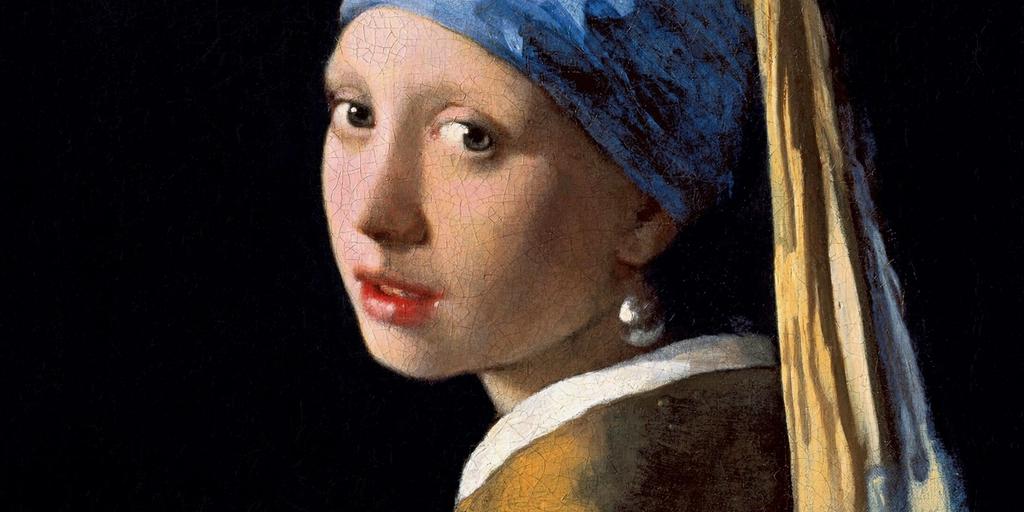
The history of Girl with a Pearl Earring is shrouded in mystery. The date of its creation is approximate, as Vermeer himself did not inscribe it. Scholars still do not know who is depicted: one theory holds that Vermeer painted his daughter Maria, who would have been around 12 at the time. Supporting this view is the remarkably direct and confident gaze of the girl, as though she and the artist know each other intimately.
According to another theory, the girl in the portrait is not a specific individual but a product of the artist's free imagination — a "tronie," an anonymous fantasy portrait. This theory is supported by the inventory drawn up after Vermeer's death, which lists "two tronies in the Turkish manner" — a description that could well refer to the elaborate turban on the girl's head.
Style
Girl with a Pearl Earring belongs to the Baroque tradition. This is evident in the richness and intensity of its colors and in the contrast that lends the portrait a sense of three-dimensionality. The artist masterfully rendered the light on the skin, throwing it into relief against the deep dark background. The highlights in the girl's eyes and on her lips appear entirely natural; she seems to be gazing at something just behind the viewer.
Interesting Facts
- Artists of the period did not title their canvases — names were invented by the clerks who compiled estate inventories. The painting was known as Girl in a Turban and Head of a Girl; only before a Washington exhibition in 1995 did staff at the Mauritshuis devise the name we use today.
- Considerable debate has surrounded the earring itself — specifically, whether it is actually made of pearl. Many researchers have noted the stone's unusually large size and the bright highlight at its lower edge. Scholars now lean toward the view that the jewel was not pearl at all, but glass coated with a matte layer. Large pearls were rare and affordable only to the wealthy, which is why imitation jewelry was imported from Venice.
The Persistence of Memory, 1931

The Artist
The canvas was painted by the Spanish Surrealist Salvador Dalí. Eccentric from childhood and a natural magnet for public attention, he produced around 1,500 works over the course of 85 years, including Surrealist paintings, illustrations, and sculptures.
Salvador Dalí was celebrated during his lifetime. He wrote several autobiographical books and screenplays, designed the Chupa Chups logo, collaborated with Walt Disney on the animated film Destino, and contributed to films by Luis Buñuel and Alfred Hitchcock. He also created 44 bronze statues at his home in Port Lligat. The artist drew inspiration above all from his dreams, from self-analysis, and from the theories of Freud.
History
The Persistence of Memory is a small canvas that Salvador Dalí painted in just a couple of hours while his wife Gala was at the cinema with friends. Dalí himself did not go, citing a migraine. He had originally been painting Cape Creus, but that day he looked at the picture and felt it was missing some idea, some meaning. He fell asleep, and before him appeared the image of soft watches melting from the branch of a dried olive tree. Dalí himself said that the image of the 'flowing watches' was inspired by a soft camembert cheese they had eaten for supper the evening before.
The small painting was deeply personal for the artist. Dalí later recalled showing it to Gala: 'I watched her examine the picture and saw a delightful astonishment spread across her face. That was how I knew the image was working, because Gala is never wrong.'
Style
The Persistence of Memory belongs to Surrealism. The soft watches express the central idea that had come to Dalí — the relativity of time and its non-linearity. The watches melt in different directions, showing how easily one might return to the past or influence the future. The artist was acutely aware of the fragility and artificiality of our conventional understanding of time, a point underscored by the 'hard' watch in the painting being devoured by ants — symbols of finitude, mortality and decay.
Yet the concept of time is not entirely destroyed — a point confirmed by the image of an egg lying on the shore, and by a mirror that seems to unite sea and sky. In the artist's eyes, time is contradictory and relative, yet it can still exist and weave the fabric of the world.
Interesting Facts
- Salvador Dalí himself offered only two comments on the painting: that the softness of the watches was prompted by his thoughts about camembert, and that while working on it he was thinking of the ancient Greek philosopher Heraclitus and his saying 'Everything changes, everything flows.'
- A few days after completing the work, it was purchased by an American, Julien Levy, who assured Dalí that The Persistence of Memory would bring no commercial success and would simply hang on his wall at home.
Read more articles about art on Losko. For instance, our feature on Surrealism in painting, or on the world's most expensive living artist David Hockney.
Follow us on social media so you never miss a new piece: VKontakte, Telegram — @loskomagazine.