Art can be found far beyond the walls of a museum. It is everywhere — on streets, on posters, on phone screens. It is easy to notice if you look around, but not always easy to understand.
We decided to ask professionals how to make sense of art and develop a personal perspective on visual culture: specialists from the online school Bang Bang and artist Mikhail Nikatin. Their answer took the form of a book selection.
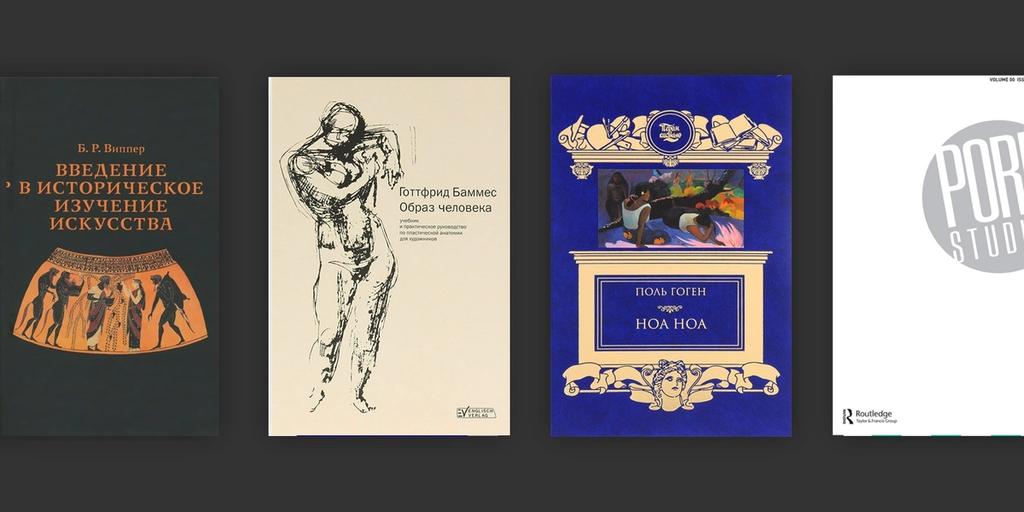
Boris Vipper, Introduction to the Historical Study of Art

A book for those who have only just set out on the path of studying art.
To speak freely about art, one needs to know the names, the dates and the connections. Diving headfirst into research without that foundation is like trying to play Bach without being able to read music.
Textbooks are often hard going, but Vipper's guide is not. His series is written with vitality, depth and expertise. The author explains precisely how a drawing, a painting, a sculpture and a work of architecture each come into being. Drawing on examples from different eras and countries — from prehistoric art to the twentieth century — he illuminates the theory of genres and sets out the specific character of each discipline within the visual arts.
About the author:
Boris Vipper was a Soviet art historian, educator and museum scholar — one of the founders of the Soviet school of Western European art history.
Gottfried Bammes, The Artist's Guide to Human Anatomy

A book for those who want to understand the structure of the human body.
This textbook was created for students at art colleges, but anyone with an interest in art would do well to read it — or at least to browse it, since it is rich in drawings, diagrams and visual examples.
The Artist's Guide to Human Anatomy teaches you how to model a figure in motion, shows you how to work with expression and emotion, and addresses all the aspects a practising artist is likely to encounter.
While reading, you can pick up a pencil and learn step by step, or simply absorb the information and gradually marvel at how expressive the human body is — and how vividly that can be rendered on paper.
About the author:
Gottfried Bammes was a German artist and anatomist, and a lecturer in plastic anatomy at the Dresden Academy of Fine Arts (the College of Fine Arts).
Paul Gauguin, Noa Noa

A book for those who want to see the world through an artist's eyes.
Paul Gauguin, alongside Cézanne and Van Gogh, was one of the foremost figures of Post-Impressionism. These artists perceived reality differently, and for many years their admirers dissected paintings stroke by stroke, seeking to explain their singular way of looking at life.
But no one can speak of a person's inner world better than the person themselves. In his writings, Paul reflects with vivid immediacy on the need for solitude, the corrosive nature of criticism, and the importance of not merely observing reality but experiencing it with acute, sensory intensity. In short, he opens every corner of his soul to the reader with complete honesty.
Art for art's sake. Why not? Art for life. Why not? Art to please. Why not? Does it matter? As long as it is art.
About the author:
Paul Gauguin was a French painter, ceramic sculptor and graphic artist. He regarded civilisation as a "disease" and spent much of his life in Tahiti, where he produced many of his celebrated canvases. Recognition came only after his death in 1903: films have been made about him, books written, and a crater on Mercury bears his name.
Logos magazine: PORN STUDIES

A magazine for those who want to learn about the representation of the body and sex in art.
The days when speaking about sex was considered shameful are long gone. Today, sex is art and an important part of contemporary culture. The philosophy journal Logos turns its attention to serious academic inquiry into pornography — a field that has been a legitimate university discipline in the West for more than 25 years, known as Porn Studies.
About the author:
Logos is an independent Russian journal of philosophy and the humanities, published since 1991.
William Blake and the British Visionaries

A book for those who want to discover where a great artist found his inspiration.
William Blake's style is difficult to assign to any particular movement, since his creations were rooted in what he called Creative Imagination. His works have even been described as visionary — from the Latin visio, meaning vision — because the artist drew inspiration from dreams and visions.
This study shows how Blake's legacy went on to influence the Pre-Raphaelites, the Symbolists, the Romantics and the Surrealists. It also explores how vital it is to cultivate a creative imagination rather than simply imitate others.
About the author:
William Blake was an English poet, painter and engraver who went unrecognised in his own lifetime. He is now regarded as one of the central figures in the history of poetry and visual art of the Romantic era.
Lucio Fontana, White Manifesto

A manifesto for those who value unconventional art.
Lucio Fontana is known for his slashed canvases. Those who encounter them for the first time often dismiss the artist as an anarchic vandal. Yet the cuts were not an act of defacement but an attempt to engage new techniques and contemporary materials.
Lucio sincerely believed that his art should become part of something larger, and so he produced numerous treatises and manifestos. The White Manifesto, published in 1946, advocates a synthesis of painting, sculpture, poetry and music. It sets out the views of the Italian Futurists alongside utopian ideas about art and science as forces capable of transforming society.
About the author:
An Italian painter, sculptor and abstractionist, he gained recognition through his innovative technique of slashed canvases.
Josef Albers, Interaction of Color

A book for those who want to learn how to engage with colour creatively.
Albers spent many years experimenting and seeking to understand the nature of colour and its properties. It is no surprise that the 1963 edition became an instant bestseller — and has remained one to this day.
This handbook by a Perceptualist painter and Bauhaus instructor is essential reading for anyone whose work involves colour. Free of metaphysics and grounded in practical exercises, it illuminates how colours interact, dispels common misconceptions, and shows how to develop creative imagination and achieve striking results with limited means.
About the author:
Josef Albers was a painter and art theorist, and one of the leading figures of geometric abstraction.
Julia Cameron, The Artist's Way

A book for those who need to find their way out of a creative block.
Art is not the preserve of geniuses — it is a long and painstaking process of working on oneself and the world around us.
A practical twelve-week course developed by Julia Cameron to help unlock creative potential, embrace one's talents and build self-confidence. Her methods may feel unsettling at first, but they genuinely work.
About the authors:
Julia Cameron is a poet, playwright and television screenwriter. She has contributed to The New York Times, Rolling Stone, The Chicago Tribune and other publications. She was formerly married to Martin Scorsese.
Austin Kleon, Steal Like an Artist: 10 Things Nobody Told You About Being Creative

A book for those trying to bring creativity into their life and work.
This book reads well alongside the previous one. It helps build confidence in your own abilities and makes the case that creativity is accessible to everyone. Austin Kleon champions the idea that you don't need to be a genius — you just need to be yourself.
A book about the importance of following your own interests and artistic preferences, exploring them, immersing yourself in the work of others, so that one day you can discover the foundation of your own.
About the author:
Austin Kleon is a writer and artist. He contributes to The Wall Street Journal and The New York Times, and gives talks and workshops on creativity at Pixar, Google, SXSW and TEDx.
José Ortega y Gasset, The Dehumanization of Art

A book for those who think about distinctions between different types of art.
Philosophical texts are demanding at the best of times, and works on the philosophy of art doubly so. Even so, José's essay became enormously popular — partly for its accessible language, and partly because the author takes up the enduring question of the opposition between art for the few and art for the many. What exactly is the difference? It is this question that Gasset sets out to answer in his reflections.
About the author:
José Ortega y Gasset was a Spanish philosopher, sociologist and essayist.
Mark Evans, Botticelli Reimagined

A book for those who want to learn about the great painter's influence on contemporary art.
Few people appreciate how profound an influence Botticelli has had on contemporary designers and artists. His works have inspired a countless number of people, and his legacy can be seen across the board — from Degas's drawings and Warhol's first computer-generated portrait to Jeff Koons's album cover for Lady Gaga.
Published to accompany a major exhibition at the Victoria and Albert Museum, this is the first book to place Botticelli's works alongside contemporary pieces made under his influence. The sheer range of interpretations raises a series of questions: how did the artist come to achieve international renown, and what made Botticelli a popular icon?
About the author:
Mark Evans is a curator at the Victoria and Albert Museum.
Christiane Paul, Digital Art

A book for those who want to understand what digital art is and how it evolves.
Christiane Paul's book is neither a textbook nor a manual — it is her own investigation into the evolution of art grounded in the latest information technologies.
Digital art is expanding — encompassing digital art proper, video games and virtual realities. This field resists any unified definition, so the author instead charts its rapid growth and examines each distinct area in detail.
About the author:
Christiane Paul is a curator and new-media scholar, Professor at the School of Media Studies at The New School, and Adjunct Curator of New Media Arts at the Whitney Museum of American Art (New York). She is the author of numerous articles and books on art and digital technology.
Tobias G. Natter «Egon Schiele: The Complete Paintings, 1909-1918»

A book for those who want to immerse themselves in the work of a provocateur artist.
Despite a life cut short at twenty-eight, the Austrian artist Egon Schiele left a vivid and lasting mark. A child prodigy, a young rebel and provocateur, he aroused incomprehension and rapture in equal measure. His paintings — with their distorted lines and bodies and their erotic charge — conveyed an emotional and sexual truth. Schiele revelled in stylistic freedom and the power to shock, and rejected classical figuration. After Klimt's death in the spring of 1918, he began to stake his claim as Austria's greatest living artist.
The book brings together all the works from his most productive period, between 1909 and 1919.
About the author:
Tobias G. Natter is an Austrian art historian.
David Hockney, Martin Gayford — A History of Pictures: From the Cave to the Computer Screen

A book for those who want to understand what a frame from a Disney cartoon and a scene from an Eisenstein film have in common.
The book is built around a dialogue between the artist David Hockney and the art critic Martin Gayford. Together they reflect on visual culture, illustrating their ideas with examples drawn from a wide range of periods and civilisations.
They raise questions that rarely occur to most people in everyday life: Do pictures show truth or falsehood? Can photographs be trusted?
About the authors:
David Hockney is an English painter, draughtsman and photographer. A prominent figure in the pop art movement of the 1960s, he is considered one of the most influential artists of the twentieth century.
Martin Gayford is a British art critic and art historian. He writes regularly about art for numerous magazines and newspapers, and is the author of books on Van Gogh and Gauguin, Michelangelo, Constable and Lucian Freud.
Hiroshi Fujiwara «Fragment»

A book for those who want to learn about a singular approach to creating a product.
Hiroshi Fujiwara has been called the 'godfather of streetwear'. Yet his work has exerted a powerful influence not only on fashion but also on music and design. This monograph presents his projects and collaborations, along with the story of his life and career.
Mikhail Nikatin also recommends paying attention to the excellent layout by Japanese studio Mo' Design.
About the author:
Hiroshi Fujiwara is a designer, musician and producer, also known as the 'godfather of street style'. He has collaborated with many major companies, including Louis Vuitton, Starbucks, Jordan and Nike.
Valery Koshlyakov. Two-volume set: Painting. Installations. Iconuses. Constructions

A book for those who want to understand how unconventional materials — such as cardboard boxes or bin bags — can be used to create a genuinely significant work of art.
This two-volume publication by Valery Koshlyakov is a relatively rare edition, produced in a run of just 2,000 copies — which only adds to its value. The books bring together his finest works, including the striking installation Cloud, created for an exhibition at the Museum of Contemporary Art in Rome (MACRO), among many others.
In his work, Koshlyakov has repeatedly turned to unconventional materials: cardboard boxes, rubbish bags, adhesive tape and polystyrene packaging. Things that are difficult to imagine as art objects in everyday life become bold works of art in his hands.
'An absolutely brilliant artist, both in terms of technique and meaning,' says Mikhail Nikatin.
About the artist:
Valery Koshlyakov is a Russian artist. In 2002 he took part in the 25th São Paulo Biennial and represented Russia at the Venice Biennale in 2003.
Recommended viewing for inspiration:
- Lauren Marsolier. The series Transition — explore the colour harmony and flawless composition in the work of French photographer Lauren Marsolier.
- Erik Bulatov. Paintings 1982–2011 — a large-format album of works with notes by the artist himself.
- Dima Pantyushin. Posters for the Entuziast moto café, 2013–2016. Beautiful posters, composition and colour.
- Arkhip Kuindzhi. Tretyakov Gallery 2018 — a detailed album with fine reproductions.
- Lucian Freud. William Feaver — a substantial monograph of the master's work.
Read about artists on Losko:
- Edward Hopper — the architecture of solitude
- Georgia O'Keeffe — mother of American modernism
- Andy Warhol: 'Once I accepted my loneliness, I found myself surrounded by an entourage'
- Frida Kahlo: 'The funniest thing in the world is tragedy'
- René Magritte: magical realism and the treachery of images
Follow us on social media so you never miss new content: VKontakte, Telegram — @loskomagazine.