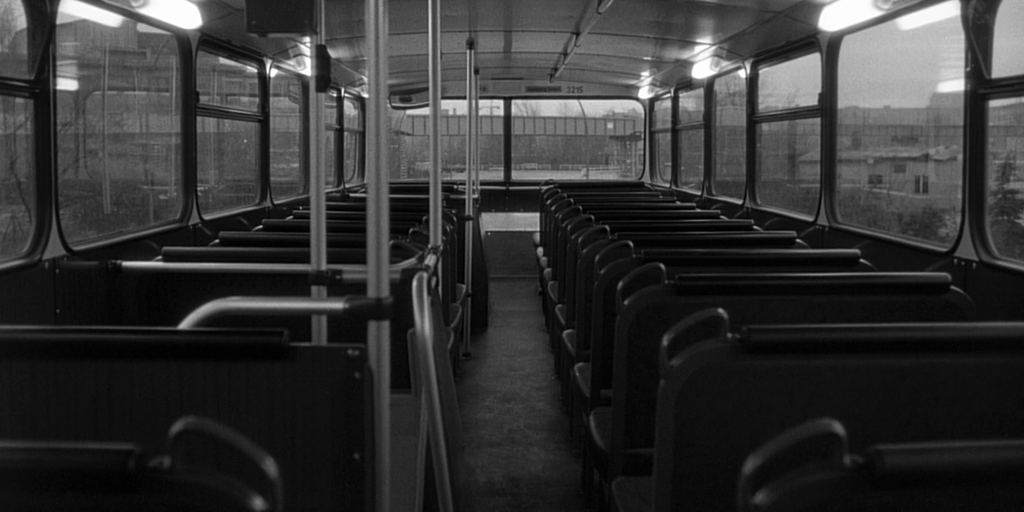
In an age of colour cinema and rapid advances in digital technology, some directors still turn to the aesthetics of black-and-white filmmaking. In some cases, the monochrome image evokes a sense of nostalgia for the era of classical Hollywood and the French "
New Wave"; in others it carries significant semantic weight, serving as a way to tell a story by focusing the audience's attention entirely on the narrative. But whatever goals a director pursues in choosing this artistic device, black-and-white films offer a wholly distinctive beauty of line, high-contrast visual imagery, and a mesmerising interplay of light and shadow.
Black-and-white cinema reminds us of the things that make films truly great. We have assembled a selection of eight contemporary pictures that everyone wishing to develop their artistic sensibility should see.
Wings of Desire / Der Himmel über Berlin
Year: 1987
Country: Germany
Director: Wim Wenders
The iconic film by German director Wim Wenders about invisible, immortal angels who inhabit a divided Berlin, peering into the homes, thoughts and souls of its residents. It is poetic cinema inspired by classical filmmaking. The voice-over monologues — the inner speech of angels and humans alike — resonate with the quality of poetry. The director dedicated the film to "three former angels": the directors Ozu, Truffaut and Tarkovsky.
Wenders transposes the conflict between the spiritual and the material, the sublime and the base, through the story of the angel Damiel, who is willing to trade eternal life for the chance to be with the woman he loves. The angels are witnesses and guardians of the past. Yet Damiel, having fallen in love with a trapeze artist, is drawn towards the future, and this choice between past and future proves to be the very choice the director himself faces. Wenders masterfully unites the aesthetics of black-and-white and colour cinema: the angels cannot distinguish colours, smell scents or feel the texture of objects, so the world they perceive is shot in black and white by the great cinematographer Henri Alekan, while the human world appears in colour.
The director wanted to capture "what is felt from the moment of arriving in Berlin — something in the air, underfoot, in people's faces." And so he made a portrait of the city, preserving on film the many kilometres of wall dividing what was once a single country. For the angels, however, the wall might as well not exist — they inhabit a unified Berlin. Two years after the premiere of Wings of Desire, the wall that had divided the city and an entire people fell.
The White Ribbon / Das weiße Band
Year: 2009
Country: Austria, Germany
Director: Michael Haneke
The White Ribbon is a German film that received the Palme d'Or at the Cannes Film Festival, the Golden Globe for Best Foreign Language Film and two Academy Award nominations. Michael Haneke's black-and-white drama portrays the troubles within a small Protestant village in northern Germany shortly before the First World War. It is a film about the nature of evil and the roots of religious and political terrorism — a meditation on how society ought to conduct itself towards the younger generation.
An atmosphere of fear and mutual hatred grips the entire village. The black-and-white cinematography underscores the mounting psychological tension. Strange and inexplicable events begin to unfold: the town doctor is wounded under mysterious circumstances, the baron's son is found hanging upside down in a barn, and a worker dies in a factory accident.
The director reflects on the causes and preconditions of fascism. The world of cruelty, denunciations and punishment contained within a single village will, just a couple of decades later, grow into a catastrophe on the scale of an entire country — and the entire world. Michael Haneke offers no answers, holding that 'the role of art is to ask questions, not to propose solutions.'
The Man Who Wasn't There
Year: 2001
Country: USA
Director: Joel Coen, Ethan Coen
The Coen Brothers' definitive noir — awarded the Best Director prize at Cannes — was originally shot on colour film but released in black and white. The Coens' picture is a study of the 'little man' who tries, without success, to break free from the system: a tale of crime, passion and punishment, set to an immaculate monochrome image and the music of Beethoven and Mozart.
The story takes place in the summer of 1949 in a small town in northern California. Day after day, barber Ed Crane cuts hair. He is dissatisfied with his life: his work brings him no fulfilment, and his wife is having an affair with a family friend. In an attempt to change his fate, he resorts to blackmail. Ed's scheme unravels, exposing still darker secrets, and a chain of events ultimately leads to death.
Frances Ha
Year: 2012
Country: USA
Director: Noah Baumbach
Noah Baumbach, one of the most instinctive American directors working today, has made a touching dramedy about the life of a New York dreamer named Frances. The screenplay was co-written with lead actress Greta Gerwig via email, and the film was shot on a minimal budget using an ordinary Canon camera.
The aesthetic of black-and-white cinema and the music of Georges Delerue — who worked with Truffaut — place Baumbach in conversation with the French New Wave as he tells the story of a twenty-seven-year-old dancer trying to build a grown-up life in New York, only to lose her apartment, her job and her friends along the way.
Frances Ha is a timeless story about the joys and sorrows of youth — a monochrome portrait of the millennial generation, a nostalgic film about everyone who has ever felt lost and is doing their best to find their place in the world. In Greta Gerwig's awkward, endlessly relatable protagonist it is easy to recognise oneself. And in the moment when Frances dances through the streets of New York to David Bowie's 'Modern Love,' it is hard not to believe that, in the end, everything will be all right.
Ida
Year: 2013
Country: Poland
Director: Paweł Pawlikowski
Ida is a black-and-white drama by Paweł Pawlikowski — the first Polish film to win the Academy Award for Best Foreign Language Film. It tells the story of Anna, a Polish orphan who, on the eve of taking her monastic vows, meets her only surviving relative: her aunt. The aunt reveals Anna's Jewish heritage, and together they set out on a journey to uncover the tragic history of their family — one that will shape both their futures.
Pawlikowski has made a decidedly unconventional road movie about the search for meaning and the discovery of self. The film's monochrome palette, combined with magnificent cinematography and a meticulously composed frame, heightens the expressiveness of the story and holds the viewer's attention entirely on what unfolds before them.
Frantz / Frantz
Year: 2016
Country: France, Germany
Director: François Ozon
In this film, director François Ozon explores the devastating aftermath of the First World War through the eyes of the war's lost generation. It is an exceptionally beautiful, unhurried picture of human drama, in which the black-and-white palette, classical score, and the thematic and visual register together form a seamless whole.
At the heart of the story is the relationship between Anna, a German woman who has lost her fiancé Franz on the battlefield, and Adrien, a Frenchman who appears at his grave under mysterious circumstances. Ozon's characters struggle with their inner contradictions — survivor's guilt, the pain of loss, and an irrepressible longing for happiness, in spite of everything.
Roma / Roma
Year: 2018
Country: Mexico
Director: Alfonso Cuarón
Cuarón made a deeply personal, semi-autobiographical film in which he served simultaneously as director, screenwriter, producer, cinematographer and editor. It is a beautiful black-and-white work of auteur cinema, distinguished by its attentiveness to detail within the frame, fluid camerawork and an unhurried pace.
The film follows the life of an ordinary Mexican middle-class family in the early 1970s. Its central narrative thread is the story of a servant named Cleo. Roma is a profoundly measured film whose single climactic event is the massacre of student demonstrators.
Cold War / Zimna wojna
Year: 2018
Country: Poland
Director: Paweł Pawlikowski
The historical drama Cold War received an eighteen-minute standing ovation at Cannes and won the award for Best Director, as well as earning three Academy Award nominations. Pawlikowski tells the story of his own parents' lives: a musical director falls in love with a singer and attempts to persuade her to flee communist Poland for France.
Pawlikowski's films are always an interweaving of historical conflict and human relationships. This is a story of people divided by politics, borders, ideologies and temperament — an impossible love story set against the ruins of post-war Poland. Cold War is visually austere and restrained: black-and-white images, a classical 4:3 aspect ratio, and a single melody that recurs throughout the narrative.
A bonus for those who have read the selection all the way to the end.
The two greatest black-and-white films in the history of world cinema, according to the Losko editorial team:
L'Avventura / L'Avventura
Year: 1960
Country: Italy, France
Director: Michelangelo Antonioni
L'Avventura is a film about loneliness and inner emptiness that brought Antonioni worldwide acclaim and became the founding point of reference for European art-house cinema. It is the favourite film of director Andrei Zvyagintsev and, in Umberto Eco's words, the benchmark of a modern work open to countless interpretations.
Masculin féminin / Masculin féminin
Year: 1966
Country: France
Director: Jean-Luc Godard
A landmark film of the French New Wave, made by the legendary Jean-Luc Godard. A time capsule of the 1960s, charged with ideas about politics, pop culture and the tensions between the sexes. In the closing credits, Godard writes: "This film could have been called 'The Children of Marx and Coca-Cola.' Those who wish to understand will understand."
Follow us on social media so you never miss new content: VKontakte, Telegram — @loskomagazine.