A church or place of worship is, first and foremost, a building. And some architects bring a bold, new vision to what a contemporary church can be. Many religious traditions still honour conventions formed centuries ago and resist any innovation in construction — yet these architects demonstrate that a building is merely a shell, and what truly matters is what stirs within the soul.
Losko Magazine has gathered 10 minimalist structures that not only fill the hearts of the faithful with joy, but also inspire awe in atheists with their grandeur and refined design.
1. Chapel on the Ocean Shore

Strolling along the ocean shore in the resort area of Beidaihe(China), one may come across the small Seashore Chapel, designed byVector Architects. Notably, the chapel can only be entered at low tide — at other times it is submerged several centimetres underwater, and from a distance it resembles a boat rocking on the waves.
The 270 sq.m. structure features a covered space at ground level that shelters visitors from the blazing sun and serves as a place to rest. On the upper level is the chapel's classic, modest interior with rows of pews. The atmosphere is deeply spiritual — though it is hard to focus on anything other than the breathtaking view of the ocean stretching before you.
2. RW Concrete Church

The Concrete Church is located in the Byeollae district(Byeollae) of Seoul. The project was designed by the architectural practiceNAMELESS Architecture.
Almost everything here is made of concrete: the foundations, the floor slabs, the walls and even the finishing. The material serves as a metaphor for steadfast religious values that have remained unchanged for centuries.
The form of the cross is evoked by a large bell tower, created by stripping the upper floors of their front walls. The resulting void also accommodates a cross that, in proportion to the building, is relatively modest in scale.
3. Contemporary Church Architecture in Lebanon

Located 50 km from Beirut, (Lebanon) the church was designed by Paris-based architect Maroun Lahoud (Maroun Lahoud). He faced a formidable challenge: the church was intended to foster reconciliation between the Christian community and the Druze ethno-confessional group.
After fifteen years of civil war in Lebanon, many homes lay in ruins. Villagers carried stones salvaged from their destroyed dwellings to help build the new church. In this sense, it became a symbol of the people's unity.
Cross-shaped openings in the walls and large windows flood the interior with natural light, which is further reflected by the bright white walls and marble floor.
4. Chapel of the Holy Cross in Greece

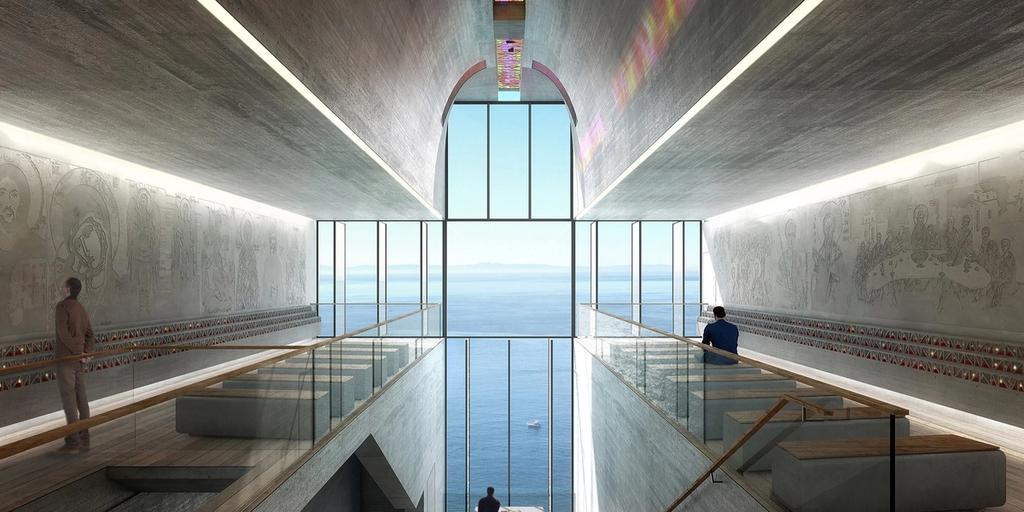
The Chapel of the Holy Cross is a timeless religious structure that serves as a link between past, present and future. It unites centuries-old tradition with the clarity and simplicity of contemporary architecture.
The unique project was created by the team at OPA. Regrettably, it has yet to be realised: the search for investors is ongoing.
The idea is certainly worth attention. Built from simple materials, the church will be situated in the rock on the island of Serifos (Greece) with sweeping views of the Aegean Sea. Its glazed façade allows sunlight to pour through the interior throughout the day, while at night the building serves as a striking beacon.
5. Greek Orthodox Chapel

A compact chapel in the city of Paphos (Cyprus) was designed by Michail Georgiou (Michail Georgiou). He drew inspiration from the architecture of local Orthodox churches, while at the same time employing innovative techniques and contemporary materials during construction.
This chapel is not a large structure — its floor area is just 56 sq.m. That is precisely why it sits so harmoniously within its natural surroundings. The gently curved roof, which echoes the contours of the hillside, contributes to this effect, as does the generously wide, open entrance that welcomes visitors and tourists inside.
6. The Chapel of St Anne in Argentina

The architects of studio Cella created the chapel in Misiones Park (Argentina). The challenge lay in the fact that the site draws large numbers of tourists and leisure visitors every day, so a small rise in the landscape was chosen as the location for the religious building.
Ramps were constructed to provide easy access to the chapel, leading up to the forecourt in front of the building. This space also serves as an overflow area when large congregations gather for ceremonies. The interior is finished in natural timber, and every architectural detail has been carefully considered: the entrance to the chapel is positioned so that a passing tourist or pedestrian cannot disturb a service in progress.
7. St. Voile Chapel in Japan

The light, weightless chapel on the bank of the Shinano River (Japan) was created for wedding ceremonies. The project was realised by architects from the studio Kasahara Design Work, who describe the pristine white interior as evoking the image of a bridal veil.
The structure, standing nearly 15 metres tall, is adorned with elegantly curved tubes that appear to float in mid-air, lending the space a singular atmosphere. With its panoramic window overlooking the river and its refined interior, the chapel is an ideal setting in which a couple can begin their new life together.
8. The Kamppi Chapel of Silence in central Helsinki

When the noise of the city becomes too much, the chapel offers a place to find calm and sit quietly for a while. It is located right in the heart of Helsinki(Finland) and is open to everyone.
The KamppiKamppi Chapel, with a floor area of 352 sq m, was designed byK2S Architects and completed in 2012. Its refined wooden facade, clad in spruce, sits naturally within the urban streetscape yet reads more as an art object than a chapel. The Evangelical Lutheran Church of Finland has long been receptive to contemporary architecture, and the chapel welcomes everyone, regardless of faith or belief.
9. A Magical Chapel Building in Nanjing

One of the most remarkable projects byAZL Architects is a magical chapel building designed for wedding and religious ceremonies. The project, known as the Nanjing Wanjing Garden Chapel, stands on a riverbank within a city park in the Chinese city of Nanjing.
Behind the building's outward simplicity lies a wealth of carefully considered detail: an intricately engineered ceiling and wooden walls of alternating beams that filter light. The interior surprises with its absence of colour — a translucent white that lends the space a particular magic, which intensifies at night when the building is lit. The clarity of line, the elegance of minimalism and a sense of weightlessness remind us, once again, that simplicity can be perfect.
10. A Futuristic Church in Austria

On the site of an old, dilapidated church in the city of Linz (Austria) a new religious building has been erected. Its interior bears little resemblance to a conventional church: strict geometry, minimalism, and a space executed in an avant-garde manner. The lines create a sense of openness and freedom, further enhanced by a well-chosen colour palette.
The church is always filled with light and recalls a multifaceted crystal. The project's authors, specialists from the studio x architekten, set out to create a building destined to serve not only as a religious centre but as a secular one as well.