Over the past few decades, the contemporary library has transformed from a quiet, contemplative space into a multifunctional public hub. Today, libraries offer far more than reading — visitors can try 3D modelling, rent office space and attend exhibitions.
In this article you will discover five contemporary libraries from around the world. We explore their histories and the architectural concepts behind their buildings.
Oodi Central Library

Location
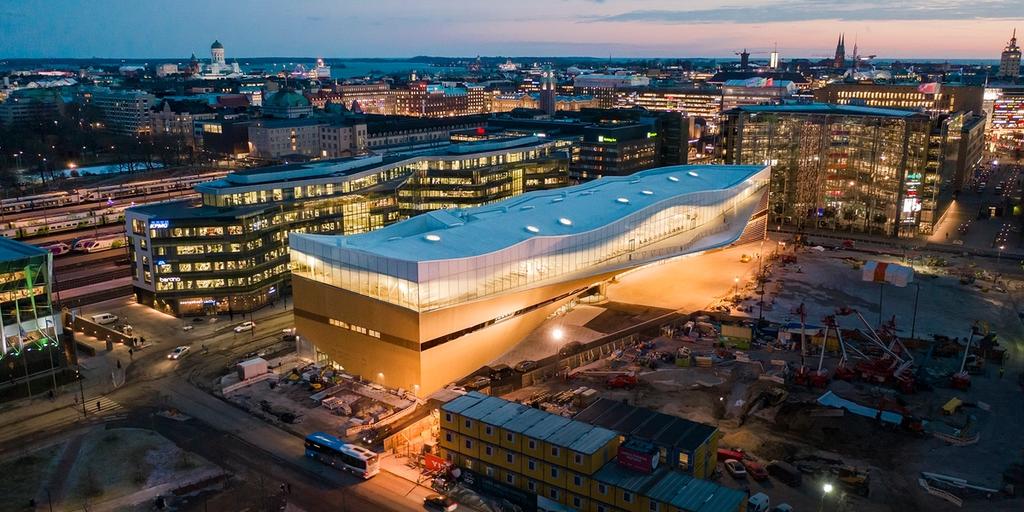
The library sits in the heart of Helsinki, flanked by the railway square, the government buildings, the music centre, the city's main street and residential housing. It offers far more than reading: the building hosts exhibitions, film screenings and a restaurant.
History
The Finnish government conceived Oodi as a centre to unite the country's entire library network. An architectural competition was held for the project, which was won by the Finnish studio ALA Arkkitehdit.
The library is a symbol of dialogue between the state and its citizens. Before developing the project, the architects sought the views of local residents, gathering ideas at conferences, on social media and at community events. More than 2,000 proposals were submitted in total, and the studio used them as the foundation for its design concept.
The library opened in 2018 and is now regarded as a landmark of Finnish architecture. Finns call it the city's living room: it is functional and firmly oriented towards local residents.
Architectural Concept
The library has an unusual form, resembling a ship sailing through waves. The building is constructed on the principle of a bridge — that is, it rests on two supports.
Kansalaistori Square flows seamlessly into the library's ground floor, creating an urban atmosphere within. This was a deliberate choice so that residents could continue their route straight through the building without feeling obstructed. The structure is built from glass, steel and timber, with locally sourced materials used throughout construction. The façade is clad in spruce, the balcony is made from pine, and the third-floor surface is oak. Light enters the library through the glazed balcony and circular skylights in the ceiling.
Almost all three floors consist of open spaces, while still offering areas for private, focused work. Books occupy only a third of the library; the remaining space belongs to a café, a cinema, exhibition areas and co-working zones.
Interesting Facts
- It was the residents of Helsinki who proposed the library's name — Oodi, meaning Ode.
- The library was conceived as a place that welcomes people of all ages and backgrounds. For this reason, words describing different groups of people are inscribed on the main staircase: 'Finns', 'city dwellers', 'children', 'pagans', and so on.
- According to IFLA Oodi was named the best library in the world in 2019.
Calgary Central Library

Location
The Calgary Central Library is located in Canada, in the province of Alberta. The library is woven into a complex urban fabric. A railway line and a light-rail station run alongside it — the tracks pass through the building and sweep smoothly beneath it. Situated in the downtown core, the library is surrounded by a high density of buildings.
History
The city administration wanted the library to be convenient and functional for everyone, so in 2012 more than 16,000 people took part in discussions about its design. The Norwegian firm Snøhetta won the architectural competition. Construction began in 2013 and was completed in 2018.
Architectural Concept
Craig Dykers, the founding partner of Snøhetta, refers to his staff not as architects but as "managers of habitat." This defines the entire concept of the library: its primary purpose is not to lend books, but to serve as a place for inspiration and human connection.
Visitors are greeted by a facade in the form of a wooden wave. The motif continues inside the building, with both the material and its sense of movement preserved. The library's design allows the entire space to be taken in at a glance. The building is conceived so that the higher you go, the more light fills the interior. In interviews, Craig Dykers has said that the dynamic forms are meant to inspire and energise.
Facts
- The Calgary Central Library represents the largest financial investment the city has made since the 1988 Olympic Games.
Halifax Central Library

Location
The Canadian library is situated in the very heart of the city, in a neighbourhood that is home to a school of architecture, museums, the Public Gardens, historic residential districts and the city's main shopping street.
History
As with the other libraries featured here, the architectural design of the Halifax library was shaped by the wishes of local residents. To this end, library staff and architects held five large public meetings with citizens, as well as several focus-group sessions, to ensure that the building would truly serve the needs of the community.
The contemporary Halifax library reflects the local community, having been created in close collaboration with residents. It was conceived as an accessible, vibrant space that accommodates both social interaction and quiet, solitary reading.
Architectural Concept
The architectural firm Fowler Bauld & Mitchell designed the library in a Scandinavian style. The cubic structure consists of four segments offset from one another. On the roof is a green terrace offering views of the Citadel Hill — one of the city's most significant historic landmarks.
The library was built on the site of a city garden. The architects chose to honour this history on the facade, applying a print of abstract tree leaves to several of the building's panels.
Facts
- During the public consultations, residents themselves determined how natural light would enter the building and where the green terrace would be positioned.
- The library has received a LEED Gold certification, confirming that all environmental sustainability standards were met during its design and construction.
Brasiliana Library

Location
The library was built on the student campus of the University of São Paulo in Brazil. During construction, several trees had to be felled; to offset the environmental impact and meet sustainability standards, more than 1,000 trees were planted elsewhere on the campus. The library is now surrounded by parkland on all sides.
History
The library was created as a repository for the rare book collection of Brazilian lawyer José Mindlin. He had been collecting valuable books since the age of thirteen, and in 1999 he asked his grandson to build a home for his vast collection. Today the library is Brazil's largest and most important archive, to which José Mindlin donated more than 17,000 documents and 60,000 volumes.
Architectural concept
The concept is rooted in the idea of permeability. Direct access to natural light and a continuous surface treatment shared by the exterior and interior walls create the impression of an unbroken street.
In daylight, the building appears to be entirely concrete. In reality, however, natural light permeates every part of the library, entering through glazing at the centre of the roof. The roof, in turn, connects all parts of the building while remaining a distinct element in its own right.
On entering the library, the visitor finds themselves at the heart of the building, surrounded by books. All four floors are visible from this central point. The spatial arrangement is intended to evoke the human mind, filled with knowledge.
Notable facts
- Solar panels installed on the roof supply part of the building's energy needs.
- José Mindlin died three years before the library opened, and never lived to see it in use.
Library of Birmingham

Location
The modern Library of Birmingham was completed in 2013 in England. It sits between the Birmingham Repertory Theatre and Baskerville House, and its architectural form entirely transforms the character of the city-centre square. The library draws in residents, first because of its central location and second because of its versatility and appeal to a wide range of people. Visitors come to work, attend events and relax on the terraces. There are guided tours for children, and tourists travel to Birmingham specifically to see one of England's most contemporary libraries.
History
The Library of Birmingham was built as part of a city-centre regeneration project, replacing the former central library. From among 100 entries in the architectural competition, the commission was awarded to the Dutch practice Mecanoo. Construction began in 2010 and was completed three years later.
Architectural concept
The practice designed the library as a place for education and culture that brings together people of all ages and backgrounds. The design is conceived so that space flows seamlessly from the street into the building. The first two floors are glazed, making the entire interior visible from outside.
Three metal cubes are stacked one on top of another. The offset blocks create a terrace. A delicate skin of interlocking rings forms a lace-like facade through which light enters the building, casting a pattern of shadows across the floors. The principal materials are natural stone, white ceramic, oak, glass and metal.
In contrast to the building's rectangular exterior, the interior of the library houses a circular atrium. Visitors move between floors on white escalators with blue underlighting.
Interesting facts
- On the library's roof stands a rotunda housing the Shakespeare Memorial Room. It was created in 1882 for the old Birmingham Library and was carefully relocated to the new building.
- The library received the highest possible BREEAM environmental sustainability rating.
- The library is connected to the REP theatre, which seats 300 audience members.
If you enjoyed this article, we recommend browsing our roundups of other projects related to education and culture:
- Modern schools: 10 impressive projects from around the world
- 10 impressive contemporary art museums around the world
- Alma Mater: five outstanding university buildings of the 21st century
Follow us on social media to stay up to date with new content: VKontakte, Telegram — @loskomagazine.
Losko is a non-commercial project with no advertising on the site. If you enjoy what we do and value creative work — your own and others' — you are welcome to support us financially on Boosty. Thank you.