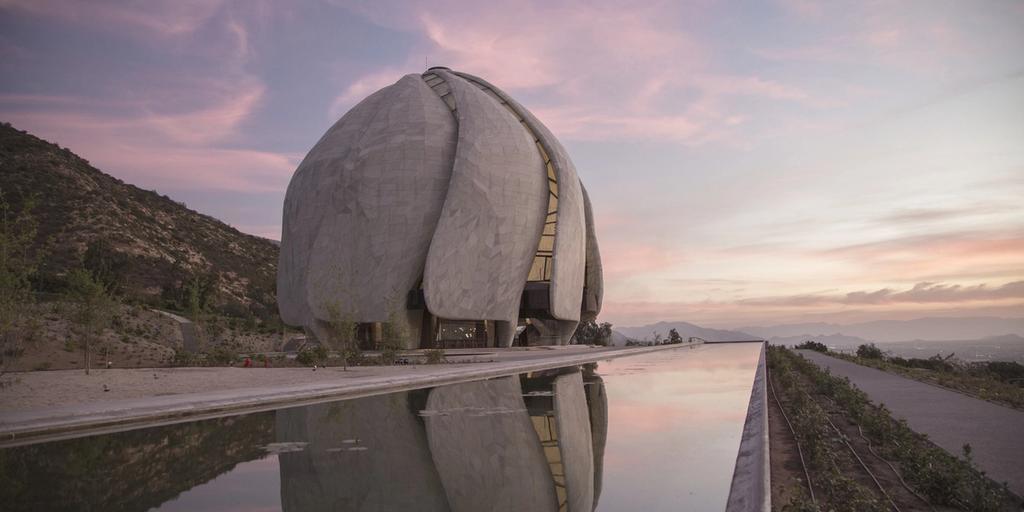
In 2016, the Bahá'í Temple of Light — Templo Bahá'í de Sudamérica — was completed near Santiago, Chile. The project began as far back as 2003, and over the course of fourteen years involved lengthy and painstaking work to select materials, arrange their delivery, and carry out construction.
This article explores what makes the Temple of Light unique, why sourcing building materials proved so challenging, who the Bahá'í are, and what ideals lie at the heart of their faith.

In 2003, the firm Toriro Hariri Pontarini Architects won the competition to design the temple. The concept was to provide a space for prayer and worship in a serene setting, free from rituals, ceremonies, icons or imagery. Bahá'í temples are conceived to embody the ideal of universal worship, where women, men and children may gather together as equals. It is the last of eight continental temples commissioned by the Bahá'í community and accommodates up to 600 people.

The temple consists of nine twisted glass petals forming a dome, and has nine entrances approached via pathways through gardens. The site was formerly an abandoned golf course, which has since been transformed into a garden. The task of designing and realising this landscape was entrusted to Juan Grimm, a renowned Chilean landscape architect. Working predominantly with native species, Grimm created an environment in which the temple can be approached from a variety of angles. More than 6,000 trees were planted across the grounds in support of an ecological programme.
The temple complex was designed with its location and surrounding landscape in mind, with the aim of enhancing the immediate environment. Additional structures were placed underground so as not to obstruct the view, and a good road was built connecting Santiago to the temple, making it easily accessible to anyone who wishes to visit.


The Bahá'í Faith is a monotheistic religion, today recognised as an independent faith, which originally emerged from Shia Islam. In Arabic, 'Bahá' can be translated as 'glory', 'splendour', as well as 'light' or 'radiance'. The faith was founded in mid-nineteenth-century Persia by the Báb and Mirza Husayn Ali. Today it counts more than five million followers worldwide. Its symbol is the nine-pointed star, inscribed with a calligraphic rendering in Arabic of the 'Greatest Name' and the name Bahá (Arabic: بهاء — 'glory').
The Baháʼí Faith is guided by 12 ethical principles, among them the rejection of discrimination in any form, the necessity of universal education, the elimination of extreme poverty and wealth, each believer's independent search for truth, and the importance of aligning religion with reason and scientific knowledge. Baháʼís first arrived in Chile in 1919.


The architectural challenge was to create a design that would draw people of all faiths and cultures. The aim was to reconcile opposing forces: silence and movement, simplicity and complexity, intimacy and monumentality. The chosen material was a solid structure capable of dissolving into light.

"It is designed to last 400 years and, in keeping with the history and philosophy of the faith, we sought an ancient, enduring material that could transmit light from the outside in and from the inside out"
The architects drew inspiration from a metaphor central to the Baháʼí faith, which describes goodness through the image of light. They therefore wanted to create a building that would allow light to pass through freely. Project director Doron Meinhard speaks of the temple in these terms: "It is designed to last 400 years and, in keeping with the history and philosophy of the faith, we sought an ancient, enduring material that could transmit light from the outside in and from the inside out." In Siamak Hariri's original concept, the building was to be constructed from alabaster, which can transmit light when cut thin enough. However, the climatic and environmental conditions forced the architects to look for an alternative solution.
The building is situated in the foothills of the Andes, where intense sun, summer temperatures reaching 40°C, and wide daily temperature swings are the norm.
The greatest challenge, therefore, was selecting a material able to withstand such conditions with integrity — one that, by design, also had to be translucent, so that the temple would be filled with light. Materials were tested for strength, seismic resistance, and tolerance of temperature fluctuations. After an extended search, the architects, working alongside the engineering firm Simpson Gumpertz & Heger (SGH), settled on borosilicate cast glass and marble panels from Portugal for the interior.
In creating them, the master craftsman drew inspiration from the work of the American abstract impressionist painter Mark Tobey — in particular the paintings White Writing and Patterned Light.
The architects collaborated with German glass artist Jeff Goodman, who created prototype panels of patterned cast glass for the temple. In creating them, he drew inspiration from the work of the American abstract impressionist painter Mark Tobey — in particular the paintings White Writing and Patterned Light.

The building's nine petals are identical; each stands approximately 26.8 metres tall, is around 10 metres wide, and comprises roughly 1,100 component glass pieces approximately 32 millimetres thick. About 20% of the panels are curved.
The fabrication and assembly of the components demanded considerable effort and time from a large number of people across several countries. The parts were manufactured in Toronto, and a portion were then shipped to Germany, where the firm Gartner Steel and Glass of Germany shaped and sized them as required. Gartner then fixed the panels to an aluminium frame, adding structural silicone sealant for additional strength and waterproofing. The façade 'petals' were packed into more than 100 containers and shipped to Chile, where they were finally assembled.


By day it is flooded with brilliant sunlight; by night, the materials emit a soft glow outward.
The architects substantially revised their original vision for the temple's cladding in response to stringent material durability requirements. Even so, they feel their intentions were honoured. "Thanks to technological innovations, we were able to turn cast glass — itself an ancient material — into something as durable and low-maintenance as stone," says Meinhard. "And it turns the entire temple into a window." By day it is flooded with brilliant sunlight; at night the materials emit a soft glow outward.


If you would like a little more background, the video below features Douglas Martin, a representative of the Bahai community, discussing the temple's creation and concept. It also includes drawings and scale models of the building.
If you would like to explore other unconventional architectural approaches to religious buildings, we invite you to read Losko's feature on 10 unusual religious buildings or the article about the concrete church in Seoul.