The architecture of New York is a mosaic of every style imaginable. Celebrated architects from around the world have worked here — and continue to do so — making the city's built environment more varied with each passing year.
In this article you will discover the five best buildings in New York according to the Losko editorial team. You will read not only about the architects and the structures themselves, but also learn the fascinating stories behind each of these five landmarks.
New museum
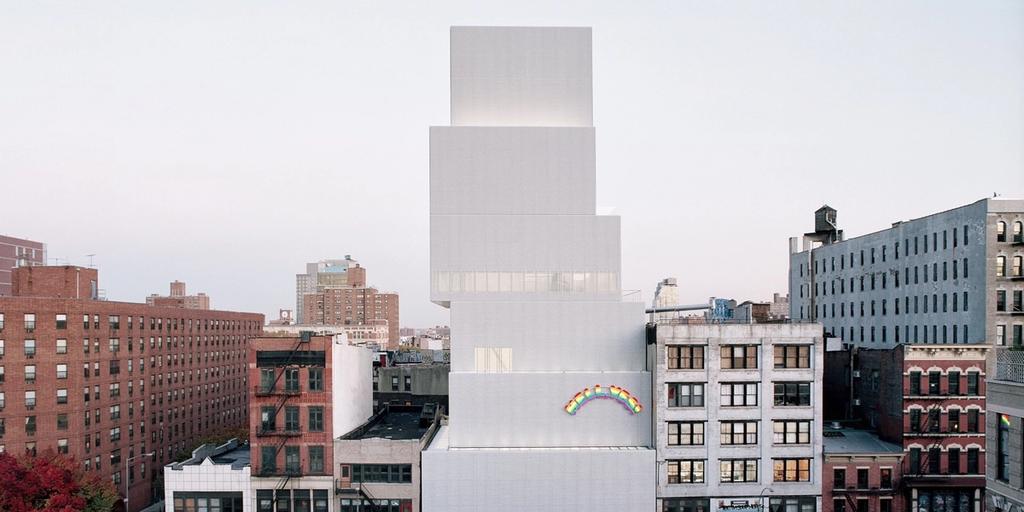
Only the newest, most radical, provocative and not always highly artistic collections find their way into the New Museum of Contemporary Art. This ethos shaped both the choice of architects and the site selected for the building.
Location
To reflect the museum's rebellious spirit and its indifference to bourgeois values, it was built in one of Manhattan's poorest neighbourhoods. The surrounding streets were originally lined with wholesale food shops, small factories and workshops. After the museum opened, New York's creative bohemia began migrating to the once-neglected area, transforming it into a fashionable destination.
Architects
The museum was designed by the Japanese architectural firm SANAA. Kazuyo Sejima (Kazuyo Sejima) and Ryue Nishizawa (Ryue Nishizawa) are known for their cool minimalism. In their buildings they employ concrete, steel, aluminium structures and glass. The architects leave materials largely untreated, though they do occasionally apply white paint.
Structure
Six boxes, carelessly stacked on top of one another and seemingly on the verge of collapse, echo the exhibitions housed within. The building and its interior are a challenge to convention and to the comfortable, undisturbed existence of humanity.
The museum's walls are clad in aluminium panels and covered with an aluminium mesh. In one interview, Kazuyo Sejima candidly admitted that she used the mesh because American workers, unlike their Japanese and European counterparts, were unable to finish the demanding material to the required standard. The result, however, turned out even better than the architects had envisaged: the mesh gives the building a slightly blurred outline.
Facts worth knowing
— "The cheese grater" — that is the nickname local residents have given the New Museum.
— Three years after the museum opened, Kazuyo Sejima and Ryue Nishizawa received the Pritzker Prize for it.
TWA Flight Center
The TWA Flight Center was built in 1962. For nearly half a century it ranked among the largest, most elegant and most technologically advanced terminals in the world. Stepping inside, visitors entered spaces that flowed seamlessly into one another. Travellers were carried along in a kind of current that swept them from the entrance all the way to their aircraft, occasionally depositing them at small islands housing cafés and restaurants.
In 2001 the terminal could no longer cope with passenger numbers or meet new security requirements. Rather than demolish a legend, the building was given listed status and converted into a hotel in 2013.
Location
The hotel is situated within John F. Kennedy International Airport. The building is connected to Terminal 5 by a passage-artery, while the other terminals can be reached by AirTrain.
Architect
The terminal was designed by Finnish architect Eero Saarinen (Eero Saarinen). At the time, Eero was producing some of the most original buildings of his era and was convinced that the success of any project lay in its psychological coherence. Symbolism and harmony between interior and exterior were the defining principles of Saarinen's architecture.
One advantage of hiring Eero was that he never contradicted his clients. This is precisely why his buildings differed so markedly from one another. Saarinen was more than once criticised for the way he shifted his stylistic approach.
Structure
The client wanted the building to embody the spirit of flight. It was for this reason that the architect designed the terminal in the form of a white seagull's wings.
Streamlined forms, curves and fluid transitions gave the massive concrete structure a sensation of flight and weightlessness. The interior is even more unusual than the building's external form. There are no sharp edges or straight walls to be found: everything seems to be in flight, in motion, flowing seamlessly into the next element.
Interesting Facts
— The TWA Terminal was the first airport in history to introduce baggage containers, electronic departure boards, cable television and baggage scales.
— André Balazs — real estate entrepreneur, owner of numerous hotels across America, and a devoted admirer of Eero Saarinen's work. When the businessman learned that there were plans to convert the terminal into a restaurant, he purchased the building and transformed it into a hotel.
— Construction of the terminal was completed a year after the architect's death.
Solomon Guggenheim Museum
The museum was founded by museum Solomon Guggenheim — the so-called 'coal king' and gold mining magnate. At the age of 58 he retired from business and turned his attention to collecting works of contemporary art. Today the Guggenheim collection is the largest holding of 19th- and 20th-century paintings in the world.
Location
After six years of collecting, Solomon's paintings could no longer fit within his apartments, and he commissioned the renowned architect Frank Lloyd Wright (Frank Lloyd Wright) to design a museum. Solomon chose a site on Fifth Avenue in Manhattan, surrounded by skyscrapers.
Frank was far from enthusiastic about the commission. He considered New York ugly, overdeveloped, and simply the wrong place for his work. Wright even asked that the museum be built in a different city. Solomon held firm, and Wright had no choice but to agree.
Architect
Frank Lloyd Wright is known for his concept of organic architecture. Most of his buildings were set among trees, rivers and waterfalls. Wright's structures merge with the landscape to form a unified whole.
The museum project was an atypical work for the architect. Rather than dissolving the building into its surroundings, he created a shell-like structure that stands in sharp contrast to the austere rectangular towers of Manhattan.
Structure
The building's facade is designed as a spiralling volume in the form of a tornado. The architect applied the same device to the interior, running along the perimeter of the structure. A vast glass dome serves as the primary source of natural daylight. The cladding of curved titanium panels and glass gives the museum its distinctive appearance.
The building's unusual design allowed the architect to reinvent the conventional way visitors experience an exhibition. Upon entering the museum, guests first take a lift to the seventh and uppermost floor, then walk down the spiral ramp, taking in the displays as they descend. Critics were slow to embrace Wright's idea and even circulated a petition against the design.
Interesting Facts
— The building was so audacious and original for its time that at first even abstract artists refused to exhibit their work there.
— Frank Lloyd Wright died just a few months before the museum's construction was completed.
— The museum has been used as a filming location for Men in Black, Mr. Popper's Penguins and The International.
— During the 15 years it took to construct the building, the architect lived in the nearest hotel — the Plaza Hotel. Over that time, he completely redesigned the layout and interior of his room.
— The cost of building the museum came to $3 million, while a recent renovation of the building's exterior cost $29 million.
Seagram Building
Samuel Bronfman (Samuel Bronfman) — head of the world's largest wine and spirits company, Joseph E. Seagram & Sons — decided to mark the company's centenary by erecting a headquarters in New York. After several years of painstaking deliberation over the choice of architect and four years of construction, Manhattan gained the most imitated building in the world: the Seagram Building.
Architect
Mies van der Rohe (Mies van der Rohe) — the foremost exponent of the International Style. His palette was steel and glass, the materials with which he began constructing a new generation of skyscrapers that became the prototypes for corporate office buildings around the world. Few people know that it was Mies who coined the celebrated aphorisms 'Less is more' and 'God is in the details'. For him, these were not passing remarks but guiding principles of his practice.
Location
The building stands at 375 Park Avenue on the island of Manhattan. Every building on Park Avenue lines up precisely along the street — every one, that is, except the Seagram Building. It is set back from the thoroughfare, with a plaza featuring fountains and benches designed in front of it. This placement was conceived as a display of the company's wealth: land in the heart of the island commanded enormous sums, so buildings typically occupied every inch of their purchased lots, and leaving even a few metres of open space was an extraordinary luxury.
Structure
Mies built his skyscrapers from his favoured materials and according to his own method: first a steel frame was erected, then glass walls were hung from it. The idea was that from the street one should be able to read the building's steel skeleton. American building codes, however, prohibited bare steel beams — they were required to be encased in concrete.
The concrete concealed the steel structure, which ran counter to Mies's intentions. He ultimately revised the design, cladding the concrete in bronze beams. By the time construction was complete, 1,500 tonnes of this costly material had been used, making the building the most expensive skyscraper of its day.
Points of interest
— The initial candidates for the role of architect were either Frank Lloyd Wright or Le Corbusier. Both were ultimately passed over on account of their difficult temperaments.
— The building's ground floor is home to the Four Seasons restaurant. Mies himself designed its interior, while the murals were painted by Pablo Picasso.
AT&T Long Lines Building
The AT&T Long Lines Building is one of New York's most forbidding and mysterious structures. Built in the Brutalist style, it has not a single window and presents blank walls along its entire perimeter.
According to official sources, the telecommunications company AT&T operates within the building. Documents declassified by Edward Snowden (Edward Snowden) indicate that following the attacks of 11 September, the building has served as a key facility for the United States National Security Agency. Its principal functions include intercepting international telephone calls and satellite communications, and monitoring internet traffic.
Architect
The tower was designed by John Carl Warnecke (John Warnecke). At that time, the architect worked closely with the Kennedy administration.
At the administration's request, he restored historic buildings, worked on the design of the presidential library, assisted with all matters relating to architecture, and after the president's death created the John F. Kennedy Memorial.
Location
The building stands in the civic centre of New York City, in the borough of Manhattan. Remarkably, art critics responded warmly to the building's austere appearance, even at a time when criticising all things Brutalist was considered almost a mark of good taste.
The New York Times published a piece arguing that the AT&T Long Lines Building fits perfectly among its neighbours, and that the building's blank walls demonstrate 'the higher aesthetic qualities of Brutalism'.
Structure
The client gave John Warnecke a single brief: the building had to withstand radioactive contamination in the event of a nuclear explosion. That is precisely why it has no windows. To prevent those inside from suffocating, ventilation openings are located on the 10th and 29th floors.
The building's walls are constructed from reinforced concrete and clad in Swedish granite. To this day, the AT&T Long Lines Building remains the tallest structure with completely windowless walls.
Points of Interest
— Since the skyscraper opened, entry has been restricted to staff only.
— The AT&T Long Lines Building is the only building in Manhattan that is not illuminated at night.
— In an emergency, the skyscraper can function as a self-contained city. Its storage facilities hold one million litres of fuel to power generators, and enough food and water to sustain fifteen hundred people for two weeks.
Photography credits: Diane Kaufman, Melissa Murphy, Max Touhey, Pablo Jones
Immerse yourself in the American atmosphere with our posts:
— Built among the rocks, Amangiri hotel in Utah
— Warm photographs of Canada and North America
— America's abandoned mining towns
— Unusual landscapes of the United States