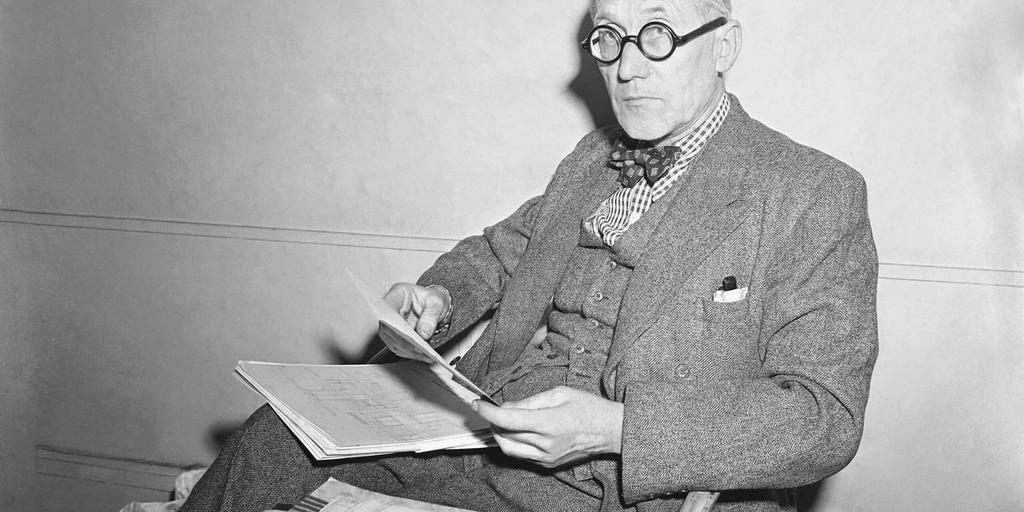
Provocative writer, gifted painter, pioneer of modern architecture, author of urban planning theories and the most formidable polemicist of the twentieth century — Le Corbusier, whose work can be seen in virtually any city in the world.
Le Corbusier: a brief biography and the key principles of modern architecture

1887
Charles-Édouard Jeanneret-Gris was born in La Chaux-de-Fonds (Switzerland). He later adopted the pseudonym Le Corbusier.
1904
Corbusier graduated from the art school and completed his first architectural project for one of the school's board members. He was seventeen and a half years old at the time.
"At seventeen and a half I designed my first house. It is simply terrible! I always go out of my way to avoid it."

1907
With the money he had earned, Corbusier left his provincial hometown and set off on an educational journey through Italy, Austria and Hungary, concluding his travels in France.
1908 – 1909
In Paris he worked as a trainee draughtsman for Auguste and Gustave Perret (Auguste and Gustave Perret), who were pioneers in their field and champions of the newly developed reinforced concrete. They later refused to call Corbusier their student, citing his "excessively radical ideas".
1910
During his two years working in Paris, Le Corbusier learned German and moved to the outskirts of Berlin to apprentice under the master architect Peter Behrens (Peter Behrens), who is often cited as the world's first industrial designer.

1911
Charles set off on another educational journey, this time heading east — through Greece, the Balkans and Asia Minor. There he studied ancient monuments and the traditional vernacular architecture of the Mediterranean.
1912 – 1916
After his travels, he returned to his home city and spent four years teaching at the school where he had studied.
During this same period, Le Corbusier designed and patented the Dom-Ino House (Dom-Ino: domus — house, ino — innovation). It was based on the concept of constructing buildings from large prefabricated elements — a genuinely pioneering step in architecture at the time. Le Corbusier later realised the Dom-Ino concept in many of his built works.
1917 – 1920
Charles had never concealed his dislike of his home city, so when the opportunity arose he moved to Paris without hesitation. There he met Amédée Ozenfant (Amede Ozenfant), who introduced him to contemporary painting. It was around this time that Le Corbusier completed his first canvas.
"I prefer drawing to talking. Drawing is faster, and leaves less room for lies."
Together with Ozenfant, he organised joint painting exhibitions under the banner of "Purism" — a movement championing restraint and waging war on eclecticism and ornament. They also founded the philosophical and artistic review L'Esprit Nouveau (The New Spirit).

1925
Le Corbusier published a new work, The Decorative Art of Today.
"In a house everything must be white. Every citizen is now required to replace their curtains, bed linen, wallpaper and everything else with white things. In cleansing your home, you cleanse yourself."
That same year, Charles conceived the Plan Voisin (Plan Voisin) — also known as A Contemporary City for Three Million Inhabitants — a proposal for the radical modernisation of Paris, which he regarded as "built at crossroads and worn down by the hooves of donkeys".
The architect planned to demolish half the city's buildings, increase the height of the new ones (to twenty storeys), create a modern road network and divide the city into a grid of squares — all in order to raise the quality of urban life.
"My task, my ambition, is to rescue modern man from chaos and catastrophe by placing him in a happy atmosphere of harmony."
1928
That year, Charles completed the Tsentrosoyuz building in Moscow — an unprecedented example, for Europe, of a solution to the problem of the modern office building.
1929
In his journal L'Esprit Nouveau, Le Corbusier published 'Five Points of a New Architecture' — a set of principles for modern architecture.
1. A house must be raised on pilotis. This frees the rooms from dampness, gives them adequate light and air, and turns the building plot into a garden that extends beneath the house.
2. Interior walls may be placed wherever required: the layout of one floor is independent of any other. There are no load-bearing walls — only partitions of whatever strength is needed.
3. The façade projects forward from the structural framework. It thus loses its load-bearing function, and windows can extend to any length without any direct relation to the internal divisions of the building.
4. The ribbon window, into which individual window openings merge, is essential. It not only improves the lighting of rooms but also creates a geometric pattern across the façade.
5. The top of the house must have a flat roof-terrace with a garden, 'returning' to the city the greenery displaced by the building's volume. Drainpipes are housed inside the building.
Le Corbusier did not indulge his clients with decoration. Colour was the only form of ornament he permitted.

For many young architects of the 'new movement', the set of principles became a point of departure in their work, and for some a kind of professional credo.
Villa La Roche (Villa La Roche) and Villa Savoye (Villa Savoye), designed by Le Corbusier, are vivid illustrations of these principles.
The Villa La Roche has housed the Fondation Le Corbusier since 1968, which is dedicated to preserving and promoting the architect's legacy.
Villa Savoye was abandoned by its owners 75 years ago, worn down by a relentless battle with leaks. The villa is now a listed architectural monument.
1940
Reconstruction work began in France, and the authorities invited Le Corbusier as a planning architect. He drew up plans for the reconstruction of the French cities of Saint-Dié and La Rochelle, following his concept of the 'green city'.
1946
Le Corbusier built the Manufacture Claude et Duval — a four-storey block containing production and office spaces, with fully glazed façades.
The construction made use of brise-soleils (rise-soleil) — special external shading structures protecting the glazed façade from direct sunlight, invented by Charles himself. From this point on, the brise-soleil became a hallmark of Le Corbusier's buildings, serving both a functional and a decorative purpose.
1948
Le Corbusier developed the Modulor, a system of proportioning in architecture based on the golden ratio and the proportions of the human body. In devising the system, Charles identified three anatomical reference points: the top of the head, the solar plexus, and the tip of a raised hand.
The architect himself described it as "a range of harmonious proportions commensurate with the human scale, universally applicable to architecture and mechanics."

1950
The Indian authorities of the state of Punjab invited Corbusier and other architects to design the state's new capital. The project became the most ambitious of his career.
Among its most accomplished and original works are the Palace of Assembly, the Palace of Justice and the Open Hand Monument.
1952
A new period begins for Corbusier: he moves away from asceticism and purist restraint. His work is now distinguished by rich plastic forms and textured surface treatments.
The Unité d'Habitation became one of the best-known projects in this new manner. It is a residential apartment building in Marseille, set within a generous landscaped site.
Most of the communal spaces are designed for the rooftop, which accommodates a garden, a running track, a club, a nursery, a gymnasium and a small pool. Shops, medical facilities and a small hotel are located within the building itself. This structure, which Corbusier called a "city within a city", is spatially and functionally optimised for its inhabitants.
The project was conceived as an experimental dwelling built around the idea of collective living — a kind of commune.
"I have the honour, the joy and the satisfaction of presenting to you a residential block of ideal proportions, an exemplary model of contemporary living space."
1950–1960
Corbusier designs a series of buildings that consolidate his reputation as Europe's foremost avant-garde architect.
The most significant among them:
The Chapel of Ronchamp
The atheist Le Corbusier took on the commission on condition of complete creative freedom. His inspiration came from a large shell he found on a beach, which struck him as the perfect expression of absolute shelter.
The La Tourette Monastery complex
The building is constructed in a rectangular form with an interior courtyard, divided by covered galleries.
The National Museum of Western Art in Tokyo
Nineteen years after construction was completed, Le Corbusier's student Kunio Maekawa added several additional spaces to the museum.
1965
Corbusier died at the age of 77. He drowned while swimming, apparently due to a heart attack. This occurred near Cap Roquebrune, where he lived in his summer retreat Le Cabanon, measuring 15 sq m. Le Cabanon is a tiny residence built as a model of minimal dwelling according to Corbusier's principles.
Youth and good health guarantee the ability to produce a great deal, but it takes decades of experience to produce well.
2003 - 2006
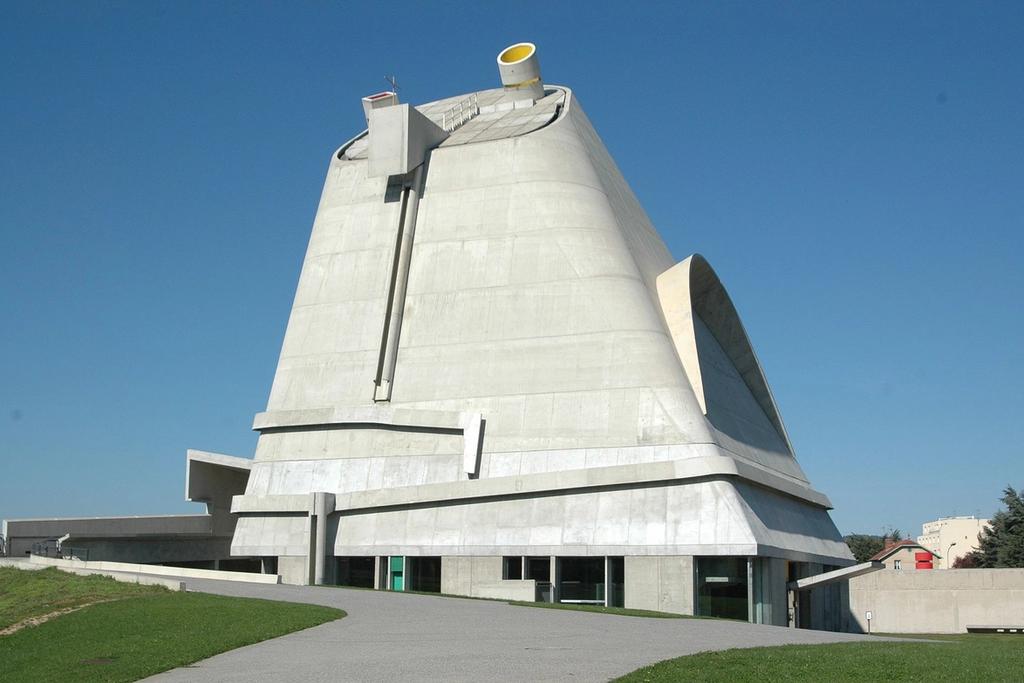
José Oubrerie — a student of Le Corbusier — completed the construction of the Church of Saint-Pierre de Firminy, whose plan the great architect had drawn up as early as 1963. At the time, a lack of funds led to the project being frozen. José never gave up hope of seeing it finished, and in the early 1990s he established a foundation to raise money. Construction resumed in 2003.

More works by Le Corbusier
Photographs: Anna Armstrong (Anna Armstrong), Montse Zamorano (Montse Zamorano), FO Travel, Tomo Yasu (Tomo Yasu), official website of Le Corbusier.
Parallels between the work of Corbusier and Russian architect Alexander Zhuk can be found in our article about the state residence K-2 in St. Petersburg.
You may also be interested in biographies of:
— Henri Cartier-Bresson — a legend of street photography
— Zaha Hadid — one of the most celebrated architects of our time
— Dieter Rams — Braun's industrial designer