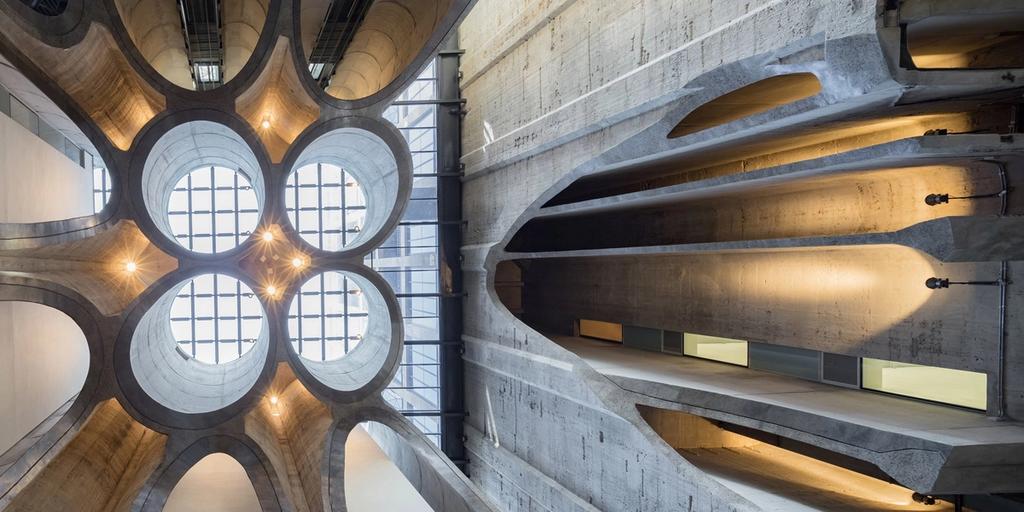
Thomas Heatherwick (Thomas Heatherwick) created the largest art museum in South Africa. The building was essentially carved out of a former grain silo; extended and modernised, it now evokes the appearance of a honeycomb or a network of burrows.


British designers have described it as the most tubular building in the world, owing to the structural elements that resemble tubes, and the Zeitz Museum of Contemporary Art Africa — or Zeitz MOCAA — has become the world's most significant exhibition space dedicated to African art.
The museum occupies a grain silo built on the Cape Town waterfront in the 1920s, which was once the tallest building in the city. Thomas Heatherwick and his team carved out large sections from the structure's tubular interior to create an intricate network of 80 galleries.


"Our role was more about destruction than construction"
"It felt like archaeology — like excavating gallery spaces — but we didn't want to completely eradicate the tubular quality," says Heatherwick. "We realised we needed to do something that the eye couldn't instantly predict. Our role was more about destruction than construction, but it was a confident destruction — without regret and without reverence for the original structure."
The museum is one of several buildings created by Heatherwick Studio within the former grain silo complex, which forms part of the V&A Waterfront development, alongside a marina, hotel, bars and restaurants. The creation of Zeitz MOCAA was, however, the most complex element of the entire redevelopment; it is centred on a vast atrium rising 27 metres in height.
The architect describes the building as an "arched cathedral". Thomas Heatherwick recognised that the tubular structure was not an immediately obvious form for a museum, so the challenge facing the architects was to preserve the building's original character while adapting it for use as a gallery.
Where the tubes were cut, the edges were polished to create a visible contrast with the rough surface of the old concrete. Glass was also introduced — patterned and textured to resemble a tortoiseshell — designed by African artist El Loko, resulting in a mirrored finish.


The total exhibition floor space amounts to 6,000 sq. metres, with the atrium providing access to every gallery.
The faceted panels set within the concrete frame, mentioned earlier, draw light down into the atrium and add a kaleidoscopic visual effect. "You look at them and they reflect you, but the side panels reflect the mountain, the other side reflects Robben Island, and the top panels reflect the sky," says Heatherwick.
More articles about museums from around the world:
— The Cité de l'Océan et du Surf in Biarritz
— The BMW Museum in Beijing by architecture firm Crossboundaries
— The Lune Museum — a home for works of art by Atelier Deshaus