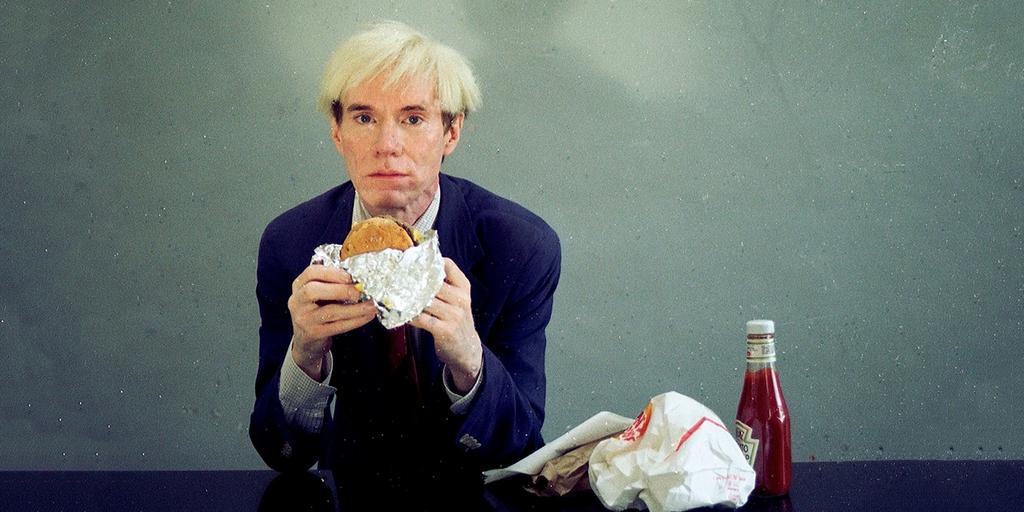
Andy Warhol's life reads like a film script that simultaneously repels and fascinates. It is no coincidence that Warhol was nicknamed 'Drella' — a portmanteau of Cinderella and Dracula. Burdened with an enormous number of complexes, shunning intimacy while craving it desperately, Andy was always surrounded by an entourage: admirers, people who saw in him a friend, a free psychiatrist, or a ticket into the scene.
In this article we offer a glimpse into the biography of arguably one of the most celebrated figures in twentieth-century graphic design — artist and pop art icon Andy Warhol.

Childhood and early years in New York
Andrei Warhola (Andrew Warhola) was born in 1928 in Pittsburgh to a family of immigrants from Czechoslovakia. He was the third son of Ondrej and Julia, and was deeply attached to his mother. This attachment became especially apparent when Andy fell ill with rheumatic chorea, a condition marked by muscle weakness, impaired coordination, and heightened emotionality. An already insecure boy, he became even more withdrawn, and developed an acute, near-panicked fear of doctors and hospitals.

As a child, Warhol suffered three nervous breakdowns that forced him to spend his summers at home. He recalls this in his book The Philosophy of Andy Warhol: From A to B and Back Again, which is built around telephone conversations with New York's "stone lady"Brigid Polk.
"Mom always told me not to worry about love and just to make sure I got married. But I always knew I would never get married, because I don't want to have children — I don't want them to have the same problems I have. I don't think anyone else deserves that."

Andy graduated from the Carnegie Institute of Technology in his hometown of Pittsburgh, receiving a Bachelor of Fine Arts in graphic design in 1949. He had no close friends at the institute, but a handful of acquaintances with whom he set off for New York to make a career as an illustrator.
In his early days in New York he moved through many apartments, sharing them with other artists. He sought out commissions on his own, worked frequently through the night, and within a year had become an in-demand designer. His clients included such brands as Columbia Records, Glamour magazine, Harper's Bazaar, NBC, Tiffany & Co., and Vogue.
Magazine covers and pages, 1948–1984
Andy had been making simple paintings and collages since childhood. In the 1950s, when Warhol was in his early twenties, he began pursuing his creative work in earnest alongside his commercial commissions. It was around this time that his mother moved in with him to look after him. In Andy's first New York apartment, the two shared a bedroom. Julia lived with Andy until 1971, when she herself needed care and Warhol sent her back to Pittsburgh to live with his brothers.
While working in advertising, Andy met the film director and former art agent Emile de Antonio. "De," as Andy called him, introduced Warhol to contemporary art, encouraged him to paint more and even appraised several of his works. He connected Andy with influential figures who were able to see past the commercial surface and recognise the art in the young painter's work. They reviewed his paintings and helped organise exhibitions.
Warhol was obsessed with the handsome, successful novelist and playwright Truman Capote and tried every means he could think of to attract his attention. In 1952, his first exhibition — Fifteen Drawings Based on the Writings of Truman Capote — was held at the Hugo Gallery; Capote, contrary to Andy's hopes, did not attend. Three years later the show was presented at the Museum of Modern Art in New York. Capote himself spoke of Andy this way: "Just a hopeless born loser, the loneliest, most friendless person I have ever seen in my life."
The creative breakthrough, Pop Art, and the Factory
The 1960s were among the most fertile years of Warhol's creative life. By that point he had become a recognizable figure in the advertising world and had developed a distinctive graphic style. Drawing on that experience, he began depicting comic strips, food products and everyday consumer goods — the kind of things the average American encounters almost every day. Andy created an entire series of paintings in which the same image is repeated many times over: Eight Elvises, thirty-two Campbell's soup cans. While working on the soup painting, Andy said he was painting what he himself liked best.
One evening, when I had been asking ten or fifteen people for new ideas, a friend of mine finally asked me the right question:
But what do you love most yourself?
That's how I started painting money.
Andy began work on the Marilyn Diptych just one week after the superstar's death. Using silkscreen printing, he transferred fifty images of Monroe onto the canvas — some rendered in vivid colour, others in black and white. Warhol was among the first artists to use the silkscreen process. Initially he made the screens himself; later he began projecting images directly onto the canvas. What might at first glance have seemed like soulless mechanical reproduction was, for Andy, an opportunity to stop wasting time drawing an object and instead work with it directly, transforming it on the canvas itself.
During this period Andy fashioned a persona for himself — one that would go on to help him manage his insecurities and sense of inadequacy for many years to come. That persona was built on the exaggeration of his own perceived shortcomings. A man afraid of his own appearance and manner of speaking made both work in his favour. Olivia Laing writes about this in her book The Lonely City: Adventures in the Art of Being Alone:
Rejected by galleries for being too mannered, too queer, he added still more femininity to his gestures, his fluttering hands, his light, bouncy gait. He began wearing his wigs slightly askew — to draw attention to their presence — and exaggerated his awkward way of speaking: he mumbled now, when he opened his mouth at all.
Many in New York's bohemian circle disliked Warhol at the time. De explained it by saying Andy was "not a real man" — too homosexual. What was more, as an artist he allowed himself to collect art, engage in commerce and even use it to promote his own name. Andy had no intention of changing: "I'm not very masculine by nature anyway, but I have to admit that on principle I went straight to the other extreme."
Warhol always wanted to feel needed and to have real friends, yet he felt lonely — especially coming home from raucous parties. His television became a consolation, absorbing Andy's attention completely. Meanwhile, more and more people began to see in Warhol a source of support, a free therapist always ready to hear their troubles. In reality, Andy was often listening to the television rather than to his companions' outpourings.
Warhol's apartment could no longer contain his rapidly expanding creative output, so he began looking for a new space and assistants. In 1963 Warhol opened a new studio and named it the Factory. There he turned silkscreen painting into a production line. Warhol would photograph his "superstars" on a Polaroid, select the best shot, enlarge it and transfer it to canvas using silkscreen. Andy wanted to make the subjects of his portraits perfect — as in advertising: no wrinkles, no blemishes, no double chins, no shadows. Many people worked on production at the studio. Warhol himself described it this way:
I usually worked from ten in the morning until ten at night, slept at home and came back in the morning, but the people I had left the evening before were still there, just as lively as ever, still with Maria and the mirrors. That was when I began to understand just how crazy people could be.
The Factory
In 1964, the Factory was unveiled at a launch party that was equal parts spectacle and exhibition, featuring Warhol's art objects — cardboard boxes, washing-powder packaging and the like. From that moment on, Warhol became a permanent fixture in the society columns, and the Factory became the favourite haunt of New York's bohemian set.
In the studio, Andy acquired the nickname 'Drella' — a portmanteau of Dracula and Cinderella. At times Drella was an emotional vampire, draining the energy of everyone around him; at other times he was a kind, if slightly unnerving, companion.
Often, when Andy was not working, he would simply sit behind a camera reading a newspaper and start filming whenever something interesting began to happen. He rarely spoke himself; he loved it when new faces arrived, asking them questions like 'Where did you get that dress?' or 'Who did your make-up?' and laughing a great deal. People came to the Factory hoping to find themselves, but in practice they tended to lose themselves even further.
'I think he enjoyed the circus. He liked being the one in command,' — Liz Derringer, music journalist
Fearful of close contact with other people yet desperately craving it, Warhol — who had initially used the television as a shield against becoming too deeply drawn into other people's problems — found a new device: the tape recorder.
'But I didn't get married until 1964, when I got my first tape recorder. My wife. My tape recorder and I have been married for ten years now. When I say we, I mean the tape recorder and me. A lot of people don't understand that.'
In his memoirs, Andy writes that the tape recorder 'put an end to whatever emotional life I might have had.' Problems could now be recorded on cassette and thereby exhaust themselves. Although being 'on tape' was less useful for Andy than for those who wished to share their pain with him, there were occasions when Warhol actually paid for stories told onto the reel.
'An interesting problem became an interesting tape. Everyone knew this and played their roles for the recording. And you could never tell which problems were real and which had been inflated for the tape.'
From the cassettes he had accumulated, Warhol conceived the idea of creating the novel 'a' and hired typists to transcribe the recordings. The resulting work was utter nonsense: it was impossible to tell who was speaking, whether the typists had omitted certain passages for one reason or another, or where the action was taking place. The novel was published in 1968 and was a commercial failure.

The Factory endured for more than twenty years, becoming a second home to an extraordinary number of musicians, journalists, photographers, models, film actresses and New York bohemians. Andy was the beating heart of this organism pulsing with creative energy.
American photographer Stephen Shore spent three years at the Factory photographing Andy and his circle. The photographer was just seventeen years old and regarded the studio as the finest art school imaginable.
'I was taking Obetrol to lose weight, in doses prescribed by my doctor, but even that was enough to keep me slightly wired all the time — with that light, happy feeling in the stomach when you just want to work and work and work. So I can only imagine how those who were seriously on it must have felt.'
The collaboration with The Velvet Underground and vinyl artwork
Alongside artists, photographers and other 'superstars', the Factory was frequently visited by well-known musicians such as Bob Dylan, Mick Jagger and Jim Morrison.
In 1965, Andy Warhol became the manager of The Velvet Underground. Andy suggested the group take on his protégée Nico as a vocalist. The collaboration lifted the band to a new level. In 1967 their debut album "The Velvet Underground & Nico"was released, with cover art designed by Warhol himself. After Andy's death, the band's key figures — Lou Reed and John Cale — recorded an album in his memory: Songs for Drella (Songs for Drella).

The Velvet Underground cover was far from the only one Andy designed for vinyl. He also created sleeve artwork for The Rolling Stones, Diana Ross, Kenny Burrell, and other leading bands and artists of the 1960s through the 1980s.
Filmmaking and Interview magazine
Between 1963 and 1968, Warhol tried his hand at filmmaking, beginning with pseudo-documentary work before moving on to narrative films. The films were most often erotic in nature and carried a homosexual subtext. Warhol also sought to invent a new kind of cinema by shooting what he called "static film". Among Andy's best-known films are Lonesome Cowboys, I, a Man and Poor Little Rich Girl.
"In my early films I was really trying to show how people can meet each other, what they can do and what they can say to one another. That was the whole idea: two people meeting. And then when you watched it and saw how simple it all was, you understood the meaning of the whole thing. My films showed how some people behave in response to other people. They were a kind of genuine sociological document"
During those years Andy found his muse — Edie Sedgwick. He frequently cast her in his films; they went out together and were, for a time, nearly inseparable. The young socialite called herself "Mrs Warhol". Their creative relationship ended as abruptly as it had begun — whether because of Sedgwick's drug use or her infatuation with Bob Dylan.
In 1969, Warhol founded Interview magazine, built around conversations with figures from the art world. Superstars interviewed superstars, which meant the texts often had no clear structure and resembled society small talk more than formal interviews.
Personal life
Andy Warhol was openly gay. In 1980 he told his biographer that he was a virgin — a claim that was later disputed, but one that once again illustrated Warhol's ambivalent attitude towards sex and love in general.
"I prefer long-term relationships. The longer, the better. Love and sex can coexist — you can have sex without love and love without sex. But love on its own and sex on its own are not good. You can be just as faithful to a place or a thing as to a person. Your heart can leap when you approach a favourite place, especially if you're flying there by plane"
More and more people in Andy's circle were being diagnosed with AIDS. Warhol's fear of the disease was compounded by a general phobia of doctors and everything associated with hospitals. So when his friends and former lovers began falling ill and dying from AIDS one by one, Andy wasted no time in cutting off any contact that posed even the slightest risk of infection. It should be noted that Warhol was equally afraid of contracting cancer, pneumonia, a brain tumour, or any other illness.
"Just as having sex is hard work, so is having a gender. I don't know which is hardest: (1) for a man to be a man, (2) for a man to be a woman, (3) for a woman to be a woman, or (4) for a woman to be a man. I honestly don't know the answer, but judging from what I've observed, it seems to me that men who are trying to be women think they have the hardest time of all"

Valerie Solanas's assassination attempt and recovery
Radical feminist Valerie Solanas, author of the "SCUM Manifesto" (the Society for Cutting Up Men Manifesto), was a regular presence at the Factory. Warhol was drawn to her singular personality and even cast her in one of his films. On 3 June 1968, Solanas came up to Andy's office at the Factory and shot him in the stomach three times. Shortly afterwards she turned herself in to the police, saying: "The police are looking for me. I shot Andy Warhol. He had too much control over my life." Solanas refused to offer any further explanation, even at her trial, pointing instead to the manifesto in which she had laid out in detail her view of men as "worthless pieces of shit."
Warhol was resuscitated from clinical death; several of his internal organs had been severely damaged and required removal. Andy underwent surgery and survived, but was forced to wear a surgical corset for the rest of his life.
In The Andy Warhol Diaries, his typist Pat Hackett recalls Warhol during his recovery: "Every time Andy met up with friends after the shooting, he had this expression on his face as if he himself was utterly amazed to have survived and to be seeing them all again… At some point, still in hospital, before the doctors had managed to bring him back, Andy had been in a semi-conscious state and heard them discussing whether he had finally gone 'to the other side' for good — and so after June 1968 he counted himself among those who had, officially speaking, 'come back from the other side.'"

Friendship with Jean-Michel Basquiat and death
Jean-Michel was as eager to meet Warhol as Andy had once been to find friends in the art world. They met at a café, where Basquiat talked Andy into buying one of his works. "He's one of those kids who drive me crazy," Warhol wrote of the encounter. They were not only friends — they went for manicures together, went out to parties together — but they also made a great deal of work and painted side by side. The partnership suited them both: one found himself a young, energetic protégé, the other a world-famous patron. Headlines appeared in the press along the lines of "Who's using whom?" — something that cut both artists deeply.


Their friendship coincided with yet another wave of AIDS in New York. Andy worried deeply about his friend, who was heavily dependent on drugs and led a sex life that Warhol found difficult to comprehend. The virus never touched Andy, but he died first, and Basquiat spent the remaining year and a half of his life in the deepest depression.
After the shooting, Warhol's old hypochondria returned: he bought a bulletproof vest and once again developed a near-phobic fear of doctors. Fear of hospitals caused him to put off a bladder operation. At the age of 58, on 22 February 1987, Warhol died in his sleep following surgery.
In his apartment an enormous collection of miscellaneous objects was discovered: magazine clippings and postcards, figurines, paintings, clothing and diamonds. The collection was sold at Sotheby's for $25.3 million.
Andy Warhol's Polaroid photographs
Andy's Short Films

Recommended Reading
- Olivia Laing: The Lonely City: Adventures in the Art of Being Alone;
- Valerie Solanas: SCUM Manifesto;
- Pat Hackett, Andy Warhol: The Andy Warhol Diaries;
- Andy Warhol: The Philosophy of Andy Warhol (From A to B and Back Again);
- Andy Warhol, Pat Hackett: POPism.
Follow us on social media so you never miss new content: VKontakte, Telegram — @loskomagazine.