The artistic journey of Vladimir Tatlin is marked by both triumphs and decline. He suffered from mental illness throughout his life, with prolonged periods of depression giving way to bursts of unbridled creative energy. This emotional instability and inconsistency bred in Tatlin a careless attitude toward his own work: a significant portion of his legacy was lost during his own lifetime.
Even so, Vladimir Tatlin stands as one of the leading figures of the Russian avant-garde: his mastery rested on a drive toward radical transformation and the courage to reject artistic dogma. He was also a virtuosic painter and draughtsman — his works are distinguished by the precision of his sketching and a confident command of composition.
In this article you will learn:
- how Vladimir Tatlin competed with Kazimir Malevich for leadership of the Russian avant-garde
- how he came to meet Pablo Picasso
- how he turned away from painting
- what his vision of art and the artist's social role looked like
- how Tatlin organised his creative everyday life

Childhood
Vladimir Yevgrafovich Tatlin was born on 16 December 1885 into the family of a railway engineer. His mother, Nadezhda Nikolayevna Bart, died when he was four years old. His father, Yevgraf Nikiforovich Tatlin, was a diligent, disciplined man who achieved considerable professional success, travelled widely, and in 1892 was sent to America by the Ministry of Transport to write a report on the development of the American railway network. Tatlin's father was keen to instil in his son a passion for science and technology. In 1896 the family moved to Kharkiv, where his father was appointed director of a factory.
Tatlin was a remarkable fantasist who loved to mystify and dramatise his own past, which makes it difficult to separate fact from fiction in his biography. Yet certain details of his life with his parents are beyond doubt: throughout his childhood the boy was subjected to physical violence. "We wouldn't see Father for days on end, except for the moments when he would suddenly emerge from his study, belt in hand, and start beating us like prisoners." When Tatlin was eight his father remarried, and his relationship with his stepmother was troubled from the start. In his memoirs he describes how, during a meal, his father threw a fork at him for showing disrespect to his stepmother; it struck him in the eyelid and pierced his eyeball, and he only narrowly escaped losing his sight.
"At home I was always scratching away at paper with a pencil, and I loved doing it"
Tatlin's desire to draw emerged at the age of seven: "At home I was constantly scratching away at paper with a pencil, and I loved doing it." At eleven he enrolled in the Kharkov Real School, where his artistic talent first made itself known. His teacher was a graduate of the Imperial Academy of Arts and a pupil of Karl Bryullov, the most celebrated Russian painter of the first half of the nineteenth century. In his memoirs, Tatlin writes of the profound influence this teacher had on his professional formation. In his spare time the boy honed his musical skills, learning to play the guitar and the harmonium. His favourite instrument was the bandura — a plucked folk instrument associated with itinerant musicians in eastern Ukraine.

At fourteen, Tatlin ran away from home and, after a long period of wandering, ended up in Moscow. There he worked in icon-painting studios and in the scenery workshops of the Solodovnikov Opera Theatre. He frequently lacked money even for food, and his poverty forced him to maintain ties with his family. In 1902 he enrolled at the Moscow School of Painting, Sculpture and Architecture, though his studies there were short-lived — he was expelled a year later for poor academic performance. In 1904 his father died and his stepmother assumed guardianship. She placed him in the Odessa School of Navigation, where he spent a full year at sea as an apprentice sailor aboard a sailing vessel.
Formative Years
In 1905 Tatlin was admitted to the Penza Art School, which became the starting point for his creative development. From Penza he made frequent trips to Moscow, attending classes at various private studios. It was in these studios that he managed to form close ties with the most radical artists of his time. The cultivation of deep connections and the ceaseless exchange of ideas in these workshops created fertile ground for the emergence of the Russian avant-garde. After graduating from the Penza Art School in 1910, Tatlin began spending more and more time in Moscow. During the summers he worked as a sailor, travelling between cities along the Black Sea and the Mediterranean. In 1911 Tatlin visited the Tower studio in St Petersburg, a gathering place for theatre artists and poets. There he befriended Vladimir Mayakovsky and Velimir Khlebnikov, with whom he went on to forge a creative collaboration.
A shortage of funds meant that Tatlin was compelled to use the cheapest available materials in his work. Between 1911 and 1913 he produced just sixteen paintings, of which only seven have survived. Many works were lost in part because Tatlin struggled to maintain an orderly working life and treated his own output with a certain carelessness. A number of art historians have linked this neglect of his legacy to his uncompromising orientation toward the future. "Tatlin was convinced, more than any other representative of the Russian avant-garde, that the conquest of the future was the only justification for an artist's life," wrote the Dutch scholar of Russian art Sjeng Scheijen. Tatlin was driven by a constant impulse toward renewal and believed that each new discovery rendered the previous stage of development obsolete.
Among the seven surviving paintings from this period, the expressive Sailor and Fishmonger were warmly received by the artistic community and are considered among the finest works produced in Russia during those years. In the following year Tatlin painted four more portraits, including the principal work of his pre-revolutionary period, The Model. These four portraits trace Tatlin's lightning-fast evolution as a painter, demonstrating that he needed only a handful of works to move on to an entirely new artistic stage.


In 1913, Tatlin moved to Ostozhenka 37 and set up his own studio there. The studio became a gathering point for many radical artists. Tatlin had a remarkable ability to draw devoted like-minded people around him. He cherished collaborative work, as his comrades helped him through periods of deep emotional difficulty. Among those who worked in his studio were some of the most outstanding artists of the nascent avant-garde, including Lyubov Popova, Nadezhda Udaltsova and the Vesnin brothers.
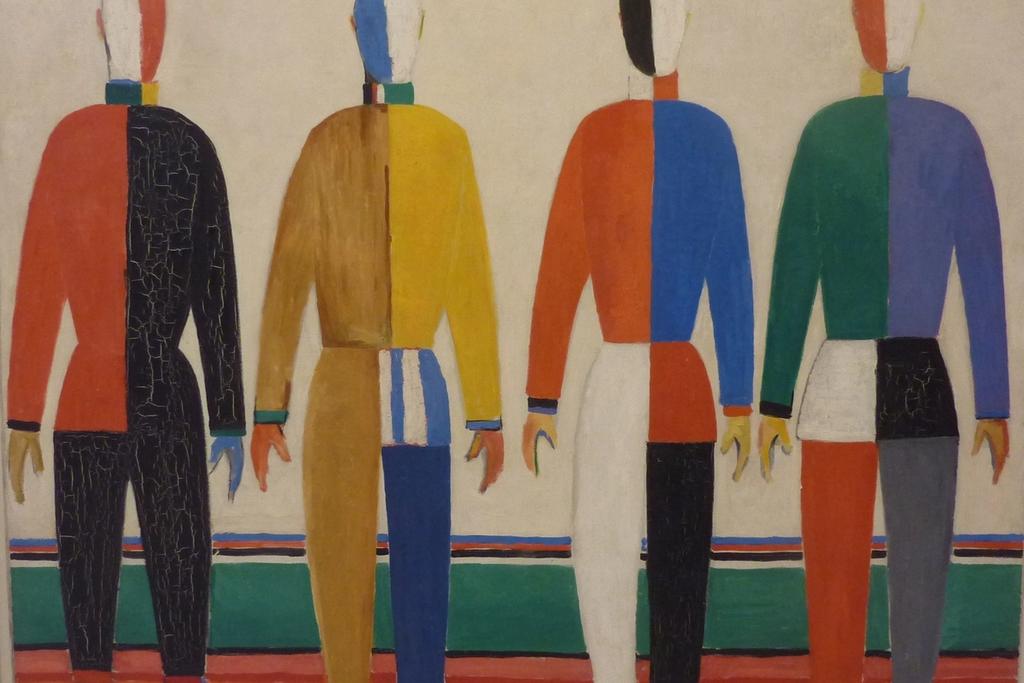
Another no less charismatic artist would occasionally appear in Tatlin's studio — Kazimir Malevich. Malevich and Tatlin had known each other for many years, had shown work together in exhibitions and were even friends. In 1913, Malevich made persistent efforts to convert Tatlin to Cubism. Ivan Klyun, an avant-garde artist and close friend of Malevich, recalled: "Malevich and I argued with him in vain, insisting that the time had come to move towards Cubism; he replied that he disagreed, that he was right, that his works were the finest in the world." Malevich took Tatlin's wilfulness as a personal affront and nursed a grievance. The tension that arose between them while working together in the studio grew into a rivalry that would last for years.


For many years Tatlin had dreamed of working in the theatre as a set designer, creating scenography for operas and plays. Beyond its creative appeal, such work could also provide financial stability. In 1913, Tatlin submitted outstanding painted set design sketches for Mikhail Glinka's opera A Life for the Tsar, but the project was not awarded to him and no further commissions from the theatre followed. That same year his rival, Malevich, celebrated a triumph with the staging of the opera Victory over the Sun. Fortune had turned away from Tatlin, and he felt an urgent need for a creative breakthrough that would consolidate his position as a leading figure.
Meeting Picasso
Russian artists' fascination with the work of the French Cubist had begun in 1911 through Sergei Shchukin's collection. Tatlin was personally acquainted with Shchukin and was a frequent visitor to his holdings. In the autumn of 1913, the French journal Soirées de Paris published a major article by the critic Guillaume Apollinaire on Picasso's work, illustrated with many of his pieces. By a fortunate coincidence, this issue fell into Tatlin's hands, and his attention was caught by Picasso's reliefs — the so-called "still lifes" made from wood, cardboard and other materials. It was precisely after encountering these reliefs that Tatlin firmly resolved to seek a meeting with their creator.
In 1913, Tatlin was offered a place on a trip to Berlin to take part in the Russian Handicrafts Exhibition — but on unusual terms: he was to perform as a Ukrainian bandura player. He later recalled: "Life was hard. I heard that they had organised an exhibition of applied folk art to travel to Berlin, and were looking for living exhibits — they needed a bandura player, a blind one preferably. I said: I can sing and play the blind man. They asked me to demonstrate. I performed. They liked it. So I sewed myself a pair of Ukrainian sharovary and rehearsed being blind. It was daunting and awkward, but I thought: with my eyes closed — I'll manage." By his own account the exhibition was a success; Tatlin claimed that visitors "touched his shirt, shook his hand and thanked him."

From Berlin, Tatlin travelled to Paris to meetPablo Picasso. Tatlin was acquainted with the community of Russian artists in Paris. Many of them worked at the artistic colony of La Ruche, which Picasso frequented. Introducing the two artists to each other was therefore straightforward. Tatlin's friend, the Lithuanian sculptor Jacques Lipchitz, brought him to Pablo Picasso's studio and introduced them. The meeting lasted several hours: the artists talked animatedly, after which Picasso gave Tatlin a few tubes of paint and the two parted on warm terms.
This encounter played an enormous role in Tatlin's sense of artistic identity. The trip to Europe finally convinced him to abandon painting and never pick up a brush again. The first stirrings of this realisation had come as early as 1911–1912: having completed a series of portraits, Tatlin understood that they no longer reflected the latest tendencies in art. Many of his colleagues had begun experimenting with abstract and non-objective painting, and against that backdrop his portraits looked dated. He felt that painting could no longer meet the demands of a new technological age, and that he needed to move on to other artistic tools. His meeting with Picasso and his encounter with Picasso's still lifes became the final turning point.
Returning to Moscow, Tatlin experienced a surge of creative energy. Drawing on what he had absorbed in Europe, he began working on abstract reliefs and three-dimensional compositions, and every day he held open studio viewings of his work in progress. These sessions attracted considerable interest and prompted many artists to break free from the constraints of painting and begin experimenting with volume. The blurring of the boundary between painting and sculpture opened up a wide range of materials for making art.

In March 1915, at the Tramway V exhibition, Tatlin presented his painterly reliefs, which surpassed even Malevich's non-objective compositions in their radicalism. Many of Malevich's devoted followers began making three-dimensional reliefs in Tatlin's wake, which only strengthened his standing within the Russian avant-garde. Malevich took a jealous view of his rival's success, and the rivalry between the two artists grew increasingly heated. Sensing his own rising authority, Tatlin became more guarded and suspicious: he stopped sharing his creative ideas carelessly and confided only in a small circle of trusted people. He even drew the curtains of his studio, afraid that passers-by might look through the window and catch sight of his work. At this time Tatlin came to understand that winning the struggle for leadership required him to disseminate his theoretical ideas through slogans, lectures and manifestos. Unlike Malevich, however, Tatlin found it difficult to articulate his artistic vision in conceptual terms. He entrusted this task to his friend, the art critic Nikolai Punin, whom he met in 1916. Punin became his loyal ally and the public voice of his work.

Tatlin's early reliefs show clear borrowings from Picasso, yet they soon became an independent and wholly original phenomenon. In the summer of 1915 Tatlin radically transformed his concept. He expanded the reliefs by introducing a variety of materials — combining metal, fabric, pieces of wood, cardboard and paper. He placed the reliefs in the corners of a space so that the viewer gained the impression these volumes were growing, forcing their way through the walls. He also decided to rename them counter-reliefs, so that the title would more precisely convey the tension and concentration of energy within them. Later, in an explanatory note on the counter-reliefs, Tatlin wrote: 'Having expressed our distrust of the eye, we place the eye under the control of touch.'
This slogan encapsulates Tatlin's central innovation: by refusing to treat visuality as the primary mode of perceiving art, he allowed the viewer a far richer and more varied experience. Moreover, the emphasis on touch suggests that the counter-reliefs were meant to be handled. Here one can trace a connection to icons, which worshippers were permitted to touch during religious services. The continuity with traditional icon painting is also evident in the colour palette and spatial arrangement: Tatlin positioned his reliefs in corners, a clear reference to the icon corner — the krasny ugol — found in Russian peasant homes.


Vladimir Lenin and the Plan for Monumental Propaganda
After the Bolsheviks came to power, many avant-garde artists were appointed to senior positions and gained the ability to shape the cultural policy of the new Soviet state. In 1918, Vladimir Lenin outlined a plan for 'monumental propaganda', which called for the demolition of monuments deemed incompatible with Marxist principles and the erection of new monuments to distinguished revolutionaries and political figures. This task was entrusted to the Department of Fine Arts, established in early 1918. When Tatlin was offered the chairmanship of the department in May 1918, he accepted without hesitation: the role of a state official would substantially extend his influence. He was charged with erecting several dozen monuments to Communist heroes in time for the October celebrations marking the anniversary of the Revolution.
Tatlin set about fulfilling his administrative duties. He drew up a list of proposed monuments and submitted it to Lenin, but immediately ran up against the chaos of Soviet bureaucracy. The haphazard, poorly organised functioning of many essential institutions severely slowed the process of obtaining official approval for projects. Tatlin was often forced to work late into the night, filling out minutes and resolutions. His one source of support during this period was his companion Sofya Dymshits-Tolstaya, with whom he had been living since 1917. She handled paperwork, planned budgets, organised payments and received visitors.

Despite all these difficulties, Tatlin managed to present thirty monuments at the October celebrations. The tight deadlines and pervasive shortages made it impossible to use expensive materials: concrete, cement and even plaster had to suffice. Wary of criticism from Lenin and the Department of Fine Arts, Tatlin was compelled to abandon the more radical proposals. One monument, however, proved to be an exception — Boris Korolev's monument to the anarchist Mikhail Bakunin. Erecting this sculpture at Myasnitskie Vorota was an extraordinarily bold and audacious act that drew public attention and provoked deep displeasure among officials. Lenin was furious: 'How could this decadent rubbish have been allowed onto our proletarian streets? Who needs these forms that say nothing to the viewer?' The monument did not stand for long — in March 1920 it was dismantled on the orders of the Moscow Soviet.
Tatlin's Tower
Following the October celebrations, Tatlin was removed from the chairmanship of the Department of Fine Arts in the wake of the Bakunin monument scandal, and in the winter of 1919 he took up a teaching post at the free art studios. Moscow was gripped by famine — there was a shortage of firewood to heat the studios, and often nothing to eat. Tatlin had to encourage and inspire his students during classes. 'On certain days of the month, Vladimir Yevgrafovich would enter the studio with a loaf of black bread tucked under his arm… he would pull a knife from his boot and cut each of us a thick slice of bread, sometimes handing out an onion as well, saying: "Your work is hard and serious, so this is to keep you going."' In moments of good cheer, Vladimir Yevgrafovich would recite poetry by Khlebnikov and Mayakovsky, and sometimes play the bandura,' recalled one student, describing life in the studio. During classes, Tatlin shared his vision of a utopian future that was just around the corner: 'Our houses will gleam like diamonds, and diamonds will be used to cut glass.'
In the late summer of 1919, Tatlin was appointed head of the free art studios in Petrograd, and he moved there in early September. In his new post, Tatlin intended not only to teach: it was in Petrograd that he planned to realise his ambitious tower-monument project, which he had conceived during his work on the 'monumental propaganda' plan. To this end, he secured a suitable studio in the former mosaic workshop of the Academy of Arts.

In March 1919, Nikolai Punin, drawing on conversations with Tatlin, published an article titled 'On Monuments'. In it he described a monumental project for a structure that, unlike Lenin's 'monumental propaganda', would celebrate not individual feats and their heroes but the unified revolutionary spirit. The concept of the monument traced its roots to an Old Russian tradition: in the pre-Petrine era, the Orthodox Church prohibited the placing of sculpture in churches and public spaces, so it was commemorative structures — cathedrals and chapels, for instance — rather than statues that served as monuments. Tatlin's monument was thus conceived as a building that would give voice to a new utopian reality.
In his article, Punin focused on the tower's practical applications rather than its outward form: the monument was to consist of 'the simplest geometric shapes — cubes, cylinders, spheres and cones… Some of the simplest forms (cubes) should accommodate lecture halls, gymnasiums, agitation halls and other spaces that could be put to various uses as needs arose; these spaces, however, must by no means become museums, libraries and the like, since it is desirable to preserve the continuous demand for these halls. The monument would furthermore house an agitation centre from which appeals, proclamations and pamphlets of various kinds would be distributed throughout the city; specially designated motorcycles and automobiles of a single approved type, bearing the monument's insignia, could serve as a highly mobile and ever-ready agitation apparatus of the government; to that end, the monument would have its own garage…'
'Furthermore, let us suppose that one of the monument's broad wings must carry a giant screen which, during the evening hours, would relay — by means of a cinematographic reel — the latest news from the cultural and political life of the world, visible from a great distance. With a view to direct information, the monument would house its own world-scale radio receiver, its own telephone and telegraph station, and any other available means of communication. At the same time, in light of the inventions made in recent times, the monument should incorporate, within one of its component forms, a projector station capable of casting luminous letters onto the clouds; from such letters one could compose whatever slogans the events of the day might demand.'
'The monument might also contain a number of smaller centres, primarily artistic in purpose — spaces for new artistic inventions, a printing press, perhaps a canteen, and so on.' With this publication, Punin hoped to secure political support for the project's realisation, although its practical application had never been Tatlin's priority. It seems he was entirely unconcerned with the feasibility of his tower: he brought no engineers into the design process, relying solely on his own efforts and artistic vision.
From early 1919, Tatlin worked on producing drawings, and by the summer of that year the monument's final concept had taken shape. The tower was an open structure supported by a metal framework, inside which four glass volumes were suspended, each intended to house different institutions. Every volume was to rotate on its own axis, like celestial bodies. A connection to the cosmos was embedded in other elements as well: the tower's height of four hundred metres was not chosen arbitrarily — it is a multiple of the Earth's meridian — and the angle of the structure is parallel to the tilt of Earth's axis. This lean lends the building a sense of dynamism and speaks to its inner kinetic energy, as though the structure were being thrust out of the ground. Tatlin's tower is often compared to Eastern architecture — El Lissitzky, for instance, in his book 'Russia.
Reconstruction of Architecture in the Soviet Union states that Tatlin drew on the spiral form of the monument after being inspired by the pyramid of the Assyrian king Sargon II at Khorsabad, located in present-day Iran. Tatlin named his tower the Monument to the Third International, proclaiming an international union of workers in the struggle for world revolution.

In late 1919, Tatlin presented his project to the People's Commissariat and was commissioned to exhibit a model of the tower at the October celebrations of 1920. The artist settled into his studio and set to work without delay. He turned to his Moscow students for help, and they came to Petrograd to take part in the construction. Sofya Dymshits-Tolstaya, Tatlin's faithful companion, continued to support him as ever. She was responsible for making the tower's geometric volumes.
Tatlin created an inspiring, energised atmosphere in the studio. Every day a group of friends gathered around him, ready to offer their help without any expectation of reward. The conditions were spartan: the studio had neither tables nor chairs, and Tatlin and his assistants had to eat on the floor at the base of the tower. Punin, after spending a day in the studio, wrote of how Sofya Dymshits-Tolstaya cooked a pot of porridge for everyone: "They eat as if on a ship's deck, like 'the dregs of society', snatching food from one another with hands that, from all the work, could bend horseshoes. I take no part in it — I simply haven't the strength, and I declare myself a delicate creature. They polish off an entire pot, which again is of no interest to me, but it's as merry as a nursery at home. They joke as hard as they can, with all their might, about painting, art, modernism and so on. If a patch doesn't fit the batten for someone, they cry out with laughter — modernism! — while Tatlin admonishes them, slowly and gravely: 'Never mind, comrades, that's his graphic form from the World of Art; let the scoundrel work a bit more and he'll start doing better.'"


After several months the model of the tower was complete, and it differed markedly from the original drawings: it had turned out far more asymmetrical, the lattice framework was more closely spaced, and the lower cube had been replaced by a cylinder. The resulting structure was not a reliable architectural maquette but rather a sculpture — an autonomous work of art in its own right. The model was exhibited at the House of Unions, where it was the most striking exhibit and attracted considerable press attention. Tatlin and his assistants were present at the display and answered journalists' questions. The tower was described on the front page of Izvestia as a "gigantic, mind-bending construction of iron and glass."
The tower provoked a wave of varied responses. The critic Viktor Shklovsky described it as a "monument of iron, glass and revolution": "Days rush past like carriages crammed with strange and diverse vehicles, cannons, crowds of people clamouring about something. The days thunder like a steam hammer, blow after blow, and the blows have already merged and ceased to be heard, just as people living by the sea no longer hear the sound of water. We live in the silence of a roar. In this paved air, the iron spiral of the monument project was born." The historian Konstantin Miklashevsky criticised the tower for its impracticality: in summer, the glass enclosures would heat up "like greenhouses for growing pineapples." After the German newspaper Frankfurter Allgemeine published news of the tower, word spread across Europe. Tatlin's experiment became enormously popular among European artists and intellectuals. Dutch newspapers wrote of "a new Tower of Babel that the Bolsheviks intend to erect," for which Tatlin "draws his inspiration directly from the world of machines. He is not afraid to show his mechanical heart." In the summer of 1920, at the art fair in Berlin, the Dadaist artist Raoul Hausmann presented his collage Tatlin at Home, in which the artist's studio appeared as a scientific laboratory and his brain as a complex mechanism. At the same exhibition, two other Dadaist artists, John Heartfield and George Grosz, held up a placard reading "Art is dead. Long live Tatlin's machine art."

It was George Grosz who had the fortune of meeting Tatlin in person during his journey through Russia in 1922. In his memoirs he described their encounter in detail, noting how strikingly Tatlin in life differed from the visionary image of him that had been constructed in the West: "I visited Tatlin again, that lanky buffoon. He lived in a tiny, old, dilapidated flat. The chickens he kept slept on his bed. In one corner they laid their eggs. We drank tea while Tatlin chatted about Berlin. Behind him, against the wall, stood a thoroughly rusted bed of steel wire, on which several chickens slept with their heads buried in their feathers. Such was the setting in which the good-natured Tatlin lived, and when, standing before an uncurtained window — its panes partly replaced by small bread boards — he played his homemade bandura, he was not in the least like an ultra-modern Constructivist; he was a piece of the real old Russia, as though he had stepped straight from the pages of Gogol, filling the room with melancholic humour. I never saw him again, nor heard anything more of the so widely discussed Tatlinism."
The excitement surrounding Tatlin and his tower continued in Europe for a long time. The Bolshevik leadership took notice of this intense Western attention to the artist. At the invitation of the critic Lunacharsky, Lenin himself came to see a demonstration of the monument in action. The model had no motor, and Tatlin's assistant had to hide beneath the structure and rotate the glass volumes by hand. The demonstration, however, was a failure: "Lenin arrived, they started turning it, but something got stuck and nothing worked out. Vladimir Ilyich looked on, said nothing, and left" — recalled the artist Valentin Kudrov. Before Lenin's visit, Tatlin had still hoped to secure approval for the project from the People's Commissariat of Education, but in its wake the party officials flatly refused to sanction construction, citing a lack of funds.
Tatlin believed that the model of the monument would remain permanently in the House of Unions. However, he was unable to secure political support within the People's Commissariat of Education, and in early 1923 he received the sudden news that the tower was to be demolished. The unceremonious destruction of his most ambitious project triggered a new crisis in Tatlin's creative life. His situation was further complicated by his separation from Sofya Dymshits-Tolstaya. "Tatlin is at an impasse and has been despondent for about two years now," Nikolai Panin notes in his diary.
The theory of "material culture"
In 1922 the free art studios where Tatlin had continued to work since 1919 were disbanded, and he took up a teaching post at the Museum of Artistic Culture in Petrograd, becoming its unofficial leader. His new circle consisted largely of avant-garde artists — friends and fellow travellers — which allowed him to cultivate a comfortable environment for creative experimentation. He founded an artists' group, the Union of New Trends in Art, with whom he organised exhibitions and delivered lectures and manifestos.
The years spent working on the Tower became a period of creative rethinking for Tatlin. He began to develop his idea of 'material culture'. In contrast to Malevich's suprematist, non-objective theory, the central task of the artist in Tatlin's conception was to reveal to the viewer the beauty and essence of visible, material reality — a reality that had grown distant from human experience through industrialisation and technological progress. Where Malevich's works were intended as portals into an immaterial world of abstractions, Tatlin's projects did the opposite, focusing attention on physical presence in space. He also entered into dispute with the Constructivists, who held an exclusively utilitarian view of art. He maintained that 'purely artistic forms must be combined with utilitarian ends'. In Tatlin's thinking, the artist became an 'investigator of the material', with 'material, volume and construction' serving as the foundations of creative work.

These theoretical discoveries led Tatlin to develop a range of everyday objects — among them a series of practical 'normal clothing'. The series included a suit composed of a main section and detachable elements (pockets and linings) that allowed it to be worn in different seasons. Also worth noting is his universal kitchen set, which could be transformed into a frying pan, a saucepan and a kettle by means of interchangeable attachments. The popular magazine Krasnaya Panorama published an article titled 'The New Everyday Life', setting out Tatlin's experiments and featuring detailed illustrations alongside a photograph of the artist wearing the normal suit. One might assume that in these projects Tatlin had abandoned his principles and surrendered to a utilitarian view of art. Yet behind these domestic objects lies not a celebration of some imminent utopian future, but the artist's modest hope for comfort in the face of the catastrophic shortages of the post-revolutionary years. Nikolai Punin wrote in his diary about preparatory work on a film in which Tatlin was to set out his sweeping vision of everyday Soviet life. The film never materialised, however, and all the optimism and creative energy once again dissipated.

Zangezi
Tatlin was shaken out of his creative stagnation by the news of the sudden death of Velimir Khlebnikov — his close friend and collaborator, who had played a significant role in his life. Throughout his poetic career Khlebnikov had remained true to himself, guided entirely by his own worldview rather than by the expectations of his audience, and for the anxious, restless Tatlin he had come to serve as a creative compass. The news of his death prompted Tatlin to pay tribute to his comrade by staging a theatrical production of Khlebnikov's final work, Zangezi — a narrative poem about the adventures of the prophet Zangezi, written in the transrational language of zaum.

Work on Zangezi marked a new stage in Tatlin's career, one comparable in significance to the construction of the Monument to the Third International. In this production Tatlin served as director, set designer and lead actor. The playbill read: 'A dramatic poem by Khlebnikov, Zangezi, is being staged. The constructor Tatlin directs. Participants: machines, people, searchlights.' The premiere took place in the autumn of 1922 at the Museum of Artistic Culture. The performance was closer in spirit to a contemporary immersive happening: the space was not divided into stage and auditorium, so the emotional boundary between performers and audience dissolved. There were no conventional sets; in their place the space was furnished with three-dimensional installations, against which the actors performed. The sequence of the theatrical action was determined by the movement of a searchlight. A couple of weeks before the premiere, Tatlin published an article, 'On Zangezi', in the journal Mir iskusstva, in which he explained that the searchlight beam, much like Khlebnikov's transrational linguistic system, 'moves slowly downward from the thinker to the uncomprehending crowd'.

The production made a mixed impression. One actor recalled that 'the performance took place in a cramped hall packed with young people. The action was received with enthusiasm by the audience, even though it was largely incomprehensible.' Another actor noted that 'the young people greeted Zangezi with great excitement, but on the whole the hall remained cold.' The young Sergei Yutkevich, later a celebrated theatre director, criticised the production in the journal Lef: 'The performance was dead. More precisely, there was no performance at all. The playbill announced: "machines, people and searchlights take part" — yet everything was inert. The searchlight wandered listlessly across Tatlin's ingenious counter-relief; the small boards painted with Khlebnikov's transrational verse, lowered on cables, failed to come alive; and the occasional brilliant word fell dully and bounced off a public that had understood nothing and been numbed by three hours of sitting.' Discussion of Tatlin's production quickly faded and, compared with the frenzy surrounding the Monument to the Third International, passed almost unnoticed.
Family Life and Mounting Difficulties
In early 1922 Tatlin met his new companion, Maria Geintse, a physician known by the nickname 'Molekula' (Molecule). Her arrival brought him great joy. They quickly grew close and moved in together in an apartment on Isaakievskaya Square. After the birth of their son Volodya in 1923, however, Tatlin began to feel the weight of family life acutely. He had always been willing to sacrifice comfort and material security for the sake of his work, but now he felt the burden of responsibility for those close to him.
At that time Tatlin's mood was darkened by Malevich's return from Vitebsk. On arriving in Petrograd, the Suprematist was immediately given a studio at the Museum of Artistic Culture — directly above Tatlin's own. The enmity between the two rivals flared up again: the ever-suspicious Tatlin began once more to board up his studio windows with plywood so that 'that scoundrel Malevich' could not 'spy on him'. He was evidently envious of his rival's rapid ascent: Malevich, who had a gift for navigating Soviet bureaucracy, quickly became the most influential figure in the museum, commanded the public's attention, and was celebrated for his achievements in Vitebsk and for his international recognition — while Tatlin was inexorably losing his position as the leading figure of the avant-garde.
After Lenin's death in 1924, the Bolsheviks feared a loss of legitimacy and launched a campaign to suppress dissent. The People's Commissariat of Enlightenment announced a new cultural policy intended to unify Soviet art. This reform had a direct impact on the Museum of Artistic Culture, which, thanks to Malevich's efforts, was reorganised in the summer of 1924 into GINKhUK — the State Institute of Artistic Culture. Institute staff were now required to submit detailed reports on their work. The freedom-loving and unsystematic Tatlin consistently filed his documents late and regularly received reprimands and rebukes from officials. His position became seriously precarious after an inspection committee from Narkompros reached his studio and demanded access to his work. For Tatlin, who was accustomed to working in isolation and keeping everything secret, this was a devastating blow. The pressure from officials produced intense inner turmoil; he was in despair and could find no peace. The artist's companion, Valentina Khodasevich, recalls in her diary: "Tatlin was not at home. Despite all her composure, Molekula was in tears, saying that something terrible had happened and that she had been powerless to stop it. Tatlin, together with several students, was burning his beautiful drawings and painted canvases. She rushed to put out the flames — he pushed her away. He was on the verge of madness. He was shouting: 'Now let them look! Open the windows!'"
Unable to bear it any longer, Molekula left Tatlin and took their son with her. Now nothing kept the artist in Leningrad, and he began to think about moving away. An opportunity to go to France seemed to present itself: the Soviet government commissioned him to construct a new model of the Monument to the Third International to be shown at the World Exhibition in Paris in 1925. Tatlin accepted the proposal with enthusiasm, but when he asked to accompany the tower to the exhibition, his request was refused. Suffering from loneliness, Tatlin moved to Kyiv in mid-1925, where he became head of the theatre and cinema department at the painting faculty of the Kyiv Art Institute. There he embarked on his last great project.
Letatlin
Tatlin had known Ukraine since his youth, so after moving to Kyiv he had little difficulty finding new friends and acquaintances. It was in Kyiv that a long-held dream came true: he worked in the theatre department and designed sets for children's productions. Despite his senior position at the institute, Tatlin lived a withdrawn, reclusive life. "The things he got up to: he kept frogs. He lived with a stork. The whole floor was filthy. The police were called several times. But the landlady, a former gentlewoman, had a soft spot for him. He charmed the police — obviously bribed them. A complicated character," recalls one of Tatlin's neighbours in Kyiv.
Birds came to play an important role in Tatlin's life. This was connected with his new project: studying the anatomy of birds, he dreamed of creating a flying apparatus powered solely by human muscle. He first shared this idea with Nikolai Punin in 1924. "Tatlin is charming, always possessed of some grand thought — a wonder-child in the body of an enormously tall man. At one point he spoke about an aeroplane that he is apparently working on. He sharply criticised the structure and appearance of existing machines, pointing to their complexity and arguing that the evolution of their design is extraordinarily tangled and inorganic. They do not know — and have no wish to know — how birds fly; they just keep on philosophising. 'I,' said Tatlin, 'will never trust their ledgers; I shall fly in my own way, as I breathe, as I swim. My means of flying will always be more perfect than their machines with their suction devices.' One came away with the impression that Tatlin genuinely wanted to fly on his own arms. He is possessed by this idea," wrote Punin in his diary.
The artist named his project Letatlin, combining the Russian verb letat' — to fly — with his own surname. The title also carries an echo of the name Lilienthal, the French pioneer of aviation.
In 1927 Tatlin received an appointment in Moscow and moved there with his new companion Maria Kholodnaya, whom he had met in Kyiv. He joined VKhUTEIN and began teaching his own course in the wood and metalworking faculty. He wrote a series of new manifestos in which he reflected on the relationship between people and objects, and declared war on 'sideboards and chests of drawers': 'Our entire life, and our production too, is burdened with things — above all with things that store other things. We aim to destroy them.' Within his teaching programme he ran a cycle of classes on the design of various everyday objects. The most celebrated outcome was the Cantilever Chair, produced by a VKhUTEIN student under Tatlin's guidance.

In 1930 the artist was given a spacious studio in one of the towers of the Novodevichy Convent in which to build his flying apparatus. He was assigned a salary and permitted to hire assistants. The studio windows offered a panoramic view of the city, which offset the spartan working conditions — the absence of running water and electricity. Between 1930 and 1932 Tatlin and his pupils virtually disappeared from public life: by day they worked on the 'air bicycle', and by night they slept in the former monastic cells.
Tatlin's assistants became part of his family: he surrounded them with paternal care, invited them to his home, and shared his artistic experience and knowledge. He seemed closer than ever to the world of children: in the early 1930s he befriended Samuil Marshak, the celebrated children's writer. It was through Marshak that Tatlin created the cover for Daniil Kharms's children's book First and Second. Together with his pupil Alexei Sotnikov he also produced a series of children's drinking cups in porcelain. All of these projects were undertaken alongside the work on Letatlin.


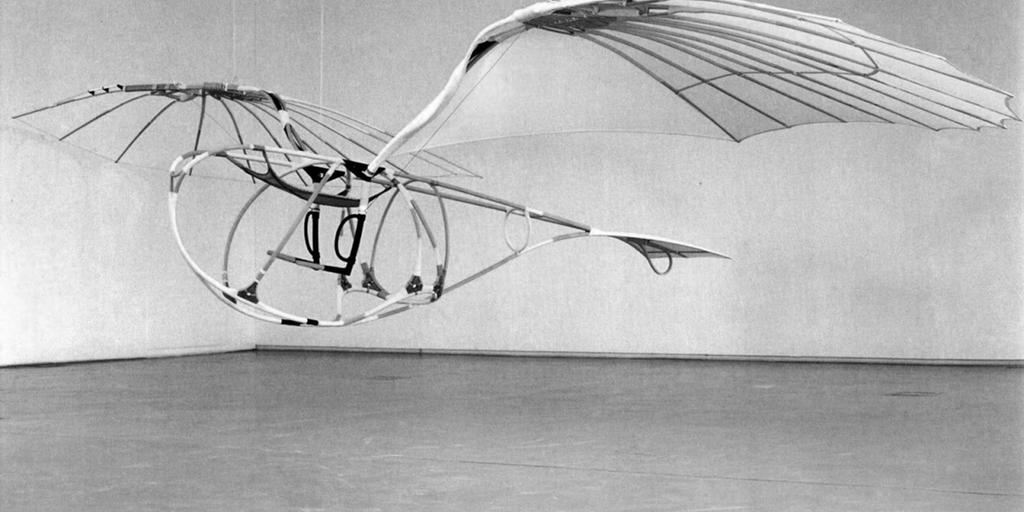
Tatlin created his 'air bicycle' by observing birds and imitating their capacity for flight, without recourse to physical or mechanical analysis. In an accompanying essay he wrote: 'I do not want this object to be approached in purely utilitarian terms. I made it as an artist. Look at the curve of the wing: we consider it aesthetically complete. Does Letatlin not give the impression of something aesthetically resolved? Like a soaring gull? My apparatus is built on the principles of living organic forms. Observation of these forms led me to the conclusion that the most aesthetic forms are also the most economical. Working to give form to material in this direction is art.' In constructing his flying apparatus Tatlin sought to use natural, unprocessed materials: the wing frame was made of ash and covered in silk, and the structural elements were faced with strips of whalebone.
In flight, the glider pilot was to lie in a horizontal position, feet on the pedals and hands on the levers. In this way, positioned within the structure, the person merged with the machine, becoming a 'human-bird'. Through this union Tatlin wished to show that organic, natural orders are an inseparable part of the automated world of technology. He also published an essay, Art into Technology, in which he criticised the subordination of humanity and art to machines and insisted on their equal-footed fusion.

Having completed the work, the artist decided to exhibit his apparatus at the Pushkin Museum of Fine Arts. The enormous Letatlin, with a wingspan of more than nine metres, was suspended from the ceiling of the Italian Courtyard and hovered directly above the statue of David. Tatlin also managed to arrange several test flights of his apparatus near Zvenigorod, after which a meeting was held with aviation specialists. The design engineers declared that Letatlin had "too low an efficiency coefficient." Tatlin objected: "Try asking a crow — perhaps it will listen to you and, on account of its 'low coefficient,' stop flying and start getting around on foot."

Art historian Anatoly Strigalyov wrote that "Letatlin compels you to believe that even if a person cannot fly with the help of this apparatus, some irresistibly alluring path has been shown to them." In this sense, Letatlin embodies the human desire to ascend toward the heavens. Had it proved functional, it would have lost its contradictions and ambivalence, and would instantly have ceased to be a work of art.
Final Years
In the 1930s, the Bolsheviks launched a campaign against formalism. The avant-garde artists came under increasing pressure from the authorities, and many were repressed. Tatlin's circle in Moscow shrank relentlessly. In 1937, he was expelled from his studio in the tower of the Novodevichy Convent and given a tiny workshop in the artists' colony on Maslovka. As the state poured money into new theatres opening across Moscow, stage design became the only paid work available to Tatlin. During the 1930s and 1940s he designed sets for fifteen productions. In 1935 he received a major commission and created the stage design for two theatrical productions. In 1936 and 1937 there was almost no work for him; he went hungry and struggled to feed his son Volodya, who had just turned twelve.
At the outbreak of the war, during the evacuation, Tatlin first went to Yekaterinburg but soon moved to Nizhny Novgorod. In the autumn of 1942, his eighteen-year-old son Volodya was conscripted into the army. He was wounded and killed in January 1943 during the Battle of Stalingrad.
In 1946, Tatlin met his wife Alexandra Korsakova — an artist, dancer and circus performer — with whom he spent the final years of his life. He had almost no friends left. His close companion Alexander Labas wrote: "This man of enormous, singular talent was abandoned, effectively hounded, kept in isolation, and branded a formalist by envious, narrow-minded, petty people." Tatlin died on 31 May 1953; some eight or nine people attended his funeral. In his farewell address, the architect Lev Rudnev said: "A true artist has died — one whom the Russian people will come to love and appreciate in the future."
Also read the biographies of El Lissitzky, Wassily Kandinsky and Kazimir Malevich.
Follow us on social media: Telegram.