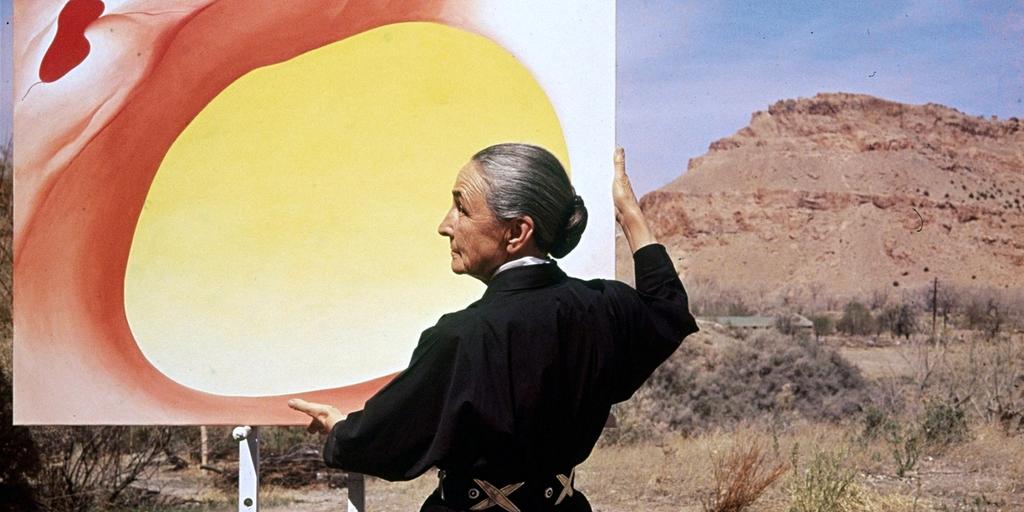
Georgia O'Keeffe was the first American modernist and a central figure in twentieth-century art — one of the first women artists to achieve worldwide recognition during her own lifetime. She forged an individual style that united the formal language of modern European abstraction with the traditions of American painting. O'Keeffe freed herself from the gender constraints and social constructs imposed on women in the first half of the last century. For more than seven decades she remained true to herself and her art, challenging the world at every turn.
In this article you will discover:
— the life and story of Georgia O'Keeffe;
— the key stages of her creative journey;
— the influence of photography on her style;
— the significance of her painting for the feminist movement;
— fascinating facts from Georgia's life.

Biography
Childhood
Georgia O'Keeffe was born on 15 November 1887 in the suburb of Sun Prairie, Wisconsin, in the north-east of the country. She grew up on her parents' farm in a large family, the second of seven children. At the age of twelve, Georgia announced that she would become an artist when she grew up. Her mother supported her daughter and encouraged her passion for art in every way she could.
Despite the family's limited means, Georgia received a good education. She attended a Catholic school and took private watercolour lessons. At sixteen, the future modernist was sent to a boarding school in Virginia, where she flourished in the art studio.
The beginning of her artistic career
At the age of eighteen, Georgia enrolled at the School of the Art Institute of Chicago, an institution known for its conservatism and commitment to academic painting techniques. Although she disliked the practical classes, anatomy exercises and drawings from plaster casts, she achieved considerable success and ranked first among the students in her year.
A year later, her artistic education came to an abrupt end: in the summer of 1906, Georgia fell gravely ill with typhoid fever. She lost all her hair, grew very thin, and was left severely weakened. The long recovery took nearly a year, which she spent with her family. The following autumn, Georgia O'Keeffe did not return to Chicago — financial difficulties made it impossible to continue at the prestigious school. Instead, she headed to New York, the heart of American artistic life. O'Keeffe looked back warmly on her year of study at the Art Students League of New York. There she mastered the art of still life and learned to find beauty in detail.
Full of hopes and creative ambitions, Georgia was forced to set aside art for three years. In 1908 she had to return to Virginia to care for her sisters and her mother, who was ill with tuberculosis. At that point, O'Keeffe declared that she was done with art for good.
In the summer of 1912, the family moved to the vicinity of the University of Virginia. With the intention of becoming a teacher, Georgia enrolled in a course on art instruction for women. Before long she picked up her brush again and produced a series of watercolours. O'Keeffe's new philosophy was to create art that neither imitated nor copied nature. She employed rigorous composition, using trees and other elements of the landscape to construct an artificial symmetry. In this way she produced paintings that recalled views seen through a keyhole.
First Abstractions
O'Keeffe's painting was growing steadily less realistic. In the autumn of 1915, while Georgia was teaching at Columbia College in South Carolina, she produced a series of charcoal abstractions. These works were unlike anything else at the time: they differed markedly from the formal, geometric abstract art of the period. O'Keeffe used forms she found in nature, seeking to express the "unknown" subconscious through drawing. By following her own creative instincts, she once again began to think seriously about a career as an artist.
O'Keeffe sent her drawings to a friend from art college, who secretly took them to Alfred Stieglitz, the celebrated photographer and owner of the New York gallery 291. He described the works as "the purest, finest, sincerest things" he had seen. In April 1916, without Georgia's knowledge, Stieglitz exhibited ten of her abstractions at his Manhattan gallery.
It was Alfred Stieglitz who was responsible for Georgia's move to New York, her decision to abandon a teaching career at the age of thirty-one, and her resolve to devote her life to art. Their professional relationship soon became a romantic one. They began living together almost immediately and married six years later.
The Birth of Colour
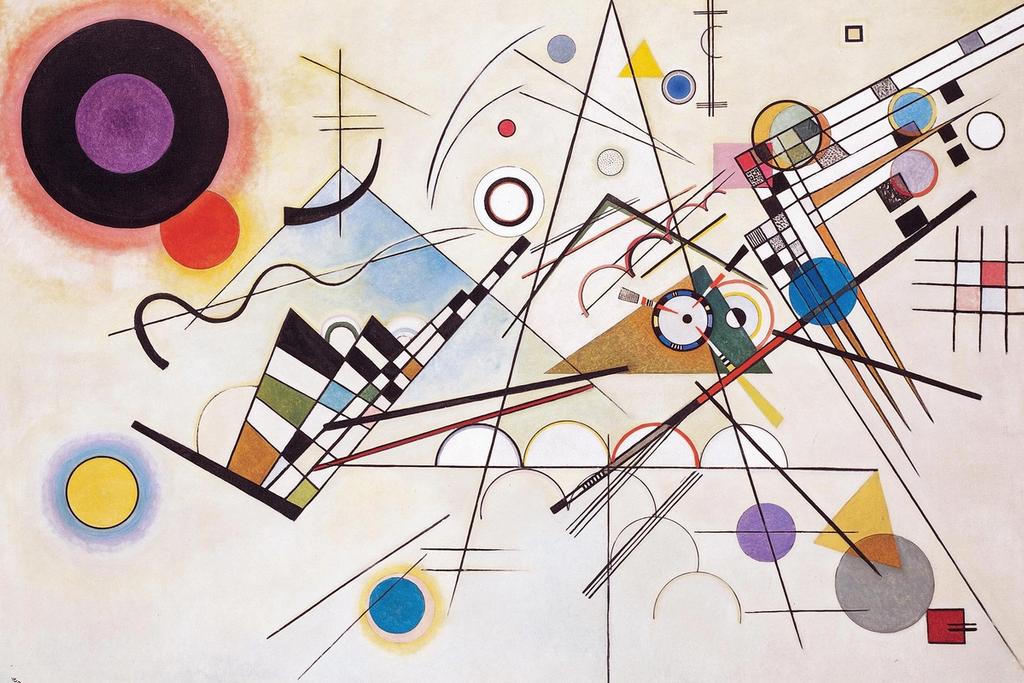
Georgia O'Keeffe's work was profoundly shaped by the theory of synaesthesia, which was widely embraced among European modernists. Whether Georgia herself was a synaesthete who heard colours as Wassily Kandinsky did remains unknown, but music played a central role in her art. She played both piano and violin, and felt a constant need to draw parallels with music.
"I love music more than anything else in the world. Colour stirs such intense emotion in me only on rare occasions"
O'Keeffe read the Russian abstractionist's theoretical writings and spoke warmly of his book Concerning the Spiritual in Art. The first colour to appear in her work was blue — the most spiritual shade, and "the typically celestial colour" according to Kandinsky.
Later works make direct reference to musical themes. In some of the abstractions one can make out the necks of violins. In the paintings of the 1920s, colour corresponds to the sensations and emotions evoked by listening to music. Colour arises in her canvases as a consequence of music — the instrument through which form itself was created.
Floral Anatomy
Georgia O'Keeffe is best known for her paintings of flowers and plants, rendered as though seen through a magnifying glass. Over the course of her career she produced more than two hundred such works. Feminist critics sought hidden symbolism in these paintings and regarded Georgia as an inspiration for the women's rights and liberation movement of the second half of the twentieth century. The artist herself always rejected Freudian interpretations of her work. The relentless search for covert symbolism and the dismissive commentary of certain critics infuriated Georgia, and on one occasion she declared in exasperation:
"I hate flowers — I paint them because they are cheaper than models and they don't move!"
In compositional terms, O'Keeffe's floral abstractions were shaped by the influence of Paul Strand, a photographer from Stieglitz's circle. Strand himself followed the tendencies of Cubist painting. He photographed his subjects from such close range that their formal structure broke down and began to dissolve into abstract geometric shapes.
Georgia was captivated by Paul's work, yet she did not blindly imitate the photographer — she sought her own meanings, adapting Strand's ideas to her own unique vision of the world and synthesising abstraction with realism. Despite an almost complete botanical accuracy, O'Keeffe was not painting a specific plant or a fragile, vulnerable flower, but something timeless and monumental. These are composite images of flowers that embody an absolute, undying ornamental permanence of form.
"I will make even the busiest New Yorkers stop and see what I see in flowers"
Another motif that recurs in these subjects is a debt to Art Nouveau, with its natural, organic lines and its love of botanical ornament. The flowers that appear most frequently in O'Keeffe's work — lilies and irises — are quintessential emblems of the Art Nouveau style.
Personal and cultural references, the influence of contemporary photography and Cubism: all of this attests to the deeper meaning of O'Keeffe's art and its inseparable connection with the artistic currents of her time. To view her work exclusively through the lens of feminism and erotic interpretation is to diminish its true artistic worth.
The Geometry of Architecture
Georgia O'Keeffe arrived in New York during a building boom, and the city's tall buildings became the central subject of her work in the 1920s. A devotee of modern American architecture, she began painting New York skyscrapers and urban views from the window of her apartment on the thirtieth floor of a hotel in the heart of the roaring metropolis.
Once again O'Keeffe challenged the American creative establishment by attempting to depict the decidedly unfeminine world of New York architecture. Fellow artists advised Georgia to continue painting flowers rather than the "symbols of modern technology" — skyscrapers — which they considered an exclusively male subject.
"When I told people about my attempts to paint New York, I was told it was an impossible task, and that even men couldn't manage it"
O'Keeffe's skyscrapers are painted in the spirit of Precisionism, a variant of magical realism defined by sharply calibrated geometry, a timeless quality and an emptiness of space. A hallmark of her work — much of it photographic in sensibility — is an unconventional perspective. The paintings carry the sense of an unseen presence: someone gazing upward from street level, or watching the city from a window. The deserted streets are dense with form, colour and shadow. These are portraits of angles and overwhelming silence. O'Keeffe conjured a cavernous, brooding image of the city. Yet beyond the concrete world there is a glimmer of light — like a beacon of hope for those lost among the monumental, awe-inspiring buildings.
Some paintings, however, reveal the nocturnal splendour of the skyscrapers — richly illuminated, almost immaterial towers of light. Georgia's delicate handling of the palette in New York Night conveys a sense of warmth and life. The lit windows of the buildings and the glowing street below conjure the people who breathe life into the city every day.
Georgia's decision to leave New York as a subject coincided with the stock market crash of 1929. Her paintings, which had once reflected the grandeur of the skyscrapers as symbols of American economic success, became little more than melancholy reminders of the former might of American capitalism.
The theme of architecture was present in O'Keeffe's work even before she moved to New York, and it was one she returned to throughout her life. Georgia painted barns and outbuildings, close-up views of typical American and colonial structures, employing the simplest forms and pure geometry.
New Mexico and Hawaii
Disillusionment with bohemian life and her husband's infidelities led Georgia to exhaustion, a nervous breakdown and depression. From 1929, O'Keeffe began escaping the city that weighed on her, retreating to New Mexico, an arid mountain region in the American Southwest. Through the 1930s and 1940s she continued to live and work there, and New Mexico became a new chapter in her professional life. In 1949, following the death of her husband Alfred Stieglitz, she acquired Ghost Ranch and made it her permanent home. By that point Georgia O'Keeffe was an established artist whose work was shown in galleries across the country.
Dramatic landscapes, mountains and deserts, ancient Spanish colonial architecture and the local flora became the focus of her work. Exploring an unfamiliar environment, she drew inspiration and experimented with form and composition. O'Keeffe's barren desert landscapes became symbols of American modernism.
O'Keeffe restored a semi-ruined colonial building in the north of the state — a place of seclusion and solitude. Her fascination with this space gave rise to a series of more than twenty paintings and drawings of the house. Although the compositions vary considerably in both scale and colour palette, each one focuses on the geometry of the building's interior courtyard.
Death and eternity were the central themes of her art during these years. Georgia gathered stones and the bones of dead animals from the desert and made them the subjects of paintings rendered in a spirit of magical realism. The remains struck her as 'strangely more alive than the animals walking around.' Like the Regionalists, she was constructing her own image of America — timeless and surreal. In the 1940s, with the onset of war, the artist returned once more to the theme of death. She painted pelvic bones, transforming them into portals connecting the earth and a sky that would remain just as blue even after all of humanity had been destroyed.
In 1938, a Hawaiian advertising agency approached O'Keeffe with a commission to create two paintings for a local pineapple company. The offer came at a critical moment in Georgia's life: she was 51, and her once-flourishing career had stalled. Critics considered her creative focus on New Mexico to be limiting, and dismissed her work as 'mass production.' The artist spent eight weeks in Hawaii, where she was given complete freedom to explore and create. She painted flowers, landscapes, and traditional Hawaiian motifs. Back in New York, O'Keeffe completed a series of twenty paintings — but she only produced the commissioned pineapple images after the Hawaiian Pineapple Company sent the plant to her New York studio.
Later Years
By her sixties, O'Keeffe was an international celebrity. In 1968, Life magazine put her photograph on its cover. People began turning up unannounced at her home, hoping to meet the great modernist.
In old age, O'Keeffe developed a love of travel. She visited Europe, India and Japan, and rafted down the Colorado River several times. What moved Georgia most were the views from aeroplane windows, which became for her a portal into another dimension.
The last series of works O'Keeffe painted before losing her sight were abstract images of rivers and roads, and views of clouds seen from an aeroplane window. At seventy-seven, Georgia began the largest painting of her career. A canvas seven metres wide was stretched across the wall of her garage. For more than three months she painted clouds, first standing on a ladder, then on a chair and a crate, and finally sitting on the floor.
Throughout her life, O'Keeffe strove to free herself from gender stereotypes and labels. In an era of intense social pressure, she did everything on her own terms, aligning herself with no movement and refusing to be confined by convention. Georgia O'Keeffe moved to Santa Fe in 1984, where she died on 6 March 1986 at the age of ninety-eight. Her body was cremated and her ashes, in accordance with her wishes, were scattered at Ghost Ranch.
Personality
Fearless and confident in herself and her calling, O'Keeffe was never afraid to stand apart from the crowd. She was unconcerned with conforming to prevailing ideas about how a woman should look or dress, or what a woman artist was permitted to paint. Georgia kept her maiden name, wore men's hats with quiet dignity, and paid little heed to others' opinions. She succeeded in persuading both the art world and the wider public that gender was in no way a determining factor in artistic competence or talent.
I was terribly frightened at every decisive moment of my life, but I never let it stop me from doing what I set out to do
Some considered Georgia a misanthrope who had shut herself off from the world and retreated into voluntary seclusion in the deserts of New Mexico; others remember how easily she could connect with people, deliver a sharp quip, or laugh in a way that was utterly infectious. Therein lies the artist's central appeal: her mystery, her many-sidedness, and a certain quality of the unsaid.
Personal life
When O'Keeffe and Stieglitz met in 1916, he was famous and married; she was unknown and twenty-three years his junior. The celebrated photographer and the provincial schoolteacher began writing to each other — sometimes two or three times a day. In total, they sent 25,000 pages of love correspondence.
In shaping both American photography and the broader landscape of North American and European modern art, Stieglitz played an enormous role in O'Keeffe's success. He exhibited her work in his gallery, organised solo shows, and opened the door to New York's bohemian art world. Georgia was his constant model; he was captivated by her art, her body, her piercing gaze, and her spirit. Over the decades they spent together, he made several hundred photographs of her. It was Alfred who created the image of Georgia.
In 1929, shortly after her husband began an affair with his young assistant, O'Keeffe made her first trip to New Mexico in search of solitude and independence — and stayed there for the rest of her life. She reinvented herself, fashioning the image of an uncompromising, resolute individualist. This new public persona stood in sharp contrast to the one Stieglitz had constructed for her. He never once visited Georgia at her desert retreat in New Mexico.
Their thirty-year relationship — at once intimate and distant, charged with passion and tension — played a defining role in shaping them both. They quarrelled and wrote rambling letters, remaining intertwined until the very end. Their respect for each other, as people and as artists, never wavered. Despite everything, they stayed in contact and remained married until Stieglitz's death in 1946.
"When I look through the photographs Stieglitz took of me more than sixty years ago, I find myself wondering who that person in the pictures is. It is as though, instead of one life, I have lived several."
Facts and curiosities
- Early in her career, Georgia worked at an advertising firm specialising in embroidery and lace design.
- O'Keeffe collected classical music. She was particularly fond of Beethoven, Schumann, Haydn, and Bach.
- The artist almost never signed her works. Only rarely did she write her name on the back of a canvas.
- In the 1930s, O'Keeffe acquired a Ford Model A, which she drove with flair across New Mexico and converted into a mobile studio.
- At Ghost Ranch, Georgia had large windows installed so that she could admire Pedernal Mountain from her bed — the mountain she painted with near-obsessive devotion, almost 30 times. "It's my private mountain," she once said. "It belongs to me. God told me that if I painted it enough, it would be mine."
- In 1945, she became the first woman to be honoured with a solo retrospective at the Museum of Modern Art in New York.
- O'Keeffe worked in all weathers. During downpours she rigged up canvas tarpaulin shelters, and painted in gloves when it grew too cold.
- Her passion for art did not fade with the loss of her sight. She declared: "What makes me want to create is still there." When painting became impossible in her eighties, O'Keeffe began experimenting with clay sculpture and continued doing so until the end of her life.
- Today, the area of New Mexico where the artist spent several decades is known as "O'Keeffe Country."
- In 2014, the painting Jimson Weed/White Flower No. 1 sold at Sotheby's for $44.4 million, making Georgia O'Keeffe the author of the most expensive painting ever sold by a female artist.
Other works by the artist
Read about other artists who worked in the magic realist tradition on Losko — for instance, about Edward Hopper and his architecture of solitude, or René Magritte and his enigmatic paintings.
Follow us on social media so you never miss a new article: VKontakte, Telegram — @loskomagazine.