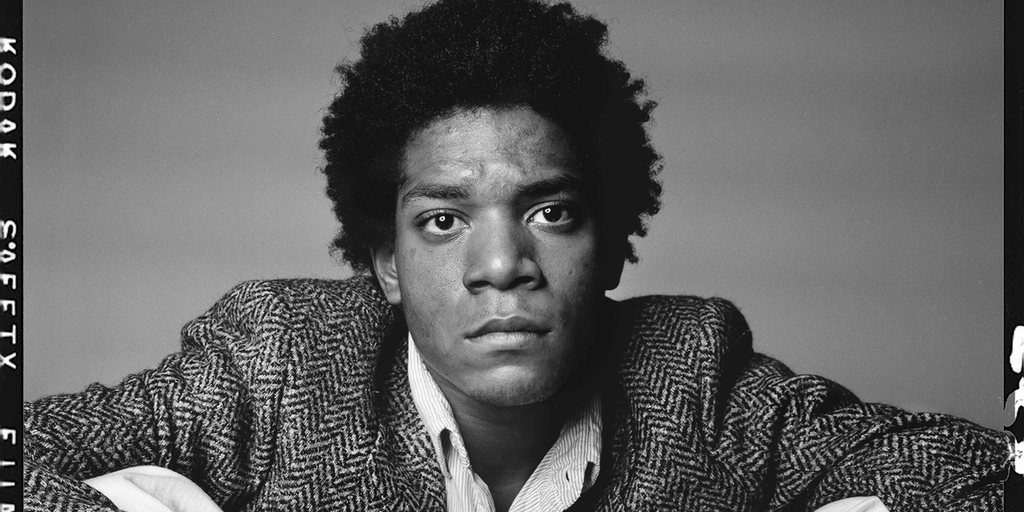
In his youth, Jean-Michel Basquiat dreamed of becoming famous — and later of fleeing his ill-fated fame to the ends of the earth, even to Hawaii. He wanted to open a tequila distillery, play jazz in local bars and simply enjoy life. Instead, he created with a feverish intensity: death seemed to lurk everywhere, and he felt compelled to pour onto his canvases everything that was tearing through him before the abyss caught up with him.
Jean-Michel made it in time: over his 27 years he produced hundreds of works that art lovers still admire today. Prices for Basquiat's canvases continue to soar, and the world's most prestigious museums and galleries compete fiercely for the chance to show them in their halls.
In this article you will find out:
- How Jean-Michel Basquiat's career began;
- Who the mysterious graffiti artist SAMO was;
- The journey the young painter made from the slums of New York to become a global celebrity;
- How Ronald Reagan's presidency and Basquiat's success are connected;
- What destroyed the friendship between Jean-Michel and Andy Warhol;
- What inspired the artist when creating his works;
- Why Basquiat's art can be seen as a marker of its era.

Early Childhood
The end of 1960 was both tragic and joyful for the Basquiat family: their firstborn, Max, died shortly before the arrival of their second son, Jean-Michel. The latter was destined to become a star of contemporary art, but in the 1960s he was an ordinary boy growing up in Brooklyn in an international family — his mother Puerto Rican, his father Haitian. Not long after Jean-Michel, two girls were born into the family.
The future painter was an unusually advanced child: at three he began to draw, announcing that he wanted to be an artist; by four he could read and write; and by eleven he had a firm command of three languages — English, Spanish and French. The boy had a passion for books, Hitchcock films and comics, which inspired his own sketches. At that time, Jean-Michel dreamed of becoming an animator.
"I would say that everything that truly matters came from my mother. Art came from her."
Much later, once Basquiat had already made a name for himself, journalists began telling stories about his supposedly troubled early years. Jean-Michel found this infuriating: "They all write about my ghetto childhood. For white artists, they don't seem to invent a childhood." In reality, his father Gérard was an accountant who earned a decent living, while his mother Matilde had a keen interest in fashion and drawing. It was she who instilled in Jean-Michel a love of art: together they often visited theatres and museums. The painter would later say: "I would say that everything that truly matters came from my mother. Art came from her."

Yet family life was far from peaceful: Jean-Michel's father was a harsh man, and both parents were prone to physical violence. There was also turbulence between Gérard and Matilde themselves — they separated and reconciled repeatedly.
When the future neo-expressionist was seven years old, he was involved in a serious accident: while playing in the street, the boy was struck by a car. In addition to sustaining multiple internal injuries and a broken arm, he had to have his spleen removed. After the operation he spent an entire month in hospital. To entertain her son and help him understand what had happened to his body, Matilde brought him the celebrated anatomical reference Gray's Anatomy. What he saw made a lasting impression: nearly all of his adult works would contain anatomical detail.

In that same year of 1968, when Jean-Michel was in the accident, his parents divorced. A couple of years later, the artist's mother was admitted to a psychiatric hospital for the first time — an institution she would return to periodically from then on. From that point, the Basquiat children were raised by their father.
Life with his father
In 1974, Gérard received a work posting to Puerto Rico, where the family lived for two years. During this period, fifteen-year-old Jean-Michel ran away from home for the first time. He was found and brought back the same day, but his relationship with his father never improved.
Things were no easier for the future artist at school: on one hand he was a gifted child, but on the other he simply "didn't like to follow rules," as Gérard later put it. Over the course of his education, Jean-Michel changed schools many times — and not only on account of the family's moves.

The last school to take him in was City-as-School — an institution for creative young people that placed its emphasis on developing practical skills. Its students regularly completed placements at some of the most prestigious cultural organisations, but Basquiat made his protest against formal education felt here too: in the penultimate year of study he threw a can of shaving cream at the principal's head and was immediately expelled. That marked the end of his formal schooling; Jean-Michel's education from then on was self-directed, taking place in the museums, galleries and other creative spaces of New York.
In 1976, Jean-Michel ran away from his domineering father for the second time, spending a couple of weeks living in Washington Square Park, and at seventeen he left home for good. He slept on the street or at friends' places, subsisting on fifteen-cent chips and cheap wine.

At that time, Jean made a living selling sweatshirts and postcards bearing his own drawings, working at Unique Clothing Warehouse in the bohemian neighbourhood of NoHo, and occasionally even begging. At night, Basquiat and his school friend Al Diaz would cover the walls of Lower Manhattan with wry inscriptions under the pseudonym SAMO. This invented persona became Jean-Michel's first step towards the fame he had so longed for in his youth.
New York, New York
To understand Basquiat's work and his earliest pieces, one must know what New York looked like in the 1970s and 1980s.
From 1981 to 1989, Ronald Reagan served as President of the United States. The economic course pursued by his administration later became known as 'Reaganomics' — and it was precisely this policy that triggered an unprecedented art boom in America.
Reagan cut taxes for the wealthy and for corporations, leaving them with surplus funds that could be channelled into the art market. Oil prices rose sharply, and the effects were felt in the art world as well. Major cities filled with so-called 'yuppies' (from the English 'Young Urban Professional Person') — ambitious young careerists who were more than willing to invest their money in art.

Since the 1950s, American authorities had been enacting desegregation legislation, and the uprisings among the Black population that followed the assassination of Martin Luther King on 4 April 1968 only accelerated these processes. Their consequence was 'white flight' — an eruption of everyday racism manifested in the mass exodus of affluent white residents from major cities to the suburbs. As a result, city centres became slums defined by poverty, unemployment and drug trafficking — fertile ground, of course, for the bohemian scene.
In these conditions, graffiti culture flourished, reaching its peak in the late 1970s. Writers — street artists — competed with one another in originality and sheer volume of work, leaving elaborate tags on the walls of streets and subway cars, and frequently ending up in police custody. The graffiti that Jean-Michel and his friend Al Diaz created under the tag SAMO were something else entirely: simple, spare, focused on the content of the phrases rather than on visual impact.
The Birth of SAMO
The idea for SAMO came to Basquiat almost by chance: while still in high school, Jean-Michel, Al Diaz and several other students at City-as-School founded a school paper called Basement Blues Press. For one of its issues, the future artist wrote a piece about a fictional religion, which he called SAMO (from the phrase 'the same old shit').
Within days, Basquiat and Diaz were consumed by the idea and began distributing flyers featuring invented testimonials from people whose lives had supposedly been transformed by the new 'religion'. By 1978, witty inscriptions in the voice of SAMO had begun appearing across Lower Manhattan and were gaining an ever-wider following — though New Yorkers had yet to discover who was behind the mysterious graffiti.

Through SAMO's messages, the two friends expressed everything they thought and felt about the world: they voiced their own frustrations, crafted poetic and satirical pseudo-advertising slogans, and commented on what they found absurd and what displeased them. Jean-Michel would later recall that on a given day he might produce as many as 30 inscriptions — some humorous, others outright rebellious.
For Basquiat, who was consumed by a desire for fame, graffiti was not merely a way to have fun or make a point — the SAMO tag was meant to serve as publicity for the future neo-expressionist. That is why Jean-Michel made a point of leaving his messages in places where celebrities, established gallerists and art dealers were likely to see them. He later claimed that SAMO was intended to become a recognisable logo — something along the lines of Pepsi.
The Secret Comes Out
Basquiat and Diaz maintained their anonymity for several months, until the Village Voice paid the two friends $100 to publish their story — though without naming them. Shortly after the piece ran, Jean-Michel appeared on television and revealed that he was the mysterious graffiti artist in question, without so much as mentioning Al Diaz. Diaz was so hurt by his friend's conduct that the two did not speak for another two years after the broadcast. During this period, Basquiat announced to New York that the project was over, leaving walls across the city covered with the inscription SAMO IS DEAD.

The last graffiti created under the pseudonym SAMO date from 1981. In the early 1980s, Al Diaz devoted himself to music, while Jean-Michel turned to painting. For a time, the SAMO tag appeared on Basquiat's own works as a signature, but was later replaced by a crown in the shape of an inverted W.
Although Jean-Michel never considered himself a graffiti artist, the SAMO project served as his springboard into the art world.
Bohemian life
While all of New York was wondering who was hiding behind the SAMO pseudonym, Jean-Michel Basquiat was creating tirelessly. Moving from one girlfriend to the next, he turned each apartment into a work of expressionist art, painted clothes that his friends then displayed in their showrooms, and, of course, made postcards. He even managed to sell one of them to his idol and future friend — the artist Andy Warhol.
Jean-Michel was desperately poor and had no money for painting materials — so anything that others might have considered ordinary rubbish could become the surface for one of his works.
After leaving home, Basquiat began spending a great deal of time in the underground clubs of Lower Manhattan that were popular with young creatives. He frequented Club 57, CBGB and the Mudd Club, which hosted not only parties but also various shows, concerts, performances and theatrical events.
Before long, Jean-Michel — a passionate jazz enthusiast — grew tired of being a mere spectator, and proposed to an acquaintance that they form their own band. Its members were enthusiasts who adored music but had absolutely no idea how to play instruments. Each time they would 'improvise' on stage, and their original approach made them popular with young audiences. The group, called Gray — a name Basquiat borrowed from a medical textbook that had captivated him in childhood — survived until 1981, when Jean-Michel decided to focus entirely on his career as a painter.
By the late 1970s, Basquiat had become a prominent figure in the underground creative scene and was in constant contact with its other members. While working on the SAMO graffiti in the vicinity of the School of Visual Arts, he met the student artists Keith Haring, Kenny Scharf and John Sex. Parties at his favourite haunts brought Jean-Michel together with Blondie lead singer Debbie Harry, director Jim Jarmusch, actress Ann Magnuson, actor Danny Rosen and other talented contemporaries. The older club regulars condescendingly called them the 'baby crowd', but it soon became clear that these children could hold their own against the 'old guard'.

In 1979, Basquiat's friend, writer and journalist Glenn O'Brien wrote a screenplay about a homeless artist and invited Jean-Michel to play the lead role. It was a stroke of enormous luck: in the studio where the film was being made, Basquiat was free to paint, and the filmmakers also supplied him with materials. After the shoot, Debbie Harry — who also appeared in the film — bought one of Jean-Michel's works for $200, marking the first significant sale of the artist's work. The next step in his career would prove decisive.

First steps in the art world
A vacant New York proved the perfect backdrop for the explosion of the arts at the turn of the 1980s, and there was no better place to showcase the results of that explosion than an abandoned massage parlour near Times Square. It was there, in June 1980, that the artist collective Collab chose to stage the Times Square Show — an exhibition bringing together works and performances by creators from the widest range of disciplines: painters, sculptors, performance artists, writers, musicians, designers, videographers and many more.

The exhibition was open for an entire month, 24/7, and admission was free to all. Jean-Michel was naturally not on the sidelines: in one of the rooms he covered a wall with spray-paint drawings and brushstrokes of paint, signing them SAMO. Visitors were thrilled, and a mention of Basquiat appeared in a review in Art in America magazine.

The next major event for Jean-Michel was the exhibition New York/New Wave at the contemporary art centre MoMA PS1. More than a hundred artists took part, but Basquiat stood out in particular: he was given an entire room at the end of the exhibition, which he filled with works arranged in a distinctive rhythm.
Visitors who flocked to the exhibition were struck by what they saw: in an era of minimalism, conceptualism, and abstract and non-objective art — that is, art in which idea took precedence over form — the works on show at MoMA PS1 came as a breath of fresh air. Basquiat's expressive, impulsive, and unguarded paintings were especially striking.

It was not only the public who began to talk about the artist — prominent gallerists took notice as well. Italian dealer Emilio Mazzoli even acquired ten canvases to show at his own gallery in Modena, Italy. In May 1981, Jean-Michel travelled there to attend the opening of his first solo exhibition.
Annina Nosei Gallery
Shortly after those first exhibitions, gallerist and art dealer Annina Nosei, who had seen Basquiat's work at MoMA PS1, offered Jean-Michel a collaboration. She provided the young artist with the basement of her gallery as a studio and sponsored the purchase of materials.
At last Basquiat could create without having to think about where to find canvases and paint. He threw himself into his work, sometimes producing three paintings simultaneously. Friends who visited Jean-Michel's studio recalled that he painted to the sounds of jazz and the television, moving from canvas to canvas and occasionally leafing through books.

The painter's style evolved and changed: the colours of his canvases grew brighter, the number of inscriptions that had filled his earlier works diminished, but a wealth of detail was added, with which he populated large, primitive figures. Annina would bring art collectors down to the gallery basement; they were invariably captivated by Basquiat's paintings and eager to acquire them on the spot.
To keep up with demand, Jean-Michel worked tirelessly — jokes circulated in the art world that his works were sold before they had time to dry. Basquiat himself was often unhappy that the frenzied demand forced him to part with paintings before he considered them finished. Nevertheless, the results of this relentless output made themselves felt: one exhibition followed another, and in December 1981 Artforum published a full-length article, The Radiant Child, devoted to the artist, which raised his profile considerably.

In the meantime, on Nosei's advice, Basquiat rented a loft in SoHo and moved there with his girlfriend Suzanne Mallouk. Before fame arrived so suddenly, Jean-Michel had been living off her income in her apartment — Suzanne worked as a waitress. From that point on, the loft on Crosby Street became the artist's true stronghold: he lived there, worked there, threw parties there, and never stopped creating.
In June 1982, Basquiat became the youngest participant in the landmark international contemporary art exhibition documenta, where his paintings were shown alongside works by Joseph Beuys, Cy Twombly, Gerhard Richter, and Andy Warhol.
I lived like a real recluse, worked a lot, took a lot of drugs. And I treated people terribly.
That autumn, the close collaboration between Jean-Michel and Annina came to an end — largely due to the punishing pace at which the gallerist drove the artist. Basquiat locked himself in his loft and continued to work on his own terms. He later spoke about this period: "I had a little money; I made the best paintings I ever made. I lived like a recluse, worked a lot, took a lot of drugs. And I treated people terribly."

Life of a Star
Credit where it is due: at this point Jean-Michel was still capable of honest self-assessment. He had never taken money seriously, and once large sums began to come in he spent them on trivialities — buying the most expensive wines, wearing Armani suits even while painting. Wads of dollars lay on the loft floor mixed in with bags of marijuana and art supplies. He never seems to have considered investing anything or opening a bank account.
As for the way he treated people: "terribly" is a fairly accurate description. Jean-Michel had no habit of deference toward anyone — not even toward someone who might be about to pay a considerable sum for one of his works. If a buyer displeased him, he might throw them out or tip the fruit and nuts they had brought as a gift over their head — which is exactly what happened to one dealer.
Friendship with Warhol
From the time Jean-Michel stopped working with Annina Nosei, he collaborated with various art dealers and gallerists, among them Mary Boone, Larry Gagosian, Fred Hoffman and Bruno Bischofberger. It was Bischofberger who, in September 1982, introduced Basquiat to one of the most important people in his life — Andy Warhol.
According to Andy's recollection, the moment Bruno Bischofberger introduced him to Jean-Michel, the younger artist dashed off somewhere and returned two hours later with a painting in his hands. It was a joint portrait of the two artists, and the paint was still wet — Basquiat had apparently been so eager to meet the celebrated figure of Pop Art that he wanted to impress him on the spot. The gambit worked: Warhol took an interest in the ambitious young man, and their acquaintance deepened steadily from there.

Within a short time Jean-Michel and Andy had become close friends: they not only spent time together but also created works in collaboration. The process typically went like this — using a slide projector and paint, Warhol would reproduce familiar objects, logos and lettering on a canvas, and Basquiat would then take the work further in his own style. Among the pieces made this way are the paintings Olympics (1984), Poison (1984–1985), Zenith (1985), and the art object Ten Punching Bags (Last Supper) (1985).
The artists maintained that their friendship was entirely selfless, but those around them thought otherwise. "A mutually beneficial partnership," "a symbiotic relationship" — such phrases could be heard everywhere. The circumstances invited that reading: Jean-Michel had not yet achieved worldwide fame, and Andy could open doors to elite society for him, while Warhol — by then widely regarded with a degree of contempt as a "court" artist of politicians and businessmen — could draw on Basquiat's youthful energy and benefit from his reputation as an underground figure.
Whatever the painters' true motives, until 1985 theirs was a genuinely close relationship. Jean-Michel rented a loft from Andy in NoHo; they met every day, and when apart they talked on the phone and prepared for a joint exhibition. Sadly, it was that very exhibition that destroyed their friendship.
In September 1985, a joint exhibition of paintings by Basquiat and Warhol opened at the gallery of art dealer Tony Shafrazi. Everything seemed carefully considered: a prestigious venue, meticulous organisation, famous artists. Yet the aftermath proved deeply disappointing — art critics and the press tore the show apart, going so far as to call Basquiat Warhol's 'mascot.' Jean-Michel was furious, and began to distance himself from Andy, apparently concluding that the association was dragging him down. In the end, the two almost ceased contact entirely.

The pop art genius died in 1987 on the operating table: his heart stopped during a routine procedure. Jean-Michel Basquiat, despite the coolness that had grown between him and Warhol, was devastated by the loss.
The painters' collaborative works are still generally regarded as weaker than those each produced independently. Even so, these pieces stand as a fascinating product of a partnership between two great artists.
The height of a career
Alongside his friendship with Warhol, Basquiat naturally kept his own career and personal life in motion. Notably, Madonna Louise Ciccone — then an unknown singer — was his girlfriend for a couple of months; shortly after they broke up, she released her debut album.
1982 was an extraordinarily productive year for the artist. During this period Basquiat created around 200 works, the majority united by a shared motif: heroic, crowned Black figures whose prototypes were drawn from famous African Americans.

In 1982, six solo exhibitions of Jean-Michel's work took place in cities around the world. He also exhibited regularly alongside such masters of contemporary art as Julian Schnabel, David Salle, Francesco Clemente and Enzo Cucchi — a group that art critics, curators and collectors would soon dub the 'Neo-Expressionists.'
After leaving Annina Nosei's gallery, Basquiat began to work more slowly and with greater care. He produced around 30 to 40 paintings a year, approaching each work with a critical eye. Success built upon success: in March 1983 the artist participated in the Whitney Biennial, one of the most prominent showcases of contemporary art, while his solo exhibitions travelled beyond New York's Mary Boone Gallery to cities across the world — Zurich, Edinburgh, London, Rotterdam, Düsseldorf, Hanover, Salzburg, Tokyo and Paris.

The painter travelled widely: in early 1984 he rented a ranch in Hawaii, where he invited his family, and in August 1986 Jean-Michel Basquiat made his first trip to Africa.
Yet despite his growing fame, record-breaking prices and outward achievements, the artist's mental health was quietly deteriorating: a prolonged depression set in, followed by paranoia. He was taking ever greater quantities of drugs, to which he had become addicted in his early youth, and was withdrawing further from the people around him.
The final years
Exactly when Jean-Michel's mental and then physical health began to unravel is a complicated question. His drug use — which had started at school and escalated steadily with each passing year — was among the most significant factors bearing on his wellbeing.
On one hand, Basquiat led an active life filled with frequent exhibitions, flights and appearances at a wide range of events: from walking the runway for Comme des Garçons to taking part in the Artists Against Apartheid benefit. On the other, he could not cope with the weight of the fame that had descended on him, compounded by the burden of being a Black man navigating an art world dominated by white voices. Then there was the relentless criticism: while some publications declared that 'Basquiat had become the very thing he despised' — a member of the art world's privileged elite — others insisted that he had 'run dry' and 'lost his originality.'

His celebrity made Jean-Michel increasingly paranoid: he suspected those around him — everyone except his closest intimates — of trying to use him, and lived in fear of having his paintings stolen and of being targeted by the Ku Klux Klan.
In the final years of his life, Basquiat turned to hard drugs, which began to show in his behaviour and appearance: he looked unkempt, and dark patches appeared on his face that he tried in vain to get rid of. After Andy died, drugs consumed so much of Jean-Michel's life that all his friends and family grew alarmed. Yet he stubbornly refused treatment.
In April 1988, the painter travelled to Hawaii once more. On his return, he told friends he had broken free of his addiction, but every attempt at abstinence ended in failure.
On 12 August 1988, Basquiat's girlfriend Kelle Inman, who was living with him in NoHo at the time, walked into Jean-Michel's room and found him unconscious. An ambulance rushed the artist to hospital, but he was pronounced dead on arrival. The cause was an overdose of heroin and cocaine.

A public memorial for Jean-Michel was held on 3 November 1988 at St. Peter's Church in New York. Among the 300 people who came to pay their respects were his family, friends and creative collaborators: musicians, artists, writers and journalists.
Work
"In just nine years of active work, he left us a legacy that some artists never manage to produce in a lifetime," said art dealer Tony Shafrazi following Jean-Michel's death. And it is true: over his brief career, Basquiat created approximately 1,500 drawings, 600 paintings, and a great number of sculptures and mixed-media works.
It is not simply a matter of quantity: by his early twenties, the artist had become one of the most prominent figures of neo-expressionism — a movement that arose in reaction to the exhausted conceptualism and minimalism of the 1970s. The neo-expressionists, Jean-Michel among them, brought figuration, emotion and imagery back into art, rendered in vivid, saturated colour.

In 1983, a correspondent for Interview magazine asked Basquiat whether rage was present in his work. The artist replied: "About 80% of it is rage" — a remark that captures his art perfectly.
Basquiat's work is broadly divided into three periods:
- early (1980–1982) — during this time, Jean-Michel Basquiat frequently depicted skeletons, mask-like faces and isolated body parts, reflecting his fascination with anatomy;
- middle (1982–1985) — the most productive period of his career, during which he actively explored his African heritage;
- late (1986–1988) — in the final years of his life, Jean-Michel grew increasingly prone to depression and preoccupied with thoughts of death, which left a clear mark on his work.
The themes of his paintings were wide-ranging: his canvases are filled with childhood memories, reflections on life, the world around him and its unfolding events. In his work, Basquiat drew on African, Aztec and classical mythology, took imagery from books, and developed an iconography entirely his own.

A subject that preoccupied Jean-Michel throughout his career was the fate of African Americans and their representation across different areas of public life. In the 1970s and 1980s in the United States, Black athletes and musicians were a visible presence, but that was largely where it ended: in other aspects of cultural life, and in the political and social spheres, African American figures were almost entirely absent. This enraged the artist, and through his work he drew attention to racial injustice.
On his canvases, Basquiat created his own pantheon of Black gods and heroes, identifiable by their crowns and halos. Among those the painter admitted to this constellation were celebrated African American boxers, actors and jazz musicians.

A defining quality of Jean-Michel's work is that it captures not the physical likeness of his subjects but their essence. This is achieved through the expressive energy of his technique — the splashes of paint and dynamic, gestural lines that recur throughout his canvases. Through these means, Basquiat laid bare the hidden feelings, innermost desires and inner selves of the figures he portrayed.
Working across a wide variety of surfaces, Basquiat constantly experimented with technique. He used oil and spray paint, ink, pencils, felt-tips, markers and pastels, and incorporated photocopies of his drawings by pasting them onto larger canvases.
Jean-Michel's works are full of inscriptions: the artist was concerned with social and universal human issues, which he expressed on his canvases in the same way as in his graffiti — through short, expressive phrases. These inscriptions reflect Basquiat's Puerto Rican heritage: many are written in Spanish, as on the canvas Sabado por la Noche.
In his short life, Jean-Michel Basquiat not only played a pivotal role in the rise of downtown New York's cultural scene but also drew the entire art world's attention to a new movement — Neo-Expressionism — popularising it among connoisseurs and the general public alike.
Although some critics regard Basquiat as a product of the celebrity- and commerce-obsessed 1980s, Jean-Michel's work remains a source of inspiration for artists and art lovers to this day.
Basquiat's most expensive paintings
Even during his lifetime, Jean-Michel's paintings fetched thousands of dollars, and by the mid-1980s the artist had become a millionaire. After his death, prices for Basquiat's works continued to climb, but the real auction boom came in the early 2000s. Today, not a single work in the top ten most expensive paintings by the artist carries a price tag below $35 million, while the number-one spot cost its owner $110.5 million — making it the most expensive painting ever created by an American artist.
Top 10 most expensive paintings by the artist:


Interesting facts
- Basquiat's friend, the artist Francesco Clemente, claimed that the three points of Jean-Michel's signature crown represented the three royal lineages of his African-American ancestry: great poets, musicians and boxers.
- The SAMO graffiti created by Basquiat and Al Diaz became interactive at a certain point: people felt free to approach the works, cross out words and add their own. This possibility of engagement only heightened the excitement around them.
- Although the artist left the band Gray in 1981, he remained a passionate music lover. In 1983, Jean-Michel recorded a collaborative track with hip-hop artist Rammellzee and designed the artwork for the single's cover.
- During Basquiat's lifetime, the Museum of Modern Art and the Whitney Museum of American Art in New York declined to include his work in their permanent collections, even as Jean-Michel's pieces were being shown by the most prominent private galleries around the world.
- In his youth, the painter idolised Jimi Hendrix and Janis Joplin — artists who had found fame early and died at 27 — and later became one of the 27 Club's most tragic members himself.
What to watch about Jean-Michel Basquiat
- Downtown 81 (1981) — a narrative fairy-tale film following one day in the life of a poor artist, with Basquiat himself in the lead role. Downtown 81 was released twenty years after it was made and became a window into the half-ruined, impoverished and intensely creative New York of the 1970s.
- "Basquiat" (1996) — a feature film by Jean-Michel's friend, the Neo-Expressionist Julian Schnabel. Schnabel's directorial debut is not the most accurate account of the young artist's life, but it is a beautiful one.
- "The Radiant Child" (2010) — a documentary film spanning the painter's entire creative life. It is notable for footage from various Basquiat interviews and stories from people who knew him.
- «Basquiat: Rage to Riches» (2017) — a documentary about Jean-Michel's youth, made by his friend Sara Driver. The film not only tells the artist's story but also vividly captures the atmosphere of Lower Manhattan in the 1970s and 1980s.
- Basquiat: Rage to Riches (2017) — a documentary that explores Jean-Michel's life and his relationship with money and the art market.
Sources: Artforum, Artifex, Artsy, Basquiat.com, Brooklyn Museum, Dazed, Medium, The Art Story, The Blueprint, The New York Times, The Village Voice, Schirn Mag, Wikipedia, artnet, Arzamas, Artguide, Arthive.
Follow us on social media so you never miss a new piece: VKontakte and Telegram — @loskomagazine.