Kazimir Malevich dreamed of radically transforming reality. He wanted to unite all spheres of life through art in a non-objective Suprematist world and to pass into another dimension. Through his uncompromising nature and sheer stubbornness, he managed to overturn the existing order in art — making him the undisputed leader of the Russian avant-garde.
From this biography you will learn:
- how Malevich's creative style evolved;
- what theoretical principles he adhered to;
- how Suprematism changed the understanding of art;
- how Kazimir Malevich drove Marc Chagall out of the Vitebsk art school;
- what his relationship with Soviet power was like;
- how Malevich achieved recognition in Europe.

Early years, before 1906
Kazimir Malevich was born in 1879 in Kyiv into a Polish family and spent his childhood in a Ukrainian village in the Chernihiv region. His father, Severin Malevich, worked as an agronomist and was constantly obliged to move from village to village with his family. As a result of these frequent relocations, Kazimir Malevich was unable to complete even a secondary education and began working every day from the age of seventeen. Yet he was perpetually driven by a thirst for knowledge and recorded all his thoughts on paper. Over his many years of scholarly work he never mastered grammatically correct Russian, though this did not prevent him from becoming an outstanding theorist of art.
Kazimir Malevich first became interested in art at the trade fairs in Kyiv, which he visited every year with his father. In his autobiography the artist wrote that there he would 'run from shop to shop and spend a long time looking at paintings.' At these fairs Malevich most likely saw no secular painting, but he could certainly have encountered traditional lubok prints, painted shop signs, and colourful placards.
Kazimir's father never encouraged his son's passion for art; his mother, by contrast, supported it and secretly bought him brushes. In the late nineteenth century there were no museums or galleries in Ukrainian villages — paintings hung only in wealthy houses and estates. The arrival of three artists to paint frescoes in the local church was therefore a momentous event for Malevich: it was his chance to witness real art. In his autobiography he does not name these artists, only mentioning that they had come to the Ukrainian village at the invitation of someone in St Petersburg. Malevich describes in detail how he and his friends would spy on their creative process:
'We walked through the rye — hidden among it — and where there was wheat, we crawled. Reaching the mill, the artists settled down, took out their boxes and began to paint. We crept forward carefully, on our stomachs, holding our breath. We managed to get very close. We saw the coloured tubes from which they squeezed the paint… Our excitement knew no bounds.'
In 1896, after the Malevich family moved to Kursk, Kazimir took a job as a draughtsman in the railway administration. There he organised his own art circle and found like-minded creative companions.

The beginning of a career, 1906–1913
In 1902 Malevich married Kazimiera Zgleits, a young woman of German-Polish descent. The role of family man, however, sat at odds with his life's ambitions — he dreamed of moving to a large city to bring his creative vision to life. "I was drawn, like a wolf to the forest, to Moscow or St. Petersburg, where true art lives," Malevich writes in his autobiography. In 1904 he moved to Moscow, leaving his family behind in Kursk. In the summers of 1905, 1906 and 1907 he attempted to gain entry to the Moscow School of Painting, Sculpture and Architecture, but was rejected each time. These setbacks did nothing to diminish his creative ambitions or his conviction in his calling. In 1906 he brought his family from Kursk to Moscow, breaking with provincial life for good.
Moving to Moscow was an extraordinarily bold and risky step for Malevich, and the decision revealed him as an audacious, reckless and resolute artist. Many years later, in one of his writings, he noted: "One must build one's creative work by burning the path behind oneself." In many respects Malevich viewed the creative process as an endless pursuit of truth. He was convinced that art is impartial and objective, and that one should not seek the imprint of its creator within it. He believed that the creative evolution comprising an artist's legacy is rendered meaningless by a single pioneering work capable of transforming the order of art.
After moving to Moscow Malevich met Sofya Rafalovich. She soon became his common-law wife. They were only able to marry in 1909, after Kazimiera Zgleits consented to a divorce. Kazimir and Sofya Malevich settled in the village of Nemchinovka outside Moscow, where their daughter Una was born.

Between 1905 and 1907 Malevich worked in a Post-Impressionist manner. Works from this period are steeped in the influence of Gauguin, Van Gogh and Cézanne. Exactly where Malevich encountered these artists' work is unclear; most likely, reproductions circulated from hand to hand within creative circles. Since revolutionary ideas were in the air within the artistic community at this time, Malevich's work was imbued with boldness and wilfulness. He searched diligently for a unique artistic language, uncompromisingly shedding the old principles of painting and devoting the greatest attention to composition and the role of colour.
From 1905 to 1910 Malevich took classes at the private studio of Fyodor Rerberg, a Peredvizhniki painter who had been strongly influenced by French Impressionism. Over his first years of study, Malevich shifted his artistic manner: from Post-Impressionism he moved towards Symbolism, and his paintings came to reflect a dream-world suffused with light. This transformation was most likely completed after Malevich visited, in April 1907, an exhibition by the Golubaya Roza (Blue Rose) art association, whose members included students of the Moscow School of Painting, Sculpture and Architecture. That exhibition marked the birth of Symbolism in Russian art.
During this period Malevich divided his time between Moscow and St. Petersburg, growing close to many of the emerging avant-garde's key figures — among them Pavel Filonov, Ivan Klyun, Mikhail Matyushin and Mikhail Larionov. He also began taking part in exhibitions and asserting his innovative vision. Having encountered Shchukin's collection of Western Cubists, Malevich turned to Cubo-Futurism from 1911 onwards. Among the most celebrated works of this phase are The Woodcutter and The Knife Grinder, both of which were highly regarded by the artistic community. Malevich's creative years from 1906 to 1916 are the most thoroughly documented, allowing us to trace his transformation from Post-Impressionist, Symbolist and Cubo-Futurist into the inventor of Suprematism and a leading figure of the Russian avant-garde.
Suprematism, 1915–1918
May 1915 is considered the moment of Suprematism's birth: the artist began experimenting with non-objective painting. The term "non-objective" plays an important role in Malevich's theoretical writings. He used it to mean "abstract," "plotless" and "immaterial," applying it not only to painting but to language and to the world at large. Malevich first exhibited his Suprematist works in November 1915, and that December saw the legendary 0.10 exhibition, at which he presented the concept of Suprematism and unveiled Black Square.

The exhibition carried a second title: The Last Futurist Exhibition of Paintings. This provocative name conveyed the idea that Futurism had exhausted itself and that the time for a new art had arrived. The choice of title also reflects Malevich's worldview: he believed that all outmoded artistic methods were unworthy of attention and should be "thrown overboard from the ship of modernity."
The idea for Black Square is thought to have first come to Malevich in 1913, when his colleague Mikhail Matyushin asked him to design sets and costumes for Alexei Kruchenykh's opera Victory over the Sun. Malevich set to work, adorning the stage with compositions of geometric forms and creating Cubo-Futurist costumes. Among the set elements was a simple canvas on which Malevich painted a black square. A second production of the opera took place in 1915, by which point Black Square had become an independent work in its own right.

"For Malevich, Suprematism was the highest, the final thought in the realm of art — the supreme, Suprematism"
Malevich conceived Black Square above all as a provocation. He believed that épater les bourgeois — shocking polite society — was an indispensable step in breaking free from the conventions of classical painting. Beyond that, Black Square stands as a manifesto of art's reset to zero. Malevich held that Suprematism represented the highest point of creative inquiry. The philosopher Mikhail Bakhtin wrote: "For Malevich, Suprematism was the highest, the final thought in the realm of art — the supreme, Suprematism."
Malevich's radical ideas were also described by the theorist Nikolai Punin: "Suprematism is the focal point to which world painting has converged in order to die." At the 0.10 exhibition, Black Square was hung in the place of the "beautiful corner" — the spot in traditional Russian homes where the icon screen was kept. In this way Malevich proclaimed Black Square the icon of a new, non-objective world. According to one of his students, the artist considered Black Square so momentous a discovery that for a week he could neither eat nor sleep. The work attracted considerable criticism from the artistic community.
For instance, the art historian Alexander Benois wrote: 'The black square in its white surround is no simple thing, no simple challenge, no minor incidental episode that occurred in a house on the Champ de Mars — it is one of the acts of self-affirmation of that principle which has for its name the abomination of desolation, and which prides itself on the fact that through arrogance, through insolence, through the trampling of all that is loving and tender, it will lead everyone to ruin.'
Malevich and the Bolsheviks
When the Revolution of 1917 came, Kazimir Malevich sided with the Bolsheviks. He wished to collaborate with the new power, as doing so would allow him to influence cultural and artistic policy. It seemed to him that the Bolsheviks would permit the avant-gardists to transform the world. In November 1917 Malevich was appointed 'temporary commissar for the protection of the Kremlin's valuables' — an appointment tinged with irony, given that he was to safeguard what he himself regarded as 'the debris of history'. In the summer of 1918 the Department of Fine Arts was established; its board included such prominent artists as Lyubov Popova, Nadezhda Udaltsova, Olga Rozanova, Alexander Rodchenko, Wassily Kandinsky and Kazimir Malevich.
Malevich was charged with reforming museums and education. With the arrival of the new authority, the avant-gardists set out to transform the methods of artistic instruction. Many academies were converted into open studios in which teachers were free to choose their own pedagogical approach. Malevich, for example, hung slogans on the studio walls for his students to read: 'Let the overthrow of the old world of art be emblazoned on your palms' and 'Burn Raphael'. This freedom, however, was short-lived: in September 1918 the Bolsheviks held elections for the directors of the open studios, and the avant-gardists failed to secure leading positions. The avant-gardists were invited to decorate the city for International Workers' Solidarity Day on 1 May 1918 and for the anniversary of the Revolution. Malevich was responsible for decorating the façade of the building of the Workers' and Soldiers' Deputies on Tverskaya Street.
From 1919 onwards, however, Bolshevik resentment of the avant-gardists' role in governance began to grow. Attempts at collaboration turned into an endless series of confrontations for the artists, ultimately costing them the privileges they had so recently acquired. Even so, in 1919 Kazimir Malevich remained a member of the board of the Department of Fine Arts and continued his work transforming exhibitions and museums. Malevich sought to advance his pioneering vision of the museum as a laboratory of art. He believed that the modern museum should become 'a collection of projects of the present day, and only those projects which can be applied to the skeleton of life, or in which the skeleton of its new forms will emerge, are worthy of preservation for the future.' Malevich's views were extraordinarily progressive — museums of this kind did not begin to appear in Europe until after the Second World War.
In the spring of 1919 his ideas were brought to fruition. The State Exhibition took place, devoted entirely to abstract art. It was here that Malevich first presented his series White on White. The exhibition did not receive the attention it deserved, however, and the avant-gardists were accused of monopolising museum policy. Working within the state apparatus had ceased to yield results, and in the autumn of 1919 Malevich decided to leave Moscow for Vitebsk.
This decision was influenced in part by El Lissitzky, who had been teaching at the Vitebsk People's School of Sculpture and Architecture since the spring of 1919. Malevich had met Lissitzky in 1917, and in mid-October 1919 Lissitzky invited Malevich to join the Vitebsk school and promised to publish his major treatise On New Systems in Art. Malevich immediately accepted his colleague's offer and submitted his resignation from the Moscow workshops: it had become increasingly difficult for him to publish his work in Moscow. Moreover, unlike Moscow, Vitebsk had no food shortages, and a position at the school guaranteed him a steady income.
Vitebsk
Malevich's arrival in Vitebsk was theatrical. Having received notice that a new teacher was coming, the students gathered on the ground floor to wait. When Malevich appeared in the doorway, he began to descend the stairs in silence, "making broad, sweeping movements with his arms" that resembled gymnastic exercises. The students were stunned by this performance and called it "Suprematist movements." In Vitebsk, Malevich quickly assembled a tight-knit circle of followers. After the move, he was able to devote himself entirely to scholarly work and the writing of theoretical texts. The publication of On New Systems in Art marked a new stage in Suprematist theory. Malevich proclaimed that all "peoples, states and nationalities" would unite in a new non-objective world under the banner of the black square. He sought to bring every sphere of life and the entire world together within Suprematism.
To realise this ambition, he founded the organisation UNOVIS (Affirmers of New Art). Malevich chose to play by the rules of the new Soviet authorities and adapted to their bureaucratic logic: UNOVIS presented itself as a party, and joining it required filling in a form almost identical to those issued by Soviet institutions. UNOVIS also had its own anthem and emblem — the black square, worn as a patch on the sleeve or lapel. Before long, however, Malevich found himself caught in an internal conflict: on the one hand, he had set out to accommodate Soviet bureaucracy with its budgets and practical obligations; on the other, he wanted to preserve the autonomy and distinctiveness of his organisation.

Despite these tensions, UNOVIS achieved enormous success: throughout 1920 they mounted exhibitions, including a revival of the opera Victory over the Sun. UNOVIS also took on state commissions, decorating the city for the May Day celebrations. The artists managed to adorn the entire city with Suprematist compositions. The film director Sergei Eisenstein wrote in his note "Vitebsk, 1920": "Kazimir Malevich's brush has passed over the brick walls. Suprematist confetti, scattered across the streets of a painted city."
Although UNOVIS was regarded as an exclusively Vitebsk institution, Malevich dreamed of opening branches in other cities. Members of the organisation established contacts with Perm, Saratov, Samara, Odessa, Orenburg and Smolensk. According to students' recollections, Malevich would declare with infectious enthusiasm: "Soon, very soon, there will be UNOVIS groups all across the country. Cities will be adorned with nothing but our canvases."
For Malevich, 1920 was a moment of creative triumph — it seemed he had taken a step forward in establishing a new Suprematist reality. In the spring of that year, a retrospective exhibition of his work was held, presenting both early Post-Impressionist pieces and his most recent Suprematist works. Malevich led a UNOVIS delegation to Moscow for the All-Russian Conference of Teachers and Students of the Free Workshops, at which a number of works by the Vitebsk students were acquired by the museum bureau of the People's Commissariat of Education.
Malevich drove Marc Chagall out of the Vitebsk School of Sculpture and Architecture. After moving to Vitebsk, Malevich began recruiting students into his studio and inviting them to join UNOVIS. As his influence grew, a powerful faction loyal to Marc Chagall — the school's founder — remained in the city. Tensions between the Chagall and Malevich studios intensified as the two camps fell into open rivalry. In May 1920, Chagall travelled to Moscow to obtain art supplies for the school. On his return he found that his students had announced they were joining UNOVIS. On the door of his office he discovered a plaque reading 'Malevich's Studio'. With no reason left to stay in Vitebsk, Chagall left his home city in early June and settled in Moscow.
In 1921, the artistic intelligentsia began to face serious repression at the hands of the Soviet authorities. Crackdowns on cultural figures intensified. Malevich was arrested in Vitebsk and held for two weeks. The files from his case have not survived, making it difficult to establish what charges were brought against him. It was becoming increasingly hard for Malevich to advance the UNOVIS programme, as it no longer met the new criteria for educational activity. The Vitebsk school came under severe pressure: censorship of the press tightened and many books disappeared from its libraries. At the end of November the school was cut off from state funding entirely. There was no fuel to heat the building, and students and teachers went hungry and struggled against the cold. These conditions were unbearable for Malevich, and he decided to return to Moscow. In the summer of 1922 he rejoined his family in the village of Nemchinovka.
Malevich and Europe
By 1922, only two powerful centres remained in the artistic community: the Free Studios in Moscow, renamed VKhUTEMAS (Higher Art and Technical Studios), and the Museum of Artistic Culture in Petrograd. Eager to lead the avant-garde, Malevich sought international recognition. In the spring of 1922, Lissitzky arranged a meeting for him with foreign artists, among them the Dutch painter Pieter Alma. Malevich also corresponded with Dutch artists from the De Stijl group — Cris Beekman and Robert van 't Hoff. One of his letters closes with the phrase: 'Long live non-objective Holland.' Malevich did not manage to visit Europe until 1927, however. Between 1922 and 1927 he directed the Museum of Artistic Culture in Petrograd and taught students in its studios.
In 1924, through Malevich's efforts, the museum was transformed into the Institute of Artistic Culture and renamed the State Institute of Artistic Culture — GINKhUK. From 1925 onwards, however, the institute came under attack from a realist artists' organisation known as the Association of Artists of Revolutionary Russia (AKhRR). Backed by the authorities, the association began controlling budgets, imposing order on cultural organisations and reforming artistic institutions. In 1927, AKhRR reached GINKhUK and shut it down.

Malevich was also forced to delay his trip to Europe by personal difficulties. In 1924 his wife Sofya fell ill with tuberculosis, and her condition worsened in 1925. Malevich made regular journeys from Petrograd to the village of Nemchinovka to be with his family. In October 1925 Sofya died; Malevich continued to visit his daughter Una, who lived in Nemchinovka with her grandmother. Six months after Sofya's death, he met Natalia Manchenko there — a neighbour of theirs. In 1927 they married and moved to Leningrad.

After the closure of GINKhUK, Malevich resolved to fulfil a long-held ambition — to show his work abroad. Émigré avant-garde artists played a significant part in making this possible: they sent him invitations to organise a solo exhibition. Malevich set about obtaining an exit visa and met with resistance from the authorities, who were concerned that he intended to remain in Europe permanently. His persistence prevailed, however, and he was granted permission to travel. Malevich set off for Warsaw, where his solo exhibition opened in early March 1927. It featured more than 70 works from different periods. He also planned to publish his major theoretical work, The World as Non-Objectivity, in Polish.
Malevich also received an invitation to the annual Great Berlin Art Exhibition, which took place in late spring 1927. He was given a dedicated hall in which visitors could trace the full arc of his creative development. Malevich was pleased with the exhibition: 'The Germans gave me the best reception I could have wished for. I don't think any artist has ever been shown such hospitality.' He also visited the Bauhaus school in Dessau and discussed with Walter Gropius the possibility of teaching there, though Gropius was compelled to decline due to budgetary constraints. Despite this, Malevich succeeded in publishing his treatise The World as Non-Objectivity in the Bauhaus Books series. In early summer he sought to extend his exit visa, but received a letter demanding that he return to Leningrad immediately.
Later years
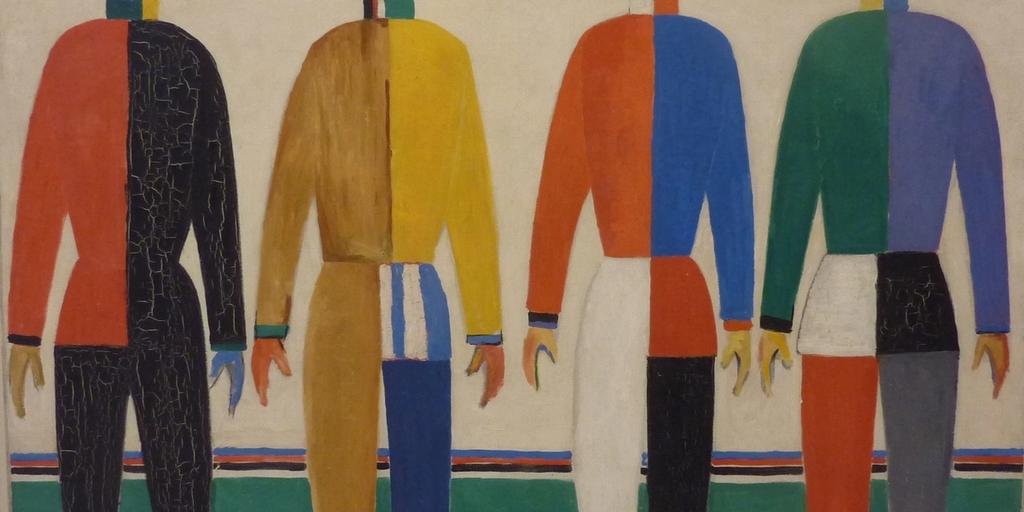
On his return to Leningrad, Malevich was arrested on suspicion of counter-revolutionary conspiracy and held for several weeks. He was interrogated many times, for hours at a stretch, but was eventually released and able to resume his work. The trip to Europe and the trauma of his arrest prompted Malevich to reconsider his theoretical views. He began painting again, and recognisable figures set against landscape backgrounds appeared on his canvases. He returned to the peasant subjects of his pre-revolutionary work. Art historians initially classified this phase as the 'Second Peasant Cycle', before later renaming it 'New Figurativity'. The paintings of this period are static and monumental. Malevich positions his figures frontally and makes deliberate use of symmetry.
The palette and the depersonalised figures create a sense of detachment from earthly reality. Alongside the motifs of his early work, Malevich drew on techniques used by his European contemporaries — Giorgio de Chirico among them. On the reverse of his 1932 painting Torso in a Yellow Shirt, Malevich wrote: 'The composition took shape from elements of emptiness, loneliness, and the hopelessness of life.' These words convey a mood of despondency and melancholy, and this new artistic phase was in all likelihood a response to the harrowing political events of the late 1920s and early 1930s: famine, the suffering of Russian and Ukrainian peasants, and the repression of cultural figures.
In September 1930, Malevich was arrested on suspicion of espionage. His apartment was searched, and personal belongings and manuscripts were confiscated. In the 1980s, the artist's sister Viktoria Zaitseva told art historian Dmitri Gorbachev that Malevich had been tortured in an effort to extract a confession that he had disclosed state secrets during his trip to Germany. The artist was held in a prison cell for three months before being released. In his diary, Pavel Filonov describes a meeting with Malevich in 1932, during which Malevich recounted the details of his imprisonment: 'The AKhRR people wanted to destroy me completely. They said: "Destroy Malevich and the whole of formalism will disappear." But they didn't destroy me. I survived. It is not so easy to get rid of Malevich.' The imprisonment deeply frightened Malevich: after his release he was afraid to be associated with Europe and severed contact with his German and Polish colleagues.
In 1932, a new cultural policy was introduced: in order to gain access to state commissions, artists were required to join a single creative union. Almost all cultural figures and artists became members of the union, Malevich among them. Within the Artists' Union, the work of the avant-garde was labelled formalism — deemed incompatible with state ideology. In 1933, the exhibition Artists of the RSFSR: Fifteen Years was held, at which only six of Malevich's works were shown, in a small, poorly lit room.

In late 1933, Malevich fell ill and was diagnosed with prostate cancer. As late as early 1934 he was still taking on new students, but in August his condition deteriorated sharply and he was soon confined to bed. Until his death, he was cared for by his students Ivan Klyun, Nikolai Suetin and Anna Leporskaya. At one of his final meetings, Malevich asked Klyun to convey to the director of the Tretyakov Gallery, Mikhail Kristi, that 'the finest work of everything held in the Tretyakov Gallery is my Black Square!'
Malevich died on 15 May 1935 in his Leningrad apartment. Nikolai Suetin oversaw the arrangement of the memorial service: the coffin stood in a room hung with the artist's paintings, Black Square above his head, a self-portrait to the left, and a portrait of his daughter Una to the right. After the service, the coffin was taken to Moscow Station: Malevich had wished to be buried in Nemchinovka. A procession of avant-garde artists formed along Nevsky Prospekt — they were accompanying to his final resting place not only a great Suprematist, but the entire avant-garde movement. Malevich's ashes were buried beneath an oak tree in a field near Nemchinovka. A monument bearing the image of Black Square was erected at the grave. Fearing suspicion during the years of terror and war, the family chose to distance themselves from the Malevich name and stopped visiting the grave. Nothing remained of the monument, and by the 1950s the grave could no longer be found; its exact location remains unknown to this day.
So ended the life of the greatest Russian avant-garde artist, who determined the course of modern art's development. Malevich transformed the relationship between viewer and artist — a contribution that art historians regard as his most significant legacy. Charlotte Douglas, a distinguished scholar of the Russian avant-garde, concluded that Malevich's entire artistic legacy rests on the foundation of 'a union between humanity and the cosmos through art.' His paintings, like icons, connected the viewer to an artistic reality beyond the visible world.
Interesting facts:
- The White on White series is considered to have had the greatest influence on abstract art in the United States and Europe, as it was precisely these works that entered Western museum collections — the Stedelijk Museum in Amsterdam and the Museum of Modern Art in New York.
- For many years Malevich competed with the Constructivist artist Vladimir Tatlin for the title of leader of the Russian avant-garde, and this rivalry hardened into genuine enmity. Malevich accused the Constructivists of holding a utilitarian view of art and believed that Tatlin had betrayed his own revolutionary principles. When Tatlin announced the creation of the Monument to the Third International, Malevich flew into a rage and published a critical article in which he rounded on his rival: 'The eccentric Tatlin wants to obtain funding for the invention of a utilitarian monument that opens up no new meaning. Enough of erecting tombstone monuments of obelisks on the red living squares of the commune.'
- Malevich apparently understood that he would be arrested on his return from Europe, and decided to leave his manuscripts in Berlin. He attached a note to the bundle of manuscripts: 'If within 25 years I give no sign of life, the package may be opened and its contents disposed of at your discretion.' These manuscripts miraculously survived the Battle of Berlin in 1945; they are now held at the Stedelijk Museum in Amsterdam.
Also read the biographies of El Lissitzky and Wassily Kandinsky.
Follow us on social media so you never miss new content: Telegram.