Édouard Manet was the rebel of his age. He quarrelled with his father, who had mapped out a legal career for his son, escaped on a round-the-world voyage and became a painter. He was headstrong: he criticised his own teacher without mercy and rejected the prevailing canons of his day. His paintings were considered a mockery of the art of painting. Did Manet want to be a rebel? No. He was searching for his own path while, at the same time, genuinely longing for understanding, recognition, admiration and triumph.
His life was more a struggle than an act of rebellion: a struggle against his father, against the traditions of painting and his teacher's criticism, against the incomprehension of the Salon juries, and a struggle to win the public's recognition. Remaining true to his principles, Manet ultimately triumphed — yet at the same time he was defeated in his fight for life.
In this article you will learn:
- how the works of Italian and Spanish masters shaped Manet's development as a painter;
- about the difficulties that lay in wait for the painter along his creative path and kept success at a distance;
- about Manet's key works, which became forerunners of a new movement in painting — Impressionism;
- how a voyage to Rio de Janeiro changed the artist's life;
- about Manet's personal life and the muses who inspired him.

Childhood and youth: choosing a path
Paris, 1840. Every day, at the same hour, a man invariably dressed in a pressed black suit and a wool overcoat with a ribbon of the Légion d'honneur in the lapel walks into the Ministry of Justice with a serious expression on his face. This is Auguste Manet, head of the office of the Keeper of the Seals. He is forty-four years old, has risen quickly through the ranks of the civil service, and is a respected man of good family. He will soon become a judge at the Seine court. Monsieur Manet, as befits a civil servant, is married — to Eugénie-Désirée Fournier, who is fourteen years his junior. The couple have three sons: Édouard, Eugène, and Gustave. Édouard is eight years old. He was born on 23 January 1832 and is growing up alongside his younger brothers in an apartment on the rue des Petits-Augustins.
His father wants his sons to make their way in life as he has done: Édouard is to become a lawyer, Eugène a judge, and Gustave a doctor. A year ago, Édouard was sent to board at the abbé Poiloux's school in Vaugirard, but the academic subjects hold no interest for him. He waits for his nurse to take him home to his brothers, his mother, and his uncle Fournier, who shares the boy's passion for painting. When the boy turns twelve, his father — dismayed by his poor grades — transfers him to full boarding at the Collège Rollin, one of Paris's most respectable institutions. But Édouard is not especially pleased about this. On the rare weekends he spends with uncle Fournier, the boy wanders through the Louvre and gazes at canvases by Velázquez, El Greco, and Ribera in Louis-Philippe's Galerie espagnole. He lingers for a long time over Goya's Majas on a Balcony and Women of Madrid in Maja Costume. The Spanish masters leave a deep impression on the young Édouard.
Édouard's progress at the collège is unsatisfactory. Only drawing interests him; as a result he falls behind in other subjects and has to repeat the fifth form. Fournier enrols his nephew in extra painting lessons. From that moment, art consumes the young man entirely. By the age of fourteen he already has his own ideas about painting: in the drawing class, he prefers to paint portraits of his classmates rather than the prescribed plaster casts and still lifes, much to the irritation of his teacher. Édouard tells his father he wants to become an artist. Monsieur Manet is outraged.
He refuses to hear a word about his son's passion — Édouard must follow his father's example, train as a lawyer, and choose a respectable and well-paid profession rather than pursue nonsense and boyish fantasies. Édouard respects and loves his father, but has no intention of yielding: he would sooner run away from home than study law. In the end, Auguste Manet agrees to a compromise — the boy may choose a vocation to his liking, but emphatically not a career as an artist. Having fallen in love with the sea during family trips to Boulogne on the English Channel, Édouard decides to become a sailor.

The Naval Academy accepts young men under eighteen provided they have completed a round-the-world voyage. For Manet this is an ideal solution: the sea promises him the long-awaited freedom from his father's pressure. In December 1848, a voyage aboard the vessel Le Havre et Guadeloupe, bound for Rio de Janeiro, is organised for those wishing to sit the naval school entrance examination. The ship sets sail, but within a couple of weeks the young man admits he is thoroughly fed up with seafaring. The monotony of the voyage weighs on him: "Sky and water, always the same — it is deadening."
He brightens the monotonous days by sketching caricatures of sailors and fellow passengers, while at night he marvels at the play of light and shadow on the water. Rio stirs Manet's imagination: the city greets its visitors with a raucous carnival, dark-eyed Black women captivate the young man, and he experiences his first love affair with an enslaved woman from Rio. Alongside the intimacy lurks a fear of contracting ataxia, a disease widespread among Black women that attacks the motor system. But this is not his only worry. A viper bites him on the left leg, and the pain keeps him confined to the ship for the rest of the voyage, even as he dreams of returning to Paris. The long sea journey has given him time to think everything through. His father need not be angry: painting is his calling.
The making of a painter
In January 1850 Manet joins the studio of the celebrated painter Thomas Couture. Édouard is happy. He gives himself over entirely to art. After sessions in the atelier, as in earlier times, he visits the Louvre and immerses himself in Italian painting, studying the canvases of Titian and Tintoretto. Several times a week a fair-haired young woman with pale luminous skin, a sturdy figure and quick hands that move nimbly across the piano keys comes to the apartment on the Rue des Petits-Augustins — Suzanne Leenhoff, a twenty-year-old pianist, gives Manet and his brother Eugène music lessons. Feelings flare between the young man and the young woman. In the evenings Manet hurries to Suzanne's small apartment for their rendezvous. At all other times it is colour and form that give Manet his visual pleasure. He immerses himself in the world of texture and hue, striving to capture life and movement in his work.

Yet Manet's era favours a lifeless painting bound by convention and established standards. One must depict not what one sees but what one ought to see — such is the merciless law of academic art. Manet grows increasingly independent of contemporary canons and begins to doubt the very nature of his artistic training: "It is all absurd. The light is false, the shadows are false. In the studio I feel as though I am in a tomb." He begins his struggle for his own understanding of art — persuading models to adopt natural, relaxed poses, dispensing with half-tones, and roaming the streets ever more frequently to sketch fleeting impressions. Couture is furious with his wayward pupil. Quarrels and misunderstandings arise between them. Couture is contemptuous of Manet's work: "You will never learn to paint what you see!" Manet retorts: "I paint what I see, not what others like to see. I paint what is there, not what is not." In 1856 Manet leaves the studio.
Alongside his quarrels with Couture, Manet is grappling with another pressing matter: Suzanne is pregnant. The artist loves her and is prepared to marry her, but cannot bring himself to tell his father. He confides in his mother, who will keep her son's secret. On 29 January 1852 Suzanne and Édouard's son, Léon-Édouard Koëlla, is born. Even so, Manet cannot bring himself to break the news to his father, and the child will be presented throughout his life as Suzanne's brother and Édouard's godson.
Italian painting is a subject of growing discussion in Manet's circle. The young man dreams of the museums of Florence, Venice and Rome, and at last travels to Italy. He returns with his own copies of works by the great masters. His copy of Titian's Venus of Urbino is by no means a slavish reproduction of the original but a bold transformation of Venus. In Manet's study she is more woman than goddess. Back in Paris the artist continues to study the masters at the Louvre, producing numerous free sketches after Titian, Rubens, Velázquez and Rembrandt. At the same time, anxieties gnaw at him. He longs for the easy, glamorous life of an admired artist, yet in reality everything seems to be moving in the opposite direction. Manet's father grows frailer with each passing day, and his son, tormented by guilt, is driven by a desperate need for success to prove himself right. It is at this time that the painter meets the poet Baudelaire, who will remain his closest friend for the rest of his life.
The sweetness of victory and the bitterness of defeat
Manet dreams of exhibiting at the Salon. The Salon — the official periodic exhibition of the Paris Académie des Beaux-Arts — was virtually the only venue at which artists could present their work to the public. A place at the Salon was formal confirmation of an artist's talent. Outside it, success did not exist, and Manet hungered for success.
The next exhibition was to open in 1859, and the artist prepared two paintings for it: Boy with Cherries and The Absinthe Drinker. In these works he drew together his research and observations. In Boy with Cherries he moved away from half-tones and became absorbed in texture, technique and colour. Couture — with whom Manet maintained contact despite their quarrel — criticised the bold brushwork of his former pupil.
In The Absinthe Drinker, Manet declared his intention to have nothing to do with history painting and his determination to seek out contemporary subjects for his canvases. In the picture he worked up the details with great care, striving to rein in his passion for free brushstrokes. The priming of the canvas followed Couture's formula, the half-tones were carefully calibrated, and the whole work breathed the discipline of the atelier. Manet made concessions in the hope of pleasing Couture and the Salon jury — but in vain. His former teacher was outraged by this portrait of a drunkard, calling the work vile. Manet was shaken; his confidence in success was rattled. And not without reason: the jury refused to admit the canvas to the exhibition.
Despite the setback, the artist was not broken. He believed the failure was a matter of circumstance. Manet continued his creative search, turning ever more often to the paintings of Velázquez and Rubens for inspiration, and spent long hours in the Tuileries Garden — the public park at the heart of Paris. There he observed people, quickly noting in his sketchbook the fleeting, shifting, contingent quality of modern life. Manet held that one must do immediately what one sees. The fruit of this search was the canvas Music in the Tuileries Gardens.
This time Manet resolutely cast aside all of Couture's precepts. He abandoned strict composition — that was beside the point. The artist concentrated on the interplay of light and shadow that creates movement on the canvas. The light, vibrating brushstrokes give the impression that barely audible music drifts from the picture. The pure, saturated colours convey a sense of freshness. Yet Manet's innovations met with no great enthusiasm. Even close friends, Baudelaire among them, were reserved, finding the work too bold.

Manet needed approval more than ever. The young painter asked his father and mother to sit for a new picture he intended to submit to the 1861 Salon. The bourgeois Parisian couple is enveloped in a vague melancholy. Monsieur and Madame Manet have lowered their eyes, as though lost in a reverie. The portrait pleased his parents: Monsieur Manet showed the canvas to his friends and marvelled at his son's talent. Encouraged by this domestic success, Édouard Manet believed in himself again, in a coming triumph, and pressed on in his struggle for recognition. In a burst of creative energy, he hired a Spanish model and painted The Spanish Singer in a single breath. He relished the broad, free strokes of gleaming, pure colour. Both the parental portrait and The Spanish Singer were submitted to the 1861 Salon.
He was twenty-eight years old and hungry for praise. What a delight it would have been to catch the envious glances of fellow artists, to hear his name on the lips of the crowd. Stung by previous failure, he was anxious once again. But this time success awaited the pictures: both canvases were not only accepted into the Salon but received genuine appreciation. The musician is painted in an unusual, fresh manner. Connoisseurs detected in The Spanish Singer the influence of the Spanish masters and of Velázquez: Velázquez would have given him a friendly wink, and Goya would have asked for a light to kindle his cigarette. How he strums that guitar! It seems we truly hear it all… In this figure, painted with a free brush, rich in texture and rendered in an infinitely truthful palette, one senses an abyss of talent. Manet was elated. The long-awaited victory was his.
1862 proves to be a rich year for Manet. The painter meets Victorine Meurent — a slender blonde with auburn-tinged hair, a matt pale complexion and expressive dark eyes. She dreams of becoming an actress. For many years she will be his favourite model. Manet paints her immediately as The Street Singer and in several portraits. Victorine appeals not only to Manet the artist but to Manet the man. An intimacy develops between them. Suzanne will know nothing of it; besides, his wife has a gentle temperament — she is not jealous and does not make a scene over a husband's passing fancy.
Around the same time Manet paints portraits of other women. The Portrait of Madame Brunet was the first commissioned work of his career; yet Manet's unflinching honesty — his refusal to apply the flattering touches typical of fashionable portraitists — offends the client. She finds the unvarnished likeness vulgar. Another figure Manet paints from Baudelaire's mistress during one of their quarrels. Jeanne Duval, a mixed-race woman with yellowish skin and a sullen, prickly gaze, wearing a dress with an enormous crinoline, reclines on a sofa. Against the expanse of her billowing skirt, her face looks unnaturally small. Manet completed this work in a single sitting and filled it with an airy lightness.


Spanish themes continue to preoccupy the painter of The Guitar Player. A troupe of dancers from the Royal Theatre in Madrid arrives in Paris on tour. On Baudelaire's advice, Manet paints several portraits of the dancers. Lola de Valence is the most successful of them. At rest, Lola is not especially striking. Yet in motion, this stocky, muscular, almost androgynous woman with an impassive face and coarse features is transformed. She becomes light, feminine, a fresh flush of colour in her cheeks — and it is this moment that Manet captures.
That same year Manet's father dies. There is nothing unexpected in the death — the old judge had been fading day by day — yet Édouard is deeply shaken by the loss. Gradually returning to work, Manet turns his thoughts to the Salon of 1863. Drawing on Giorgione's Pastoral Concert, he creates Le Déjeuner sur l'herbe and submits it to the jury together with two portraits. Shortly before the Salon opens, a private exhibition organised by Martinet takes place in Paris, at which Manet shows fourteen paintings ranging from Music in the Tuileries to his most recent portraits of women.
The painter is pleased by the coincidence. He intends to cause a sensation with his canvases, to ignite public interest in his work and to win admiration at the Salon. Everything has been carefully thought through. But alas — to Manet's astonishment, visitors to the exhibition are once again displeased: they whistle and jeer, and some attempt to jab at the paintings with their walking sticks. Music in the Tuileries provokes particular outrage. Arguments and indignation mount: What carelessness! Mere daubing! Manet is stunned, drained, crushed. The critics press on: A garish jumble of colours is not a palette — it is a caricature of painting. Then comes the verdict from the Salon jury. All three works are rejected.
The Salon des Refusés
In 1863 an unusually large number of works were rejected from the Salon — 2,800 canvases in all. Artists are outraged. Their angry protests echo across Paris. They demand a free salon, free from jury oversight. The rumble of discontent reaches the Emperor himself. Napoleon III decides to open the Salon of the Emperor, where the public itself will settle the disputes. The news fills the rejected artists with indescribable joy. Yet if rumour is to be believed, the academicians and jury members — incensed by this intrusion into their authority — will do everything in their power to turn the Salon of the Emperor into a Salon of Mediocrities. Several dozen wavering artists withdraw their paintings. Manet is not among them. He has no doubts about the success of Le Déjeuner sur l'herbe.
Tension in Paris has reached a fever pitch: everyone is talking about nothing but the Salon and the Counter-Salon. The 'rejected' are the sensation of the season. Within just a few hours of the Counter-Salon opening, seven thousand tickets have been sold. Every visitor arrives predisposed to view the rejected canvases with contempt. Few make any effort to approach the Salon des Refusés without prejudice. For most, any work on display provokes an outburst of laughter. Everything here is perceived as ridiculous and absurd. If the celebrated Mona Lisa were hanging among the paintings, it too would reduce the crowd to howls of mockery.

From its very first days, Le Déjeuner sur l'herbe draws a crowd. The painting stands apart from the other canvases through its vitality and originality, eclipsing everything around it. Manet's technique is so striking that the work immediately becomes the emblem of the Salon des Refusés. Two nude women alongside two fully dressed men. The public finds the composition an act of unheard-of audacity — 'indecent,' a mockery of painting itself. The Déjeuner provokes not so much laughter as outrage. Manet is bewildered. What could viewers possibly find offensive in the picture? The artist genuinely wishes to please, yet instead finds himself the subject of scandal. The gulf between his personal aspirations and the public reception of his work erects a wall of incomprehension between him and his audience.
It is not in Manet's nature to concede defeat and set down his brushes. Once again he sets out to make his ideas felt in the world of art lovers and to reclaim his standing. This time he takes as his point of departure a masterwork he had once copied — Titian's Venus of Urbino. He reworks the canvas and presents the goddess in a new light, casting her as an ordinary woman. His model is Victorine Meurent. The young woman's slender, dark-complexioned body he places against a backdrop of snow-white sheets and pillows. The pale tones contrast with the dark background. To animate the composition and lend it depth, Manet introduces a secondary figure into the right-hand side of the canvas — a Black maidservant. After long deliberation, he replaces the little dog of the Venus of Urbino with a black cat — his favourite animal.
Manet completes the work exhausted but elated. For the first time, he feels entirely confident in a painting. His Venus is a masterpiece. The superb technique, the interplay of light and shadow, the struggle between white and black fill the canvas with a sense of vibration. Sharpness is wed to refinement. Baudelaire encourages his friend: 'The Salon of 1864 will see nothing finer than Olympia.' It is thanks to Baudelaire that the painting came to be known as Olympia. Yet beneath Manet's elation lies a creeping fear. What if the picture once again provokes scandal and ridicule? Intimidated by this perfect creation, he puts it away in a distant corner of his studio, where it will remain for years.

At the Salon of 1864, Manet presents two paintings: Episode from a Bullfight and a religious composition, The Dead Christ with Angels. For the central figure of the Episode, the artist draws on Velázquez's The Dead Soldier. He labours long over the bullfight scene, repainting it from scratch. At last both canvases are finished and submitted to the jury. The committee finds both works 'repulsive', yet nevertheless accepts them into the Salon, so that 'the jester cannot use their rejection as a pretext for scandalous success.' Manet is unaware of this and is therefore happy. He awaits recognition.

Yet a false image of him has taken hold. Critics and public alike are convinced that he seeks only provocative bravado, that he is hungry for notoriety and publicity — a rebel and a mocker. Manet himself wants nothing of the sort. He wishes only to be what he considers himself to be: a young man of good family, dreaming of honest and untroubled success. The critics are merciless: 'ugly canvases,' painting done with 'a boot brush.' Manet has even begun to concede the flaws himself — the bull is too small, and the perspective looks dreadful. When the canvas is returned to him, he takes a knife to it, keeping two fragments — a view of the arena and the figure of the slain torero — and destroys the rest.
Preparing for the next Salon of 1865, Manet heeds Baudelaire's advice and submits Olympia. He is convinced that even the sharpest tongues will be silenced before a masterpiece. As his second canvas he sends a new religious work, The Mocking of Christ. Both paintings are accepted, but compared with the extraordinary explosion of hostility directed at Olympia, The Luncheon provokes only mild displeasure. The public is outraged once again. Where on earth did Manet find such an Olympia? What new trick is this from the clown Manet? 'Shameless courtesan,' 'pornography,' 'female gorilla' — insults rain down on Manet from every direction. The Salon administration is forced to station guards beside the painting to prevent the public from tearing the canvas to shreds. But even that proves insufficient. The picture is rehung near the ceiling, out of reach of the furious crowd. The religious subject is denounced as a caricature of Christ. Another failure.
On the street, Manet is recognised and practically pointed at: 'The man who painted the Venus with a cat.' Not a single person stands by the hapless painter who sees what others cannot. Only Baudelaire believes that Manet's talent will 'endure' and supports his friend — yet Manet is utterly broken, unable to bear yet another defeat, and flees to Boulogne, to the sea he loves so dearly, though this time it cannot heal the wounds of an unrecognised genius. Manet travels to Spain, the homeland of El Greco, Goya and Velázquez.
The works of the Spanish school draw Manet back to his brush. He returns to the theme of bullfighting, which had not come off in Episode of a Bullfight, and swiftly paints Bullfight in Madrid and several similar canvases. In these new works he takes his bearings from Goya's painting and strives to convey the taut dynamism of the Spanish corrida. Around this time the artist also paints The Fifer. The composition is simple and spare, yet radiates energy and force. The boy plays his fife with a child's unselfconscious gravity. His lithe figure is perceived by the viewer as a vision conjured by the instrument's melody. In The Fifer Manet reaches the height of his mastery. He has cast aside all of Couture's academic rules and brought pure colour into perfect harmony.


Gradually, Manet's work gained recognition within French intellectual circles. Contemporary artists — among them Auguste Renoir, Edgar Degas and Claude Monet — along with several writers began to gather around him. The young men met regularly at the Café Guerbois and argued at length about art. From 1876 they moved on to the Nouvelle Athènes. The public and the press quickly dubbed the group 'Manet's gang' and the 'Batignolles School.' Gradually the circle of like-minded figures widened to include Camille Pissarro, Paul Cézanne, Émile Zola and others. Manet sees nothing provocative in these gatherings.
Meanwhile, the Salon jury once again rejects Manet's inoffensive canvases, among them The Fifer. The number of rejected artists grows too large to ignore. One of them takes his own life. Discontent spreads through the artistic community: cries of 'Murderers!' ring out in the streets. The newspapers report that Manet — the very Manet who works quietly in his studio — is secretly stirring the discontented to revolt alongside his 'gang.' Around the same time, Émile Zola writes: 'Monsieur Manet's place in the Louvre is already assured. We laugh at Monsieur Manet today, and our sons will admire his canvases tomorrow…' Society has split into a small number of Manet's admirers and crowds of his opponents.
But Manet is troubled by another piece of terrible news: the newspapers have reported the death of his closest friend Baudelaire. The report is false, yet the truth is no better — the poet is gravely ill. For Baudelaire's sake, Manet spends the summer of 1866 in Paris, continuing to work, producing several paintings and hoping for success. In 1867, Napoleon III announces that that year's World's Fair will be held on the Champ de Mars in Paris and will include an international art exhibition. Soon, however, word spreads that only artists recognised by the Salon jury will be permitted to participate. Manet is not among them. He suffers. He is thirty-five years old, still unrecognised, earning nothing, and having made little progress since the beginning of his career.
Manet plans to mount a private exhibition, constructing his own pavilion near the Champ de Mars in which he will present his finest canvases. Fearing that his initiative will be seen as yet another act of rebellion, he calls on the public to 'look at sincere works.' He presents his best pieces: The Absinthe Drinker, Le Déjeuner sur l'herbe, The Spanish Singer, Olympia, Music in the Tuileries Gardens, and the portrait of Lola de Valence. But the public, once again, refuses to recognise the artist's mastery. He is mocked and criticised. Manet is exhausted. Obstacles lie in wait for him at every turn. In his own words, each new day promises only 'a foul torrent of insults.' Manet once more takes refuge in Boulogne and its restorative sea air, but a piece of sorrowful news draws him back to Paris — Baudelaire is dead.
Manet's Muses
And yet life goes on. The painter spends long hours in his studio. He works on a portrait of his son Léon — Soap Bubbles. He has made his peace with his scandalous reputation, but remains true to his talent. It is encouraging that two canvases are accepted for the Salon of 1868. Manet turns to Goya's Majas on a Balcony and begins work on The Balcony. He plans the composition with great care. The painting has four figures: two women and, behind them, a man. In the background, another indistinct male silhouette is visible, painted from Léon Koella. The standing figures are posed by two young people who are in love with each other — a fashionable painter from the Café Guerbois and a friend of Suzanne. The model for the other female figure is Berthe Morisot.
Together with her sister Edma, Berthe studies painting under Manet. The young women come to the artist's studio accompanied by their mother. Madame Morisot, however, is rather less interested in painting than in securing her daughters' futures. Edma will soon marry and give up art. As for Berthe, she appears to be in no hurry to wed. At twenty-seven, she has already turned down more than one proposal. Outwardly she is cool and reserved, yet within her burns a fire of molten intensity. Her deep green eyes stand in sharp contrast to the pallor of her thin, sharply defined face. She admires the pure and sincere work of Manet, so unlike the rigid painting of the day. She recognises in Manet the artist a genuine talent. He stirs something in her as a man, too. Manet, for his part, is equally captivated by Berthe. Through her influence he develops a passion for plein air painting, increasingly working outdoors.
Manet is at work on The Balcony. The two models who are in love soon grow weary of the repetitive studio sittings. They would far rather meet elsewhere, and so in one voice persuade the artist that the painting is 'already perfect' and that 'there is nothing more to add.' Manet turns his focus to the seated female figure of Berthe. She poses for long stretches at a time. The painter studies her features with tireless attention — her gaze, her skin, the dark curls falling to her shoulders. Sensing the hidden passion of her nature, he is fired by it himself, working the brush 'with the look of a madman.' The canvas is accepted for the Salon of 1869. This time the jury is well-disposed: 'Manet's works are respectable; they will cause no scandal.' The figure of Berthe on the canvas draws widespread attention. It is hardly surprising that she 'overshadows' the other figures. Even so, the public and critics greet the artist with hostile indifference.
Manet continues to work in his studio, frequently sketching portraits of Berthe. Berthe paints under his guidance. Between the young woman and Manet stands a wall of obligations, moral principles and personal convictions. Alone together, they talk about everything except their feelings, and they will never allow a flame to kindle between them. Berthe's presence in the studio leaves the artist restless and the young woman melancholic. She makes no effort to conceal her irritation when she sees other women in the studio. Her unease grows when Eva Gonzalès asks Manet to become her painting teacher. Eva has been practicing art for two years and is eight years younger than Berthe. A thick mass of hair, a determined chin, a sharply defined nose with a slight bridge — the young woman radiates youth and femininity, bringing a new liveliness to Manet's studio. The artist frequently praises Eva and holds her up as an example to Berthe. The two women regard each other with undisguised coolness.

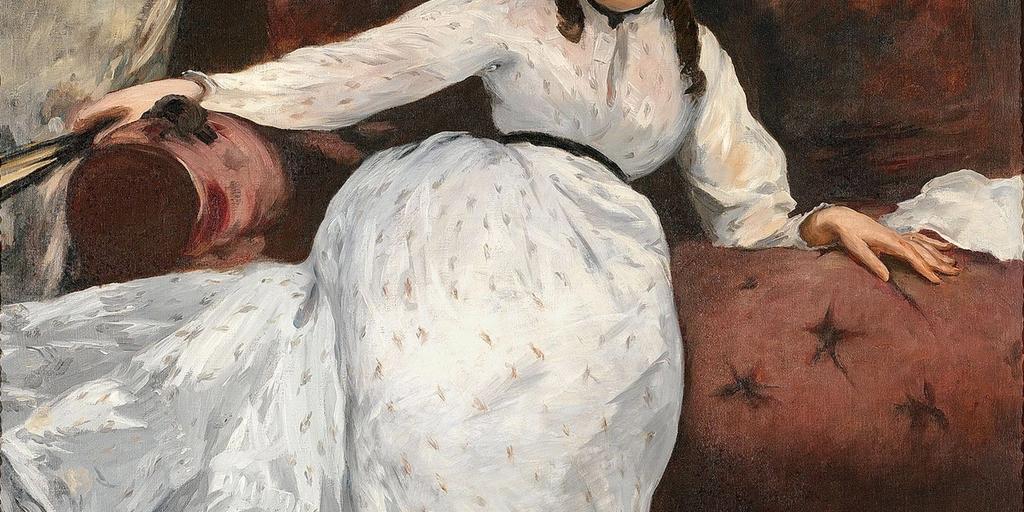
Manet begins to paint Eva's portrait. Where portraits of Berthe come to him with ease, this one demands extraordinary effort. The difficulty irritates the artist, and in Berthe it provokes a quietly poisonous pleasure. He travels to Boulogne, returns to the work, and tries again — all to no avail. The sittings multiply while results remain elusive. How much he would have liked to exhibit the portrait at the Salon of 1870. But one autumn day Berthe arrives at Manet's studio and, with her characteristic ease, settles on the sofa in a loose white dress cinched at the waist with a black belt. Manet seizes his brush and, in a single minute, paints her portrait. Not a single additional sitting was needed to transfer the sketch to canvas and transform it into the sensuous, air-filled portrait that would become known as Repose. He does not, however, send the canvas to the Salon, fearing that it would lay bare his most intimate feelings before the public.
During this same period Manet creates the canvas The Execution of Emperor Maximilian, inspired by the tragic events in Mexico. During the French intervention in Mexico of 1861–1867, Napoleon III helped Maximilian obtain the title of emperor. However, when armed resistance intensified in 1866, the French were forced to withdraw; Maximilian was taken prisoner and sentenced to death by firing squad. Manet was less motivated by republican sympathies than by Goya's work The Third of May 1808 in Madrid. The artist places the emperor and his companions on the left side of the canvas. The soldiers occupy the compositional centre. There is almost no empty space on the canvas — as if the artist is showing that the figures are cornered, with nowhere left to turn.

The artist creates another canvas — Luncheon in the Studio. The work resists easy categorisation: it combines genre scene, portrait and landscape. In the foreground, the artist's son Léon gazes dreamily beyond the edge of the canvas. The painting is filled with colour and life; it feels as though, in another moment, the figures will turn back to their everyday affairs. In 1870, Berthe Morisot introduces Manet to her acquaintance Valentina Carré, and the artist produces his first plein-air painting, The Garden, in which he brings together portraiture and landscape painting. The Garden marks a new chapter in Manet's work — one suffused with light and the purity of colour.

The cloudless days filled with women's smiles did not last long. In 1870, Napoleon III declared war on Prussia. The fighting forced Manet to set aside his painting for a time. He sent his family south to the French provinces and enlisted as a volunteer in the artillery of the National Guard. The artist spent four long months in a besieged Paris. He wrote letters to his wife but received no reply. Winter set in. The weather worsened. Frost came. Food was scarce in Paris. Manet was ill with influenza, 'thin as a rail.' His left leg began to ache. The silence from Suzanne tormented him. 'No gas, nothing but black bread and cannon fire day and night. I simply cannot hold on any longer,' he wrote. In 1871, following the armistice, Manet left for the south to rejoin his family.
Yet news of civil war soon reached him from Paris. Unable to work, the artist returned to the capital. Confronted with the devastation of his home city, he fell into despair. The gruelling year had broken Manet. He seemed shattered, his vital energy spent. Everything irritated him. On his doctor's insistence, he travelled to the seaside at Boulogne. In 1872, Manet and Suzanne made a brief trip through Holland. The short respite restored his strength, and on returning to Paris he picked up his brushes once more.
Success at last?
Manet still agonised over his failure to establish himself as an artist, over his inability to earn a living from his paintings. He asked his more successful colleague Alfred Stevens to hang a few of his works in his drawing room on the off chance that someone might take a liking to them and he could make a little money. And then, a miracle: Paul Durand-Ruel, a dealer born into the art trade, took an interest in Manet's paintings and within a week bought canvases worth 53,000 gold francs — a considerable sum at the time. It was an extraordinary success for Manet. He was happy at last. His financial troubles were resolved. Paris began to murmur his name, and Manet knew he had to cultivate his image at the Salon of 1873. The creator of Le Guitarrero looked back on past glories: eleven difficult years had passed since his painting had last been publicly admired. He felt buoyed up, reconciled with life and with people.
For the new Salon the artist painted Le Bon Bock — a portrait of the lithographer Émile Bellot, a regular at the Café Guerbois. Manet had no doubt that this time he had created a masterpiece. A man with an open, guileless gaze, a ruddy face beneath a fur cap, thick moustache and beard, lounges freely in his chair, a mug of beer in one hand and a pipe in the other. His friends were unanimous: 'What painting!' At the Salon, Manet's reception was overwhelming — a genuine triumph. The very triumph the artist had been striving towards since the beginning of his career in Couture's studio. Prints of Le Bon Bock sold everywhere; the portrait was even adopted as the sign of one of Paris's taverns.

Alongside Le Bon Bock, Manet showed another masterpiece at that year's Salon: Le Repos. Bertha and Édouard's brother Eugène were now engaged, and the artist felt it was safe to exhibit the work. The critics, however, were more reserved about the female portrait. Some drew comparisons between the 'old' Manet — the creator of Olympia — and the 'new' Manet, suggesting that the artist had 'watered down his beer.' Manet was at once indignant and unsettled by the success.
In the summer of 1873, Manet holidayed with his family at Berck on the English Channel coast, where he worked exclusively en plein air. Back in Paris, he began two large open-air canvases — The Croquet Game and The Railway. Both paintings feature the figure of Victorine Meurent, who had returned from her wanderings in search of a better life at home. At the same time, Manet worked on other canvases, completing Masked Ball at the Opera and the plein-air painting The Swallows. Buoyed by his success, the artist submitted three paintings to the jury — but only one was accepted: The Railway. The Swallows and Masked Ball at the Opera were rejected. Critics felt that Manet was wrong to stray from the path of Le Bon Bock and revert to his old ways. And what kind of title was The Railway? There was not a single carriage or locomotive in the picture — only a cloud of white steam in the background.


Manet is once again cast among the rebels. The success of Le Bon Bock has changed nothing. After yet another scandal, the hapless painter makes his way to his friend Claude Monet for an open-air painting session on the banks of the Seine. It was Monet's canvas Impression, Sunrise that gave the Batignolles group their resonant name — the Impressionists — a word meaning, in translation, impression.
His companion's vivid canvases fill Manet with admiration. Enchanted by the refined palette of Monet's work, Manet turns to pure tones and plays with light and shadow. From his brush emerge fresh, accomplished pieces — Boating and Argenteuil. The paintings radiate light. Figures stand out against a backdrop of azure water. In 1875, the artist submits Argenteuil — a single canvas — to the jury of the next Salon. The painting is accepted, but controversy erupts around it. The cerulean blue of the Seine soon becomes no less famous than the cat in Olympia. Viewers and critics indulge themselves in mocking the master's pure colours, likening the transparent waters of the Seine to a painted wall. Manet has long grown accustomed to the blows of fate. Ridiculed once more, he travels to Venice, where he creates another light-filled canvas in the spirit of Argenteuil — The Grand Canal in Venice.


Meanwhile, the Impressionists organise their own exhibitions and invite Manet to join them. But the painter has no intention of taking part, fearing that he will once again be branded a rebel and a troublemaker. He wants to achieve universal recognition in the traditional way — through the Salons and their juries: "I shall never exhibit in a back room; I enter the Salon through the main door." Besides, Manet does not share all the innovative ideas of his Impressionist companions.
He embraces their pure, saturated colours, but retains his commitment to monumentality and solidity. He dislikes incompleteness and ambiguity in a canvas. Manet bristles when he is called the king of the Impressionists. He is not an Impressionist and will never become a slave to any formula. The ideological founder of a new direction in painting follows his own singular path.
At the 1876 Salon his paintings are rejected. But Manet, true to himself, is ready to respond. He will show his work in his own studio. His atelier becomes a private exhibition. Over the course of two weeks, four thousand people pass through the small room. Manet's name is on everyone's lips, and this time the public is nearly ready to acknowledge his talent. The press treats him with favour.


His studio is also visited by young women who come to admire his canvases. Among them is Méry Laurent — a tall courtesan with a full figure, clear blue eyes, and copper-tinged blonde curls. Manet increasingly pursues brief affairs — he has never been indifferent to female attention. Suzanne turns a blind eye. The artist paints a portrait of another celebrated demimondaine, Henriette Hauser, and titles it Nana. The image is inspired by his intimate involvement with Méry, and the title by Zola's novel L'Assommoir, which follows the story of the kept woman Nana. He submits the painting to the Salon, but it is rejected for immorality. A half-dressed woman in a room with a fully clothed man — it is indecent, vulgar, common. In a fit of pique, Manet declares that he will not exhibit at the next Salon in 1878.
A Belated Triumph
In the spring of 1878, Paris is alive with festive energy. Manet hosts receptions that draw ever-growing crowds, as does his studio. Around him a circle of admirers and like-minded friends is gradually taking shape. He spends his days standing before the canvas, concealing physical suffering and low spirits behind a smile. Pain and numbness in his left leg trouble him with increasing frequency, and bouts of dizziness follow. He tells himself it is nothing more than ordinary rheumatism, yet he finds his thoughts turning, despite himself, to a youthful act of rebellion and a voyage to Rio. Could the time have come to pay for the follies of boyhood?
The master has conceived a series of paintings depicting modern life and works in something close to a fever. As a sequel to Nana he paints another portrait of Henriette — a prostitute sitting at a café table, waiting for a client. A run of works set in cafés, café-concerts and cabarets follows. Pushing through physical pain, Manet takes on the large canvas In the Conservatory, only to find that he can no longer work as he once did — he needs to rest more and more often. He turns to pastel: it is easier to handle than oil, and its tones convey the stirring beauty of women with remarkable subtlety. In this medium he produces a light, fresh portrait — Blonde Woman with Bare Breasts.


One evening in 1878, as Manet leaves his studio after another full day of work, a sharp pain in his lower back strikes him and he falls to the pavement. His doctor spares him the truth, concealing a diagnosis that can no longer be in doubt. Before long, however, the artist learns the name of his illness. In horror he repeats it over and over: ataxia, ataxia… It cannot be. Could a carnival night in Brazil have poisoned him with its venom? Manet wants to live. He must live. He must recover. He sustains that belief through relentless work. Every ounce of his energy is concentrated on art.
Filled with defiant enthusiasm, Manet tells those close to him: "One day my paintings will be showered with gold — unhappily, you will not live to see it. Success will come late, but it is certain: my pictures will enter the Louvre." The works of this period radiate an extraordinary love of life and beauty. Yet there can be no illusion: it is the fever of a dying man. He does not recover; his legs lose their suppleness and the brush falls from his hand with ever greater frequency.
At the same time, respect for his art is growing. Mary Laurent, eager to distract her dear friend from his illness, sends wealthy collectors his way. Manet's talent is in demand, and portrait commissions arrive in number. Of the author of Olympia it is written: "Manet is a man of conviction and tenacity. He believes in his painting. The work of younger and newer artists owes a great deal to his lessons and methods… Those who once choked with laughter before his canvases and now contemplate them without the shadow of a smile insist that Manet has grown wiser with age. But perhaps it is rather they themselves who have grown wiser?" Meanwhile, Manet fights desperately for his life: he endures his treatment with courage and follows his doctors' advice, though in his own words it amounts to "the most brutal torture." He is not yet broken, and deep down he still hopes for a recovery.
He has no finished canvases ready for the Salon of 1881, and the unacknowledged genius hastily produces two works. The first — a portrait of the lion hunter Pertuiset — underscores all the virtues of Manet's painting, yet the composition feels unresolved. The lion in the background looks more like a pelt than a living animal. The second is a portrait of Rochefort, the polemicist who was condemned in 1871 and sent to penal servitude, but who escaped and returned to France in 1880 with renewed political convictions. Manet depicts the escape.


While the painter labours over his canvases, changes are taking place in the artistic life of Paris. The Salon is no longer a state institution. Young and independent artists are winning seats on the jury. Despite the controversial nature of Manet's works, they are accepted by the Salon. What is more, a significant number of the new committee members vote to award the master a prize. From this point on, the paintings of Édouard Manet will bear the letters 'H.C.' — hors concours — two letters towards which the creator of these remarkable canvases had been working from the very beginning of his career, and which he received as official recognition only at the age of forty-nine. That same year, Manet is awarded the Légion d'honneur. His heart is filled with genuine joy.
Now a recognised artist, he cannot afford to waste a single minute. He senses the breath of death. Working rapidly, he completes the flower-scented canvas Spring, continues work on another portrait, Autumn, and sets about his most ambitious painting, A Bar at the Folies-Bergère. Extraordinarily bold painting. The fair-haired Suzon stands behind the bar. A large mirror in the background creates a fluid, ambiguous space, pushing the boundaries of painting outward. The viewer involuntarily feels like a patron of the bar. The work cost Manet enormous effort, but it was not in vain. At the 1882 Salon, Spring and A Bar at the Folies-Bergère are hung with the 'H.C.' label, which draws the public's attention and respect, invites reflection and encourages sympathy. 'This man has strength,' writes one critic. 'The French Goya,' echoes another. Manet is at last satisfied, yet he understands that he cannot hold out against death. Death is already very close.

Manet tries not to give in. Despite terrible pain, he starts and abandons pastel works, paints fresh floral still lifes from the flowers his friends continually send to the studio. Suzanne and his son Léon surround him with care, and his friends support him in every way they can. The artist keeps up his spirits in the company of young women, but can no longer conceal his pain. In the autumn of 1882, Édouard Manet writes his will: 'I appoint Suzanne Leenhoff, my lawful wife, as my sole heir. She shall bequeath everything I have left her to Léon Koëlla.' Manet's mood worsens day by day. The good health of those around him irritates him. With bitter determination he tries to finish the sketches for a future work, The Amazon, intending to submit it to the next Salon, but the painting will never be completed. Manet is gravely ill. Gangrene sets in on his left leg, and it is amputated. Léon, who has long since learned the secret of his parents, spends all his time with his father. On 30 April 1883, on the eve of the opening of the next Salon, Manet dies in agony in his son's arms. 'We did not know how great he was!' Edgar Degas will say the following day.

Throughout his life, Édouard Manet remained true to his conviction of 'painting only what you see.' After his death, Manet's reputation grew without pause. In 1884, his friends mounted an exhibition of his paintings that became an absolute posthumous recognition of his genius. His work exerted a powerful influence on modern painting and served as the point of origin for a new artistic movement that came to be known as Impressionism.
Interesting facts
- Even as a child, Édouard Manet preferred the profession of artist to the lucrative profession of lawyer.
- Manet rejected academic standards in painting and worked by the principle of 'paint what you see,' which led to a falling-out with his teacher and earned him harsh criticism from the jury of the French Salon.
- Most of the artist's paintings were not accepted by the public, and Olympia even had to be guarded by two attendants and hung close to the ceiling to prevent an enraged crowd from tearing the canvas to pieces.
- Manet is considered the father of Impressionism, yet he himself took offence whenever he was associated with the movement.
- Although the artist was married to Suzanne Leenhoff throughout his life, he shamelessly pursued young women and had affairs on the side. In his final years he was tormented by ataxia.
- Édouard Manet received full recognition as a painter only after his death.
Losko also has biographies of other artists: Kazimir Malevich, Edvard Munch and Vincent van Gogh.
Follow us on social media so you never miss new content: Telegram.