Today, Edward Hopper's work is admired equally by champions of traditional classical art and by the avant-garde. He has been called many things: 'the poet of empty spaces', an urbanist, a forerunner of Pop Art, 'a dreamer without illusions', and more. Yet Hopper's road to the top was far from dazzling, and the originality of his paintings is inseparable from his own personality.
In this article you will learn:
— about the key stages of Edward Hopper's creative career
— about his artistic style
— about architecture in Edward Hopper's work
— about the artist's most celebrated works

Childhood
Hopper was born in 1882 in the small town of Nyack, New York, into a prosperous family. As a boy, Edward loved to draw, and even though he spent a great deal of time at the harbour learning about seamanship, the urge to make pictures never left him. His parents encouraged his artistic interests and enrolled him in illustration studies; he later gained entry to a prestigious New York art school. Most of his fellow students remained obscure; others went on to become painters of national standing; Hopper achieved international recognition — though not immediately.
His was a complex personality: introverted, taciturn, and deeply shy. His paintings are often read in exactly this light. They tend to depict enclosed spaces, solitary figures, twilight, lifeless interiors and roads that lead nowhere — all of it conveying feelings of alienation and isolation that run like a thread through his entire body of work.
University
Hopper enrolled at the school of the celebrated American realist Robert Henri (later the New York Art School), which at the time was focused on forging a modern national art for the United States. Nurturing individuality in students was its guiding principle. Among Hopper's classmates were figures who would go on to reach the heights of American painting: George Bellows, Rockwell Kent, and others.
Hopper always held his teacher Robert Henri in high regard. Henri introduced them to such outstanding masters as Velázquez, Hals and Manet, showing that among art's central aims are the description and narration of the everyday reality around us. It may well have been then that the young artist first developed the commitment to realism that would later find such distinctive expression in his watercolour and oil compositions.
Travels and artistic style
After a brief period working as an illustrator, Hopper made three trips to Europe between 1906 and 1910 — journeys that would prove highly significant for his artistic style and subsequent career. His encounter with European artistic culture led him to turn from illustration to painting proper.
Yet after thoroughly studying artistic works and the fashionable new currents in art, Hopper found little interest in them. Neither the avant-garde, nor Cubism, nor Surrealism touched the painter. Paris did not make him fall in love with modernism, and Picasso's canvases did not turn his head. Only Impressionism managed to win his attention. The works of Claude Monet, Paul Cézanne and Édouard Manet captivated the American and left their mark on his own paintings. Even so, the subjects of Hopper's Paris pictures — painted under Impressionist influence though they were — remained rather understated: a barely recognisable French capital with unremarkable architecture.
What makes Hopper's paintings distinctive is their absolute universality. Little in them suggests Paris, beyond the title of the work.
By 1910, most of the defining elements of Hopper's style had taken shape under the influence of Manet. Even his palette closely resembled that of the Impressionists, though somewhat lighter. But most striking of all was the relentless desire to paint in the manner of realism — simply to depict the life around him. As he put it: 'When I paint, my aim is to transfer to canvas my most intimate impressions of nature with the greatest possible fidelity.'
Until 1915 he earned his living through illustration and commercial art, though without any sense of fulfilment. He said: 'All I ever want to do is paint and capture sunlight on the sides of buildings.' By the mid-1920s, Hopper had developed a personal artistic language that would stay with him for the rest of his life.
Why is Edward Hopper so often described as a painter of the urban? He loved to find inspiration on empty highways and deserted city streets. The fact is that he invented his own distinctive genre — the 'portrait of a building', or simply a solitary structure standing alone. The city, desolate and drained of life, became the American painter's abiding subject. A large proportion of the buildings and houses Hopper depicted belong to the Second Empire style, which gained popularity in America during the second half of the nineteenth century.
His painted scenes of contemporary urban life are always photographically precise. Solitary, anonymous figures frozen in stillness and sharply defined geometric forms create a sense of alienation, drama and loneliness. A portrait of any particular individual is almost nowhere to be found. Everyone who appears in the frame is a generalised, depersonalised city dweller.

Hopper's paintings are very often perceived as a frame from a film — one that has just replaced the last and hangs suspended for a moment before the next. This quality earned him the deep respect of American filmmakers. David Lynch, for instance, regards him as his favourite artist. Alfred Hitchcock, Terrence Malick and other directors have repeatedly looked to his canvases for the right compositional balance and for the atmosphere of menace and solitude. It is even said that Hollywood's standard conventions of framing a shot were shaped, in no small part, by Hopper's influence.
The Architecture of Solitude
Listing Edward Hopper's principal and best-known works, one cannot fail to notice that they consist above all of architectural structures rendered on canvas. The city became Hopper's primary protagonist, his chief source of inspiration. His tireless searching made him a painter of the everyday — yet through sheer talent he managed to transform that everyday into something meaningful and compelling.

How, then, is loneliness expressed in Hopper's paintings? Above all, through emptiness, light and windows — what critics call the 'eyes' of Edward's canvases. The artist himself said that it was in Paris that he arrived at a particular understanding and vision of light: 'I have always been interested in light. The light there was special, quite unlike anything I had known before. Even the shadows were illuminated.'
Early Sunday Morning is one of Hopper's most celebrated paintings, completed in 1930. He later declared that 'it is literally Seventh Avenue in Manhattan. Those buildings have since disappeared.' For Hopper, the building with its empty shop fronts represented a specific place — a New York street near his home. The concrete structure is, in this sense, an act of nostalgia for the buildings that surrounded him in his youth: buildings that were already vanishing from America and that he so wished to preserve.

In the upper right corner of the background, a second building is barely visible — one that is often taken for a skyscraper. Hopper disliked skyscrapers and almost never depicted them in his work. That strand of architecture never found any resonance with him.
When Hopper did paint skyscrapers, he rendered them as in The City — abruptly cut off by the picture frame. 'It is really strange for a New York painter not to like tall buildings and skyscrapers,' wrote Alfred Barr, the first director of the Museum of Modern Art in New York.

In this painting the artist champions late Victorian architecture. At the time, Hopper was living in Manhattan, which he watched gradually transform before his eyes into a technological, reinforced-concrete business district, while nineteenth-century architecture was being demolished. The mansard-roofed house depicted here is one of the few survivors of Manhattan's redevelopment. Its white form rises above a red apartment block and commands the viewer's entire attention. Yet the tall structure in the background looms menacingly over this representative of the Victorian style.
House by the Railroad reflects the emergence of a new vernacular architectural type that coincided with the rapid growth of capitalism in the late nineteenth century. The construction of large houses for prosperous residents was increasing everywhere. Fuelled by the growing cultural exchange between Europe and America at the time, elements of styles from other countries began to find their way into American architecture. These fusions gave rise to a new 'face' of American architecture of the period.

Critics attach great importance to the windows in this house, likening them to eyes. It is worth noting that Hopper has more than once been called the Hitchcock of painting — some of his canvases carry the same sense of unease, even menace, as Alfred's films. House by the Railroad served as the model for Norman Bates's house in Psycho. It was also the first painting ever acquired by the Museum of Modern Art in New York.
Although Hopper is chiefly known as an urban painter of architecture and solitude, his work contains a considerable number of rural subjects. Lighthouses are one of Edward Hopper's favourite recurring themes.


Captain Upton's House was painted in 1927, as if in counterpoint to architectural modernism and utilitarianism. Four years earlier, in 1923, Le Corbusier had written in his book Vers une architecture that 'a house is a machine for living in.' Lighthouses were, after all, quintessentially utilitarian structures. But for Hopper, a house is anything but a machine — quite the contrary. He depicts delicate ornament set against a powerful tower. For him, the architecture of humanism, elegance and monumentality stands above functional design.
A love of cinema
Edward Hopper's paintings are often called 'frozen moments', and his drawings and prints look like frames from a storyboard for the latest Hollywood picture. Hopper was a devoted lover of cinema. He noted on many occasions that whenever he was not in the mood to paint, he would invariably go to see a film. The Sheridan Theatre was his favourite spot in Manhattan.


The genius of the canvas lies in its composition: from the expressive, mysteriously lit architecture to the strikingly precise placement of the painting's central figure, who draws the eye irresistibly.
Another of Hopper's major works is New York Movie. On the right stands an usherette bathed in the glow of the theatre lights, set against a contrasting, darkened area occupied by the audience. The painting is rightly regarded as a masterpiece and the most outstanding work ever to depict the interior of a cinema.

The years 1925 to 1950 are considered the most creatively fertile period in Edward Hopper's life. It was during this time that cinema exerted a profound influence on his paintings. Hopper not only depicted the interiors and architecture of old movie theatres but also made highly effective use of cinematic compositional principles: camera angles, lighting and colour palettes.
The years 1925 to 1950 are considered the most creatively fertile period in Edward Hopper's life.
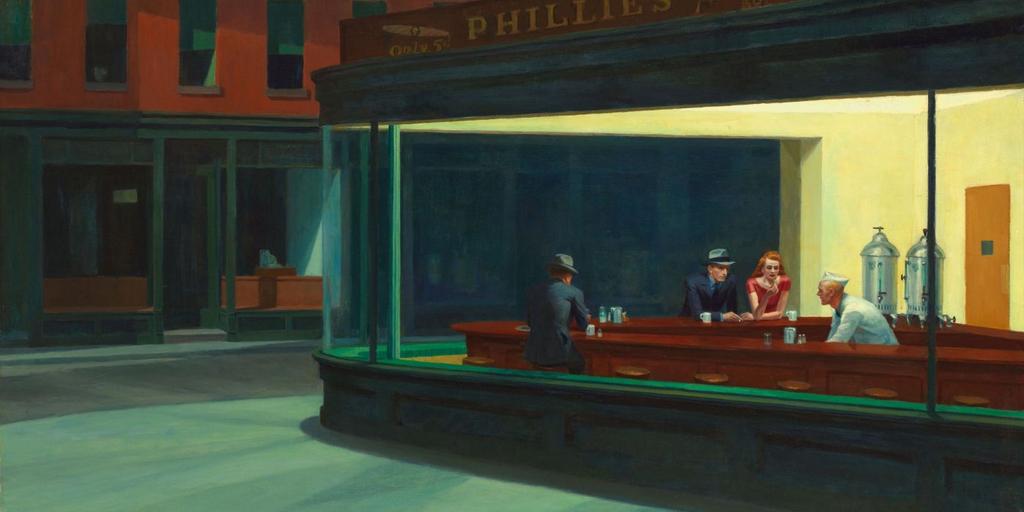
Nighthawks is one of the most recognisable paintings in American art. A desolate late-night New York diner, men in identical suits, a harsh light casting shadows on yet another seemingly lifeless apartment building of the kind that recurs throughout Hopper's canvases.

The geometric parallel lines, the lifeless windows of the building opposite the bar stools, the plate glass and the stone walls are mesmerising. In one interview Hopper remarked: 'Unconsciously, probably, I was painting the loneliness of a large city.'
This painting served as the basis for a scene in the musical film Pennies from Heaven (1981) and can be clearly traced in such films as The End of Violence (1997) and Faraway, So Close! (1993). In Blade Runner (1982), Ridley Scott drew directly on Nighthawks in his attempt to recreate an atmosphere of loneliness and desolation in his noir city of the future.


In Railroad Train, the railway itself recedes out of view. The train is a symbol of nineteenth-century progress. Hopper intended the image to express the contrast between rural life and technological advancement. In several of his works he presents the rails as 'one of man's intrusions into nature'. Seventy years later, director Terrence Malick would draw on Hopper's idea in his film Days of Heaven (1978).
Late Recognition
One of the most celebrated American painters of the twentieth century received recognition only in the final years of his life. His path as an artist was unlike any other. His first solo exhibition did not take place until he was already 37. Having spent a very long time in obscurity — not only professionally but personally — Hopper did not marry until he was past forty. His wife, Josephine Nivison, kept a remarkable diary that subsequently became the primary, and almost the only, source of information about the painter's life.
Despite frequent and sometimes fierce quarrels, Josephine managed to become a true source of inspiration for her husband. She supported him in many of his endeavours and kept detailed records of all his works, ideas and notable events.
Making a house or any other building the true protagonist of a painting is no easy feat, yet Edward Hopper achieved exactly that. His canvases are always deeply cinematic because they tell a story. They are filled with empty spaces, architecture, unsettling light and vague intimations. His paintings conceal rich emotional narratives beneath a surface of desolation and quiet monotony.
Other works by the artist
Follow us on social media so you never miss new content: VKontakte, Telegram — @loskomagazine.