Residential homes with glass walls: today we look at five of the most remarkable projects.
A cylindrical glass house around a tree by Aibek Almasov
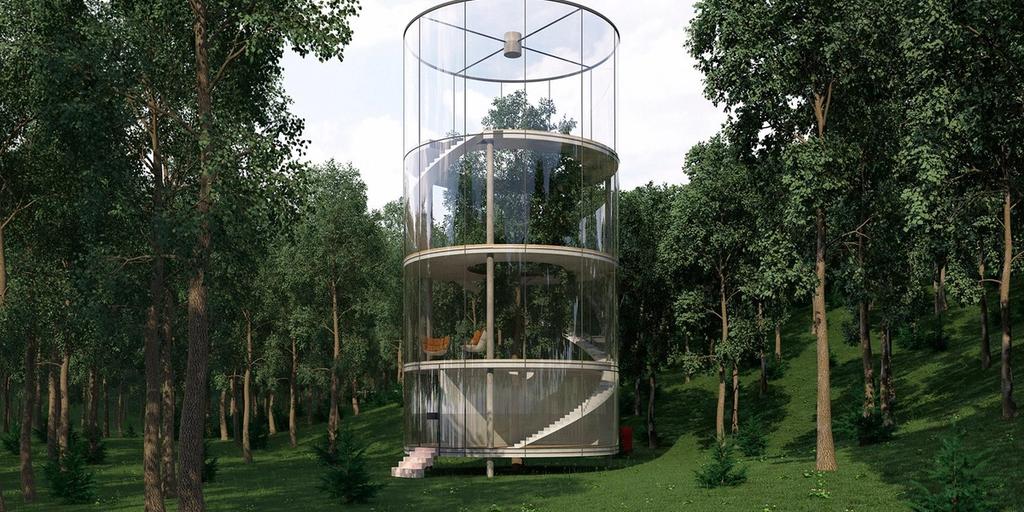
Kazakhstani architect Aibek Almasov designed an unusual glass house, 12 metres tall, in the middle of a forest.
The walls of the house are made of glass, allowing residents to take in a panoramic view of the surrounding nature. Forest rangers, meanwhile, will find plenty to observe — even the shower cubicle is designed to be completely transparent. A minimalist spiral staircase runs along the inside of the wall and leads up to the roof, from which a green sea of treetops stretches out in every direction. For the floor, the architect chose pale wood decking that harmonises perfectly with the surrounding space. At the centre of the cylinder, a mature pine tree is intended to rise up, serving as the natural and principal decorative element of the interior.
Aibek paid considerable attention to the ecological credentials of the house. Its upper section collects and purifies rainwater, and transparent solar panels are attached to the walls. These are currently still in the development stage.
Aibek notes that the structure is intended to offer the opportunity to escape the 'concrete boxes' and feel a sense of unity with nature. He likens the ascent of the steps to the stages of spiritual purification and enlightenment.
The project attracted public interest but remained on paper, having failed to secure funding from investors.
A glass house concept by Carlo Santambrogio
Another house, remarkable for its transparency, is soon to be built far from prying eyes. In this architectural wonder, all the furniture — save for the bed — is made of glass.
According to Italian architect Carlo Santambrogio (Carlo Santambrogio), the house will be built in a location where temperatures drop below zero. Carlo maintains, however, that this will not be a problem, as nearly invisible heating elements are embedded within the 7-millimetre glass. These will create a comfortable microclimate. But the wonders of the glass walls do not end there. Built into them is a special element that frosts the walls at the touch of a button.
Santambrogio notes that he can create a glass building suited to any conditions, whether Siberian frosts or tropical downpours.
The price per square metre of such a building is approximately 6,000 dollars.
The R-128 glass house by Werner Sobek
The completed building is located in Stuttgart (Germany). The minimalist modular structure was designed by German architect Werner Sobek (Werner Sobek), who lives in it himself. The house has been named an architectural icon of the twentieth century.
The walls of the house are made from high-quality triple-glazed panels. Privacy is afforded only in the two lavatories and the shower, which are enclosed within aluminium frames.
The house is equipped with solar panels generating 6.77 kW, as well as geothermal heating and cooling. All building materials are 100% environmentally safe and fully recyclable. The house is controlled by motion sensors and voice commands.
Notably, the house was built in just 11 weeks.
A glass house in the heart of the forest by Utz-Sanby Architects
Architects from the Australian practice Utz-Sanby Architects designed a glass house on a steep, densely wooded hillside.
The building sits among the trees, resting on a series of reinforced concrete, steel and timber piles. The house follows a simple linear plan, though one section curves outward — resembling the prow of a ship — and appears to float above the ground. The kitchen area flows onto a terrace that can be enjoyed in any weather. The exterior walls are glass, yet the surrounding trees provide a natural screen from prying eyes.
The house is priced from USD 1,500,000.
The Sliding House by dRMM
Architects at the London practice dRMM designed a barn-like house in Suffolk with movable walls and roof. The client set a straightforward brief: to build a home for growing old gracefully, growing vegetables, entertaining and enjoying the views of East Anglia. The house comprises three parts: the main building, a guest wing and an orangery.
A movable timber element — 28 metres long and weighing 50 tonnes — conceals the main house beneath it, sliding along purpose-built tracks driven by a powerful motor. It provides excellent protection against bad weather. Opening the house fully takes six minutes. The inner structure is made entirely of glass.
Also worth highlighting is the website, dedicated to this house. On it you can view the building's floor plan, follow the stages of construction, and examine it from every angle through a wealth of photographs and video. The house diary is particularly worth reading.