Vitra Campus is a unique cluster of avant-garde architectural projects, combining understated elegance, a sense of beauty and function. It is the only place in the world where a single site brings together buildings by Frank Gehry, Zaha Hadid, Tadao Ando, Álvaro Siza, Herzog & de Meuron, as well as other acclaimed masters of architecture and legendary practices.
Losko has assembled a comprehensive selection of 11 buildings and 4 art objects from the complex, so you can take a tour of this remarkable architectural ensemble.
The Vitra brand
Vitra is a Swiss furniture company that improves homes, offices and public spaces through design. Its products are developed through a rigorous design process that unites technical excellence with the creative genius of the world's leading designers. Vitra's primary goal is to create functional and inspiring interiors.
In 1981, a major fire destroyed much of the factory buildings erected in the 1950s, and the company's leadership invited distinguished architects to create what would become a celebrated campus. In Philip Johnson's view, "not since the Weissenhof in Stuttgart in 1927 have so many buildings designed by the most outstanding architects of the Western world been gathered in one place."
The History of Vitra
The company's story began with the family business of Willi and Erika Fehlbaum in the small German town of Weil am Rhein. In 1953 they travelled to the United States, where they fell in love with the furniture collection produced by Herman Miller and designed byCharles and Ray Eames and George Nelson. After lengthy negotiations, in 1957 the Fehlbaums began manufacturing the Eames and Nelson furniture at their factory, and also acquired the rights to produce pieces by other designers now regarded as classics: Alexander Girard, Isamu Noguchi and Verner Panton.
In 1977, Willi and Erika's son Rolf took over the management of the company. At that point Vitra was represented only in Switzerland and Germany, so he set himself the goal of expanding the business across Europe and the wider world.

In 1981 a fire broke out at the factory in Weil am Rhein: struck by lightning, the factory buildings caught fire and were destroyed. Vitra resolved not simply to rebuild the factory but to create its own campus, which would also house design museums. For the campus project, Rolf invited architects whose work had not yet been represented in Europe. The result was a campus that came to include buildings by Frank Gehry, Nicholas Grimshaw, Zaha Hadid, Tadao Ando and Herzog & de Meuron.
Today Vitra's product range comprises designer furniture for offices, homes and public spaces. When selecting designers for its products, Vitra seeks out those who are relevant and in demand, not merely qualified — designers who have something to say about the world today, and who can then articulate that through their work.

Vitra's products have received numerous design awards from international organisations. They can be found in public spaces around the world, including the Bundestag, Tate Modern in London, the Centre Pompidou in Paris, Deutsche Bank's headquarters in Frankfurt, Novartis in Basel, Dubai International Airport and Munich International Airport.
This success has been made possible only through the consistent integration of design, quality and function: designers, engineers and architects work together in Vitra's workshops, meeting the most exacting standards of furniture production. Products must be aesthetically compelling while remaining contemporary for many years to come. This is Vitra's concept of sustainability — one that has been evolving since the company's founding.
Buildings on the campus
Factory building, Nicholas Grimshaw
Years of construction: 1981–1983
Materials: reinforced concrete, aluminium
In the immediate aftermath of the fire, the British industrial architect Nicholas Grimshaw was commissioned to design the first building in the new Vitra campus.
Since insurance funds covered only a six-month break in production, Grimshaw designed a factory built from readily available prefabricated metal components. The corrugated sheet metal cladding the façade gives the building a distinctly industrial character that reflects its function.
In 1983, Grimshaw designed a second workshop that is almost identical to the first and also accommodates office space. Both buildings are still in use for manufacturing today.
Factory Building, Frank Gehry
Year of construction: 1989
Materials: plaster, titanium-zinc alloy
American architect Frank Gehry was originally invited solely to design the design museum building, but in 1989 he also constructed a large factory pavilion directly behind it.
The museum matches the scale of the adjacent factory by Nicholas Grimshaw, while the sculptural forms characteristic of Gehry visually link his projects to one another.
The building houses production spaces, a testing centre and offices. Panoramic windows on the ground floor allow passers-by to observe the manufacturing process.
Factory Building, Álvaro Siza
Year of construction: 1994
Materials: brick
The large, austere brick workshop designed by Álvaro Siza is reminiscent of the anonymous factory buildings of the 19th century and is strikingly unassuming compared to its neighbours.
The most prominent and striking element of the building is the curved arched bridge connecting it to the adjacent structure. It stands high enough not to obstruct the view of Zaha Hadid's fire station, and automatically lowers in wet weather to shelter vehicles making their way to the Nicholas Grimshaw factory.
Factory Building, SANAA
Year of construction: 2012
Materials: reinforced concrete, steel, acrylic glass
The architectural firm SANAA (Sejima and Nishizawa and Associates), founded in Tokyo in 1995 by Kazuyo Sejima and Ryue Nishizawa, initially built its reputation through residential buildings and small museums in Japan. Almost all of their major projects had been for cultural and educational institutions, and so the central idea behind this project was to bring a similar approach to the construction of a production workshop.
Vitra's management wanted to erect a new structure on the site of an old factory building that had survived the fire — one composed of four orthogonal spaces intended to align with the existing grid of the campus. SANAA, however, managed to persuade management otherwise and built a single circular building. That said, when viewed from above, the building's geometry can be seen to deviate from a perfect circle.
"A perfect circle is too rigid"
The new production workshop covers the largest floor area on the Vitra campus. The building was constructed in two phases in order to minimise disruption to operations. The first semicircular structure was erected alongside the old factory, which was subsequently demolished to make way for the corresponding second half that completed the plan.
The interior is not merely dictated by the conditions of the facade — it is the central concern of the architectural brief. Every detail, down to the screws in the tall storage shelving, reveals the designers' intentions; the architects left nothing to chance.
Fire Station, Zaha Hadid
Year of construction: 1993
Materials: reinforced concrete
Following a fire, Vitra decided it would be prudent to have its own fire crew, and commissioned Zaha Hadid — who had by then gained recognition through her paintings and drawings — to design a building to house them.
The fire station on the campus grounds became her first built project. She used the building as a protective barrier against the surrounding traditional architecture, which stood in sharp contrast to the overall character of the campus. Rather than designing the building as a standalone object, it was conceived as the outer edge of a landscaped zone: defining space rather than occupying it.
The building's diagonally intersecting planes, which form both the walls and the roof, are cast in in-situ concrete and represent Hadid's earliest attempt to translate her visionary, powerfully charged conceptual drawings into functional architectural space.
The resulting building conveys a strong sense of 'frozen movement' — the quality of perpetual readiness essential to a fire station.
Petrol Station, Jean Prouvé
Years of construction: 1953–2003
Materials: aluminium
The filling station designed in 1953 by Jean Prouvé and his brothers is one of the earliest mass-produced petrol stations. It was built around 1953 for the French branch of Mobil Oil Socony-Vacuum. One of three surviving stations was installed on the Vitra campus in 2003.
The building is composed of angled aluminium components and sheet perforated cladding. The load-bearing structure and the wall construction are clearly differentiated from one another, a distinction further reinforced by the colour palette.
Bus Stop, Jasper Morrison
Year of construction: 2006
Materials: steel, glass
In the early 2000s, the local authorities planned to modernise the bus stops in Weil am Rhein and to install new ones opposite the Vitra campus — stops that Rolf Fehlbaum considered poorly designed and entirely out of keeping with the complex. He therefore approached Jasper Morrison, who was developing his own furniture collection for Vitra, with a request to design bus stops that would be consonant with the campus's design ethos.
Morrison designed a minimalist, unobtrusive structure of glass walls, placing inside it three steel chairs by Charles and Ray Eames on which people waiting for the bus can enjoy views of the campus and the wine-growing village of Ötlingen.
Design Museum, Frank Gehry
Years of construction: 1989
Materials: plaster, titanium-zinc alloy
The design museum building on the Vitra campus, developed in collaboration with the German architect Günter Pfeiffer, was Frank Gehry's first project in Europe.
From simple classical geometric forms, the architect created a dynamic sculpture in which individual structures appear to fragment and set into motion. This was Gehry's first realised building in the spirit of his now-signature style — deconstructivism.
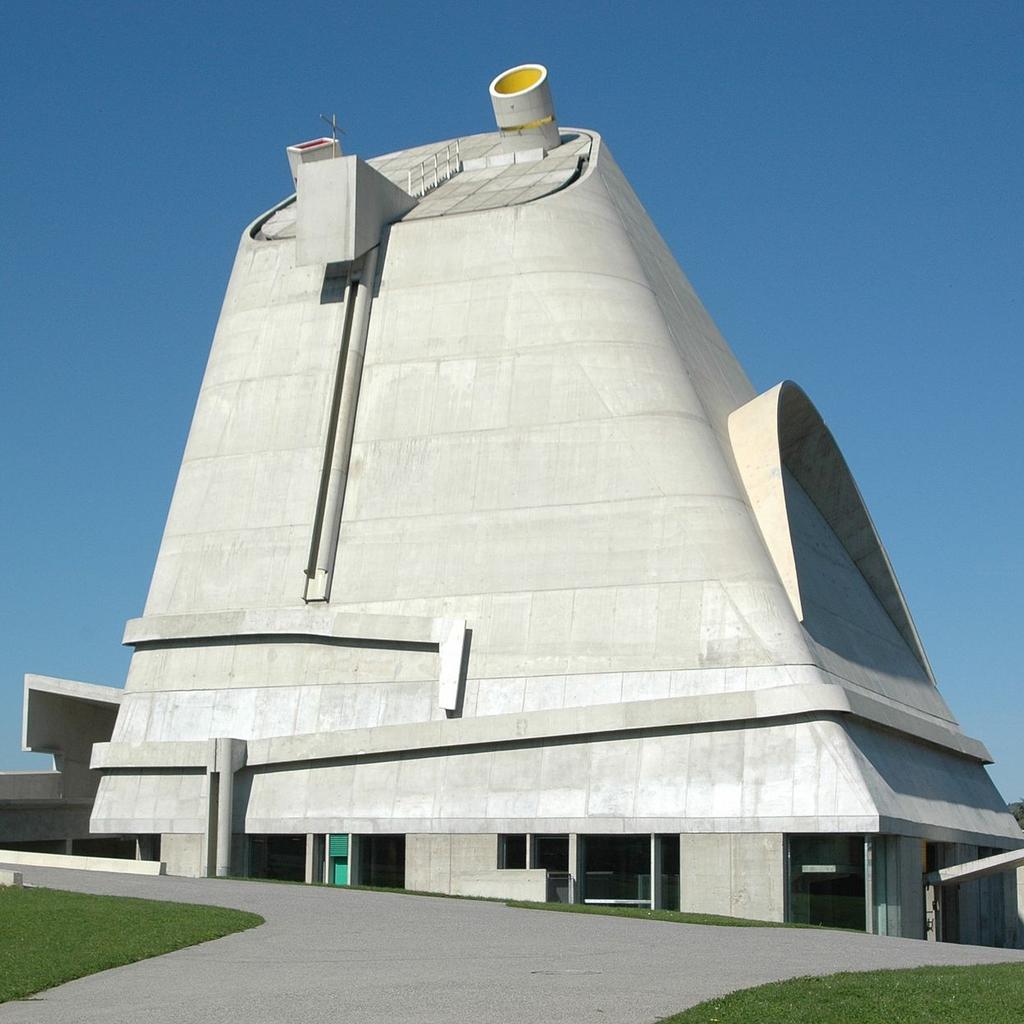
The Design Museum is neither entirely angular nor entirely curved, but a hybrid of the two, with volumes of every kind intersecting at slight angles throughout the structure. The sloping curves clad in white render are likely a reference to Le Corbusier's Notre-Dame-du-Haut, situated nearby just across the French border, while the zinc-alloy roof cladding creates a visual connection with Nicholas Grimshaw's adjacent factory building.
The museum's interior houses four large exhibition galleries with uniformly white walls. The main source of natural light is a cruciform skylight. Despite an exhibition area of just 743 m², the Vitra Design Museum is nonetheless one of the world's leading institutions in its field.
The Design Museum hosts exhibitions devoted to outstanding figures — architects, designers and artists. It was the first venue to mount a show placing sustained focus on the furniture design ofDieter Rams, demonstrating how closely that work is bound up with his philosophy. His celebrated 606 Universal Shelving System has been in continuous production since 1960, and modules made today can be combined seamlessly with examples from the 1960s.
Conference Pavilion, Tadao Ando
Year of construction: 1993
Materials: concrete, wood
In 1993, Tadao Ando designed his first building outside Japan — a conference pavilion that embodies the Japanese architect's singular approach to architecture and landscape, known as critical regionalism.
The central section of the building is sunk below ground level, ensuring what the architect describes as a priority given to nature. From here, a series of narrow, carefully composed corridors and ramps lead to the various conference rooms, evoking the meditation paths of Japanese monastery gardens.
The refined exposed concrete and timber surfaces intensify the sense of calm and concentration that the building radiates, standing in sharp contrast to Frank Gehry's deconstructivist structure nearby. They speak to the architect's inspiration in the work of Le Corbusier and Louis Kahn, while at the same time revealing roots in traditional Japanese architecture. The synthesis of Western and Eastern architectural traditions that Tadao pursues in his buildings is equally apparent in the distribution of light and in the way the structure is embedded in its surrounding landscape — one that recalls the austerity of Japanese Zen gardens.
In designing the building, Tadao sought to preserve as many of the existing cherry trees on the site as possible — trees that hold deep traditional significance in Japanese architecture — but three could not be saved. Their memory is kept alive through imprints of their leaves pressed into the concrete walls of the façade.
VitraHaus, Herzog & de Meuron
Years of construction: 2007–2010
Materials: reinforced concrete, wood
Until 2004, Vitra's activities were focused on the creation of office furniture, but in January of that year the company launched its first home collection, which encompasses design classics alongside reissues and products by contemporary designers.
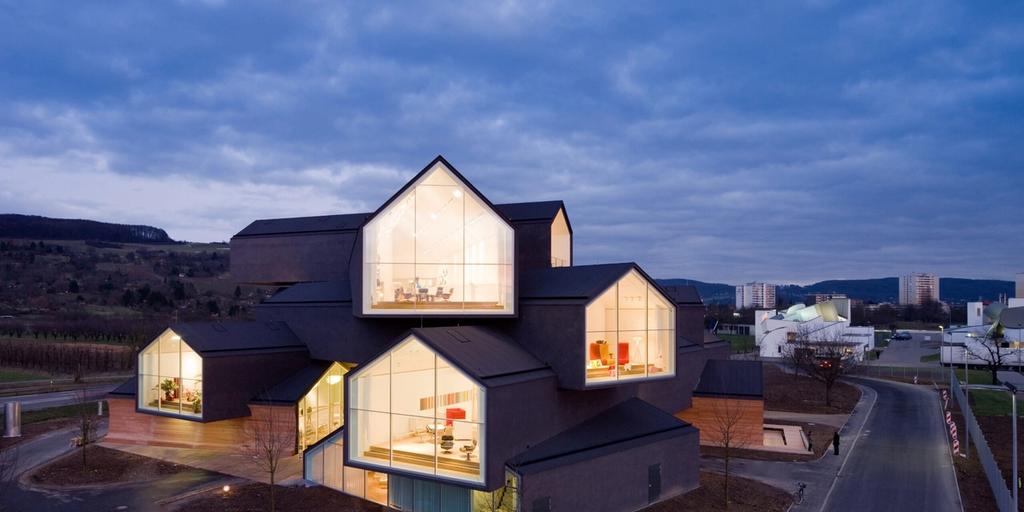
As there was no interior space on the Vitra Campus in Weil am Rhein suitable for presenting the new collection, the company commissioned Basel-based architects Herzog & de Meuron (Jacques Herzog and Pierre de Meuron) to design VitraHaus in 2006.
The concept of VitraHaus brings together two themes that recur throughout the work of Herzog & de Meuron: the archetypal house and the stacking of volumes. The proportions and scale of the interior spaces give the exhibition halls the feel of ordinary domestic rooms.
VitraHaus is deliberately the tallest building on the campus: the architects wanted to create a vertically oriented structure distinct from the horizontal production volumes — one that offers a broad panorama in several senses at once: a view of the surrounding landscape (given Weil am Rhein's position at the meeting point of three countries, each of the VitraHaus 'houses' faces toward one of those countries) and an overview of the Vitra Home Collection displayed within.
Vitra Schaudepot, Herzog & de Meuron
Years of construction: 2014–2016
Materials: brick
Vitra's vast furniture collection, assembled over the entire history of the company, had been kept in a basement in the northern part of the campus. Rolf Fehlbaum decided to open part of the collection to the public and asked Herzog & de Meuron to design an underground extension, since he was reluctant to sanction further architectural interventions — particularly in the context of the financial crisis. The architects, however, persuaded him that an above-ground structure with access to the basement would be less expensive.
The result was the Schaudepot — a monolithic volume built from handmade brick, defined by a completely windowless façade and a simple pitched roof.
The building's interior provides ideal conditions for preserving the valuable items in the collection (Vitra's holdings currently number around 20,000 objects, including approximately 7,000 pieces of furniture, more than 1,000 lighting objects and extensive archives). The museum space within the Schaudepot is divided into three zones with a combined area of approximately 1,600 m². The ground floor houses the main hall, where a substantial permanent exhibition is on display.
At its core are more than 400 carefully selected key works of modern furniture design from the 1800s to the present day, including early Bucholtz furniture, iconic Modernist pieces byLe Corbusier, Mies van der Rohe, Marcel Breuer, Alvar Aalto and Gerrit Rietveld, works by Charles and Ray Eames, Eileen Gray, Eero Saarinen and Gio Ponti, as well as more recent examples of 3D-printed objects and lesser-known pieces, prototypes and experimental models.
Art objects
Balancing Tools, Claes Oldenburg and Coosje van Bruggen
Year: 1984
Materials: copper
The artist Claes Oldenburg and his wife Coosje van Bruggen are counted among the leading figures of Pop Art. From the 1960s onwards, they experimented with sculptures of everyday objects enlarged to monumental scale.
The Balancing Tools sculpture was a gift from the children of Willi Fehlbaum on his seventieth birthday. It depicts three essential tools — a hammer, a screwdriver and pliers — that play a central role in furniture production, reflecting the dialogue between art and technology that lies at the heart of the design process.
The arrangement of tools teetering on the verge of falling recalls an acrobatic act, evoking Charles Eames's well-known love of the circus.
The sculpture originally stood in the middle of the industrial part of the campus, but in 1984 it was moved closer to the Frank Gehry museum — an architect whom Rolf Fehlbaum had first met in the studio of Claes Oldenburg, whose spinning, unpredictable forms bear a striking resemblance to Gehry's own.
Diogene, Renzo Piano
Year of construction: 2013
Materials: wood, aluminium
In 2009, Renzo Piano, inspired by Le Corbusier's Cabanon and Kisho Kurokawa's Nakagin Capsule Tower, and with no specific client in mind, developed his own proposal for a minimal space in which a person could live.
A year later, Rolf Fehlbaum came across the project in the Italian magazine Abitare, where it had been published in the monograph Being Renzo Piano, and by a fortunate coincidence met Renzo on the jury of the Pritzker Prize, where the two agreed to develop the project together.
The result, completed in 2013, was Diogene — the smallest building on the Vitra campus. The two-by-two-metre house is equipped with a solar panel system, a rainwater tank, a composting toilet and natural ventilation, ensuring complete ecological self-sufficiency and independence from the grid. Inside, there is enough room for a bed, a chair and a small table.
Diogene is not emergency housing but a voluntary place of retreat. It is designed to function in a variety of climatic conditions, independently of existing infrastructure, as a fully self-contained system. That said, multiple units can also be grouped together to form a hotel or guesthouse.
Promenade, Álvaro Siza
Year of construction: 2014
Materials: asphalt, granite, brick
From the outset, the route to the fire station and the Vitra Schaudepot passed directly through the industrial part of the Vitra campus, disrupting production and posing a safety risk to visitors. This prompted Vitra's management to approach Álvaro Siza once again, this time to design a path along the western edge of the campus.
Siza designed a 500-metre asphalt path framed by a two-metre hornbeam hedge. The promenade route resembles a pilgrim's journey to this architectural mecca, with individual architecturally articulated stopping points along the way.
Vitra Slide Tower, Carsten Höller
Year of construction: 2014
Materials: steel
The 30-metre Vitra Slide Tower by German artist Carsten Höller is an observation tower, a slide and an art installation rolled into one. It consists of three diagonal columns that converge at the top in a rotating clock, which every 12 hours briefly forms the Vitra logo for a few fleeting moments.
This is not a building in the conventional sense, but a work of art that offers a new and singular experience of understanding oneself and the surrounding landscape. The tower also provides two extraordinary vantage points across the Vitra campus: from the observation platform at the top and during the vertiginous descent on the transparent slide.
Follow us on social media to stay up to date with new content: VKontakte, Telegram — @loskomagazine.