I. M. Pei, an American architect of Chinese descent and the greatest figure in modernist architecture of the 21st century, was born on 26 April 1917 in Guangzhou, grew up in Hong Kong and Shanghai, but became an architect in the United States. At the Harvard Graduate School of Design, I. M. Pei studied under former masters of the Bauhaus: Walter Gropius and Marcel Breuer.
He was a committed modernist, and while none of his buildings could be called conventionally traditional, his distinctive style — clean and restrained, with simple geometry and a drive towards monumentality — represents a return to the finest architectural traditions of the previous century.

I. M. Pei rejected the contemporary trends of globalism and the uniformity inherent in the International Style, instead advocating for contextual development and the evolution of architecture. He noted that "the important distinction lies in the stylistic and analytical approaches to design, which imply attentiveness to place, time and purpose."
Pei urged his Chinese colleagues to draw more on their national architectural traditions rather than imitate Western ones. All of his works, from commercial skyscrapers to art museums, represent a balance between cutting-edge technology and Asian conservatism. Concerned that "ideas and professional practice do not intersect enough," he wanted not merely to solve problems but to create "architecture of ideas."
Over seven decades of creative activity, I. M. Pei built more than fifty landmark structures — from religious buildings, museums and libraries to civic centres and glass skyscrapers across the globe. He began his long career as one of a thousand anonymous urban developers in New York and ended it as a respected architect and laureate of the Pritzker Prize. I. M. Pei died in 2019 at the age of 102. We have selected 10 of the most significant works by the last great modernist of our time.
1. Luce Memorial Chapel
Location: Taichung, Taiwan
Year completed: 1963

The Luce Chapel is an early work by the architect and the principal landmark of the campus of a local university founded by Methodist missionaries. The chapel rests on an irregular hexagonal base. The structure, composed of four inclined planes, rises to a height of 19 metres. The exterior is decorated with glazed diamond-shaped tiles.
I. M. Pei gave careful thought to a design that would respond to Taiwan's natural conditions. The reinforced-concrete walls provide stability against earthquakes and frequent typhoons, as well as durability in the hot, humid climate.
2. Mesa Laboratory
Location: Colorado, USA
Year completed: 1967

On the grounds of the National Center for Atmospheric Research, set at the foot of the Rocky Mountains, stands the first architectural landmark that brought Pei widespread recognition. In this project, the architect sought to create a structure bold enough yet sufficiently organic. He maintained that no building could win a competition with nature.
The Mesa Laboratory is a composition of abstract, unresolved geometric forms that echo the surrounding rocky landscape. To match the colour of the local stone, pink sandstone from the area was added to the concrete mix.
3. East Building of the National Gallery of Art
Location: Washington, D.C., USA
Year built: 1978

To visually unite the modernist west wing with the rest of the architectural composition, I. M. Pei used the same pink Tennessee marble from which the museum's east building had been constructed. The architect's work defined the evolving role of the contemporary museum and its social function. He designed a unified museum complex complete with a cafeteria, bookshop, lecture hall and public spaces.
The bright, spacious interior is crowned by a soaring glass vault sixteen metres high, through which natural daylight flows freely. The building marked the return of natural lighting to American museums after many years of darkness.
4. John F. Kennedy Presidential Library
Location: Boston, USA
Year built: 1979

Built as a memorial to President John F. Kennedy, the library consists of a single triangular tower rising from an expanding base composed of geometric forms. At the centre of the architectural composition is a glass cube offering breathtaking views of Massachusetts Bay.
Celebrated architects such as Alvar Aalto and Ludwig Mies van der Rohe were considered for the commission; nevertheless, the candidacy of I. M. Pei — at the time relatively unknown — was approved by the Kennedy family shortly after the president's assassination in 1963. However, due to difficulties with funding and site selection, the project was not completed until sixteen years later.
5. Bank of China Tower
Location: Hong Kong, China
Year built: 1982

Built more than three decades ago, this 367-metre skyscraper remains one of the most striking structures amid the rich diversity of Hong Kong's contemporary architecture. In form, the tower evokes the rising shoots of bamboo, symbolising traditional Chinese values.
The structure is supported by five steel columns at the corners of the building, to which the weight of the tower is transferred via triangular frames. The glazed facades provide natural lighting. The Bank of China Tower was not approved by feng shui experts and drew sharp criticism for its sharp edges and numerous X-shaped forms, which carry negative symbolism.
6. Rock and Roll Hall of Fame
Location: Massachusetts, USA
Year built: 1983

The Hall of Fame and Museum in Cleveland is dedicated to the most celebrated and influential figures of the era who shaped the history of rock and roll. The architect deliberately employed a bold, innovative architectural vocabulary. Pei's aim was to capture the energy of the music movement in built form.
Two enormous triangular glass pyramid surfaces rest against a tower some fifty metres tall, creating a vast exhibition space that contains a five-storey atrium with open balconies, walkways, staircases and escalators. The building is clad in white square metal panels that visually extend the grid of the facade.
7. The Grand Louvre
Location: Paris, France
Year built: 1993

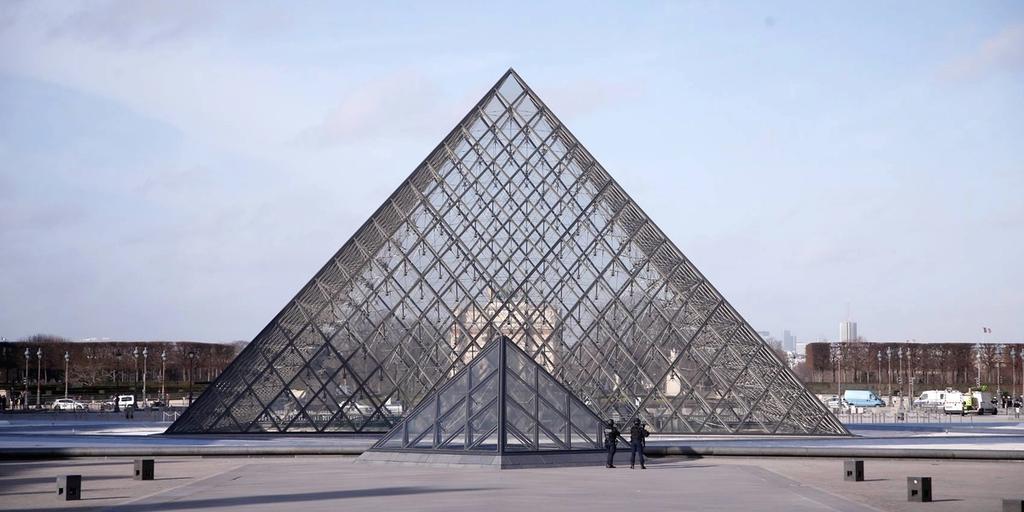
In addition to the pyramid serving as the Louvre's main entrance, I. M. Pei designed a system of galleries, storage spaces and passageways connecting the buildings as part of the museum's large-scale renovation project. Construction continued for ten years, at a total cost of more than one million euros.
The architect's most recognisable work — the Louvre Pyramid — was widely criticised at the time and subsequently became a symbol of Paris. It was designed in the proportions of the Great Pyramid of Giza. The steel-and-glass structure, twenty-two metres tall, allows natural light to flow freely into the underground spaces below.
8. Miho Museum
Location: Kyoto, Japan
Year built: 1997

The Miho Museum is set in a remote, forested mountain landscape. Three-quarters of the building lie underground, effectively carved into the rocky terrain. The architect sought to achieve harmony between the structure and the natural landscape. Pei drew his ideas for the museum's design from the temples of nearby Kyoto.
The roof is a glass-and-steel structure that contrasts with panoramic views of the valley. The exterior and interior walls and floors are clad in beige French limestone — the same material the architect used at the Louvre.
9. Museum of Islamic Art
Location: Doha, Qatar
Year built: 2006

Before embarking on the project, I. M. Pei spent six months travelling through Southwest Asia and Africa to immerse himself in Islamic architecture. Drawing inspiration from traditional Islamic motifs, he developed his own interpretation of local religious philosophy and character.
Set on an artificial island in the Persian Gulf, the building is constructed from pale limestone blocks that softly reflect the desert sun. A glass curtain wall on the north side offers panoramic views of the bay across all five floors of the gallery space.
10. Suzhou Museum
Location: Suzhou, China
Year built: 2006

The museum of Chinese art and craft is one of the architect's last major projects, completed when he was 89 years old. The building brings together Pei's characteristic rigorous geometry and pyramidal forms with the traditional architecture of Suzhou: whitewashed walls, dark grey tiled roofs and intricate garden design. The contrasting elements of the façades are rendered as if by a calligrapher's brush.
Modernist architectural means combined with a local palette reflected the architect's desire to look at Chinese culture afresh. I. M. Pei called for a design that "synthesises into a new language and order, and represents a possible direction for the future of contemporary Chinese architecture."
Follow us on social media so you never miss new content: VKontakte, Telegram — @loskomagazine.