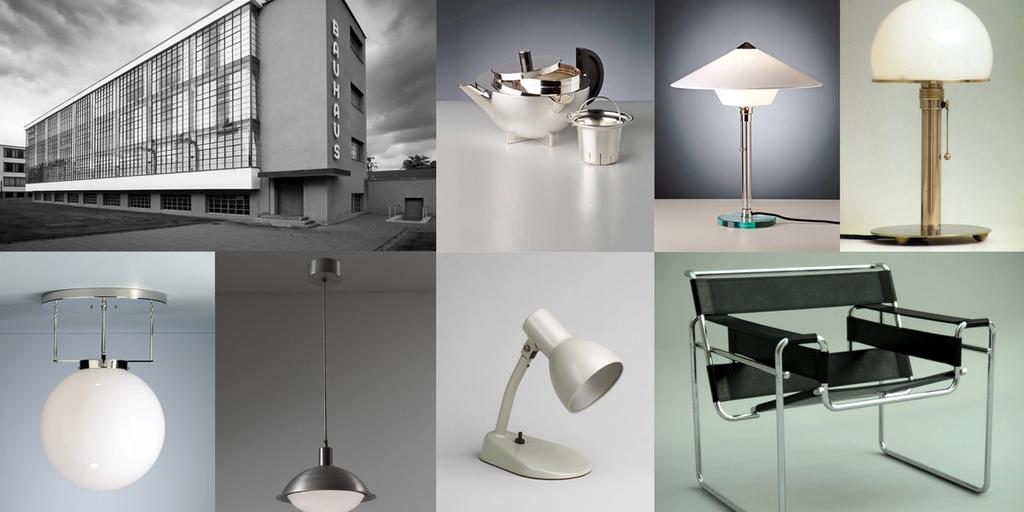
In 2019, the Bauhaus marks its 100th anniversary. In this article we present objects designed both during the 1920s and 1930s within the Bauhaus itself, and those created later by its followers and adherents.

One of the Bauhaus's founding principles erases the distinction between artists and craftsmen. Every artist should know applied techniques, be able to work with their hands, and therefore understand the structure and purpose of the objects they create. Functionality became the cornerstone of every object and architectural work produced by Bauhaus students and masters.
Glass, plywood, plastic and steel were the principal materials used by its artists. Functional, comfortable and beautiful furniture was intended to be affordable — and therefore suitable for mass production.
Marcel Breuer's Wassily Chair
Year of creation: 1925 — 1926
Materials: chrome-plated steel tubing, canvas (later leather) straps
Marcel Breuer's celebrated chair, made from bent metal tubing, is an undisputed example of functional design. In creating the Model B3 Chair — as it was originally known — Breuer drew inspiration from the handlebars of an Adler bicycle. The chair was renamed in honour of Wassily Kandinsky in the 1960s by the Italian manufacturer Gavina. Since 1968, production rights have been held by Knoll.
Works by Wilhelm Wagenfeld
Years of creation: 1925 — 1956
Materials: nickel-plated metal and glass, glass, Cromargan (stainless steel) and others
Wagenfeld worked for more than 50 years, producing dozens of models of vases, bowls, dinner services and various pieces of cutlery. He believed that everything useful should also be beautiful, and that the functionality of objects must be supported by an aesthetic dimension. At the Bauhaus, working under a brief from László Moholy-Nagy, Wagenfeld created the WG 24 lamp, also known as the Bauhaus lamp.
Marianne Brandt's tea service and lighting
Date created: 1924 — 1928
Materials: silver, brass, ebony
Brandt produced her most celebrated works between 1924 and 1928, first as a student and later as a member of the Bauhaus workshops. She gave the tea service a simple geometric form entirely free of ornament, following the early-20th-century modernist principle of form follows function.
Josef Albers's 'Nest of Four Tables'
Years created: 1926 — 1927
Material: oak with acrylic lacquer finish
Josef's white, yellow, red and blue tables nest inside one another like a set of Russian dolls. Albers combined a simple geometric form — the cube — with flat, solid colours. The same palette was used by Peter Keler, when, inspired by the work of Wassily Kandinsky, he designed a children's cradle in 1923.
Josef Hartwig's chess set
Year created: 1923—1924
Material: various types of wood
The shape of each piece in Hartwig's chess set reflects its unique movement. The queen can move in any direction, so her form is a sphere. The bishop is X-shaped, the rook is a cube. Looking at these pieces, a player can recall the basic rules of the game even after years away from the board — and that was precisely Hartwig's intention. He designed not only the pieces but also the board itself, a table with two chairs, and even an entire chess room.
Ludwig Mies van der Rohe's chairs and chaises longues
Years created: 1929—1930
Materials: stainless steel, leather
We have already written about the life of the outstanding modernist of the 20th century, the last director of the Bauhaus, Ludwig Mies van der Rohe. His chairs differ considerably from the pieces featured in this article. With this particular model, Mies had no ambition to make something 'accessible to all' — he designed it with the upper echelons of society in mind. Even so, the influence of the 'Less is more' principle, which the designer followed rigorously, is clearly evident. The official rights to the chairs also belong to Knoll.
Gerrit Rietveld's Red and Blue Chair and Zig-Zag Chair
Year of creation: 1918, 1934
Material: wood
Gerrit Rietveld was a member of the De Stijl art movement. According to the group's aesthetic programme, a work of art must be strictly utilitarian in character and clearly suited to its purpose. The fundamental elements of the visual language are the right angle and three colours — red, yellow and blue — with black and white as secondary tones. These are precisely what the designer drew on when creating his works.
The Furniture of Charles and Ray Eames
Years of creation: 1946–1950
Materials: moulded plywood, fibreglass or plastic
Charles Eames studied at the Cranbrook Academy of Art, where Walter Gropius was among the visiting professors. It was at the academy that Charles met Ray, his future wife and partner. The designers worked extensively with plywood, striving to transform it into a material capable of taking any form. In 1946, the first moulded plywood chairs were presented at an exhibition at the Museum of Modern Art in New York.
Philippe Starck's Ghost Chair
Year of creation: 2002
Material: transparent or coloured polycarbonate
Starck's chair is a canonical object of postmodernism. The French designer took the Louis Ghost Chair as his starting point — a padded armchair with a rectangular or rounded upholstered back. The chair is manufactured by Kartell.
Minimalism and mindful consumption are very much in vogue; there is a desire to surround oneself with things that are genuinely necessary — and therefore functional, yet aesthetically beautiful. Nearly a hundred years ago, the representatives of the Bauhaus laid down the principles of functional design, and those principles remain as relevant as ever. We scarcely notice that we live in homes designed by Bauhaus students and furnish them with pieces made to their plans.
Follow us on social media so you never miss new content: VKontakte, Telegram — @loskomagazine