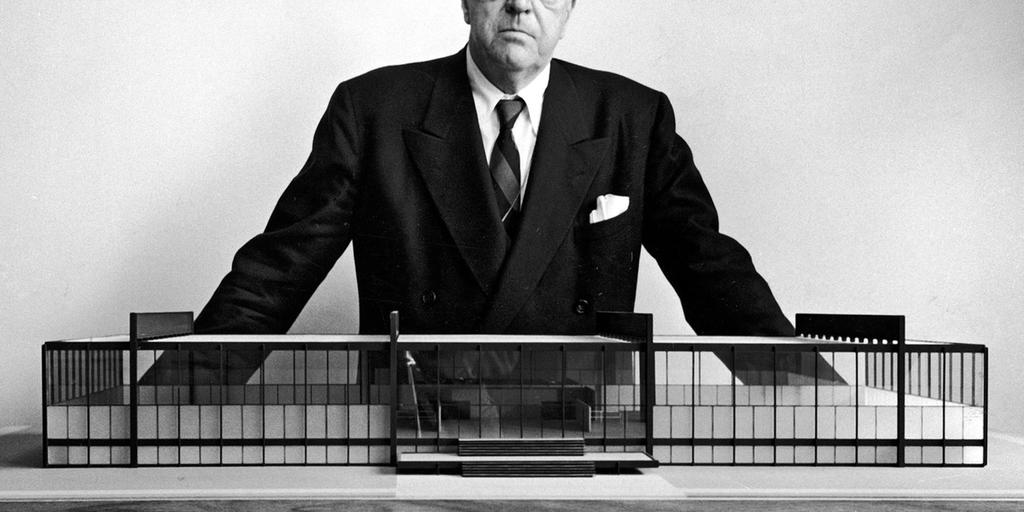
Ludwig Mies van der Rohe was the leading figure among modernist architects of the twentieth century. Many considered him the most taciturn architect of his era — he let his buildings do the talking. The celebrated, lapidary phrase "Less is more" was Mies's reply to a journalist, delivered between draws on one of his ever-present cigars. The architect was not being glib: the expression captured the entire underlying philosophy that had guided his work throughout his long life.
In this piece you will find:
- The early life of Ludwig Mies van der Rohe and the formation of his character;
- The core principles and defining qualities of his work;
- The architect's most celebrated projects;
- Fascinating facts from the life and career of the architect.

1886–1912 Early Years
He was born on 27 March 1886 in the spa town of Aachen, near Germany's borders with Belgium and the Netherlands. He studied at an ordinary trade school before joining his father in the family craft as a stonemason. He later moved to the studio of Peter Behrens, whose influence helped Mies find his direction and develop his own distinctive approach to designing buildings.
Tracing the origins of Mies's thinking, one can detect philosophical glimmers of Thomas Aquinas and Spinoza in his outlook. Neo-Thomism — which holds that things are a union of matter and form — does indeed run through the structural grammar of his work.
In the final year of his time with Peter Behrens, Mies oversaw the project for the German Embassy building on St Isaac's Square in St Petersburg.

After completing the Behrens project, the now seasoned architect left Russia and departed for Berlin to work as an independent practitioner.
1912–1921 The Beginning of a Career
In 1913, on his return to Germany, Mies opened his own design office, where he began testing his ideas for the first time. A new name heralded a new life: Ludwig Mies now adopted the aristocratic particle "van der" and appended his mother's maiden name, "Rohe".
Ludwig Mies van der Rohe was always drawn to the transparency and gleam of glass, and he put forward proposals for glass skyscrapers in Berlin. The architect's unconventional ideas invariably stirred considerable excitement and divided opinion among critics. Some felt that materials such as glass and steel gave buildings an elegance of their own. Others, on the contrary, argued that such materials could lend a structure a cold, indifferent quality fit only for industrial use, while people needed warmth and comfort. No expert remained indifferent to Mies's ideas, and the simplicity of his architecture gave pause for thought time and again.
"Architecture is a language. When you are very good at it, you can become a poet." — Ludwig Mies van der Rohe
After the end of the First World War, a certain nihilism towards culture at large had taken hold in society, bringing with it a hunger for fresh ideas and modernism. Mies wasted no time in transforming the neoclassical style so familiar to him, and in 1921 he broke with his earlier approach to urban design by creating the glass skyscraper project for Friedrichstrasse. It was never built, but the concept made the architect's name regardless — and marked the true starting point of his career.
The sketch was later realised in the skyscrapers he built in Chicago and New York.
The project for a concrete-and-glass residential complex in Weissenhof marked the beginning of Ludwig's realisation of the founding ideas of neo-Thomism in architecture. The principal difference between this building and his earlier designs lay in his use of the 'free plan' — a technique Ludwig had come to love. The kitchens and bathrooms were fixed within the structure, while the remaining rooms varied in form and size. A characteristic feature of the building was that the load-bearing walls were no longer confined within the main shell but extended to the exterior.
In his projects, Ludwig placed functionality at the forefront, allowing it to dictate future form — in contrast to Le Corbusier, who held that form was the primary element of any project.
Through his future masterworks of the late 1920s — the Barcelona Pavilion and the Villa Tugendhat —miesbcn.com— Ludwig wielded considerable influence in the architectural world. Many experts took his views seriously, while critics continued to struggle with his minimalist aesthetic. It seemed as though Ludwig was championing an ultra-modernism. His projects resembled works of art — at times appearing, in some uncanny way, on the verge of departing the material world altogether. Perhaps that was his true intention.

In the 1930s, Ludwig was invited to become director of the Bauhaus school and readily accepted. The political radicalism of the time, however, prevented him from realising his full professional potential, and within three years the Bauhaus closed. Ludwig subsequently emigrated to the United States for good — and it was there that the central period of his professional development began.
"My thoughts guide my hand, and my hand points to what my thoughts are worth"
1930 – 1946 Recognition in the United States
With the arrival of Ludwig Mies van der Rohe in Chicago, the existing movement towards 'organic architecture' gradually lost its currency and ceded ground to 'functionalism'. It was said that shortly after Mies reached America, an unknown Mr Priestley relayed to Frank Lloyd Wright — the pioneering architect and creator of organic architecture as a movement — that Ludwig Mies van der Rohe wished to speak with him. Notably, the justifiably proud Wright had refused meetings with such figures as Le Corbusier and Gropius, yet he not only received Mies but fully acknowledged all his ideas and achievements. In this way, an invisible baton passed from Wright to Ludwig, and the era of architectural functionalism in the United States had begun.
The move to America had a profound effect on Ludwig Mies van der Rohe. While his German-period work had featured brick, metal and glass now became his primary materials. In America, where democracy permeates every sphere of public life — including the question of land — the policy of the gridded plot merits particular attention. This meant that every square unit of a site was the owner's property, to be disposed of as they wished. This social strategy was enshrined in law and treated as a matter of special importance. It was for this reason that Mies van der Rohe began employing a modular grid in his work — an innovation driven by the shift in his own worldview.
Once Mies had settled in Chicago, he was invited to become the head of the Illinois Institute of Technology — an offer he accepted with pleasure. It gave him yet another opportunity to flourish in an academic role. In 1946, with great enthusiasm, he set about redesigning the entire campus. A master plan for the whole complex was drawn up on a modular grid of 7.2 × 7.2 m, so as not to disrupt the coherence of the site as a whole. Mies also designed individual buildings, the most celebrated of which was Crown Hall, home to the school of architecture. The building has two levels: a lower floor that appears to be sunk into the ground, and an upper level — a glass pavilion that seems to float, suspended from two powerful frames. As ever, steel and glass did their work.
The philosophy of Ludwig Mies van der Rohe was rooted, above all, in the understanding that a building, as a physical structure, has no intrinsic value in itself. It is merely a mirror of the age in which it is made. A structure acquires its value only when a higher meaning is invested in it.
"The divine order and the earthly order are bound together; and if the earthly order does not reflect the order above, it is worth nothing — it is a false path."
From 1952 onwards, the Illinois Institute of Technology gained recognition as an architectural landmark. Crown Hall remains, to this day, inseparably linked with the name of Ludwig Mies van der Rohe.

1946–1958: A New Phase in the Work
This period in the architect's life is marked by a transformation in the overall character of his work. The entire structural framework was now brought to the exterior, leaving the interior completely free. The most prominent example of Mies's new approach was the celebrated so-called Glass House in the countryside, designed for Edith Farnsworth. Edith was a distinguished surgeon in Chicago at the time, and she entrusted the project to an architect of no less renown. That choice was driven not only by an objective preference for a skilled professional, but also by the feelings that had developed between Edith and Mies. The client wanted an extraordinary house — something unlike anything the architectural market had to offer. For the woman he loved, Mies was determined to create something truly remarkable. He planned to give full expression to all the minimalist ideas he had been developing over thirty years.
In this future work, as the architect envisioned it, there were to be no superfluous details that might distract from nature. In this new idea, Mies was still pursuing the central philosophical theme of his work — the "unity of being and the higher order" — but now with new elements and new intentions. Ludwig fulfilled Edith's wish and designed an unconventional structure composed of two horizontal planes, a third in the form of a raised terrace, and eight columns set along the exterior. Edith's expectations were not met, and in a fury she took her former lover to court — for not only had the project failed to live up to her hopes, but Mies had also submitted a bill for $73,000 (the equivalent of $500,000 today) for his services. "Well… love flies out the door when money comes innuendo," as the comedian-philosopher Groucho Marx once put it. Edith Farnsworth could surely never have imagined that her country house would one day become an exhibit in a museum of modern art.


Chicago and New York skyscrapers also played a significant role in the architect's creative portfolio. Ludwig's best-known residential towers are the 860/880 Lake Shore Drive apartment buildings (1952), which are listed among Chicago's official landmarks. His most celebrated New York skyscraper was the Seagram Building, completed in 1958. The Seagram's structural approach can still be observed today in countless business centres around the world. One of Mies's further innovations was his proposal to set the skyscraper back from the main street line, deeper into the block. This created space for a fountain to be placed in front of the building. Ludwig sought to move away from the core tenets of functionalism in order to integrate the building's design into the character of the city. To achieve this, he applied external steel mullions to the facade, used purely as decorative elements. These elements played no structural role — they simply enhanced the skyscraper's visual appearance. All load-bearing components were positioned inside the building and kept out of sight.


1961–1969 The Final Years
On 17 August 1969, Mies died in Chicago after a prolonged battle with oesophageal cancer. Many of his remarkable projects survive to this day, continuing to impress visitors with their innovative design. Despite his relocations and the shifting pressures of society and era, Mies van der Rohe remained true to his own aesthetic. It is perhaps his progressive design philosophy that made his work so significant — both for the architects who followed in his footsteps and for ordinary people of his time. "I have tried to create an architecture for a technological society," he told the New York Times. "I wanted to keep everything reasonable and clear — to create architectural designs that anyone could build."
Core Principles and Defining Characteristics of His Work
Certain consistent principles ran through all of Ludwig Mies van der Rohe's projects, and he adhered to them throughout his career. The architect identified three guiding principles:
- The first principle holds that architecture is directly linked to the historical period through which it is viewed — that is, it is a product of a particular era's influence.
- As his second principle, Ludwig advanced the thesis that architecture is a language governed by discipline and grammar. He believed that the physical construction of a building and its functional expression are of secondary importance.
- His final principle was Mies's conviction that the primary goal of any project is the development of its structure.
In his lectures to students, Ludwig sought to explain the distinctions between the key concepts in his principles, drawing on the architecture of ancient Roman buildings as an example. In his view, there is no grand creative formula for producing a masterpiece in which a building might simultaneously satisfy the functional needs of society and inspire love for its outward form. The architect faces a specific task: to express the ordinary and impersonal qualities that define an era.
Mies believed there was little point in attempting to express individual artistic potential when people always need something definite. Any contrivance is futile — the only way to hit the mark is through a genuine understanding of society's prevailing disposition.
For Ludwig Mies van der Rohe, structural grammar is the outcome of the transition from construction to structure. Put simply, so long as a brick wall is merely a method of laying bricks, it is construction. When a selection is made among all possible variations of construction, that becomes structure. And when both construction and structure are present, the entire process of moving from one stage to the other is what constitutes structural grammar.
Defining characteristics of Mies's work:
1. Varied arrangements of structural elements, intersecting planes and the avoidance of corners
All walls within a project served a largely decorative purpose, as the architect sought to move away from the cumbersome load-bearing wall. At first glance, they resemble partitions rather than walls in the conventional sense.
2. Complete or selective enclosure of the entire structure
The houses have an external invisible contour that frames the entire composition and separates the world of harmony from the surrounding space. The walls may either remain within the defined perimeter or cross it.
3. Metal Frame
The most vivid examples are the skyscrapers in Chicago and New York. In one way or another, the frame can be discerned in all of Ludwig Mies van der Rohe's structures. In 2011, Canada completed the renovation of a former Imperial Oil service station that Mies had designed in 1969. The first thing the builders did during the renovation was to paint the post-and-beam frame — welded from steel components — black.
"So, a building has 'bones' (the frame) and 'skin' — glass, for instance. If the bones, as is proper, sit beneath the skin, there is no need for separate window structures."


Notable works of Ludwig Mies van der Rohe
Mies's most important legacy is his style. Many architects have attempted to replicate it, yet no prototypes have ever been designed that fully convey Miesian ideology and logic. The master's hand had a unique and unmistakable signature. In his honour, an architectural award has been established in our time — the Ludwig Mies van der Rohe Award — which a jury presents every two years to outstanding projects.
Riehl House

Ludwig built his very first independent architectural project — the Riehl House — when he was just 21 years old. The design shows none of the hallmarks of a seasoned architect. The work is restrained and in no way distinguishes itself from the surrounding residential buildings. The celebrated Miesian signature would emerge later, but the beginning had been made.
Villa Tugendhat


Villa Tugendhat is rightly regarded as a symbol of architectural modernism of its era and stands as one of the architect's most celebrated works. The villa was designed for the Tugendhat family in 1928–1930 in Brno, Czechoslovakia. For the first time, Mies employed a steel frame to do away with load-bearing walls that blocked light. Great importance was placed on design: the house contained no paintings or supplementary decorative elements, as these were considered superfluous — the impression was created entirely by materials with natural textures, such as onyx and wood. A particularly striking feature of the onyx wall is that it changes tone at sunset. Moreover, because the villa is built on elevated ground, its owners were treated to sweeping views through the large windows.
Captivated by the project, Ludwig Mies van der Rohe designed furniture to suit the interior. The Tugendhat and Brno chairs remain in mass production to this day, and the passage of time has done nothing to make these models feel dated. The current price of a single such chair ranges from $2,000 to $2,500.
The Villa Tugendhat is currently a UNESCO World Heritage Site, and the building itself serves as a museum and is one of the main attractions of Brno.
Barcelona Chair

Mies believed that a chair was a complex object, since it had to be sturdy, lightweight and comfortable all at once. He once joked that the difficulty of building skyscrapers was nothing compared to the difficulty of designing a good chair. Furniture-making genuinely captivated him, and that devotion to design bore remarkable fruit. Today, a single Barcelona Chair starts at 70,000 roubles.
Ludwig sought to make his furniture elegant, substantial and exclusive. He catered primarily to people of the highest social standing — which is why the chair's steep price is entirely justified: even the King and Queen of Spain used it as a throne.
New National Gallery Building

In 1961, Ludwig Mies van der Rohe was commissioned to design a museum building to house West Berlin's collection of twentieth-century art. He had previously developed a scheme for the offices of the Bacardi company, a project that ultimately came to nothing due to the Cuban Revolution. Mies decided to adapt that design for the museum and later moved to Berlin to oversee construction in person.
The New National Gallery opened in 1968. It was the last project of the architect's life.
Martin Luther King Jr. Memorial Library

After Ludwig's death, several of his unrealised projects were completed by others. Among them was the Martin Luther King Jr. Memorial Library — his only built work in America. The building became a symbol of modernism in Washington.
Interesting facts from the architect's life and work
- At the age of twenty-two, Mies was in close contact with Alois Riehl, who had a profound influence on his worldview. The Riehl family took Mies under their wing and were genuinely fond of him. Alois later commissioned Ludwig to design his house — a notable gesture, given the German philosopher's means and his ability to engage a more experienced architect. It was Alois's wife who introduced Ludwig to the woman who would become his future wife.
- Mies's design for a petrol station, realised only years after his death, has since been listed as a work of architectural heritage. The former filling station has had its entire air-conditioning and ventilation system replaced, and the building is now heated by heat pumps. In this way, a modernist masterpiece in the guise of a petrol station has been transformed into a contemporary, environmentally responsible building.
- A feature film is in development based on the scandalous story of Mrs Farnsworth's country house — she had been Mies's lover. The adaptation is said to focus less on the figure of Ludwig Mies van der Rohe himself than on the deeply complicated romantic relationship between the celebrated physician and the architect. A remark attributed to Ludwig on the affair runs: 'The lady thought the architect came with the house.'
- In 2008, Illinois was struck by flooding that became a state-wide disaster. The Farnsworth House could be reached only by boat, and few believed the building could survive such a natural catastrophe. Nevertheless, thanks to the efforts of American preservationists, the structure was restored and retains its original appearance to this day.
And here is our article on another influential and celebrated architect — Le Corbusier. Like Rohe, he was a revolutionary in the architecture of his time, whose ideas continue to impress and inspire us today.