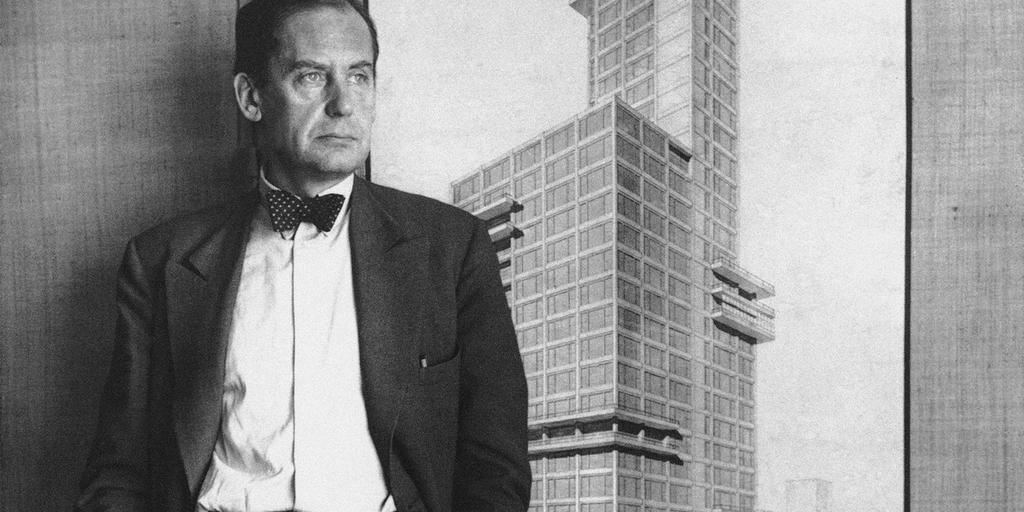
Walter Gropius is a central figure in twentieth-century architecture — a theorist of modernism, and the founder and driving intellectual force behind a revolutionary German school. Reserved and cool-headed, he was easily overshadowed by the eccentric colleagues and wayward students of the Bauhaus. The great architect's originality expressed itself above all in his work. He possessed a remarkable ability to identify and nurture talent. The historical and social significance of his ideas and projects — across more than fifty years of practice in Europe and the United States — can hardly be overstated.
In this article you will learn:
- about the key stages of Walter Gropius's life;
- which architectural principles the German modernist followed;
- about the architect's most significant projects;
- interesting facts from his life.

Biography
Childhood and Youth 1883–1907
Walter Gropius was born on 18 May 1883 in Berlin. His choice of profession was largely shaped by his immediate circle: his father worked in public construction, and a great-uncle on his father's side was an architect.
At the age of twenty, Walter enrolled at the Munich University of Technology, where he studied the history of architecture, design and construction. After little more than a year in Munich, he returned to Berlin due to his younger brother's illness, continuing his studies at the Berlin Institute of Technology.
Early Career 1908–1914
Gropius spent a full year travelling through Spain, drawing inspiration from its architecture. On returning to Berlin, he joined the studio of Peter Behrens, the founding father of German industrial design. It was there that the young Gropius met Ludwig Mies van der Rohe and Le Corbusier. Working on industrial commissions, he immersed himself in contemporary construction methods and the use of new materials, absorbing ideas that would later find expression in his own projects.
In 1910, Gropius founded his own firm in Berlin in partnership with Adolf Meyer. Around the same time, he joined the Deutscher Werkbund — an association of architects and designers committed to the industrial mass production of well-designed objects. In the early years, with few major commissions to hand, the partners designed serial furniture and produced wallpaper and vehicle designs.
Their first major project was the design of the factory buildings for the Fagus Works. The following year, Gropius and Meyer participated in the Werkbund Exhibition in Cologne, where they presented the Model Factory — an administrative and industrial complex whose most distinctive feature was its cylindrical glass staircase towers. The innovative building was met with great acclaim.

In 1914, Walter Gropius's rapidly rising architectural career was abruptly interrupted by the First World War: he spent four years fighting on the Western Front, was seriously wounded, and narrowly escaped death.
Gropius and the Bauhaus 1918–1928
The war profoundly influenced the architect's theoretical outlook. Gropius returned to Germany with a conviction that fundamental change was necessary and a firm resolve to push the boundaries of architecture.
"After such an outburst of brutality, every thinking person felt the need to shift their intellectual position. And it was precisely then that I first became conscious of the singular mission of the architects of my generation"
In 1918, Gropius became director of the united Saxon-Weimar School of Fine and Applied Arts, which he soon renamed the Bauhaus. The school's experimental approach — drawing on elements of Neo-Plasticism and Soviet Constructivism — was set out in Gropius's 1919 manifesto.

"Let us together conceive and create the new building of the future, one that will bring everything together in a single form: architecture, sculpture and painting. A building that will rise towards the heavens, built by the hands of millions of craftsmen like a crystal symbol of a new and coming faith"

In the early years, Gropius placed great emphasis on handcraft, individuality and Expressionism. The mid-1920s marked a turning point for the Bauhaus — during this period Gropius shifted his focus towards functional, affordable design and industrial production, "adapted to the modern world of machines, radios and fast automobiles".
With the rise of right-wing political forces, Bauhaus came under criticism, and the school soon lost its state funding. In March 1925, the Bauhaus closed its doors in Weimar and relocated to the small industrial city of Dessau. In 1928, having definitively lost the support of the Weimar authorities and his colleagues at the school, Gropius left the Bauhaus and moved to Berlin in order to devote himself entirely to private practice.
The mass housing construction period, 1926–1932
In his drive to address the shortage of affordable social housing in the post-war period, Walter Gropius worked on large-scale residential projects. The strict geometric facades and standardised floor plans characteristic of his work from this period were later criticised by Gropius himself, who called them the "curse of uniformity".
The architect experimented extensively with prefabricated concrete construction. In the Dessau-Törten housing estate, 370 identical residential homes were built to his design in three phases. He developed the method of linear block planning, based on the uniform orientation of all buildings. Using this approach, Gropius designed the Dammerstock estate and the Siemensstadt residential quarter on the outskirts of Berlin. His innovations would go on to exert a significant influence on social housing construction in Germany and across Eastern Europe.

"Every adult should have a room of their own, however small it may be! Maximum light, sun and air for all dwellings!"
Emigration and life in America, 1934–1969
After the Nazi government came to power, Walter Gropius's position became precarious. He had never been and could never be a Nazi: subservience was not in his nature, and the authorities' antisemitic policies filled him with horror. In search of any work at all, the architect joined the Reich Chamber of Culture, membership of which was a prerequisite for professional practice. This desperate step had little effect: by the winter of 1933, his financial situation had become so dire that he was forced to sell his beloved convertible and rent out most of his apartment.
Deeply devoted to his country, Gropius was reluctant to leave Germany until the very end. But his liberal views and associations — compromising in the eyes of the Third Reich — made him too conspicuous and left him no choice. In 1934, the architect and his family secretly fled to Great Britain under the pretext of travelling to a conference in Italy. In London, he worked within the modernist practice Isocon. The only major English project Gropius undertook was the construction of a village school in Impington.
Fearing the German occupation, Gropius accepted an invitation from Harvard University, emigrated to America in 1937, and took up a position as Professor of Architecture. Shortly after the move, he set about designing his own house in the suburb of Lincoln. The building — the first example of the International Style in America — would launch a modernist architectural movement.
A few years before his retirement in 1952, Gropius founded the Harvard alumni collective The Architects Collaborative, which would become one of the most celebrated architectural practices in the world. In 1969, shortly after being awarded an honorary fellowship, Walter Gropius died at the age of 86. By that point, the ideas of the great German modernist and his theoretical writings had become a lasting foundation for modernist architecture across the world.

"Cremate me, but do not keep the ashes. Do not mourn. It would be wonderful if all my friends, past and present, were to come together and, as in the Bauhaus days, drink, laugh and love."
Personal Life
Discipline was an inseparable part of the German architect's character: composure, a well-groomed appearance, impeccable suits and an invariable bow tie. Walter loved to dance and always said: "Love is the essence of everything."
Gropius was married to two exceptionally remarkable women. His first wife, Alma — widow of the composer Gustav Mahler — was widely considered the most beautiful woman in Europe, and at the same time the most fickle. She was reputed to have had love affairs with the painters Gustav Klimt and Oskar Kokoschka, the poet Franz Werfel, and other figures from the Austrian bohème. In 1920, after five years of marriage, Walter and Alma divorced. Their only daughter, Manon, died of polio at the age of 18 in 1935. The composer Alban Berg would later dedicate his Violin Concerto, "To the Memory of an Angel," to her.
Gropius's second wife, Ise, was an intelligent, level-headed woman. They married in 1923, raised an adopted daughter, Ati, and remained together until his death. Ise was in every way as extraordinary as her husband. From her handcrafted hats and articles on fashion to her passionate love of gardening and experiments with photography — Ise's entire life was art. Friends affectionately called her "Mrs Bauhaus": she believed in the school without reservation and spent her life championing her husband's ideals.
Core Architectural Principles
1. The unity of art, craft, industry and architecture
By erasing the boundaries between fine and applied art, and by synthesising artistic design with mass production, it is possible to achieve a unity of the material world and the human spirit — to restore the wholeness that society has lost. This is the architect's foremost task.
2. A break with the architectural traditions of the past is a necessary step
An architect should not seek safe refuge in the architecture of bygone eras. New times demand their own means of expression. It is impossible to create great architecture by drawing on a tradition that has long since disappeared.
"New buildings must be created afresh, not copied from old ones"
3. Architecture cannot exist outside its cultural and historical context
Acknowledging the influence of industrialisation, the architect must follow the new rules dictated by the progress of society and science, and strive to create new structures for an industrial society in keeping with the demands of the age.
"Good architecture must be a projection of life itself, which implies a deep command of biological, social, technical and artistic questions"
4. The common good above all else
The architect fulfils social functions, takes account of society's needs, and bears responsibility for the results of his creative work.
5. A building must correspond to its structural form
The absence of decorative concealment, sharp contrast, and the unity of form and colour are the foundations of architectural rhythm. An architect must not disguise engineering solutions and structural elements of a building.
6. Spiritual concerns are no less important than utilitarian ones
The philosophy of rationalism and functionalism does not deny the importance of architecture and design's emotional impact on people. An architect must not be indifferent to social factors and human psychology.
Principal architectural projects
Fagus Factory
Architects: Walter Gropius, Adolf Meyer
Location: Alfeld, Germany
Years of construction: 1911–1925
Materials: brick, glass, steel

The Fagus shoe-last factory — a manufacturer of metal components for the footwear industry — was Walter Gropius's first major project. It became the launching point of the Bauhaus movement and brought the architect international renown. Built by Gropius in collaboration with Adolf Meyer, the factory comprises a complex of production, storage and office spaces.
Of greatest interest is the three-storey office building, regular in its geometric form and topped with a flat roof. Rather than constructing load-bearing external walls, Gropius placed reinforced-concrete columns inside the building. This innovative decision made it possible to glaze the facade entirely and to leave the outer corners of the structure free of any structural elements. Despite its apparent weightlessness and abundance of natural light, this building of glass and steel represents a decisive step towards a functional industrial architecture.
Auerbach House
Architects: Walter Gropius, Adolf Meyer, Alfred Arndt
Location: Jena, Germany
Year of construction: 1924
Materials: stone, reinforced concrete, glass, steel

The Auerbach House, which became a symbol of resistance to the school's expulsion from Weimar, belongs to the Expressionist period in Bauhaus history. It is one of the few private residences designed according to the school's principles. Every element of the house is governed by a geometric ratio of 3:2. Gropius regarded perfect proportion as the essential condition for achieving harmony and beauty.
A distinctive feature of the building is its interior colour palette, which is uncharacteristic of Gropius. Alfred Arndt, a Bauhaus student, devised complex, almost psychedelic colour schemes — 37 shades in all — for each room, calibrated to its lighting and function. Rather than following the Bauhaus theory of colour contrast, Arndt drew on the idea of intricate colour harmony.
The Bauhaus Building Complex in Dessau
Architects: Walter Gropius
Location: Dessau, Germany
Years of construction: 1925–1926
Materials: reinforced concrete, glass, steel

In the school's forced relocation from Weimar, Gropius saw a unique opportunity to design a building that fully embodied the principles and philosophy of the Bauhaus. A considerable stroke of good fortune was that construction was funded by the liberal authorities of Dessau.
The architectural complex consists of numerous elements that appear, at first glance, disparate, yet together form an interconnected asymmetric whole. The campus — comprising teaching blocks, workshops and a student dormitory — is a spatial reflection of the school's interdisciplinary curriculum: corridors link the buildings much as the Bauhaus united industry, craft and art. Through continuous glazing, Gropius emphasises the strong bond between architecture and its surrounding environment.
Harvard University Graduate Center
Architects: Walter Gropius, TAC (The Architects Collaborative)
Location: Cambridge, Massachusetts, USA
Years of construction: 1949–1950
Materials: reinforced concrete, brick, glass, steel

Entrusting the construction of university buildings to Gropius and his team of young architects was a bold decision for an institution as conservative as Harvard. The graduate campus became the university's first modern building and marked a courageous departure from the traditional Georgian style, so far removed from functionalism.
The architectural complex consists of eight asymmetrically arranged buildings connected by covered walkways. Structurally, the campus recalls the Bauhaus building in Dessau: the same materials, glass panels, flat roofs and simple geometric forms.
Residential Building in Berlin for the Interbau Exhibition
Architects: Walter Gropius, TAC (The Architects Collaborative)
Location: Berlin, Germany
Year of construction: 1956
Materials: reinforced concrete, steel, wood

In 1956 Walter Gropius returned briefly to Germany to take part in the Interbau International Building Exhibition, whose aim was to rebuild the devastated districts of West Berlin. Alongside Gropius, Le Corbusier, Oscar Niemeyer, Alvar Aalto and other celebrated modernists also presented their projects.
As a prototype for social housing, Gropius proposed a nine-storey, gently curved building. The staggered balconies are decorated with multicoloured acrylic panels. All 67 three-room apartments, ranging from 71 to 81 m², have open-plan layouts. The ground floor accommodates storage rooms and a laundry.
US Embassy in Athens
Architects: Walter Gropius, TAC
Location: Athens, Greece
Years of construction: 1959–1961
Materials: marble, reinforced concrete, glass, steel, wood

The American Embassy building in Athens was conceived as a symbol of democracy at the birthplace of ancient democratic and architectural traditions. Gropius sought to reflect a distinctly Greek identity without imitating classical forms, aiming for a balance between local architectural character and the principles of modern architecture.
The three-storey square building with a central atrium combines modernity and tradition in equal measure. Gropius employs the reinforced-concrete structures and continuous glazing characteristic of modernist architecture. The external concrete colonnade and façades are clad in Pentelic marble — the same stone used to build the Parthenon. The railings and decorative interior elements were crafted by Greek artisans from locally sourced pear wood.
University Complex in Baghdad
Architects: Walter Gropius, TAC
Location: Baghdad, Iraq
Years of construction: 1957–1963 (unfinished)
Materials: reinforced concrete, brick

The Baghdad University complex was the most ambitious — yet never fully realised — utopian project of Gropius's career. He was not content merely to design a campus; he sought to create an entirely new educational philosophy within the framework of a total university. The project was cut short by a change of political regime and the deteriorating situation in Iraq.
Gropius devoted considerable time to studying Eastern culture, traditions, and ways of thinking. Innovative sun-shading screens, air-conditioning systems, and numerous pools and fountains were employed to protect against the harsh climate. The campus plan took the form of a network of radially diverging streets, along which buildings were arranged asymmetrically. Only a small part of the original vision was ever completed: a futurist mosque, a faculty tower, several teaching buildings, and an arch named Open Mind — a symbol of a multi-ethnic and hope-filled future Iraq.
Pan Am Building Skyscraper
Architects: Walter Gropius, Pietro Belluschi, Richard Roth
Location: New York, USA
Years of construction: 1960–1963
Materials: steel, reinforced concrete
The skyscraper — once owned by Pan American Airways and later acquired by MetLife Insurance — is the most controversial building of Walter Gropius's entire career. Many critics took the architect to task for his urban planning decision: the tower, despised by New Yorkers, blocked views along the full length of Park Avenue.
At the time of its completion, the Pan Am Building was the largest office building in the world. Despite its contentious reputation, Gropius's 59-storey skyscraper proved popular with tenants, thanks to its location in the very heart of Manhattan and its practical floor plans.
Interesting Facts
- Walter Gropius never received a degree in architecture. He dropped out of the Berlin Technical School without sitting his final examination.
- Gropius could not draw and had little interest in doing so. When working on projects, he was obliged to hire assistants. In 1907 Walter wrote to his mother: "I am incapable of drawing even a straight line. I draw no better than a twelve-year-old child!"
- During his travels across Europe, Walter met Antonio Gaudí in person on several occasions.
- For courage and bravery displayed on the battlefield, Gropius was twice awarded the highest military decoration — the Iron Cross.
- Gropius took part in the competition for the Palace of Soviets in Moscow, but lost to the Soviet architect Boris Iofan. The palace, which was planned for the site of the demolished Cathedral of Christ the Saviour, was never built.
- Walter was deeply devoted to his stepdaughter Ati and would grant her every wish without question. When the girl asked for a private entrance in the form of a spiral staircase and her own terrace for 'sleeping under the stars' in their house in Lincoln, the loving father could not refuse.
- At the age of 71, Gropius embarked on a round-the-world journey and fulfilled a long-held dream: he visited his former students scattered across the globe and spent several months living in Japan.
- After Walter Gropius's death, a district on the outskirts of Berlin, partly built to the architect's design, was renamed Gropiusstadt.
You may also enjoy these other Losko articles about the Bauhaus:
— Bauhaus. The story of the most audacious educational institution of the twentieth century;
— Less is more: iconic objects of the Bauhaus school.
Follow us on social media so you never miss new content: VKontakte, Telegram — @loskomagazine.