A textured house in Spain
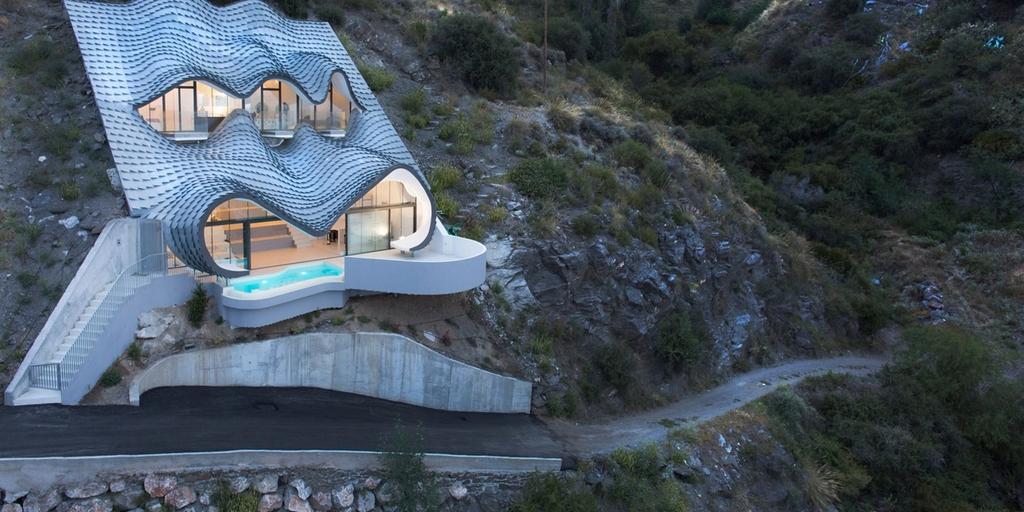
A project by Spanish architects called House on the cliff is a textured house set in the mountainous surroundings of Granada (Spain). It is striking not only for its futuristic appearance but also for its unusual location: the house is embedded into a 42-degree slope with breathtaking views of the Mediterranean Sea.

Pablo Gil (Pablo Gil) and Jaime Bartolome (Jaime Bartolome), founders of the Madrid architecture studio GilBartolome Architects, designed this project for a young couple. Despite a limited budget, the architects managed to create a truly unique work.
The villa's textured roof, which resembles scales, makes it look like a sea creature, while its form calls to mind a futuristic spacecraft. The architects themselves see a likeness to dragon skin and ocean waves when viewed from above.
The homeowners wanted something out of the ordinary, and the architects delivered.

Because of the complex positioning within the rock face, the house is arranged on two levels. The upper floor contains three bedrooms, each with its own door leading onto a small balcony that offers a stunning view of the sea.
From here you can not only watch breathtaking sunsets and sunrises, but also admire the masterfully crafted roof structure. It was developed using a patented method by engineer Manuel Rojas, with sheet metal fixed entirely by hand.
Notably, the project's authors deliberately sought to maximise the use of manual labour, in order to provide employment for local residents at the height of a period of unemployment and economic crisis.


The ground floor opens directly onto a patio with a swimming pool. Sliding partitions allow you to step out to it straight from the room.
The spacious living room accommodates up to 70 people. Arranged in the form of an amphitheatre, it has another distinctive quality: the shape of the ceiling and the fiberglass and polyester resin furniture — designed specifically for this house — create the feeling of being inside a cave. The villa's setting, its soft curves and stalactite-like forms all reinforce the effect.
The house blends seamlessly into its surroundings through its use of organic forms. This is not a new idea — Antonio Gaudí was among the first to explore natural contours in architecture. The architects make no secret of having drawn inspiration from his work, and even describe their creation as a 'contemporary Gaudían cave'.

'The form of the house and its unusual roof create an aesthetic ambiguity between the natural and the artificial,' say the project's authors.
This house strikes a harmonious balance between aesthetics and functionality. The vast panoramic windows not only frame spectacular views of the sea, but also allow natural light to fill the interior throughout the day.
A specially developed structural system takes advantage of the site's particular asset — a constant subterranean temperature of 19.5 degrees. A double shell with a 40 cm air pocket runs around the building; the air inside is warmed by this stable temperature and then used for heating, cooling and ventilation.
These technologies, combined with skilled manual craftsmanship, made it possible to achieve a high standard of construction at minimal cost.

Photography: Jesus Granada