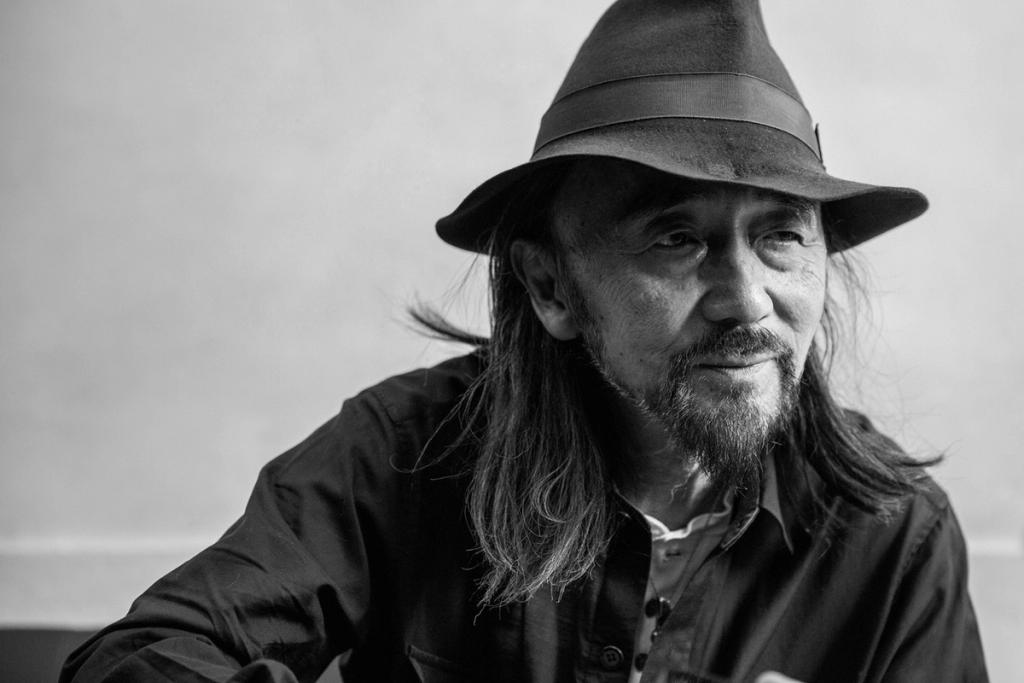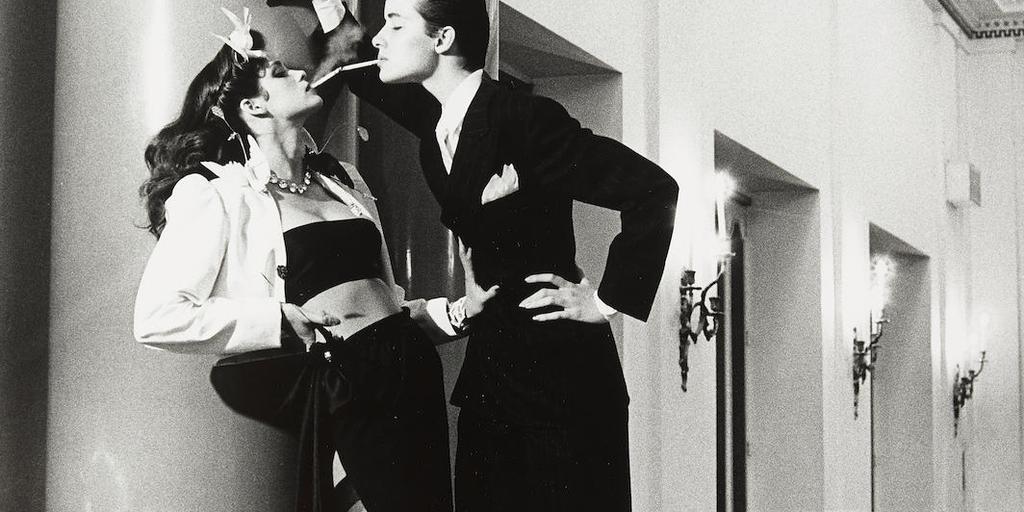
Helmut Newton was a world-renowned twentieth-century photographer who created a new direction in advertising photography. He had a love of luxury, bourgeois women and beautiful cars. His images were bold, erotic and provocative, and they exerted a profound influence on the fashion industry.
In this article you will learn:
- about Helmut Newton's childhood, youth and early photographs
- about his life in Singapore and Australia
- about his ill-fated collaboration with Vogue
- about the shots that sparked an international scandal
- about his key secrets of photography

1920 – 1938. Childhood and youth of a wealthy Jewish boy in pre-war Germany.

Helmut Neustädter was born on 31 October 1920 in Schöneberg, a suburb of Berlin. He grew up in a prosperous Jewish family that owned a factory manufacturing buckles and buttons. The family kept drivers, servants, nannies and housemaids. It is little wonder that Helmut grew up a spoilt child. He was given whatever he wanted, yet even the most expensive toys held his interest for only a few days.
Young Helmut was never distinguished by good health or academic success, but from an early age he was popular with girls and had a passionate love of photography. His father used to say: "My boy, you will end your days in the gutter. All you think about is girls and photographs."
Helmut bought his first camera, an Agfa Tengor Box, with his pocket money in 1932, when he was twelve. He took eight shots; seven came out blank and the last one was blurred. The boy decided that this remarkable image marked the beginning of a great photographer's career.
Meanwhile, the persecution of Jews was growing steadily worse. At first, Helmut's parents had to move him to an American school. In 1934, signs reading "No Jews or Dogs Allowed" appeared in cafés across Berlin, and yellow benches were placed in parks and on streets. Around the same time, Helmut began a romance with a full-blooded German girl. When his parents found out, they gave the boy a sound beating.
After the Nuremberg Laws came into force, Helmut's father was no longer permitted to run the factory. The money ran out, and the Neustadt family lost all hope of a normal life.
Jews tried to acquire skills they could use to earn a living in emigration — professors were learning to be carpenters. Since Helmut had long been interested in photography, his mother used her connections to place him as an apprentice with Yva (real name Elsa Simon), a well-known Jewish female photographer. To become a photographer, one had to complete formal training: serve an apprenticeship and then obtain a certificate. Six months later, Yva telephoned Helmut's parents to tell them they no longer needed to pay for his training — she would now pay him herself as a reward for his progress.
Because Yva was Jewish, her situation grew increasingly difficult. She received invitations to move to New York in 1935 and again in 1936, but declined both. In 1938 she was sent to the Auschwitz concentration camp, where she perished.
After Kristallnacht on 9 November 1938, remaining in Germany became impossible. Helmut's father, Max, was sent to a concentration camp. His mother somehow managed to obtain a passport for her son that permitted him to leave Germany. Helmut took only the bare essentials: clothes and his cameras.
Two days before his departure, his father came home. Helmut was shaken by what he saw. Max had suffered no physical injuries, but the Max Neustadt of before was barely recognisable. His parents booked passage on a ship to South America, while Helmut set off for China.
1938–1946. Life in exile.
His mother's parting gifts were a ticket on a ship to China and some on-board spending money that could only be used aboard the vessel. Since Jews were forbidden from carrying more than five dollars, this money gave him one last chance to feel wealthy: on the ship he entertained himself, bought drinks and lived it up.
The ship passed through Singapore, and certain foreigners were permitted to stay there. Helmut was fortunate: the commission selected him because he was young, spoke English, had cameras with him and held a photographer's certificate.
Landing in Singapore, Helmut found work at the Straits Times newspaper. Two weeks later he badly botched a roll of film. He was dismissed without severance pay and found himself penniless in a foreign country. A friend helped him for a time, and later the nineteen-year-old Neustadt met Josette Fabien — a wealthy thirty-four-year-old widow. Their affair lasted two years, during which Josette supported her young lover.

Meanwhile, the Japanese were drawing ever closer to Singapore, and Helmut was deported to Australia as a foreign national. The migrants were housed in a camp where Helmut was put to work cleaning latrines. He was later sent to pick peaches for a canning factory, and was then offered the choice of volunteering for the Australian Army or returning to the camp. Naturally, Helmut chose the former.


Helmut's service continued until the end of the war. He would later recall this period as an "entirely undemanding time": it was enough to carry out the bare minimum of duties — mopping floors and light tidying — while the rest of the time he and his friends enjoyed themselves around the city. He eventually became a military driver, but his army life remained just as carefree. In 1946, his service came to an end.
1946 — 1956. Melbourne.
Once the war was over, Helmut was free to return to photography — but the surname Neustädter struck him as wholly unsuitable for a famous photographer. He chose a new surname, Newton, obtained an Australian passport, and from that point on introduced himself exclusively as Helmut Newton.
In 1946, Newton opened a small photography studio in Melbourne, where he met his future wife June — a young and promising actress. He made it clear to her from the outset that work would always come first. Photography was not a lucrative profession at the time, and Helmut warned June that he was unlikely to ever become wealthy.
When June's mother learned of their decision to marry, her first words were: "And what do you intend to live on? Your husband will stand on a bridge photographing passers-by. What will you eat?" But June was unshakeably convinced that Helmut would become a celebrated photographer. On 13 May 1948, they were married in Melbourne.

To pay for their room and board, Helmut shot portraits and wedding photographs while June sat in the studio selling prints. They both found it thoroughly dispiriting: he hated working weddings, and she hated selling. Business was going badly. Later, Helmut moved into fashion photography, catalogues and advertising shoots, but even that brought little money. Photography was simply not a profitable pursuit in those days.
Newton became a recognisable name in Australia, but the lack of prospects frustrated him. So when, in 1957, Helmut was invited to work for the British edition of Vogue, he accepted without hesitation.
1957 — 1961. In search of a place.
Helmut was overjoyed: his dream had come true — he was a photographer for Vogue. But the euphoria quickly gave way to routine. After moving to Britain, the Newtons were still short of money, and their rented flat was in a rough part of London.
Newton felt like a naive young man from the Australian bush. He could not understand the British way of life, yet was terrified of appearing professionally inadequate. His photographs came out monotonous and dull. Unlike Australia, where Helmut had faced no competition, in Britain he felt like a provincial, worlds away from the great masters of photography.
Newton was unhappy in London. Reaching his lowest point, he saw out his contract with Vogue and moved to Paris — a city he had long loved. After several interviews, he secured a position at the magazine Jardin Des Modes.
The atmosphere of Paris bewitched Helmut: beautiful, intelligent and uninhibited women, small neighbourhood cafés, even the noise of the street traffic — everything delighted him. Life was wonderful, yet earning enough money remained as difficult as ever.
In early 1959, Helmut decided to return to Australia to make money. After working for Australian Vogue, he realised that fame on a global scale was not something the country could offer him. Financial comfort — perhaps; world renown was simply not on the cards there. In 1961, Helmut and June returned to Paris.
Recognition.
Helmut Newton joined Vogue once more — French Vogue this time — and his career finally began to flourish. Paris was then the fashion capital of the world, and the 1960s were the era of the sexual revolution: girls wore short skirts, flesh-coloured bras and bikinis. Helmut seemed to be in exactly the right place at exactly the right time. Over the following twenty years he produced his finest work.
Although his photographs seem quite inoffensive today, at the time Helmut's work was considered indecent. He shot for Vogue, Queen, Elle, Nova, Paris Match and many others.

In late 1971, Helmut received a call from Alex Liberman — editorial director of Condé Nast's glossy empire in the United States — inviting him to shoot for American Vogue in New York. For the next seven years Helmut travelled the world, shooting for French and American Vogue as well as collections in Milan and Rome. It was a frantic period: he travelled constantly, earned well, but slept a catastrophically small amount. This continued until the punishing schedule triggered a stroke. After that, Helmut carried on working, but at a more measured pace.
In 2004, at the age of 83, Helmut Newton died while leaving a parking garage in Los Angeles. Losing control of his car, he struck a wall and died in hospital an hour later.
Photographs and Projects
After the fall of the Berlin Wall, Helmut was asked to travel to Berlin and shoot a short photo-film for French Vogue. He decided to tell the story of a beautiful Russian spy.
In one of the shots, his model — Brigitte Schilling — stands on a watchtower overlooking the other side of the Berlin Wall. Unfortunately, Helmut had not noticed that at the foot of the wall stood a cross with a plaque commemorating the first person to attempt to flee to West Berlin.
When the photograph appeared in the magazine's pages, an international scandal erupted: the accusation was that a fashionable French magazine was mocking a tragedy. In response, the Germans severed their contracts with French Vogue.
Fortunately, Vogue's editor at the time, Edmonde Charles-Roux, showed generosity and did not hold Helmut responsible. But his model suffered greatly: she could no longer find work, as in Germany her image had become synonymous with that of a Russian spy. The two policemen who had posed in the photograph were dismissed from service.

After watching La Dolce Vita, Helmut produced a series devoted to the paparazzi. In the 1960s they represented a new breed of press photographer. Helmut asked the staff of the Italian magazine Linea Italiana to arrange a meeting with several paparazzi. He wanted to get a closer feel for the genre in order to produce the most authentic images possible.
The men who were to play these intrusive photographers were told by Helmut to behave exactly as they would when encountering a celebrity: as aggressively and mercilessly as possible.

In the spring of 1975, Helmut received an assignment from the prestigious French magazine Réalités to produce a photo-essay on the luxury lakeside hotel Villa d'Este on Lake Como.
Helmut produced two series: one for the magazine and a second for his personal archive. Later, when Helmut Newton's first book White Women was published — featuring images from the second series — the hotel's director declared him persona non grata.
The same thing happened following the publication of his second book Sleepless Nights. Helmut once again made both official and personal photographs, this time at the Hotel Raphael in Paris. The hotel's management subsequently banned Newton from the premises.
In time, both hotels forgave Helmut Newton.
Helmut was also frequently invited to photograph celebrities. His lens captured Margaret Thatcher, Austrian President Kurt Waldheim, Salvador Dalí, Paloma Picasso, Monica Bellucci, Catherine Deneuve, Anthony Hopkins, and many others.
The Photographer's Most Celebrated Works
Celebrity portraits
Shoot like Helmut
1. Prepare in advance
"Don't forget that models, hairdressers, stylists and make-up artists are very expensive. When I find myself on a shoot with all these people, I cannot rely on God to send me a spark of inspiration"
Helmut kept his ideas for photographs in a notebook and would speak with models, stylists and make-up artists several days before the shoot. Having thought the frame through carefully and briefed the team, Newton would work quickly, using only a couple of rolls of film.
2. Photograph for yourself first
"I never tried to please the public — if I had, I would not have taken up photography. Above all, I want to please myself"
Long before readers wanted to see fuller-figured models, Helmut was imploring magazine editors to source dresses for larger women. It took two years before fashion publications began featuring women with unconventional beauty.
3. Beauty in imperfection
"I always try to make a good 'bad' photograph. There should be a sense that something is not quite right. I don't like it when a picture comes out too perfect, too polished and too professional"
In his work, Helmut Newton strove to make the poses, locations and photographs themselves feel everyday and relaxed. However carefully prepared each shot was, there was always plenty of life left in it.
4. Technique is not the point
"I think the world is complicated enough as it is. My technique is very simple. That leaves me more time to work with the model, which is far more important"
Helmut preferred simple equipment. It mattered to him that his cameras were not overly professional — easy to operate and not too heavy.
Follow us on social media so you never miss new content: VKontakte, Telegram.