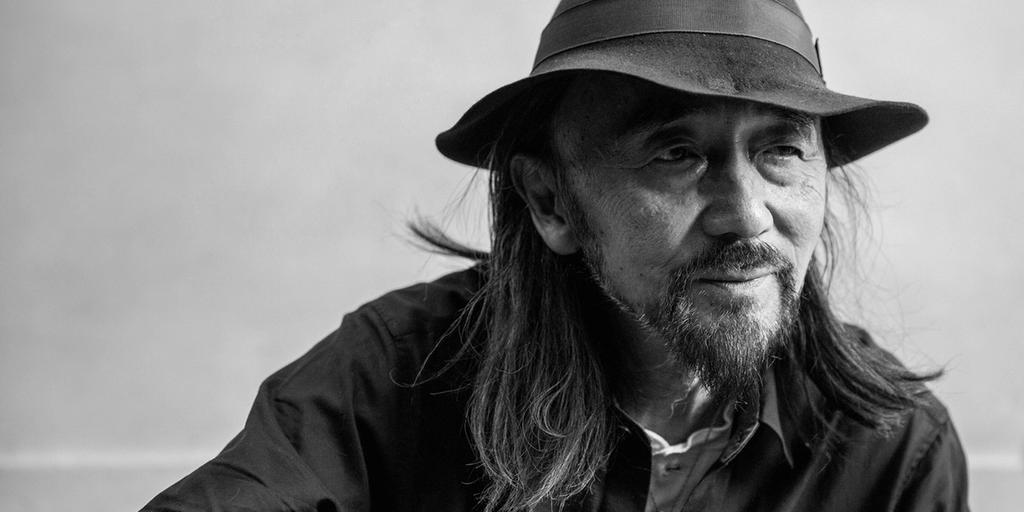
Yohji Yamamoto is a Japanese fashion designer who does not follow trends and rejects the rules of fashion culture: he creates clothes for ordinary people of all ages. Yamamoto's style sits on the boundary between minimalism and the avant-garde, with functionality and a concern for the human spirit at its core.
In this article you will:
- find a brief biography of Yohji Yamamoto;
- learn about the personal tragedy that shaped the brand's philosophy;
- read the story of how the designer's labels were created;
- discover the defining characteristics of Yamamoto's collections.
A brief biography of Yohji Yamamoto

1943
Yohji Yamamoto was born in Tokyo in the midst of the Second World War. Two years later, the bombing of Hiroshima and Nagasaki plunged the whole of Japan into mourning. His father, conscripted into the army by force, was killed in the war. These events left their mark on the designer's mother, Fumi: for the rest of her life she wore mourning black.
"When I think about my father, I realise that the war is still raging inside me."
1947
By the age of four he already understood that life could be cruel. He witnessed the devastation of war and felt despair, hunger and fear at first hand. Yohji recalls that he wanted only one thing — to protect his mother.
Fumi worked as a seamstress for sixteen hours a day in her small shop. Fabric was scarce, so she did her best to use every scrap of cloth. Watching her work, Yohji grew to love sketching garments, cutting patterns and sewing.
1966
To please Fumi, Yohji completed a law degree. But what he wanted most was to help his mother with her work. Fumi was unhappy with her son's decision, but agreed and sent him to study at Bunka Fashion College, one of Japan's most prestigious fashion schools. Among his fellow students were future couturiers: Issey Miyake and Kenzo Takada.
1972
Fumi sold her shop to provide Yohji with the capital to start a business. His style was distinctive from the very beginning: the designer erased the boundary between menswear and womenswear, chose dark fabrics and rejected symmetry.

1977
Yohji created a womenswear collection under the Y's label. That same year, his first prêt-à-porter collection was shown in Tokyo.
"The central idea behind the Y's line is to dress women in men's clothing. Women's clothing should be armour that protects the body."
1981
Yamamoto opened a boutique in Paris. His first show unleashed a storm of reactions from critics and journalists. The designer's models appeared without make-up, and the garments were defined by shapelessness, asymmetry, raw seams and an abundance of black. Critics dubbed the collection the 'refugee look', and a new term entered the fashion world: 'Hiroshima chic'.
I think perfection is ugly. I want to see scars, failures, disorder, distortion.
1984
The first menswear collection, Yohji Yamamoto Homme, was presented in Paris. Its defining features: black, collarless jackets and shirts with asymmetric sleeves, and unfinished seams.
1990
Yamamoto designs the costumes for Puccini's opera Madama Butterfly. He would later create stage costumes for the band Placebo and for films by Japanese director Takeshi Kitano.
The designer composes music for his shows and sometimes performs it himself, sitting backstage.

1996
Yohji embarks on creating a fragrance line under his own brand. The designer named his first perfume after himself — YOHJI.
2002
For the first time in fashion history, high style merged with sportswear. Yohji Yamamoto began collaborating with Adidas and launched the clothing line Y-3. Together they developed a collection of trainers and sportswear. Accessories, hats, balls and even bicycles followed shortly after.
2008
Yamamoto introduced the clothing line Coming Soon. It is more affordable than his other lines and aimed at a younger audience. What makes the collection distinctive is that every piece can be mixed and matched with the others. Another defining detail of the line: the clothes carry no brand label.
2009
At the end of one of his shows, Yohji announced that Yohji Yamamoto Inc had been brought to the brink of bankruptcy, with debts of $65 million. Even so, the designer had no intention of leaving the fashion industry — he decided to wait for better times. They were not long in coming, arriving just six months later.
2010
Yamamoto publishes his autobiography My Dear Bomb. It would have been naïve to expect a chronological account from Yohji. His memoir is a stream of vivid flashbacks, thoughts, short prose pieces, poems, proverbs and reflections on his thirty-year career.
2011
The Victoria and Albert Museum in London hosted an exhibition tracing the history of the brand.
2014
Rizzoli New York published the book Yamamoto and Yohji.
Forty years of Yohji's work were explored by his friends: German director Wim Wenders (Wim Wenders), French architect Jean Nouvel (Jean Nouvel), Hollywood actress Tessa Charlotte Rampling (Tessa Charlotte Rampling) and Japanese director Takeshi Kitano (Takeshi Kitano).
2016
Vietnamese director Ngo The Chau (Ngo The Chau) made a film about Yohji, Yohji Yamamoto. Dressmaker, in which the couturier shares his thoughts on life and his career.
Defining features of Yamamoto's style
Unisex
The primary and founding concept behind Yamamoto's clothing is the protection of the female body from male gazes and cold winds. The androgynous cut of his collections shifts attention away from the body and onto the face. In Yohji's view, it is the face that is the true source of sexuality.
"The more a woman conceals her sexuality through clothing, the more sexuality appears in her eyes."
The colour black
Yohji has a particular affinity for black, for several reasons:
— Fumi, the designer's mother, wore only black clothing.
— Yohji associates black with the sea, which he sees as a mixture of all other colours.
— Black does not distract from what matters most: the cut and the texture of the fabric.
— Black shields you from those around you.
"Black is at once modest and noble. Effortless and comfortable, yet mysterious. But above all, black is a message to the world: I won't disturb you, so please don't disturb me."
Covered and relaxed cuts
A covered cut offers shelter from the elements and protection from unwanted, unkind glances. The designer believes that body-hugging clothing "suffocates" the body and kills freedom. A relaxed cut creates space between the body and the fabric, allowing the wearer to feel truly free.
Functionality
Yamamoto's garments transform through layering and an abundance of pockets, zippers, and ties. In addition, most pieces are produced in a single universal size.
Quality
Driven by what might be called a near-obsessive desire to protect the body, the designer approaches fabric selection with the utmost care. Yohji sources his materials from the Hizo family in the Japanese city of Kyoto. Hizo founded their business in 1555 and have since been regarded as masters of traditional kimono-making and the tailoring of garments for monks.
Yohji notes that history matters in clothing. This is why he creates slightly worn-in pieces, comparing them to items found in a second-hand shop. Unlike old clothes, however, his designs are made to last a minimum of ten years.
The Y's, Yohji Yamamoto, and YOHJI labels
Y's
Yohji's first label, which he founded forty years ago. Under this brand, the designer creates everyday womenswear. The defining characteristic of the collections is a voluminous silhouette.
The label is divided into three collections:
Rismat by Y's — a knitwear line. Yamamoto describes it as minimalist with playful elements.
Michiko by Y's — a dress line in an elegant-casual style.
Kayo Nakamura — a line of bags and footwear.
Yohji Yamamoto
The second label was founded 36 years ago. It encompasses both womenswear and menswear lines. Unlike Y's, as the couturier notes, its collections are imbued with a rebellious spirit.
The label is divided into 6 lines:
Yohji Yamamoto FEMME — the womenswear line.
Yohji Yamamoto pour HOMME — the menswear line.
Yohji Yamamoto + NOIR — a line of everyday classics (as Yohji understands them).
Yohji Yamamoto Regulation — a line the designer describes as "clothes with discipline." In creating it, Yohji drew inspiration from military uniforms.
Yohji Yamamoto Ragne Kikas — a line developed in collaboration with Estonian designer Ragne Kikas. Ragne is a passionate devotee of knitting, which is reflected in the collection's defining feature: knitwear.
Yohji Yamamoto B — a unisex line. Pieces come in black and white, in a single oversized size.
YOHJI
Yohji created his fragrances in collaboration with perfumers: Jean-Michel Duriez (Jean-Michel Duriez), Jean Kerléo (Jean Kerleo), Jean-Pierre Béthouart (Jean-Pierre Bethouart) and Dorothee Piot (Dorothee Piot).
Fragrance connoisseurs note that Yamamoto's compositions can hardly be called complex. They are a vivid embodiment of minimalism.
Women's collection: Yohji, Yohji Essential, Yohji Senses, Yohji Pour Femme and Her Love Story.
Men's collection: Yohji Homme, Yohji Pour Homme and His Love Story.

Collaborations
Adidas
In 2001, Yamamoto approached Adidas with a proposal to jointly develop elegant sportswear, footwear and accessories. The new label was named Y-3.
In one interview, Yohji would admit that he was struck by how ugly Adidas trainers were, which was what prompted him to offer his help. In another interview, the designer says he asked the company for a pair of trainers for one of his shows — after which Adidas proposed a collaboration.
New Era
In 2013, New Era and Yamamoto created a capsule collection of caps, backpacks and jackets. The collection is presented entirely in black. Select cap styles feature a sewn-in silver plate engraved with Yamamoto's signature.
Hello Kitty
In 2015, the Hello Kitty brand invited Yohji Yamamoto to head a new line, Kitty's. Yamamoto's team took on product development, production and branding.
The collection includes accessories and clothing featuring characters from the Hello Kitty and My Melody universes.
Interesting Facts
- The designer considers laziness and smoking to be his main vices.
- Yohji Yamamoto is the only world-renowned designer who is not a member of the Haute Couture Association.
- In his youth, Yohji practised karate and earned a black belt.
- The couturier says that when he grows tired of making clothes, he will retrain as an actor or become a gangster.
- At the end of the film about Yamamoto, Notebook on Cities and Clothes (1989), Yohji says: "My own experience is this: I am my mother's only son. My life is devoted to this remarkable woman. Everything was started for her. Our world has always been ruled by men. It is a man's world, and so I must constantly protect her. I revere women. And in creating designs for them, I am, in a sense, asking: 'May I help you?'"
- Yohji's favourite pastimes outside of work are driving and walking his dog — which is exactly what he does in the video below.

Read more about the book-album dedicated to the exhibition at the Victoria and Albert Museum in our article.