"I am a relationship builder" — that is how Jeanne Gang, founder of the architecture firm Studio Gang, describes herself. And this is not a hint at matchmaking or a confession about her personal life, but the design philosophy that guides the studio she leads.
Studio Gang's defining approach lies in carefully studying the relationships between people, communities, infrastructure and the environment, and then weaving that understanding into buildings and public spaces — in its home city of Chicago, in the business world of New York, and beyond.

Jeanne Gang grew up in a civil engineer's family, watching from childhood as landscapes and urban spaces were transformed around her. This shaped not only her interest in architecture but also her sensitivity to context — to space itself. In the studio's work one can trace both an effort to bring the natural environment into buildings — through materials, structures and forms — and a desire to embed buildings within their surroundings, drawing them into the urban fabric and into the lives of the people who inhabit it.
It was with this in mind that Jeanne, having studied at the University of Illinois at Urbana-Champaign and the Harvard Graduate School of Design and worked at architecture firms in the Netherlands and France, returned to her native Chicago. Her husband and colleague Mark Schendel acknowledges that with such a résumé Jeanne would have been warmly welcomed in Los Angeles or New York, yet she chose to work with a less pretentious city — one that genuinely needed new ideas and fresh energy:
"She had knowledge of the city and of the people in the area — it seemed as though Chicago had been stewing in its own juices and had been fairly dormant architecturally for the past twenty years or so, and she could see that untapped potential in the city."
Her first project in her home state was the Starlight Theatre (Starlight Theatre) — a structure for near open-air performances with a folding roof that, on summer nights, transforms into a place for stargazing.


Many of Jeanne's projects are developed for what she herself calls 'architectural deserts' — neighbourhoods cut off from architectural innovation and denied the opportunity to encounter inspiration:
'Some segments of the population have no access to architecture. It is strange to think about, because architecture can truly change your life, especially when it touches you at a young age.'
The idea of bringing people closer to architecture has found expression in, among other things, one of Studio Gang's Chicago projects — the Arcus Center for Social Justice in Kalamazoo, Illinois.
Arcus Center for Social Justice
Arcus is a stronghold of support for human rights and social justice. Ideas are debated here, projects take shape, advocacy groups convene, and the next generation of rights defenders and equality advocates is nurtured. The concept behind the Arcus building is one of bringing people together. As Jeanne's studio worked through the design, one of the central questions driving the brainstorming was:what elements will draw people together?. The answer took the form of a generous shared kitchen and a fireplace around which people can gather to exchange ideas in a calm, welcoming atmosphere.
The building's exterior also speaks to this sense of connection — the wings extend in three directions, reaching simultaneously towards a residential neighbourhood, a local college campus, and a small grove of trees. The walls of the Arcus Center follow smooth, concave lines and are built using an unusual technique: cement, rather than conventional stone, holds together cross-sections of timber logs. The approach is highly sustainable — it sequesters carbon dioxide within the walls of the building, purifying the air both inside and out. The building also sits beautifully within the surrounding landscape, and after dark small circular porthole windows glow against its facade.
As Jeanne Gang acknowledges, designing a project that does not merely bring people inside a building but genuinely unites them is a challenge; yet it is far easier to achieve in a single-storey structure than to forge connections between people vertically — across the floors of a multi-storey residential building.
Aqua Tower
Skyscrapers are generally perceived as cold and corporate — even when they are residential rather than office buildings. Whether it is the severe lines and materials or the vertical organisation of space, where neighbours see each other only in lifts, the effect is the same. Studio Gang set itself the task of designing a skyscraper that would become a platform for interaction among its residents. The solution proved to be an unusual balcony structure: undulating forms that shift in curvature from floor to floor, allowing occupants to see what is happening a few metres below and to strike up an easy conversation with a neighbour without having to venture into the lobby or ride the lift.
The balcony curves were not dictated by a client's whim — in designing the building's exterior, the studio took its cues from wind patterns. Using 3D modelling, the architects studied airflow directions across different seasons and developed a structure that would break up the wind as effectively as possible, creating comfortable conditions for the tower's residents. This is not the only Gang project designed with such attentiveness to natural processes: the studio employed the technique of solar carving (solar carving) in the design of this office building in Manhattan, which has yet to be realised. By calculating the trajectories of sunlight at different times of day, the architects arrived at a crystal-like structure that will cast minimal shadow — a benefit to the residential buildings, parks and public spaces in its immediate vicinity.
Yet the distinctiveness of Aqua Tower lies not only in its careful integration with its surroundings, but also in its capacity to foster and sustain a community within an architectural form that might seem inherently ill-suited to social interaction. Beyond the thoughtful arrangement of the balconies, the architects incorporated another unifying element: the skyscraper features a green roof — one of the highest in the city. Tending a shared rooftop garden brings people together and helps build an ecosystem within a single residential building. Jeanne Gang has noted — half in jest, half in earnest — that thanks to the garden and the balconies, some Aqua Tower residents have found love.
The theme of a connective hub, a communal nest, a place that accumulates ideas, runs through many of Studio Gang's projects. Not long ago, the practice unveiled a completed residential hall for the University of Chicago, which serves as the heart of the university campus.
North Campus Residential Commons, University of Chicago
The University of Chicago residence hall designed by Studio Gang bears no resemblance to the dormitories most of us picture. Yet the spirit of student communal life — solidarity, the exchange of ideas, a full range of activities from the academic to the recreational, all without leaving your pyjamas — has been preserved and carried through, and multiplied by four. That is precisely how many slender, tall, almost paper-thin buildings make up the complex.
They were conceived as a connective link between the campus and the outside world, and so they bring together residential quarters, reading rooms and other spaces essential to student life alongside shops, cafés and green areas. The walls of the buildings are gently curved, as though casually sketched by a student in the margins of a notebook. These bends and arcs recur throughout the interiors of the dormitories. The structures draw together students, professors, campus visitors and chance passers-by, creating a wealth of territorial opportunities for interaction.
The residential quarters are divided into three-storey clusters, each with its own spaces for cooking, relaxing and studying, though the building also offers places where students can come together as a whole. One such space is the reading room on the top floor, which affords a wonderful view of the city, the campus and Lake Michigan.
Unusual geometric forms that mirror natural processes are, as one might notice, among Studio Gang's favourite devices. The next project, on the Chicago River, is remarkable for the way the architects translated the building's purpose and function into its very silhouette — expressed through the idea of movement.
The Eleanor Boathouse at Park 571
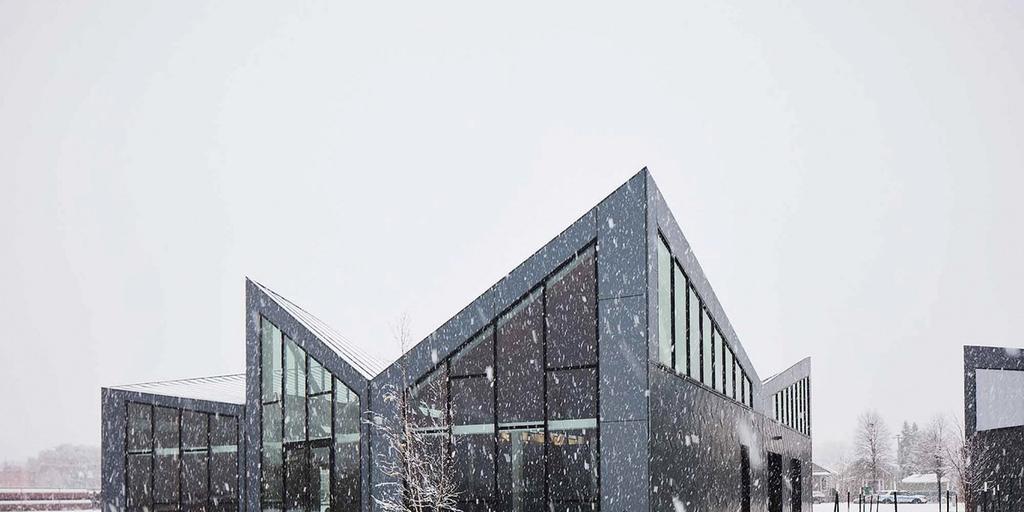
The Chicago River — once polluted and overgrown — is now the focus of an ecological battle. Jeanne Gang's studio has contributed to the transformation of the river into a place of recreation and wellbeing for the city's residents, designing two boathouses — the WMS Boathouse at Clark Park and the Eleanor Boathouse at the aptly named Park 571. The latter has become a home for local school and university rowing teams as well as boating clubs and organisations. Athletes gather at the Eleanor Boathouse year-round for training, team-building and other activities; the building also houses an after-school programme space that sees active use. "The boathouses on the Chicago River are part of a new way of seeing the river through the lens of environmental stewardship. By making the riverbank a place for recreation, we hope to spark a commitment to the river's recovery and to foster the wellbeing of the communities surrounding it," says Jeanne Gang herself.

The building's distinctive zigzagging lines are drawn from the rhythm of rowing and are intended to inspire Chicago residents — if not to take up the sport itself, then at least to embrace the spirit of teamwork that rowing embodies. The building's windows face south, providing additional natural light without any energy cost. A gradient green window glass on the south façade offers a striking contrast to the dark grey galvanised exterior, as though dissolving the building's geometry into the organic flow of the river.
Studio Gang continues to work in Chicago, New York and around the world — most recently, the studio was commissioned to design the US Embassy in Brazil. If you share the ideals of the studio and of Jeanne Gang herself, take a look at some of the firm's forthcoming projects: among them, a residential skyscraper in San Francisco that follows in the footsteps of Aqua Tower in its attentiveness to air currents and natural surroundings; a new building for the American Museum of Natural History in New York — captivating in its simultaneously futuristic and prehistoric vaults and arches — or even the building of the Academy for Global Citizenship.
Photography: Studio Gang, Steve Hall © Hedrich Blessing, © Tom Harris Photography