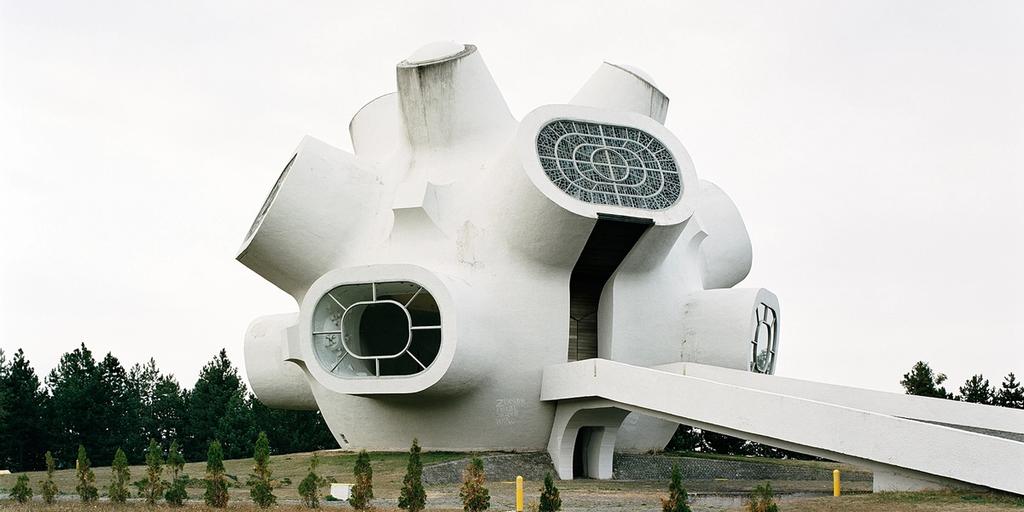
Yugoslavia's monuments are numerous and varied: ranging from modest memorial plaques of little artistic merit to monumental sculptural structures and urban architectural ensembles of considerable aesthetic, artistic and architectural significance. The Spomenik project was intended to immortalise the exploits of the partisans in Yugoslavia's National Liberation War and the revolution that brought Josip Broz Tito to power. The monuments stand out strikingly from the rest of socialist architecture — not only for their brutalist quality, but also for the democratic approach taken to selecting the works.
We have gathered ten of the most significant examples from the Spomenik project — those that best illustrate how the role of the monument was reinvented and reimagined by the Yugoslav modernist memorial movement.

History
The Serbo-Croatian word 'spomenik' refers to an extensive series of memorial structures built between 1950 and 1990 across the territory of the former Yugoslavia — from the Drava river to Lake Ohrid. Their abstract form was too modern for its time and was regarded as a marker of the republic's post-national and universalist identity.
The monument-building project was part of the grand plan conceived by Yugoslavia's leader, Josip Broz Tito, to forge a cohesive, classless, multi-ethnic country free from interethnic conflict. The memorial complexes were intended to commemorate the achievements of the Yugoslav peoples during the National Liberation War of 1941–1945.
Yet these modernist memorial structures mean far more than mere mourning for the victims of war and the glorification of partisan struggle. Their abstract form combines political and artistic innovation, conveying universal values of reconciliation, resistance and the principles of transnationalism that Tito embedded in the founding of his country.
An abstract sculptural approach to commemorative structures had never before been applied on such a scale or at such a level. Despite their formal heterogeneity, the dozens of monuments that emerged in Yugoslavia during this period share common traits: they are typically large in scale, extraordinarily ambitious in their development of new monumental forms, and most often situated on elevated ground. This resemblance — which allows a monument to be immediately identified as part of the Spomenik series — was shaped by several factors.

First, they sought to form and embody in monuments a national collective vision oriented toward an optimistic and hopeful future defined by unity and symbolic universalism. Much of the Yugoslav political imagery of the period, as expressed through art, conveyed concepts such as 'progress' or 'the future'.
A similar aesthetic can be found not only in monumental structures but also in the architectural projects of the era: the largest concert hall in Yugoslavia — the Sava Centre in Belgrade, designed by Stojan Maksimović — or the General Plan for Skopje, developed in the aftermath of the 1963 earthquake. Modernism and futurist approaches to design also made their way into everyday life, as seen, for example, in the modular K67 kiosks created by the Slovenian designer Saša Mächtig.

Second, the abstract form of the monuments served Tito's political aims of perpetuating the revolution that had brought him to power. Through their amorphous, geometric and indescribable shapes, the very concept of 'revolution' could be readily reinterpreted in line with the official political narrative. The monuments opened a memorial space for individual thought and association, accommodating diverse interpretive approaches and stirring political imagination.
Finally, a significant role in the emergence of the modernist style in Yugoslav memorial architecture was played by the innovative process through which the memorials were developed. Rather than selecting an artist by hand to create a monument — as had been the custom in earlier eras — veterans' commissions (SUBNOR) introduced democratic design competitions. These allowed artists and architects to submit their proposals freely, while a jury of creative figures and public representatives chose the winner collectively and anonymously.
Although Yugoslavia was a socialist country, its monumental construction escaped the fate of Socialist Realism — even though monuments in that style had begun to be erected actively during the first postwar decade. In the 1950s, however, the relationship between Tito and Stalin soured of its own accord, and Yugoslavia turned away from Socialist Realism in search of its own style. It was aided in this by Western European ideas that entered Yugoslavia partly through the celebrated exhibitions of the New York Museum of Modern Art held in Belgrade in 1956 and 1961.
Following the dissolution of the Socialist Federal Republic of Yugoslavia, which began in 1991, the newly formed states developed their own concepts of national identity, grounded largely in a break with the universalist symbols of the past. The connections that had been established between historically significant theatres of war, the monuments erected there and social memory were almost entirely severed, leading to the destruction of most of the monumental structures or, at best, their abandonment.
1. The Flower Monument, better known as the Stone Flower

What it commemorates
After the forces of the Fascist Axis invaded the Kingdom of Yugoslavia in April 1941 and transformed it into the puppet Independent State of Croatia (NDH), labour camps were established in the region, which later became death camps.
One of them was Jasenovac, located in the town of the same name. During the Second World War it was considered the sixth deadliest camp. After the war ended, all of its infrastructure was dismantled, making it the only major camp from which no physical evidence of its existence survived.
History of the monument
In the late 1950s, under pressure from survivors and their families, the Yugoslav government began implementing plans to build an official contemporary monument to commemorate these tragic events.
In 1960, the Yugoslav government approached architects Bogdan Bogdanović and Zdenko Kolacio and asked them to submit design proposals for the memorial complex. Ultimately, Josip Tito selected Bogdanović's design.
The original concept included a greater number of elements that were never realised. The monument itself and its grounds are currently well maintained.
Symbolism
Bogdanović chose as his representative form a 24-metre stone flower opening toward the sky, with six petals rising from a crypt. A path of wooden sleepers from the old railway tracks — once used to transport prisoners to the camp — leads through the landscaped park to the monument. Through this device, Bogdanović sought to recreate for visitors the final journey of the victims to their resting place. This lyrical memorial serves as a metaphysical allegory of life and death, of reconciliation and the cessation of hatred that passes from generation to generation.
2. Monument to the Revolution of the People of Moslavina

Dedicated to
This monument was erected in 1967 by Dušan Džamonja in memory of the uprising of popular forces against occupation in the Croatian region of Velika Moslavina. The small village of Podgarić was an important centre of the partisan movement of the Croatian Communist Party. In the 1960s, it was decided to erect a monument here to commemorate the support that local residents had given to the partisans.
History
The competition for the monument was won by the acclaimed Serbo-Croatian sculptor Dušan Džamonja, and in 1967 the monument was inaugurated at a grand ceremony attended by Josip Tito. Simultaneously with its construction, a small artificial lake was created in the valley below the memorial complex, with the support of Serbian artist Vladimir Veličković, who was responsible for the landscape design. After the country's dissolution in the early 1990s, national interest in the memorial declined significantly; it fell out of use and gradually fell into disrepair.
Symbolism
The centrepiece of the complex is a large, winged abstract sculpture approximately 10 metres high and 20 metres wide, with a central sphere-like 'eye' clad in aluminium panels. The designer sought to create 'wings of victory' transcending death and defeat. Each of the five wings was intended to symbolise one of the five republics of unified Yugoslavia. The monument's sharp concrete contours and lines, visible from all sides, convey dynamism, flight and power, while the metallic core embodies solidity and unity.
3. Monument to the Uprising of the People of Kordun and Banija

Dedicated to
This monument is dedicated to the uprising and resistance movement of the people of the Croatian regions of Kordun and Banija against Nazism, and commemorates the fallen fighters and civilians.
History
In 1972, seventeen proposals were submitted to the monument competition, with young architect Igor Toš emerging as the winner. However, during construction his design proved extremely costly and complex. At a second competition held four years later, the jury selected the design of Serbian sculptor Vojin Bakić, who had placed second in the first round.
The political upheavals of the 1980s, brought on by the death of President Josip Tito, meant the monument was never completed. During the Yugoslav Wars of the 1990s it was targeted by vandals, who stripped away almost all of its aluminium cladding.
Symbolism
The exterior of the monument has no openings whatsoever, giving it the appearance of an enormous sculpture that dominates the rural landscape.
"Sculpture, and monuments in particular, must be architecture stripped of its utilitarian function — something akin to a pure poetic conquest of space and the establishment of new human relationships with it." — Josip Tito.
The monument represents a distinctive synthesis of the organic and the technological, achieved through the contrast between its curving volumes and the gleaming cladding of a modern industrial material.
4. The Ilinden Memorial, or Makedonium

Dedication
The central historical event this monument commemorates is the Ilinden Uprising of 2 August 1903, in which Macedonian insurgents rose against Ottoman rule. It also honours the memory of local fighters who served under the partisan banner during the Second World War.
History
An open competition was won by the married couple Jordan and Iskra Grabul. The commission charged with preserving the artistic value and social significance of the project pressed for more traditional and figurative elements in the memorial, while the Grabuls wanted the monument to be entirely abstract. The final version consequently diverged markedly from the concept approved by the jury.
Symbolism
The memorial complex comprises several sculptural elements: a row of large concrete "chains" along the road leading to a crypt formed by two walls inscribed with the names of 58 prominent Macedonian revolutionaries. Directly in front of the monument stands a large, colourful relief wall. At the summit of the hill rises the Makedonium itself — a 25-metre concrete mace studded with numerous tubular projections, named after the construction company that built it.
The Grabuls incorporated a substantial amount of symbolism into their memorial complex: the entrance doors echo the letter "M", and the eternal flame inside the monument is shaped like the Macedonian flag. Four fractal stained-glass windows by the Macedonian artist Borko Lazeski are set into the ceiling, symbolising the four seasons and creating a vivid contrast with the gleaming white interior. Jordan Grabul produced a series of bas-reliefs on the interior walls that tells the story of Macedonia through abstract imagery of genesis, conflict and liberation.
In 1990, a memorial to the schoolteacher Nikola Karev — who led the uprising against Ottoman rule — was installed inside the dome. The tomb takes the form of a cube of white marble from which one corner has been removed, as a reminder that Karev died with the great work of his life unfinished: the independence of the Republic of Kruševo.
5. Monument to the Revolution

Dedication
The monument, memorial wall and museum were built in memory of the Battle of Kozara in the spring of 1942, during which more than ten thousand partisans and civilians lost their lives.
History
On 26 January 1962, in a competition featuring 49 submitted entries, the committee selected the concept proposed by Dušan Džamonja. Construction began on 2 August 1971 and was funded almost entirely through donations. Within a year of its completion, the monument had already become one of the most significant memorial sites in all of Yugoslavia. A popular saying even circulated in the country that its people fell into three categories: those who went to Rome, those who went to Mecca, and those who went to Kozara.
Owing to its remote location and protected status within a national park, the monument was spared serious damage and vandalism following the break-up of Yugoslavia.
Symbolism
The central monument of the memorial complex takes the form of a cylindrical monolith approximately 33 metres tall. It is composed of 20 vertical ribs with intermittent curved projections, the outer faces of which are clad in strips of polished stainless steel.
Dušan Džamonja sought to create an ambivalent structure with a rhythmic profile in which positive projections and negative recesses alternate as a symbol of the antagonism between life and death.
6. The Battle of the Sutjeska Memorial Complex in the Valley of Heroes

What it commemorates
The monument memorialises the more than 7,000 people who died in the Battle of the Sutjeska, when Axis forces attempted to destroy a group of Yugoslav troops led by Josip Tito, who nonetheless managed to escape.
History
Tito's escape from the Sutjeska is regarded as a pivotal turning point in the partisan liberation struggle. In 1964 a closed competition for the monument's concept was held, with architects and sculptors from across Yugoslavia invited to take part — among them Stanko Mandić, Jovan Kratohvil, Boris Kobé, and the eventual winner, Miodrag Živković.
Construction began in 1969 and was completed two years later. The project was funded entirely by federal resources from the capital. During the Yugoslav era this monument was considered the most significant memorial site in the country, but following the dissolution of Yugoslavia it began to fall into disrepair.
Symbolism
The sculptural monument consists of two 19-metre concrete walls adorned with a fractal pattern in which, on closer inspection, one can make out the heavily stylised faces of fallen soldiers — evoking their heroic spirit rather than any individual likeness.
The monoliths resemble wings of victory, pointing toward the steep ravine through which the partisans fled the valley during the battle. They appear to mirror one another, yet subtle differences exist between them, symbolising the clash of two opposing armies.
7. The Korčanica Monument

What it commemorates
The memorial on Mount Grmeč honours the staff of the largest clandestine partisan hospital to operate during the Second World War.
History
In 1975, SUBNOR, together with local and regional authorities, organised a competition in which the jury selected, from 13 submitted proposals, the concept by the noted Slovak sculptor Ljubomir Đenković.
The monument was inaugurated in 1979. Today it is overgrown and in a state of extreme neglect, abandoned and forgotten in every sense.
Symbolism
The monument consists of two hemispherical marble walls approximately 15 metres high. In front of it, a large circular pool was excavated to serve as a reflecting surface. A network of paths through the surrounding forest was laid out, with small concrete structures along the way marking the locations of the former hospital wards.
The form of the memorial complex resembles a flower bud opening above the pool that nourishes it, symbolising the birth of life from the sacrifice of those who fought and died in these places.
8. The Memorial House or Municipal Assembly of Kolašin

What it commemorates
During the Second World War, the town of Kolašin in northern Montenegro repeatedly changed hands between resistance forces and Axis control, and suffered aerial bombardment until it was finally liberated in 1943.
On 15 November of that year, Kolašin hosted the first session of the Montenegrin parliament in 26 years, which proclaimed the independence of the liberated region under the leadership of the surgeon Niko Miljanić.
History of the project
In 1970, a competition organised by local and regional authorities together with a group of veterans was won by the Slovenian architect Marko Mušič.
Construction began the following year and lasted four years. The building, in whose design Marko was assisted by his father — the experienced Slovenian architect Marjan Mušič — continues to serve the municipal administration and local political parties to this day.
Symbolism
The memorial house, whose form is dominated by sharp concrete angles, is distinctive in that it functions simultaneously as a monument and as a civic building. Inside, it houses numerous exhibition spaces and a large hall for public events.
The building's sharp triangular elements echo the traditional pitched roofs of the surrounding houses, symbolically embedding it within the community it inhabits.
The building's flexible interior was designed in the spirit of the Brutalist school of architecture. Movable walls between the multipurpose halls conveyed the ideology of connection and unity that underpinned the Yugoslav state.
9. Monument to the Fallen Soldiers of the Kosmaj Detachment
What it commemorates
The monument is dedicated to the partisan regiment from the Serbian district of Kosmaj and honours the memory of 5,600 partisans who died fighting the occupiers and collaborators.
History of the project
In the late 1960s, local committees of the SUBNOR organisation began seeking concepts for a monumental complex; the winning proposal came from the Belgrade artist Vojin Stojić and the architect Gradimir Medaković.
Built in a single year on a mountaintop in Kosmaj National Park, the monument quickly became a landmark and remains popular with visitors today.
Symbolism
The central monumental structure of the complex consists of five separate 30-metre concrete double-ended ribs which together form a shape reminiscent of a blazing star.
From a distance, the star-shaped monument appears to be a single unified structure combining the symbolism of a five-pointed star and an explosion. Standing directly beside it, however, it becomes clear that the five cantilevered forms are entirely freestanding and do not touch one another. This visual effect reflects the idea of Yugoslav unity — acting together as one, yet composed of distinct and unique peoples.
10. The Partisan Memorial Cemetery in Mostar

Dedicated to
During the war, the city of Mostar became part of the NDH and was finally liberated only on 14 February 1945. In August 1941, a popular resistance movement began to rise here; 810 of its fallen fighters are buried in this cemetery.
History
Groups of Yugoslav veterans opposed the burial of partisan soldiers in religious cemeteries, as this ran contrary to the communist ideals of the revolutionary fighters. Accordingly, in 1959 Mostar's civic authorities approached Bogdan Bogdanović with a request to create a memorial complex that would bring together the remains of all the fallen partisans in a single place.
During the monument's construction in the 1960s, much of the work was carried out by volunteers from youth civic movements. After its completion in 1965, the memorial became a popular landmark, drawing visitors from across the country. During the Bosnian Wars of the 1990s the Mostar cemetery was attacked, vandalised and bombed, and today it has fallen into an extreme state of neglect.
Symbolism
The memorial complex consists of several earthen terraces, ascending via a series of broad, curving paths. These lead to a large, jagged fountain whose waters reflect a sweeping cosmological dial set into the wall at the summit of the memorial.
The absence of religious, nationalist or sociological symbols, combined with the surrealist manner of its execution, makes this complex unique for its time.
The memorial, nicknamed the 'city of the dead', echoes real physical features of Mostar. It serves as a reflection of the city of the living, for which the partisans buried here gave their lives.
Interesting facts:
- The monument at Podgarič and the monument at Tjentište appear in the music video for Alan Walker — Darkside
- In the past decade, radio masts have been installed at the summit of the monument on Petrova Gora
- The monument on Petrova Gora appears in the Netflix series Tribes of Europe
- The Makedonium has become a symbol of statehood and is depicted on the 10,000-dinar banknote
- Director Ridley Scott specifically instructed his designers to use the monument on Mount Grmeč as the basis for their concept designs for the alien temple in the film Alien: Covenant
- Ranko Radović was just 27 years old when he won the competition to design the monument to the Battle of Sutjeska
- After the dissolution of Yugoslavia, Kolašin became the only city that did not rename a single street honouring partisan heroes or wartime events
- A likeness of the Kosmaj monument is used in scenes from The Hunger Games: Mockingjay – Part 2
If you enjoyed this article, we recommend exploring 10 more projects by the architect Le Corbusier or Tadao Ando.
Also follow us on social media so you never miss new content:
— Telegram