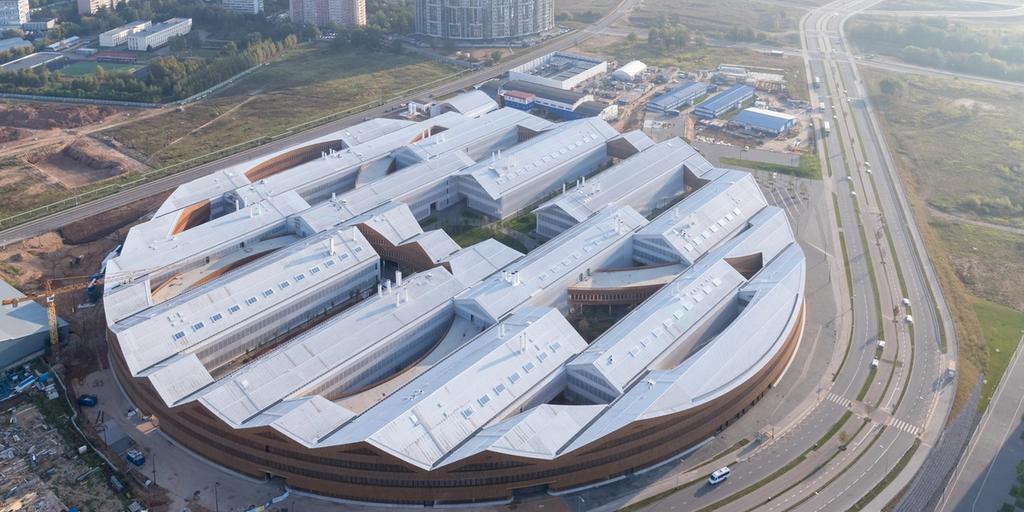
The Skolkovo Institute of Science and Technology is a project by Herzog & de Meuron, the architectural practice based in Basel, Switzerland. The Skolkovo Institute of Science and Technology is a private technological university that forms part of the Skolkovo Innovation Center, located near the Moscow Ring Road.


The original master plan for the Skolkovo campus was conceived to create a high-quality urban environment combining different aspects of human life: study, work, travel, shopping and leisure. The Skolkovo scheme comprises five distinct districts or quarters. Each district has its own form and was designed by a different architect, giving every quarter its own character and atmosphere.
Herzog & de Meuron developed the master plan for District 3, centred on the university. It consists of three parts, or three rings: the East Ring, the Agora and the West Ring. Skoltech University forms the heart of the district. The outer ring has a diameter of 280 metres and encloses two smaller rings. It contains teaching and public spaces. The buildings' curved forms close into a loop. The outer ring houses faculty buildings, administrative spaces and meeting rooms, while the inner ring contains classrooms and lecture halls. The main auditorium sits at the centre, at the point where the rings intersect.

A grid of rectangular repeating blocks resembles a chessboard. To maximise natural light, the spaces are oriented so that windows face east or west. The laboratory blocks are based on a 7×7-metre structural grid and are either 21 or 28 metres wide, with varying lengths — a strategy the architects used to make the modules as efficient as possible. Research spaces, along with technical and logistics zones, are located in the basement levels.


The arrangement of the blocks and rings creates a distinct pattern. Three rings form a boulevard and a network of interconnected courtyards. The building reads as monolithic, yet it is not — opening its interior spaces to passers-by. The central courtyard is the largest; it is visible from all the rings and from most of the blocks, and serves as the primary venue for formal events and everyday recreation. The remaining courtyards vary in shape and size, connected to one another by passages beneath the rings or around the corners of the blocks. The planting scheme integrates the university's landscape into the surrounding forests of the Moscow region.


The university blocks are clad on the outside with vertical fins that regulate sunlight and give the facades a uniform appearance. The finishing materials used for the blocks and the rings differ both externally and internally. The ring interiors feature natural oak flooring and wall cladding, with Siberian larch fins on the facades. The blocks have industrial vinyl flooring and aluminium wall cladding in the laboratories, while their facades are covered with white aluminium fins. The walls throughout the entire building are constructed from the same concrete material, and each structure is topped with identical sloping roofs. Together with the facades, the roofs unite all the elements into a coherent whole and visually distinguish the university from the buildings nearby.

Photo: Iwan Baan
If you are interested in the architecture of educational projects, we invite you to read our article on contemporary schools featuring remarkable projects from around the world.
You can also follow us on social media so you don't miss new content: VKontakte, Telegram — @loskomagazine.