The Global Seed Vault: the architectural landmark of Spitsbergen Island
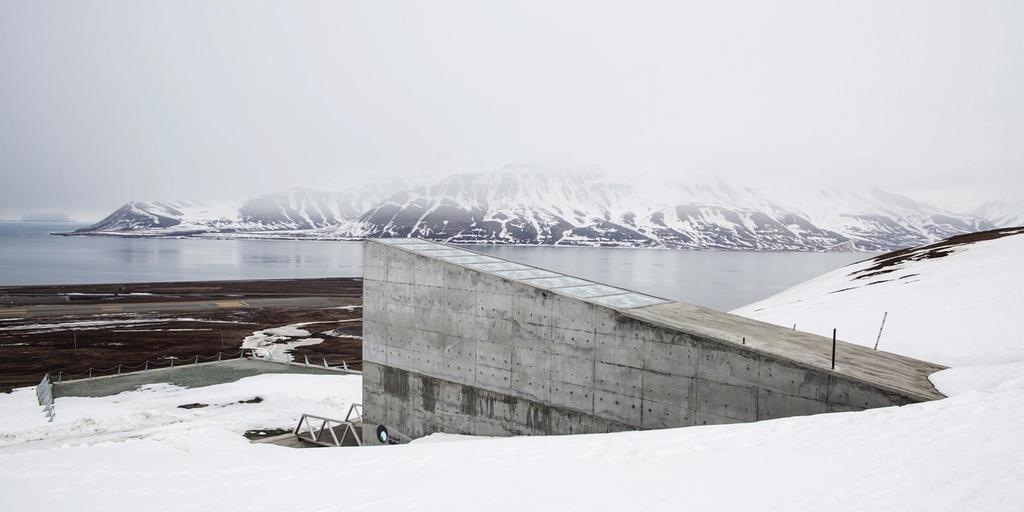
The Global Seed Vault on the Svalbard Archipelago is an underground tunnel designed to store seed samples of the world's principal agricultural crops from every country. Its striking appearance has made the structure not only a scientific facility but the island's sole architectural landmark.
The Idea
The facility was designed to protect seeds from global catastrophes: climate change, nuclear war, and even asteroid impact. The initiative was launched by members of the Norwegian Government, who in 2006 commissioned engineers from the Norwegian firm Barlindhaug Consult led by architect Peter Søderman (Peter W. Søderman).
The Location
For the construction of the vault, Norwegian scientists chose the Svalbard Archipelago (Norway), situated 1,300 km from the North Pole.
In permafrost conditions, even if all equipment were to fail, the seeds would remain undamaged. The archipelago lies outside any seismically active zone, so the steel-reinforced bunker is safe from earthquakes, and the vault's position inside a rock face 130 metres above sea level protects it from flooding.
The Design
The vault is a system of tunnels resembling a horizontal mine shaft, consisting of three spacious chambers cut into the rock. The distance from the entrance door to the rear of the building is 145.9 metres. Each chamber is 27 metres long, 10 metres wide and 6 metres high.
Reinforced concrete walls one metre thick, together with the surrounding rock acting as a natural solid casing, will protect the seeds even from a direct nuclear warhead strike.
Airtight blast-proof airlock doors, a low-temperature environment (−18 °C), restricted oxygen levels and specialised aluminium packaging inside sealed plastic boxes guarantee the indefinite preservation of cereal crops.
A control tower, motion sensors and surveillance cameras guard the building against unauthorised entry.
Design
Norway has a law stipulating that any building constructed with government funding that exceeds a certain cost must have value as a work of art.
Decorating the interior of the structure made little sense, as tourists are not permitted inside. It was therefore decided that the exterior of the vault would serve as the artwork.
Norwegian artist Dyveke Sanne (Dyveke Sanne) decorated the roof and façade with light-reflecting triangles, prisms and illuminated mirrors, making the artistic element impossible to miss. Depending on the weather and time of day, the futuristic composition shifts in colour from white to a greenish turquoise.
According to the artist, the work symbolises the diversity of life contained within the vault, reflected out to the entire world through a great prism.
Interesting facts
- The Doomsday Vault — the nickname journalists jokingly gave the building for its ability to withstand every catastrophe on Earth.
- The vault currently holds 860,000 seed samples from around the world, and the number grows every year. In total, the facility has capacity for 4.5 million samples.
- Every country has its own compartment in the vault, which holds its primary sowing and planting material. Access to it is permitted only with the official authorisation of the depositing country's government.
- Russia's compartment holds 12,000 samples of legume and grain crops.
- The vault opens only for the deposit of new specimens. This happens three to four times a year.
- To reach the innermost part of the vault, visitors must pass through five coded security doors.
- In 2015, seeds were withdrawn for the first time to restore agricultural crops in Syria that had been lost to conflict. Syrian scientists requested the return of 130 boxes containing the hardiest, lowest-maintenance seeds.
- In addition to the Norwegian government, the Bill & Melinda Gates Foundation and the Rockefeller Foundation were among the project's funders.
A short video about the vault in English.

How to get there — and whether it's worth it
The vault is located on Svalbard, the largest island in the archipelago, in the settlement of Longyearbyen. The town sits on the south-western shore of Adventfjorden. Longyearbyen is surrounded on all sides by steep mountains. Its wide, sparsely populated streets run from the bay along a valley, and the locals' houses — painted in red, orange, yellow and green — are something of an attraction in their own right.
Beyond the colourful houses, the picturesque Arctic landscape and the vault itself, the area offers one more photographic subject: polar bears. Their numbers exceed the local human population. As a result, people do not venture outside without a firearm, and the first classes at the local university begin with weapons training.
Flights to the island operate from the Norwegian cities of Oslo and Tromsø. Tourists tend to pass through as a staging point for onward travel around the archipelago's islands. Seeing and appreciating the beauty of the vault's entrance is therefore more of a pleasant bonus than the purpose of a trip — especially since the surroundings and the vault's interior can also be explored via a virtual tour.
Photography: Rune Almeland (Rune Almeland), Jason Ahrns (Jason Ahrns), Matthias Heide (Matthias Heyde)
Another architectural structure designed to preserve tea can be found in our feature on a teahouse in Beijing. More photographs of the island are available in our roundup of works by Greg White.