Wassily Kandinsky belongs less to the Russian avant-garde than to the world's — he is one of the founders of abstraction in painting. He was the first to provide a theoretical grounding for the principles of the new art. His painting, which was in many ways autobiographical, traced a demanding journey from the figurative to the abstract, shaped by personal upheaval and the tragedies of his age. An eternal wanderer and a man of many gifts, his philosophy inspired generations of artists, from students at the Bauhaus to the representatives of postwar Abstract Expressionism.
In this article you will learn:
- about Kandinsky's life and fate;
- about the key stages of his creative journey;
- what lies behind the interplay of line and colour in his painting;
- about the theoretical legacy of this great avant-garde artist;
- and some fascinating facts from the artist's life.

Biography of Wassily Kandinsky
Childhood and youth, 1866–1895
A descendant of taiga outlaws, Siberian convicts, Mongol princes and wealthy merchants, Vassily Vasilyevich Kandinsky was born in Moscow — a city for which he would carry an abiding love throughout his life. From early childhood the boy grew up in a multicultural environment: his mother was a Baltic German, his father a first-guild merchant from an ancient Transbaikal family.
When Kandinsky was five, the family moved to Odessa owing to his father's poor health. Shortly after the move, his parents divorced. He was raised by his aunt — his mother's elder sister. It was she who instilled in him a love of painting, music and literature, and it was to her that, many years later, he would dedicate his book Concerning the Spiritual in Art. With his father, whom Kandinsky called his "elder friend", he shared a warm and trusting relationship. His father noticed his son's passion for art early on and encouraged private lessons in drawing, piano and cello.
After graduating from the Odessa gymnasium, Kandinsky chose the career path typical of a young man from an educated family: law. He returned to his native Moscow and enrolled in the law faculty of Moscow University. The artist devoted the next ten years of his life to law, political economy and ethnography.
"I loved all these subjects, and even now I think with gratitude of those hours of exhilaration — and perhaps inspiration — that I experienced then"
One of the turning points on his path to painting was an ethnographic expedition to Vologda Province. The everyday life of the Russian North and its folk traditions captivated Kandinsky and became the starting point of his artistic work. Slavic motifs and fairy-tale subjects would recur throughout his paintings.
"In those wonderful houses I experienced something I have never felt since. They taught me to step inside a painting, to inhabit it with my whole body — before me and behind me"


The beginnings of an artistic career: the Munich period, 1896–1910
Kandinsky was already thirty when he finally resolved to break with academia and abandon a promising career. Brilliant prospects lay before him: he had recently become a lecturer and had been offered a professorship at the prestigious University of Dorpat. Three events changed his life irrevocably. The first revelation was Claude Monet's Haystacks, which Kandinsky saw at a Moscow exhibition of French Impressionists. The second was a production of Wagner's Lohengrin at the Bolshoi Theatre. He would later write in his autobiographical book Steps:
"In my mind I could see all my colours; they stood before my eyes. Wild, almost frenzied lines drew themselves before me"
Around the same time came the scientific discovery of atomic fission, which Vasily Kandinsky experienced as the destruction of the entire world. Having lost faith in science and chosen the complete uncertainty of an artist's life, he set off for Munich, which would become his second home.
"The German fairy tales of my childhood came alive in me. I live in a city of art — and therefore in a city of fairy tales"
Classes in the fundamentals of painting at Anton Ažbe's prestigious private studio left Kandinsky uninspired. On his second attempt he gained admission to the Munich Academy of Fine Arts, joining the studio of the respected German Symbolist Franz von Stuck. A year later Kandinsky left the academy, never having found himself drawn to academic painting.
In 1901 Vasily Kandinsky founded Phalanx — an association of artists opposed to the conservatism of established art institutions. Those four years proved unfruitful for him. After dissolving Phalanx, he travelled across Europe with his common-law wife, the German painter Gabriele Münter, taking part in exhibitions intermittently, until he settled in the Bavarian Alps in the village of Murnau — a place known today as the cradle of abstraction. It was here that the artist's great breakthrough occurred; here that abstract painting was born.


The early works of this period were painted under the influence of the Fauves and the French Post-Impressionists — chiefly Paul Cézanne and Vincent van Gogh. They are predominantly landscapes built on vivid colour contrasts, an explosion of pure light and pigment, broad brushstrokes and a transformation of space. From this point on, colours no longer served merely a descriptive function but carried their own symbolic meaning.

The watercolour Untitled, painted in 1910, is considered the artist's first fully abstract work. As colour moved to the fore, Kandinsky abandoned Post-Impressionist landscape, immersing himself ever more deeply in pure abstraction and producing his series of Improvisations, Impressions and Compositions.
- Improvisations — paintings that are "spontaneous and unconscious", inspired by the artist's inner upheavals;
- Impressions — works that retain a connection with reality and the external world;
- Compositions — the least spontaneous and most carefully considered works, requiring lengthy preparatory effort.
The Der Blaue Reiter art group, 1911–1914
In 1911, Kandinsky founded the Der Blaue Reiter art group together with his friend, the German Expressionist Franz Marc. The group brought together painters, musicians, philosophers and poets, and lasted only three years — yet it left a profound mark on European avant-garde art.


Kandinsky was breezy about the odd choice of name: 'Marc loved horses and I loved riders. And we both loved blue.' In reality, the meaning ran deeper: the rider depicted is Saint George — guardian of the spiritual values of art — while blue, a 'quintessentially celestial' colour, symbolised the triumph over materialism.
"The darker the blue, the more it calls man towards the infinite, awakening in him a longing for the pure and the transcendent"
The artists were seized by the idea of a synthesis of all the arts — one that would bring about the spiritual renewal of society. They published an almanac of the same name, a manifesto of a new understanding of painting that became a symbol of imminent change. Change soon arrived: Der Blaue Reiter perished with Franz Marc at the very outset of the First World War.
Return to Russia, 1914–1921
Vasily Kandinsky remained a Russian citizen and was compelled to return to Moscow. During these years he painted relatively little: the post-revolutionary public life consumed him, and the upheavals of war and the October Revolution had shattered the former wholeness of his art. In his effort to align himself with the new artistic order, Kandinsky worked in the Fine Arts Department of Narkompros — the People's Commissariat of Education — served as vice-president of the Academy of Artistic Sciences, helped organise regional museums, and published articles.
The painting of these years centred on Moscow, which the artist called the starting point of his artistic quest — his 'painterly tuning fork'. In his apartment in Khamovniki, Kandinsky produced studies of the views opening from his studio windows.

Even in this period of crisis, Kandinsky sought to give art a scientific character — to establish principles in painting and to give his philosophy and perception of the world an institutional form. He began teaching at VKhUTEMAS, the celebrated art and industrial school that was the Russian counterpart of the Bauhaus, and in 1920 he founded and directed INKhUK, the Institute of Artistic Culture.
Despite all his efforts, Kandinsky never succeeded in fitting into the concept of socialist productivist art. He was far removed from the Constructivism that dominated those years, and he soon became the target of sharp criticism from the creative intelligentsia. He was regarded as a mediocre artist; his works were mocked and dismissed as 'mangled spiritualism'.
"There are no fewer dead triangles than dead chickens, dead horses or dead guitars. Form without content is not a hand but an empty glove filled with air"
In 1921 he left Russia for good, and seven years later was stripped of his citizenship as a 'non-returnee'. For the following seventy years, Vasily Kandinsky was banned in the USSR: his paintings were removed from museums, and his articles and books were subjected to censorship.
The Bauhaus, 1922–1933
Vasily Kandinsky enthusiastically accepted the invitation of Walter Gropius, founder of the German school of applied art and design Bauhaus, and moved to Weimar. During his early years at the Bauhaus, Kandinsky taught courses in mural painting and analytical drawing, guiding students towards an understanding of elementary forms and the psychology of colour.


His research into composition and pictorial elements would later find its full expression in the book Point and Line to Plane. Kandinsky described the point as an invisible, immaterial primary element. The line he regarded as its greatest derivative and opposite, while the basic planes — triangle, square, circle — he called "the result of a systematically moving point."
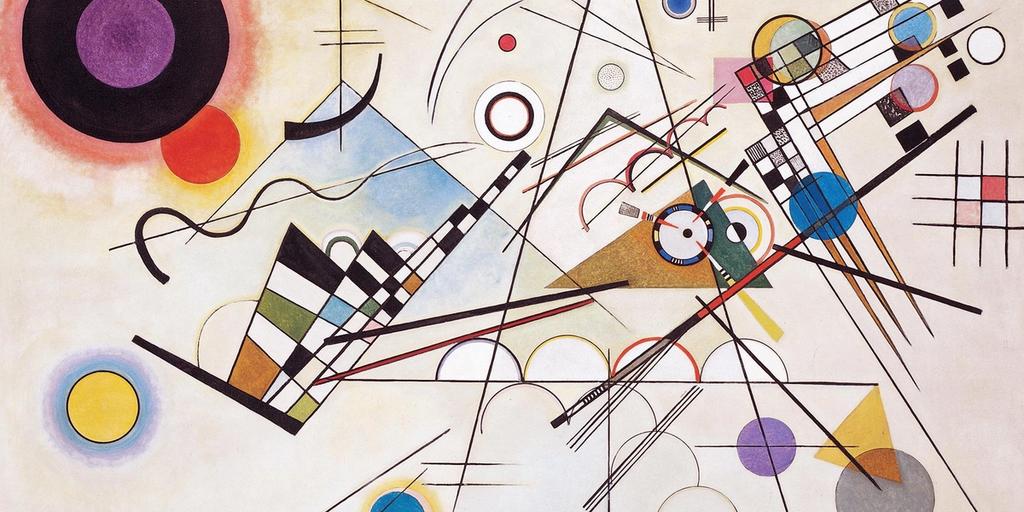
The rigorously geometric canvases of this period are associated with the "Cold Period" in the artist's work, whose crowning achievement is considered to be Composition VIII.

When the Bauhaus relocated to Dessau, the school gained its own teaching buildings and workshops, and new opportunities opened up for Kandinsky in teaching the core painting courses. He moved into the masters' houses, personally taking part in the interior design of his own home. The sixty-year-old artist was thoroughly enjoying life, convinced that the years of restlessness and wandering were behind him.
"We live as if in the countryside: you can hear chickens, birds singing, dogs barking, and the smell of hay in the air"
But with Hitler's rise to power and the closure of the Bauhaus, history repeated itself: Kandinsky's works were seized from German museums and his theoretical writings were banned. After the artist was forced to flee to France, the Nazis declared his work "degenerate art." Paintings and sketches by Wassily Kandinsky, along with hundreds of others, were publicly burned in the courtyard of a fire station on the outskirts of Berlin.
The French Period and Final Years, 1934–1944
During the ten years he spent in France, the exiled artist never truly became one of his own — neither among the Parisian creative intelligentsia nor within the Russian émigré community. He did not understand a word of French, and Paris had no language for non-objective abstraction.
Kandinsky's artistic style underwent yet another significant transformation. Fantastical, biomorphic imagery in the spirit of Surrealism replaced the austere geometric forms of the Bauhaus period. In place of his familiar combinations of primary colours, the artist turned to soft pastels and half-tones: pink, violet, turquoise and gold.
Kandinsky himself paradoxically described this phase of his work as "a truly painterly fairy tale" — though it is hard to call that gruelling wartime period anything of the sort. Due to a shortage of materials and money, Kandinsky could afford only small-format works. At times he had no choice but to paint in plain gouache on a sheet of cheap cardboard.
In the suburbs of Paris, Kandinsky found his final refuge — yet never found a true home. He lived to see the Second World War begin, but did not live to see the fall of fascism. He died in 1944, three days before his seventy-eighth birthday.
Personality and Personal Life
A dreamer, a mystic and a metaphysician, Wassily Kandinsky lived from earliest childhood to his final days in an inner world filled with mysterious occurrences and private experience. His contemporaries nicknamed him "the Doctor" on account of his measured bearing: he wore fine-framed spectacles and was always immaculately dressed. Yet this did not prevent him from posing for photographs — now in medieval armour, now in a kitchen garden with a spade, now cradling his cat Vaska in his arms. There was something distinctly Chekhovian about his appearance and character. The artist had a ready sense of humour and a loud, infectious laugh.


Kandinsky's interests extended far beyond painting. He was captivated by theatre, music, psychology and literature. He wrote poetry and screenplays, played the cello and piano with great skill, and read voraciously. He had a deep love of Russian classical literature and always travelled with books by Russian writers and poets.
Kandinsky married for the first time shortly after graduating from law school, at the age of 26. His wife was Anna Chimyakina — his cousin, a woman he had known since childhood. She was six years his senior and reminded him in many ways of his mother. Theirs was more of a companionate union than a romantic one: Anna supported his decision to abandon law, stood by him through emigration, and followed him into the unknown without complaint.
In Munich, Kandinsky's marriage began to fall apart. At the time he was teaching at the Phalanx art school, where he grew close to one of his students, Gabriele Münter — a German Expressionist painter who would have a profound influence on his work. Over the following eleven years they worked and lived together, travelling widely across Europe before eventually settling in Murnau. In 1911 Kandinsky finally obtained his long-awaited divorce, yet he was in no hurry to formalise his relationship with Gabriele. He never found the courage to make a definitive break. When he left for Moscow in 1916, he swore his love to her and promised to begin the paperwork required for their marriage — then vanished from her life forever.


Throughout the war, Münter tried in vain to find Kandinsky: she wrote letters, made enquiries through every available channel, and attempted to learn something through mutual acquaintances. Only four years later did she receive a letter from his lawyer: the man who had fled demanded the return of all his paintings, an old bicycle, clothing and other personal belongings. She learned that her beloved had long since married and was living in Germany. Wounded and betrayed, she wrote him a furious forty-page letter. Kandinsky's only reply was a notarised document granting Münter the right to manage his property. The separation broke her: she withdrew from the world and was unable to paint for ten years. Yet despite his betrayal, Gabriele risked her own life to save Vasily Kandinsky's archive and works from the Nazis.


Kandinsky himself was in the grip of a creative crisis: his unresolved situation with Gabriele weighed on him, and he produced almost nothing during the two years following his move to Moscow. Then a single chance phone call brought him back to life. The artist heard a voice on the line — that of Nina Andrievskaya, his future wife. That same day he picked up a brush and painted the watercolour To an Unknown Voice. The girl was eighteen when they married. They remained together until the great abstractionist's death.


Music and Synaesthesia
Many scholars agree that Kandinsky was a synaesthete who possessed an unusual mode of perceiving the world. His synaesthesia manifested as a unity of the senses: he saw colour when he heard music, and heard music when he painted. He frequently experienced his own pictures as sounding and vibrating.
For Vasily Kandinsky, music and painting were inseparable. The synthesis of colour and sound was the foundation of his artistic convictions and the starting point of his entire practice. He believed that music could be transferred to canvas in much the same way that notes written on paper could be turned into melody. He regarded music as the most elusive and unknowable form of art — one capable of acting directly on human consciousness.
"Colour is the keyboard, the eyes are the hammers, and the soul is a piano with many strings. The artist is the hand that plays, touching one key or another, to cause vibrations in the soul."
Synaesthesia also shaped Kandinsky's relationship with colour. For the artist, paints were animate 'strange beings' capable of 'creating an endless number of new worlds', and colours provoked specific psychological and emotional experiences.
The music of Arnold Schoenberg had a particularly profound influence on Kandinsky's work. The Viennese composer had abandoned tonal and harmonic conventions in his compositions much as Kandinsky had once moved away from figuration in painting. The two men were close friends for many years, exchanging ideas, critiquing each other's work, and maintaining an extensive correspondence.
In the pre-war period, Kandinsky wrote the libretto for the stage work The Yellow Sound. It was an experiment in the synthesis of drama, words, dance, colour and music. The premiere was due to take place in Munich in the autumn of 1914, but Kandinsky was never to see it performed on stage.
Interesting facts
- From childhood he had difficulty memorising numbers and poems, and remembering names and dates. At school he struggled to learn the multiplication table, and relied on visual images and associations to get through his exams.
- Marcel Breuer's iconic Wassily Chair took its name from Kandinsky. It is something of an irony that chairs of this model could be found throughout the Bauhaus — everywhere, that is, except in the artist's own home.
- The only son of Wassily and Nina Kandinsky died at the age of three. The artist never truly recovered from the loss, and the subject of children became forever off-limits for him.
- A spiritual search led Kandinsky to religious and mystical teachings — theosophy and anthroposophy. In them he found confirmation of his own system of perceiving the world, which formed the very foundation of his art.
- Kandinsky saw the ultimate aim of his art as an attempt at the spiritual and moral redemption of humanity.
- At Kandinsky's commission, swept up in the Moscow construction boom of the 1910s, a six-storey apartment building was erected on Burdenko Street. His career as a property developer was brief: after the Revolution, the building was confiscated.
- Kandinsky came close to changing his citizenship for a third time. Fearing the threat of German occupation of France, he seriously considered the possibility of emigrating to America.
Other works by the artist
Recommended reading
- The first theoretical justification of abstraction and the artist's aesthetic manifestoConcerning the Spiritual in Art;
- A fundamental study of the foundations of Kandinsky's artistic language Point and Line to Plane;
- Vasily Kandinsky's autobiographical notes Steps;
- A translation of Kandinsky's poetry collection Sounds in prose;
- The landmark correspondence between the abstract painter and the Viennese composer, Vasily Kandinsky — Arnold Schoenberg: Letters;
- Memories of Nina Kandinsky, the artist's last wife, Kandinsky and I;
- Boris Sokolov, Vasily Kandinsky: The Era of Great Spirituality. Painting. Poetry. Theatre. Personality — a book devoted to the artist's creative pursuits, written on the basis of archival materials and years of field research.
Follow us on social media so you never miss new content: VKontakte, Telegram — @loskomagazine.