This year David Hockney turned 82 — one of the most influential and audacious British artists of the twentieth century, a central figure in the Pop Art movement, and one of the first to speak openly, through painting and photography, about same-sex love. From photo-collages and opera posters to Cubism-inflected abstractions and pastoral landscapes: over a career spanning more than sixty years, Hockney has worked across an extraordinarily wide range of genres and modes. A legend who stepped boldly into the technological age, he continues to seek out and discover new forms of expression, remaining all the while the same rebel — loyal to his love of vivid colour and bold composition.
In this article you will learn:
- about David Hockney's life and career;
- about the key stages of his creative journey;
- about David's personal philosophy;
- fascinating facts from the life of the world's most expensive living artist.

Biography
Childhood, 1937–1952
David Hockney was born in 1937 in Bradford, a small industrial town in the north of England. His father Kenneth was an intensely eccentric man, despite spending his entire working life as an ordinary clerk. He wore two wristwatches in case one broke, and never left the house without a hat, a tie and a cane. Kenneth was a member of the Campaign for Nuclear Disarmament and a communist with a rather romantic and naive vision of the Soviet Union. Each morning, Hockney's father sent letters setting out his ideas on war and peace to world leaders — Stalin, Eisenhower and Mao — and in the evenings attended classes at the local art school.
It was his father who proved decisive in shaping Hockney both as an artist and as a person: he encouraged his son's passion for art in every way he could, and taught David not to fear standing out from the crowd or to worry about what others said about him.


Laura, David's mother, was a devout Methodist and a strict vegetarian. She tried to raise her son according to religious principles, though with limited success. Hockney shared a very warm relationship with his mother: he returned to Bradford every Christmas right up until her death at the age of 99. Portraits of Laura Hockney are among the most recurring subjects in the artist's work.

When David turned 11, he decided he would dedicate his life to art. During his school years Hockney was described as a 'fairly serious but bold' young man. He was bright, yet his academic success became an obstacle on the path to a career as an artist: at Bradford College, gifted students were not permitted to choose creative subjects. David therefore deliberately failed his exams in order to continue studying painting.
Britain, 1953–1963
A pacifist by conviction, Hockney refused to do military service as a conscientious objector and instead spent two years working in a hospital. Around this time, David also discovered Sergei Diaghilev — the legendary impresario and arts figure who had openly declared his homosexuality and been accepted by society. Diaghilev's honesty about his own orientation gave Hockney the courage to come out himself.
At twenty-two, Hockney moved to London and enrolled at the Royal College of Art. He was a brilliant student, and even then his works were winning prizes and entering private collections. David experimented with a range of styles and movements, most notably Abstract Expressionism.
A profound influence on the young artist came from a Pablo Picasso exhibition at the Tate Gallery, which he visited eight times, his acquaintance with the American artist R. B. Kitaj, and the poetry of Walt Whitman. Hockney devoured Whitman's verses, and they inspired him to create a series of 'love' paintings. The 1961 work Two Boys Together Clinging became the first expression of the theme of homosexuality in his art. By inscribing a passage from Whitman on the canvas, Hockney declared to the world that he would live the life he wanted: 'We two boys together clinging, one the other never leaving, up and down the roads going, north and south excursions making.'
References to contemporary visual culture, graffiti-like scrawls, and the garish colours characteristic of Hockney during that period drew disapproval from his teachers, but were received with enthusiasm by critics and became a significant contribution to the development of British Pop Art in the 1960s.
In his final year of study, Hockney refused on principle to submit a diploma piece, arguing that an artist should be judged solely on the strength of his artistic achievements. As a protest, David produced a sketch entitled Diploma Work. A considerable scandal ensued, but Hockney was awarded his diploma nonetheless. After leaving college he travelled around Europe, visiting Rome, Florence and Berlin. On returning to London, the artist briefly taught at Maidstone College of Art before moving to a new studio in Notting Hill. Gradually, Hockney turned his attention to the theme of romantic intimacy and began painting couples in domestic interiors and scenes in the shower.
America, 1963–2005
In 1961, using money earned from exhibitions, Hockney travelled to New York for the first time. The United States made a striking impression on the young man. The commercial success of his work led David to consider the possibility of relocating to America permanently, and at the end of 1963 the artist left conservative England for several decades.
"The fact that at three in the morning you could watch television, go out into the street where the bars were still open — that amazed me"
Almost immediately, Hockney struck up a friendship with Andy Warhol and Henry Geldzahler, curator at the Metropolitan Museum of Art. Despite the possibilities that such a vast metropolis and world centre of contemporary art might have offered a young artist, David chose not to linger in New York.


David had fallen in love with the image of sunny California in childhood, when his father took him to watch Hollywood films. Having never previously visited the West Coast of America, Hockney moved to Los Angeles, where he found genuine freedom. Within a week in the unfamiliar city, he had obtained a driving licence, bought a car, made a trip to Las Vegas where he even won a little money, rented a studio and immediately set to work. Hockney's visual vocabulary of artistic styles shifted constantly: it was a combination of academic drawing, figurative painting and abstraction.
Around the same time, the artist began experimenting with photography for the first time, taking Polaroid shots and using them as sketches for future paintings. Hockney tried working with acrylic paints, and began producing his first swimming pool paintings alongside stylistically bold Southern Californian landscapes.
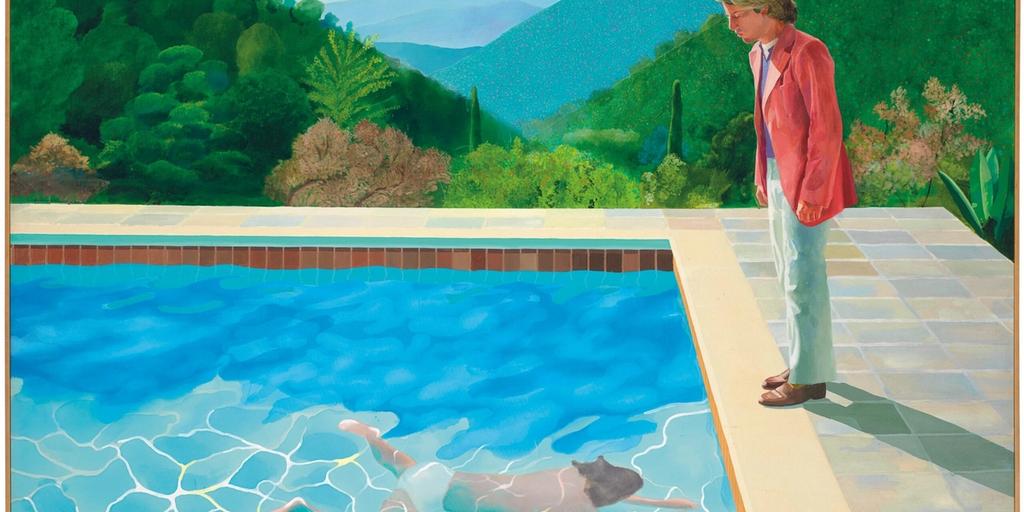
Swimming pools had caught Hockney's attention during his very first flight into Los Angeles. The artist was fascinated by the way they reflected light, punctuating the monotonous palette of grey-green urban sprawl with vivid aquamarine. They became for David a symbol of the freedom he had gained, and an ideal motif for expressing an alternative way of life and the theme of homosexuality: same-sex relationships were illegal in Britain, and swimming pools were a luxury beyond the reach of the vast majority of people.
Portraiture, rendered in a naturalistic style, became another central theme in the artist's work. Preparing such paintings demanded considerable time and effort: Hockney made numerous sketches and studies, drew on photographs for accuracy, and could repaint faces and details ten times over. By depicting figures at almost life size, David sought to create the impression that the subjects were nearly present in the room with the viewer.


"Looking at people is endlessly fascinating. I could spend an eternity doing it."
In the 1980s Hockney moved to the Hollywood Hills. The views that opened up from there prompted the artist to rethink the California landscape for himself. David wanted to capture the sensation of driving down from the hilltops — to render in paint his daily route from home to studio.

"When you live here, your sense of Los Angeles changes. These winding ribbon roads become part of your life, and they have come into my paintings."
Return to England, 2005–2013
Throughout those years, the artist had never let go of the idea of painting the misty Yorkshire countryside in a series of English landscapes. As Hockney himself recounted, the decisive event that drew him back to his homeland was the death of his beloved dachshund. And so in 2005, at the age of sixty-eight, David crossed the ocean again and settled at his late mother's house in Bridlington, which became his studio for the next eight years.
"A simple change of seasons becomes something extraordinary for someone who has long lived in California."
The years spent in America had shaped his perception of his homeland and made him see England with fresh eyes. In the works of this period, the restrained British landscape appears in vivid colour, recalling the painting of Van Gogh and the Primitivists. Hockney himself never denied the influence of the great Dutchman, who was and remains a source of inspiration to him.
Hockney transformed the well-tended, muted fields and woodlands of the East Riding of Yorkshire into vibrant, sun-drenched, high-contrast spaces suffused with bright greens, pinks, oranges and purples. David wanted the viewer to be able to "enter the landscape and feel themselves inside" the painting. Some works accordingly reach more than three metres in height and ten in length, assembled from dozens of individual canvases.


In 2012 the Royal Academy of Arts in London hosted a monumental solo exhibition, David Hockney: A Bigger Picture, presenting more than 150 of the artist's landscapes.
Back in Britain, Hockney developed a keen interest in public and political affairs alongside his art. What he regarded as excessive state intrusion into private life and the curtailment of individual freedoms met with his firm disapproval. He publicly described the government as "a bunch of philistines," remarking that the previous Prime Minister "at least played the piano." The artist took part in demonstrations in support of fox hunting, and campaigned against the ban on smoking in pubs. He condemned the war in Iraq, grew disillusioned with Labour, expressed scepticism about a united Europe, and objected to the compulsory wearing of seat belts.
Los Angeles Again, 2013 – present
After eight years of working in Yorkshire, the 76-year-old artist returned to California and immediately embarked on another ambitious project — a series of portraits of friends, colleagues, neighbours and acquaintances that took two and a half years to complete. The project can be seen as a kind of retrospective of the artist's own life: an album of the people closest to him whom he had encountered along the way.
The exhibition titled 'David Hockney: 82 Portraits and 1 Still Life' was a great success at the Royal Academy of Arts in 2016. The reason a still life found its way among the portraits is entirely prosaic. One of the sitters pulled out at the last minute, yet Hockney was already in the studio, fully resolved to paint, and could think of nothing better to do than set up a still life.
David Hockney marked his 80th birthday in 2017 with a major exhibition held jointly with the Metropolitan Museum of Art, the Centre Pompidou and Tate. The occasion was not without experimentation: specially for the show, Hockney painted a series of hexagonal canvases with their lower corners cut away. With this device, the artist sought to create a sense of expanding space and to heighten the effect of perspective.
Today, having lost almost all his hearing and having survived a stroke, David Hockney remains as restless and enthusiastic an experimenter as he was at the very start of his career. He can still stand at a canvas working for seven hours at a stretch, insisting that artists do not retire.
Picasso once said that when he was drawing he felt thirty again. When I work, I can be on my feet for six hours at a time. When I draw, I feel like Picasso. I feel as though I'm thirty.
Theatre
David Hockney designed sets for eight productions in all, while never ceasing to say that he was interested neither in theatre as such nor in theatrical design. The first play he worked on was Ubu Roi, staged in 1966 at the Royal Court — a small theatre in London's West End. David simply could not resist the absurdist, convention-defying work of the playwright Alfred Jarry.
Nine years later Hockney was invited to design the sets and costumes for Stravinsky's opera The Rake's Progress, based on the works of the eighteenth-century English painter William Hogarth. Captivated by the Russian composer's opera, David agreed at once, fired by the idea of bringing Hogarth's iconic engravings into the modern age. The hatching technique applied to the sets created the illusion of engraving in three dimensions. The result was so unexpected that Hockney was immediately invited to design Mozart's The Magic Flute, for which he painted 35 backdrops inspired by a journey to Egypt.
Hockney would later design sets for several productions at the Metropolitan Opera in New York, for Wagner's Tristan und Isolde and Puccini's Turandot at opera houses in California, and for Strauss's Die Frau ohne Schatten at London's Covent Garden.
Photography and Photo-Collages
From the time he moved to America, David photographed friends and everyday life extensively — finding it endlessly fascinating — creating source material for his paintings and compiling them into albums. In 1976 his work attracted attention, and the first exhibition of Hockney's photographs, titled Twenty Photographic Pictures, was held at the Sonnabend Gallery in New York.
For a long time David did not regard photography as art. Everything changed when Hockney decided to turn to Cubism and the technique of the photo-collage. First with a Polaroid, and later with a Pentax and 35mm film, Hockney would take numerous shots of the same subject and assemble them into collages. These were compositionally complex works, thought through to the last detail — Hockney's meditation on how human perception of reality is structured.
"I realised that photography is neither art, nor technique, nor craft, nor hobby. It is a tool. An extraordinary tool for drawing. It was as though I, like most ordinary photographers, had been a devotee of some long-entrenched culture in which pencils were used only for making dots. And now, alongside the realisation that a pencil can draw lines, came an unmistakable sense of liberation."
New directions in art
Hockney had always taken a keen interest in technology and progress: in the mid-1980s he bought one of the very first colour photocopying machines and a fax, which he used to make drawings. Canon even sent him experimental colour print cartridges of their own accord, simply to see what David would do with them.
In 2008 Hockney discovered the iPhone, and a year later the iPad, and was utterly captivated by drawing apps. David still marvels that a phone could rekindle his passion for painting. In 2011, the Museum of Modern Art in Copenhagen held an exhibition devoted exclusively to his digital works.


"I love drawing flower arrangements on the iPhone and then sending them to friends, so they have fresh flowers that never wilt."
Like many, Hockney believes that technology will quickly and irreversibly transform the media landscape. But drawings, like songs, will always be with us, the artist is certain — only the means of creating and reproducing them will change.
"Picasso would have gone mad for modern technology. So would Van Gogh. In fact, I can't think of a single artist who wouldn't."
The man and his private life
A nonconformist and an inveterate smoker with perpetually dishevelled hair the colour of burnt straw, dressed in the brightest hues and wearing round glasses — Hockney was a "hipster" long before it became a trend. Despite the widespread notion of David leading a dissolute life, he always preferred work to parties. David invariably rose very early so as not to miss the particular quality of morning light, and urged everyone to live in the moment.
"If you are obsessed with the goal of living as long as possible, you are thereby denying life itself. For the purpose of life is living."
As an openly gay man, Hockney was regarded by the public as something of a pioneer — an artist too honest not to paint the full truth of his life at a time when same-sex relationships were prohibited.
"I always knew I was gay, and I always understood that I was in a minority."


In America, Hockney's muse became his friend and later lover Peter Schlesinger, whom he met in 1966 while teaching at the University of California. Peter was nineteen at the time; David was nearly thirty. For the artist, Peter was a living embodiment of the California dream. The relationship was brief, and in 1971 Hockney and Schlesinger parted ways, in no small part because of their considerable age difference. Peter featured in many of David's intimate drawings, but the most celebrated works to emerge from that period were Peter Getting Out of Nick's Pool and Hockney's most expensive painting, Portrait of an Artist (Pool with Two Figures) — the latter painted immediately after their painful break-up.
Over the years, David Hockney was linked to a small number of romantic relationships, none of which lasted long. When asked whether he had ever wanted to marry and have children, the artist invariably said no. He regarded such formalities as attempts to be like everyone else — and that was precisely what Hockney spent his entire life desperately avoiding.
David Hockney's Rules for Life
You must know how to look and truly see the world around you
I have always loved to observe. When I was eight and was finally allowed to ride the bus on my own, I would always run straight up to the top deck and take the front seat, where you could see the most.
In the age of technology, photography is not to be trusted. Painting is the most truthful form of truth
To make a work of art you need hands, eyes and a heart. Many people prefer to photograph memorable moments. But a camera will turn them into a performance. Fellini himself said that everything that happens in front of a camera is a show.
Don't be greedy for money — be greedy for life
I can feel a sense of wonder simply watching raindrops hit a puddle. I'll admit that few people would find the sight quite as thrilling as I do. But I do. And I want my life to be exciting and rich. I do everything I can to make it so.
Limits exist only in our minds
As long as you can imagine yourself capable of something, and you believe it one hundred per cent, then truly nothing is impossible for you.
Only the lazy wait around for inspiration!
When I look back, I realise that I have always worked — my whole life, every single day.
Anyone can learn to draw
No one will become the new Picasso or Matisse. But any person is capable of drawing reasonably well. Learning to paint is learning to see. Most people, however, don't even try to make the effort.
Don't try to understand the nature of art
In the end, nobody knows how art is made. It is inexplicable.
Defend your personal freedom and fight against foolish prohibitions
Smoking is calming. Tobacco is the greatest gift America ever gave the world. Politicians should not be the ones to decide what gives us pleasure in this life. Those who oppose cigarettes should come to terms with the fact that I am still alive and full of energy. My colleagues — Picasso, Monet, Renoir — all smoked and still lived to a ripe old age. My friends, on the other hand, died from alcohol.
Be spontaneous!
As you get older it becomes harder and harder to remain unpredictable. But you have to work at it.
Laugh. Laughter clears the lungs!
It seems to me that people today lack a sense of humour. And yet the world offers plenty to laugh about.
Interesting facts
- Emulating his communist father, David would buy second-hand clothes to affect a Soviet proletarian look, which earned him the nickname Boris at college.
- Hockney lost his hearing due to hereditary causes when he was just 40. David owns several pairs of hearing aids in the most vivid colours.
- In 2001, David Hockney and physicist Charles M. Falco put forward a hypothesis. Their central idea was that the advances of Western European realist painting during the Renaissance were driven by technological progress — specifically the advent of the camera obscura and convex mirrors — rather than by an evolution in painters' skill. The hypothesis generated considerable public debate and was not accepted by art historians.
- On 15 November 2018, Hockney's 1972 work Portrait of an Artist (Pool with Two Figures) sold at Christie's for $90 million, making it the most expensive work by a living artist ever sold at auction.
- David Hockney is the creator of a six-metre stained-glass window for Westminster Abbey, for which he produced the design on an iPad in 2018.
- The artist's assistant took his own life in Hockney's studio in Bridlington. Having taken drugs, the young man ingested acid and died in hospital. The artist was deeply affected by his death and was unable to paint for several months.
- In 1990, Hockney declined a knighthood, stating that he 'simply did not want to be Sir David.'
- Hockney chose not to paint a portrait of the Queen, explaining that he prefers to paint only those he knows personally.
- Hockney is known for his critical remarks about his fellow artist Damien Hirst. David has taken the leader of the Young British Artists to task for delegating the finishing of paintings to his assistants — something Hockney considers an 'insult to skilled craftsmen.'
- The artist signs all his letters with the phrase 'Love life, David Hockney.'
Useful links
Official website of David Hockney
Documentary film about the artist, The Art of Seeing, produced by the BBC
An interview with David Hockney by art critic Martin Gayford, The Guardian, 2016
More works by David Hockney
Follow us on social media so you never miss a new post: VKontakte, Telegram — @loskomagazine.