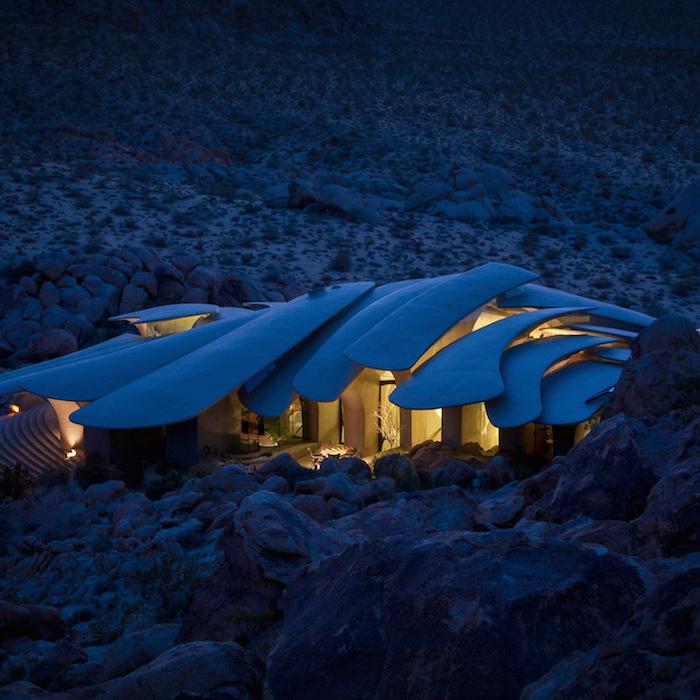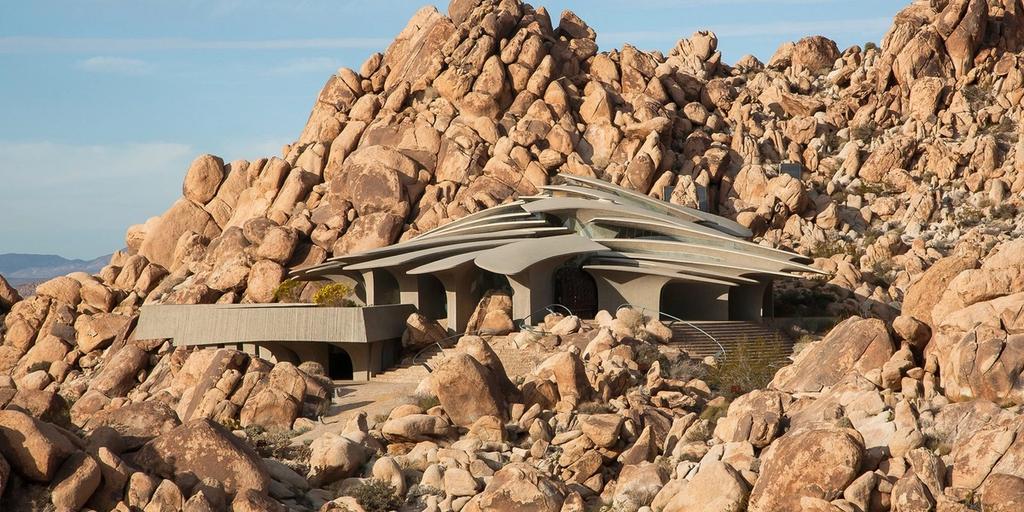
This desert house resembles something between a dinosaur skeleton and a fossilised trilobite. It looks like an alien structure set against the Martian landscape of Joshua Tree National Park. The house is striking in its unfamiliar form, yet it seems entirely at home among the fantastical jumble of boulders.

The building was designed by organic architecture practitioner Kendrick Kellog for artists Jay and Bev Doolittle. The couple purchased an unusual plot of land in California on the edge of Joshua Tree National Park and asked Kellog to design them a house. The extraordinary site, surrounded by massive boulders, captivated the architect, and he accepted the commission. Kellog worked on the project from 1986 over the course of five years. The desert house ultimately became one of the finest examples of organic architecture.
The colour and texture of the building material harmonise with the surrounding rocks
Kellog set out to create a house that would merge organically with the otherworldly rocky landscape. The colour and texture of the building material harmonise with the surrounding rocks. Concrete columns flow seamlessly into a ribbed roof that recalls a shell. The gaps within it are glazed; by day the glass diffuses light throughout the interior, while at night it frames a breathtaking view of the starry sky.


Kellog completed construction in 1993, but work on the house continued for a further 14 years. The interior was designed by John Vugrin, who wanted it to be a logical extension of the building's Martian character — and he succeeded. Inside, the house feels no less extraordinary and otherworldly than it does from the outside.
Vugrin used organic materials: metal, glass, mahogany and stone. Almost all the decorative elements, apart from the dining chairs, are built into the walls. Curved sections of furniture sweep through the entire space, connecting the different rooms. Enormous boulders in the interior liken the house to a cave, while tables shaped like the giant vertebrae of extinct animals reinforce that impression.


Based on materials from dwell.com
If you are interested in organic architecture, we invite you to discover its foremost exponent — Frank Lloyd Wright. We also invite you to explore the defining characteristics of organic architecture and to look at other impressive buildings in this style.
Follow us on social media so you don't miss new content: VKontakte, Telegram — @loskomagazine.