Frank Lloyd Wright was a legendary American architect, the father of organic architecture and the Prairie style — both of which profoundly influenced the modern approach to architecture. He completed around 500 distinct built projects, among them the famous Guggenheim Museum in New York, Fallingwater in Pennsylvania, and the Ennis House, which has appeared in films on numerous occasions.
In this article you will learn:
- about Frank Lloyd Wright's life
- the architect's philosophy
- the principles of Wright's architecture
- about his major projects
- about Wright's outstanding work in graphic design
- his advice to aspiring architects
- interesting facts

Biography
Childhood
Frank Lloyd Wright was born on 8 June 1867 in Richland Center, a small town in the state of Wisconsin. From the very beginning, his mother dreamed of raising her son to be an architect. Throughout his childhood the boy was surrounded by all manner of engravings, books, drawings and sketchbooks. His biography includes a mention of Froebel Gifts, the educational building set with which young Wright would play for hours on end. It is widely believed that these toys were what determined the future architect's calling.
Becoming a Master
The young Wright was educated at home before enrolling in the engineering programme at the University of Wisconsin. During his studies he worked part-time as an assistant to a local civil engineer to help support his family. At the age of twenty, however, he left university without graduating and moved to Chicago with the aim of securing a position at the architectural studio of Joseph Lyman Silsbee. These were Wright's first steps as an apprentice in his architectural career. A year later he moved to the firm of Adler and Sullivan, joining Louis Sullivan — one of the most prominent figures of the Chicago School of Architecture and, as Wright would later write in his essay, 'the greatest architect of the age.'

Sullivan would go on to play a significant role in the architectural development of the young Wright, becoming a true mentor to him. Wright worked under Sullivan for six years, being entrusted with all residential construction projects. At the same time he took on private commissions to support his family with his first wife, Catherine Lee Tobin. Sullivan was not pleased by this moonlighting, and Wright's contract was terminated.
An independent career
At twenty-six, Wright established his own firm. He began to develop his distinctive style, the seeds of which had been planted under Sullivan's guidance. Wright had absorbed Sullivan's principles — a natural, honest and holistic approach to design. Organic architecture and the Prairie style began to emerge in all the young architect's work. As Wright later stated, Sullivan was the only architect who had exerted any influence on him in his formative years.
Prairie houses are an architectural style dating from 1900 to 1917, created by Wright on the basis of his ideas about organic architecture. Buildings in this style are characterised by continuous, smooth, horizontal lines. Such houses typically feature relatively low-pitched roofs with wide, substantial eaves that project beyond the main body of the structure. Casement windows arranged in horizontal bands are also a defining feature. These houses are usually distinguished by an abundance of glazed surfaces, as well as open interiors that dispense with partitions between the kitchen, living room and dining area.

Despite all this, Prairie houses are anything but imposing — on the contrary, they integrate seamlessly into the natural landscape. The horizontal sweep of the structure and its planes running parallel to the ground anchored the house to the earth as a unified whole. Between 1901 and 1909, Wright produced around 120 designs and built 76 Prairie houses. The majority were intended for middle-class clients and businesspeople. One of the finest examples of the Prairie house is the Robie House in Chicago, built in 1907.
A connection with Japan
Two of the most important sources of inspiration for Wright were his love of nature and a deep connection with Japan, where he opened an architectural office and built fourteen buildings, of which only three survive to this day. His Prairie style and organic architecture are widely considered to draw substantially on a Japanese worldview. Tadao Ando, the contemporary Japanese architect, wrote in his autobiography: 'I think Wright learned the most important aspect of architecture — the handling of space — from Japanese architecture. When I visited Fallingwater in Pennsylvania, I found that I felt that surrounding space in exactly the same way. But there were also additional sounds of nature speaking to me.'

Throughout his life Wright collected Japanese woodblock prints. Among his assistants were also several Japanese architects, including Kameki and Nobuko Tsuchiura. They also worked on the Imperial Hotel in Tokyo, which was later badly damaged by an earthquake and subsequently demolished. The building had been conceived as a system of interconnecting gardens. It stands as a bridge between Wright's early and middle periods as an artist, and between Western and Eastern design.
The personality of Frank Lloyd Wright

The great architect's personal life was no less remarkable than his architectural work. In 1909, for instance, Wright left his wife and six children and travelled to Europe with a client's wife. He was a man of wide-ranging interests, sharp wit, plain speaking and total absorption in his work. Dramatic events coloured his everyday existence. More than once, friends broke with him over his uncompromising nature and his contempt for bourgeois convention.
Is there anything more pleasing to the soul than a clean sheet of paper? The painstaking comparison and selection from every possible texture, colour and paper?
Money, too, posed no obstacle for Wright. A constant pursuit of new structural forms, the realisation of compelling ideas and unexpected solutions defined Wright both as an architect and as a person. More than once his experiments resulted in catastrophic cost overruns during construction. Wright frequently trusted his intuition over engineering calculations, which often led to alterations and reconstructions carried out even at his own expense.
Final Years
In the last years of his life, Wright began shifting from organic architecture towards the International Style. He died on 9 April 1959 at the age of 91, six months before the completion of the Guggenheim Museum in New York. Wright's final project, the Norman Lykes House in Arizona, was completed by one of his apprentices. Over the course of his life, Frank Lloyd Wright produced more than 1,100 designs, 500 of which were realised. A third of his entire body of work came in the last ten years of his life. His death did not bring his work to a close, and his projects continued to be built: the Monona Terrace conference centre, for example, was completed as late as 1997.
The Philosophy of Frank Lloyd Wright
— The naturalness inherent in every work of architecture must never be lost. Wright called this quality the 'inner nature.'
— Unity and organicism. A building must give the impression of wholeness — of being made from a single piece, rather than assembled from disparate parts.
— Form and function are the backbone of organic architecture.
— Poetry and romance in architecture belong to the word 'quality' and are vital to it. In Wright's view, organic architecture perceives in concrete reality the true romance of human creativity.
— The authenticity of tradition matters. Imitations and every manner of copying what has already been copied only damage architecture. Wright believed that truth and authenticity should be the sacred values of his profession.
— Ornament is an inseparable part of architecture. When its conception is sound, it transforms architecture into poetry. When it is not, it destroys the architecture entirely.
— In his philosophical concept of organic architecture, Wright also distinguished the notion of 'spirit.' He believed this to be something interior — not something descending from above, but something that manifests from within outward.
— The third dimension in organic architecture is not width but depth — a quality inherent to a thing, not applied to it.
— Space is the invisible source from which all rhythms flow. It is the breath of a work of art.
Core Architectural Principles
From these philosophical ideas, Wright derived the core principles that guided his creative practice and that underpin every one of his projects.
1. Integration with the Landscape and Natural Materials

No two of Wright's buildings are alike, because he believed that every project is unique — created for a specific place and specific people, and therefore capable of existing only in that context. A building removed from its setting no longer truly exists. Wright held that harmony with the surrounding environment was not optional but essential — an idea that formed the foundation of his organic architecture. In his own words, a building should not stand apart from its environment but should 'grow from it like a plant, blending harmoniously with its surroundings as though nature itself had created it.'
Wright always selected materials suited to the specific locality where a building was to be constructed. He was known to prefer working with local quarries and sawmills so that the building would be fashioned from the same substance as the surrounding landscape. Equally, in keeping with the principles of his philosophy, he tried to avoid using too great a variety of materials. This helped to preserve harmony. Wright consistently sought to emphasise natural beauty.
2. Human Scale

Wright considered closeness to the earth and a scale proportionate to human dimensions to be essential conditions of life. From Wright's organic philosophy flows the following principle: the proportions of a building and its furniture should be determined by the dimensions of the human figure. He aimed to create spaces that felt intimate and welcoming. For residential design, this meant he avoided excessively high ceilings and vast rooms. On a broader level, Wright was opposed to the concept of building cities with skyscrapers.
In his book The Future of Architecture, Wright writes: "The open plan and the elimination of useless height in the new dwelling worked a miracle. A sense of appropriate freedom utterly changed its appearance. A new feeling for the value of space in architecture emerged. It has now entered the architecture of the modern world — as it should. Here and there in buildings a new sense of repose appears, expressed in a quiet streamlining of the kind we now see in steamships, aeroplanes and automobiles."
3. Harmony and Space

For Wright, a comprehensive approach to his projects was essential. He designed not only buildings but also their surrounding landscapes, and took charge of interiors as well. Wright believed that all of these elements should exist in harmony.
"A house is not walls and a roof. It is the space within them." This was Wright's conviction as he designed rooms that flowed seamlessly into one another. He sought to move away from the idea of a home as a life lived within four walls, preferring instead niches, Japanese-style partitions and changes in level. These devices brought his creations closer to nature, where there are no abrupt corners, blank walls or closed doors. Wright frequently turned to terraces and ribbon windows as the connective tissue between the interior and the exterior world.
Space — or "the fluidity of space" — along with the concept of the open plan, were what Wright regarded as his own contributions to architecture. He addresses this in The Future of Architecture: "The supreme order is the sensation of sunlit space and a lightness of structure akin to the lightness of a spider's web."
Architectural Projects
Robie House
Designed: 1909
Construction began: 1908
Purpose: residential
Location: Chicago, USA
One of the most celebrated Prairie houses, it exemplifies the commanding presence and spatial composition characteristic of the style. During this period Wright was building homes with open plans in which a fireplace — an integral part of the whole structure — was always placed at the centre. The pronounced horizontal silhouette of Robie House alludes to the boundless expanses of the Midwest.
The design is rooted in the idea of a soaring, outstretched composition, from which all other elements of the building follow: broad roof overhangs, a flat profile and low-rise floors. The house consists of two horizontal rectangular volumes layered one upon the other. Concrete and brick combine beautifully with hand-polished wood and coloured stained glass.
La Miniatura
Designed: 1923
Construction began: 1923
Purpose: residential house, villa
Location: Pasadena, California
Miniatura House is one of the first textile-block houses built by Wright. The client was Alice Millard, a collector of antiques and rare books. The site chosen for construction is remarkable — a ravine shaded by picturesque eucalyptus trees. This textile-block house is regarded as one of Frank Lloyd Wright's greatest masterpieces. So why did Wright call his blocks textile?
For many years, concrete was considered an unwanted, inexpensive material on the construction market. Wright set out to rethink it and turn it into an aesthetic statement. He proposed making non-standard hollow cubic concrete blocks and threading them onto steel rods like beads on a string — which is why they came to be called textile. The surface of each block was covered with ornament, in this case recalling the art of the Maya. The organic quality of the project also lay in the fact that sand and gravel from the building site were incorporated into the concrete mix.
Unity Temple in Oak Park
Completed: 1908
Construction began: 1905
Purpose: church
Location: Oak Park, Illinois
A thoroughly revolutionary project for its time: the new church for a Unitarian congregation was completed in 1908. It was recognised not only as the project that defined Wright's own style, but also as one of the first monuments of twentieth-century modernism. Wright would later declare: 'The soul of a building is its space, not its walls.' The design was therefore spare, yet fully responsive to the needs of the congregation.
Here concrete was chosen as the primary material and enriched with ornament. The church interior is divided into two parts: the first serves for worship, and the second for community gatherings. Ceiling lighting and glass in natural shades of yellow, green and brown conjure the feeling of nature itself within the space.
Fallingwater
Completed: 1939
Construction began: 1935
Purpose: country house
Location: Pennsylvania
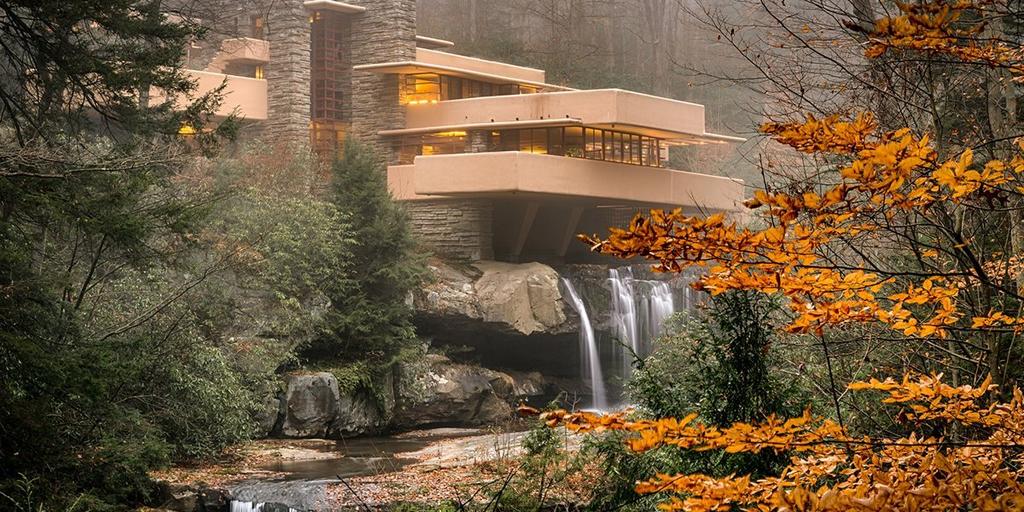
A National Historic Landmark of the United States and the defining example of Frank Lloyd Wright's organic architecture, the house was originally built for the Kaufmann family in 1935. It is considered one of the most significant works of architecture of the twentieth century, and Wright's finest achievement alongside the Guggenheim Museum. In 1991, members of the American Institute of Architects described it as 'the best all-time work of American architecture.'
Wright sought to celebrate the character of the place. The stone for the walls was quarried in the same area, and the cantilevered terraces were built from local sandstone that harmonises naturally with the native rock. Their particular positioning creates the impression that they float above the rushing waterfall. The architect's aim was for the house to become part of the local landscape, and not a single tree was to be felled during construction.
In this project, Wright placed emphasis on the interpenetrating spaces of the house, which symbolise the harmony between human beings and nature. The overall colour palette is light in tone. As in his other projects, Wright avoided solid walls and installed transparent screens that open up picturesque views of the surrounding landscape from every point in the house. He also stripped away the interior plaster and, to conceal the stone walls and reinforced concrete, applied timber cladding.
Nevertheless, Wright made an error in the structural calculations for the load-bearing elements. The Kaufmanns hired an engineering firm to review the work, and it emerged that unless the amount of steel in the concrete structures was increased, the house would soon end up in the river. The dispute between the clients and Wright was not resolved quickly, but eventually the concrete cantilever of the terrace was reinforced on the engineers' advice.
Ennis House
Designed: 1924
Construction began: 1923
Purpose: residence, private house
Location: Los Angeles
The largest and last of the textile-block houses, it features the most complex asymmetrical patterning on the block surfaces. It is a project of considerable scale, one that gave Wright room to deploy a wide range of his ideas. The client, Ennis — a millionaire who had made his fortune through a chain of department stores — was also deeply interested in Mayan culture. A shared sensibility and a generous budget produced a monumental building of patterned concrete blocks.
From the outside the house looks more like a temple, and the ornamentation has often led critics to read Wright's work here as a decorative rather than a structural statement. Inside, however, this impression is somewhat softened. In the design Wright favoured a precise plan over free-flowing transitions and personally designed the interiors. The living room and balcony command fine views over Los Angeles, while beyond them lie a symmetrical dining room, a swimming pool and the bedrooms. Throughout, Wright gave particular attention to the scale of each space, breaking up empty volumes with changes of level of two or three steps, screens, partitions, a mosaic above the fireplace and other subtle details.
Subsequent disputes with the client led Wright to abandon the ornamental concrete-block system in new projects. Even so, the owners grew to love the singular house built for them. In 1968 it was purchased by Augustus Brown and later, in the 1980s, transferred to a heritage preservation society. Sadly, the 1994 earthquake and heavy rains in 2004 caused serious damage to the building, and it remains under restoration to this day.
Guggenheim Museum
Completed: 1959
Construction began: 1943
Purpose: museum
Location: New York
A building that has been subjected to fierce criticism on more than one occasion, it is nonetheless regarded as the pinnacle of Frank Lloyd Wright's career. For this project Wright produced approximately 700 sketches and devoted fifteen years of his life to it. Sadly, neither Wright nor Solomon Guggenheim lived to see the museum open. Yet the building is rightly considered one of the greatest achievements of modern architecture.
The contrast between this project and the textile-block houses — as well as Wright's other work — is immediately striking. Initially, Wright was sceptical about the proposal by Hilla von Rebay, the patron of the Guggenheim collection, to create a kind of temple to house Guggenheim's extensive collection of modern art.
The plasticity of organic forms is rendered with great success. From the outside, the building resembles a stepped Babylonian pyramid; inside, it recalls a shell. Visitors can climb to the very top and descend from the glass ceiling by way of a spiral staircase, all while taking in a rich collection of contemporary art.
Taliesin
Created: 1911
Construction began: 1911
Purpose: residence, studio
Location: Wisconsin
No survey of Frank Lloyd Wright's projects would be complete without Taliesin — the longest-running of the architect's endeavours. It was Wright's own residence, named after a sixth-century poet in tribute to his mother's Welsh heritage. The name translates literally as "shining brow." It reflected Wright's wish to set his home on the "brow" of the hill rather than its peak — entirely in keeping with the Prairie style. Wide windows, cantilevered roofs, materials drawn from a nearby quarry, a house that dissolves seamlessly into the local landscape, an open floor plan: everything here speaks of the authentic Frank Lloyd Wright.
The history of the house is dramatic enough. It was damaged by fire on at least two occasions — in 1924 and 1925 — yet was restored each time to its former appearance, acquiring only a new name: Taliesin II and then Taliesin III. Later, the house became an architecture school and the home of Frank Lloyd Wright's fellowship programme.
Frank Lloyd Wright's Graphic Design: A Language of Ornament

Wright's name is well known in the world of architecture, yet his contribution to graphic design remains largely uncharted territory for many. His interest in the printed image began in his youth, when he taught himself the basics of letterpress printing in his basement. That fascination led him to serious work in two-dimensional graphic design. Throughout his career, Wright practised lettering, developed distinctive inscriptions for books, and produced posters, illustrations, magazine covers, brochures, architectural ornaments and stained glass.
Worth noting are Wright's witty and bold graphic works for the cover of Liberty magazine. Some were so unconventional that the magazine declined to use them. It is known that Wright produced twelve pencil drawings for the publication, yet not one was ever printed. His designs were grounded in the principles of Froebel Gifts — straight lines and geometric structures.

One of Wright's most celebrated graphic works is his drawing of the American flag. The design was originally made for Liberty magazine, but was later published by Town & Country in 1937 — the only Liberty-intended drawing by Wright ever to appear in print. Wright was also captivated by Japanese woodblock prints and by Owen Jones's The Grammar of Ornament (1856), a book that revealed the universal laws of decoration and ornament.
Counsel for the Architect of the Future
In 1931, Wright delivered his celebrated lecture "To a Young Architect" in Chicago. Many of its points are still quoted today, particularly the advice the master left for the next generation of architects:
— If you do not understand that all the world's architects were good in their own way and in their own time, then forget about them.
— You must be true to architecture. Do not enter the profession to earn a living if you do not love it as a living principle, if you do not love it for its own sake.
— Beware of schools of architecture in everything except the study of engineering.
— Go into industry, where you can observe the workings of the mechanisms that produce modern buildings, or work in hands-on construction until you are able to make the natural transition from building to designing.
— Make it an urgent habit to ask yourself "why" about everything you like or dislike.
— Learn to distinguish the curious from the beautiful. Take nothing for granted — neither as beautiful nor as ugly. Analyse every building piece by piece, scrutinising every detail.
— Cultivate the habit of analysis. In time, the capacity for analysis will allow the capacity for synthesis to develop, and that too will become a habit of mind.
— My teacher used to say: "Think in simple terms." He meant that the whole should be reduced to its parts and simplest elements on the basis of first principles. Do this in order to move from the general to the particular, never confusing the two — otherwise you will only confuse yourself.
— Abandon as quickly as possible the American notion of "quick turnover." To begin practice half-baked is to sell your birthright as an architect for a mess of pottage, or to spend your life merely claiming to be one.
— Do not be in a hurry to complete your training. An architect who wishes to rise above the average — in both critical judgement and practical work — needs at least ten years of preparation before entering architectural practice.
— Go as far from home as possible to build your first buildings. A doctor can bury his mistakes, but an architect can only advise his clients to plant climbing vines.
— Consider building a henhouse as worthwhile a task as building a cathedral. Setting aside financial considerations, the scale of a project matters little in art. What truly counts is expressiveness. Expression can be great in something small, or negligible in something large.
Interesting facts
— Wright's life partly inspired Ayn Rand's bestselling novel The Fountainhead (1943). It was adapted for the screen in the United States in 1949, with Gary Cooper in the lead role.
— David Lynch is known to have said of Wright's architecture: "To walk into the Ennis House is like entering paradise."
— The Ennis House has long been a favourite with filmmakers. It has appeared in twenty films in total, among them Female (1933) and Blade Runner (1982).
— The Ennis House also features in music videos: in Vuelve by Ricky Martin and Bad Day by the American rock band Fuel.
— The Solomon R. Guggenheim Museum is no less popular on screen: it has appeared in Men in Black, Three Days of the Condor, and Mr. Popper's Penguins.
— Fallingwater brought its owners no shortage of trouble: a construction error required the installation of supporting beams, and the proximity of water meant persistent damp and mould. Eventually the owners' son donated the house to the state.
— Frank Wright's home, Taliesin, burned down twice. The first time, it was set alight by a servant following the murder of the architect's lover, Mamah Borthwick Cheney, and her children.
Losko has also published profiles of other architects:
— Le Corbusier — a visionary genius of modern architecture;
— Ludwig Mies van der Rohe — a master of open-plan design;
— Frank Gehry — the expressive genius of Deconstructivism;
— Alvar Aalto — the benchmark of Scandinavian architecture;
— Zaha Hadid — the first woman to receive the Pritzker Prize.
— Renzo Piano — the founder of the high-tech style in architecture and its most charismatic practitioner.
— Norman Foster — known as the "green architect."
Follow us on social media so you never miss new content: VKontakte, Telegram — @loskomagazine.