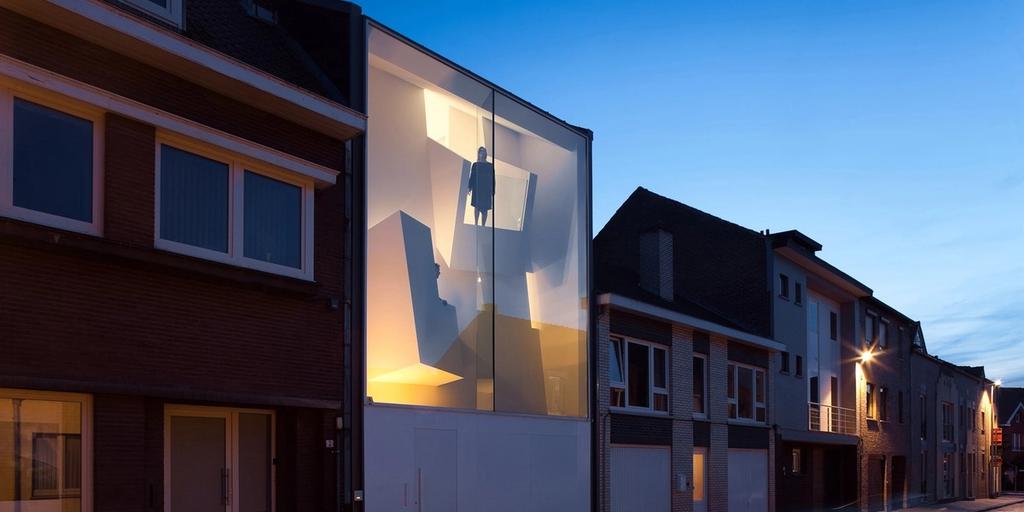
On the streets of Bilzen, a small town near Belgium's eastern border, Narrow House stands out sharply from the traditional buildings that surround it. Here is why.

From the street, the building's striking facade commands attention: what appears to be a wild, complex geometry is in fact nothing more than a flat sheet of glass — a solution the architect adopted to both distinguish the project and integrate it into its urban context. In the evening, the white facade comes alive with colour, becoming a public light installation after dark. The project's authors — Bassam El-Okeily and Karla Menten — succeeded in creating something that functions simultaneously as an atrium, a public lighting fixture, and a living space.
Measuring 5.3 metres wide, the residence was built for a couple and includes all the standard amenities — among them a garage and a ground-floor entrance. The two floors above are fully glazed, concealing a library and a reading nook with natural light and a view onto the street. The third floor houses a studio: the space where the owner paints.

The main living area appears to be carved back behind the glazed surface, allowing daylight to pour through the entire space. Small, precisely geometric windows bring light to rooms without direct access to the facade.
Two angled balconies face the street, lending the building its angular character. The lower balcony holds a reading corner intended for the male owner; positioned so as to remain hidden from passers-by, it offers a concealed view of the street. The upper balcony serves as the studio — the female owner's workspace mentioned above.


In the evenings the house seems to transform into an installation, a cinema screen, or a stage set, alternately glowing — in blue, then yellow, for instance — to symbolise, as the architects conceived it, the relationship between a man and a woman. When the glazed facade is illuminated, it takes on depth and layering as the sections of wall set further back from the street recede into shadow.
The courtyard space is largely very bright and even, giving it a clean, understated quality that suits the character of a residential building.
The architecture invites passers-by to look not only at the ground but at their surroundings. A home is not merely a place to live — it is something that catches the eye and stays in the memory long after.
If you are interested in equally unconventional residential designs, take a look at some of the homes we have written about previously:
— A family mansion in northern Portugal
— A house by the sea on the Huangqi Peninsula: how a sea wolf lives
— Vipp Shelter — a stylish and functional house in the forest