When you think of famous colleges, sprawling American campuses or Europe's great seats of learning come to mind. For all their undeniable beauty, these historic buildings were constructed at a time when students' needs and construction technologies were very different. We have gathered five examples of contemporary university buildings — the kind where you would never dream of skipping a morning lecture.
University of Massachusetts

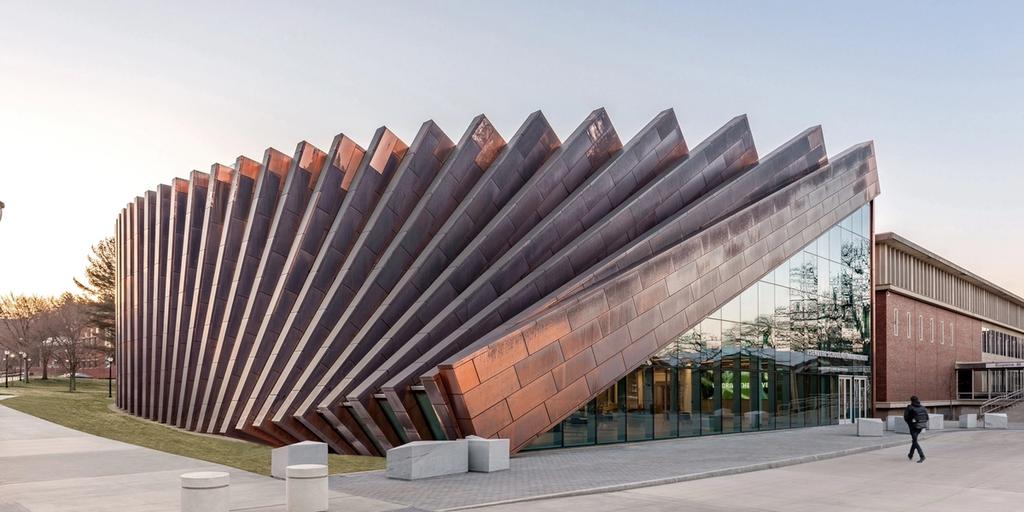
Over the past several years the business school has grown considerably, and students began to outgrow the historic 1964 red-brick building. The practice was called in to help: Bjarke Ingels's architecture firm BIG. They constructed a new building, landscaped the courtyard and redesigned the space in front of the block.
The structure takes the form of a loop, as Ingels describes it. This effect is created by "falling" columns — closer to the entrance they lean inward, forming a triangular glazed entry. The copper from which they are made is a durable, non-harmful material, which means the building can qualify for a LEED Silver certification from the US Green Building Council. This certification is awarded when a building meets several requirements — for example, it is constructed from environmentally responsible materials and consumes less water and energy than buildings of comparable size. A specialist committee awards points against these and several other criteria and assigns a certification level accordingly.
The interior was handled by local firm Goody Clancy. Its brief was to create generous communal zones for students to relax and collaborate. Upon entering the building, students step directly into an open space that hosts award ceremonies, careers fairs and guest lectures. The second and third floors contain innovation labs, consultation rooms and faculty offices. In addition to open communal areas along the building's perimeter, the school of management gained an internal courtyard with a garden and stone benches.
Ontario College of Art and Design

In an interview with Archdaily architect William Alsop said he was categorically opposed to working from the original brief proposed by the college. "Every room was specified in detail, and all the functions were listed down to the last particular. It was very dull." To keep the architect on the project, the university had to make concessions and agree to experimentation with the building's form and working method.
Alsop's first move was to meet with students and staff at the college and speak with neighbours on the street. Participants in the workshops did not simply share their expectations for the new project — they also picked up pencils and brushes. Those conversations formed the basis of the building model that was ultimately realised: a rectangular block lifted to the height of the fourth floor on coloured columns, with a pixelated facade and coloured windows. Thanks to its rectangular form and columns, the new arts college was quickly nicknamed the "tabletop".
The "tabletop" is clad with coloured windows that wash the studios in pink, green and blue. Their design and placement, together with the black pixels, deliberately dissolve the distinctions between floor, ceiling and wall, entirely disrupting the building's sense of scale. Alsop frequently works with colour — for instance in residential buildings in London and Manchester and in a business centre in Düsseldorf. "Coloured glass casts coloured shadows. I think colour has a powerful effect on how we behave and how we feel."
The centre's new building has become a visual landmark for the entire district, thanks to its vivid colour and unusual form. The structure is raised off the ground, allowing the architect to preserve the park entrance from the street side; in warmer months, students will display their work there. "If I were a politician, I would pass a law requiring everything to be situated ten metres or more above the ground. The ground should be given over to people and gardens, not to buildings."
Free University Library

In 1971, the Philological Institute of the Free University of Berlin was conceived by the celebrated Team X — a group of young architects and urban planners who wanted cities to be more legible and clearly organised. They carried these same principles into their campus design. It is composed of interconnected internal streets and squares, courtyards, and a web of passageways modelled on the Arab medina. The Free University project was radical in its intent, since universities had always operated as hierarchical structures; Team X, by contrast, realised a concept of horizontal exchange between teachers and students. Classrooms, administrative offices and service spaces are decentralised and distributed across the entire site.
In 1997, the commission to build a new library on the campus was awarded to Foster + Partners. The project brought eleven separate libraries together under a single roof. The result is a four-storey structure with a central book stack at its core and wave-shaped working areas running around the perimeter of each floor — a configuration that gives the building a sense of lightness and dynamism. It has since acquired the nickname "The Berlin Brain".
The library's envelope is made up of three layers. The outermost alternates opaque aluminium panels with transparent glass ones — an arrangement that is far from arbitrary: it follows the path of the sun and prevents the interior from overheating. The second layer of the shell is a translucent membrane that diffuses daylight and sustains a soft luminous quality inside the library regardless of the weather.
The library is regarded as the culmination of Foster + Partners' experiments with ecological, energy-efficient buildings. The double envelope functions as a natural ventilation duct, while the concrete structure acts as a passive thermal store, additionally heated and cooled by a network of water pipes. The outer tent is also adapted to Berlin's variable climate: in cold weather, panels on the exterior of the roof close and air is drawn in through the lower layer and the thermal core, while in warmer periods it is cooled at the base of the roof. This multi-layered construction consumes 35% less electricity than a conventional building of comparable size.
Alongside the construction of the library, Foster + Partners also faced the task of renovating the existing façade. In 1973, the original cladding had been designed by the Constructivist architect Jean Prouvé, who drew inspiration from Le Corbusier's Modulor. The panels were fabricated from steel with a specialist anti-corrosion coating — one that, unfortunately, proved ineffective. The building's drab appearance eventually earned it the nickname "the rusty bucket". During the restoration, the architects replaced the steel with bronze, which over time will develop a patina that brings it closer in appearance to the original.
American University of Beirut

The Issam Fares Institute for Public Policy and International Affairs was established in 2006 at the American University of Beirut. Its students conduct research on Arab policy issues, including the refugee crisis, climate change, water scarcity, social justice and urbanism.
The institute's leadership sought to create a space for interdisciplinary exchange among researchers, civil society actors and policymakers — an ambition that Zaha Hadid's practice brought to life. The paths that run through the campus converge on the grounds of the Fares Institute, and the theme of meeting and convergence became the guiding concept for the building's design and interior organisation. Researchers, faculty and visitors gather in a two-level courtyard — a covered terrace and a shaded zone beneath two-hundred-year-old fig trees and cypresses. A ramp between the trees leads to the second floor, connecting the research halls directly with the campus. A 100-seat auditorium occupies the lowest level and has its own entrance, ensuring that conference guests do not disturb staff and students working in the main building. Like other structures on the campus, the IFI building is made of concrete. Each wall features curved tetrahedral recesses, many of which serve as windows.
The relocation of the infirmary closer to the university hospital freed up space for a new building — a continuation of the master plan for the American University of Beirut developed by Sasaki Associates in 2002. For the project, Zaha Hadid inherited a site with a seven-metre change in elevation between its southern and northern boundaries, resulting in a building much of which appears to float above the entrance plaza.
Utrecht University

The educational centre was designed by the Office for Metropolitan Architecture (OMA), founded by architect Rem Koolhaas. The Educatorium was the firm's first educational project, despite its nearly two decades in existence. Before becoming a visionary in architecture, Koolhaas — and with him OMA — suffered from a succession of "unfinished projects" that were sometimes abandoned after work had already begun. The educational centre in Utrecht is one of the few completed buildings OMA produced in the 1990s.
The Educatorium is the first phase of a comprehensive modernisation of the university's original 1960s campus. Its aim is to serve as a social hub for the campus as a whole. The building brings together 14 faculties and several research institutes, making the Educatorium an embodiment of the idea of shared experience and dialogue between students and faculty.
The project connects two existing buildings through a hybrid architecture of glass and steel divided by a band of concrete. It consists of two concrete "sheets" that fold and appear to press into one another. The ground floor rises through the building like a rolling wave, then curves back, creating a convex bulge along the facade on one side. The bowed walls cause the concrete floor to flow continuously into the walls, generating a space that feels open and airy.
Through the unconventional layout of lecture halls and communal areas, Koolhaas carves out intimate spaces without physically subdividing the building. In the cafeteria, for instance, randomly positioned columns create pockets of enclosure within a generous, open interior.
Follow us on social media so you never miss new content: VKontakte, Telegram.