Norway is a country of contemporary architecture and traditional Scandinavian building heritage. While cutting-edge design may not be the first thing that comes to mind when thinking of the Norwegian capital, the city is in the midst of a genuine architectural renaissance.
Cutting-edge architecture — this is precisely how the latest architectural innovations in Oslo are now being described.
This article looks at how the Norwegian capital has changed in appearance over recent years and offers a glimpse of Oslo's architectural plans for the decade ahead.
Barcode


Location
A civic and commercial hub in the Bjørvika district, close to Oslo Sentral Station and directly opposite another celebrated architectural landmark — the Norwegian National Opera House. The quarter is five minutes from the central station yet commands fine views over the city's green hills.
Architects
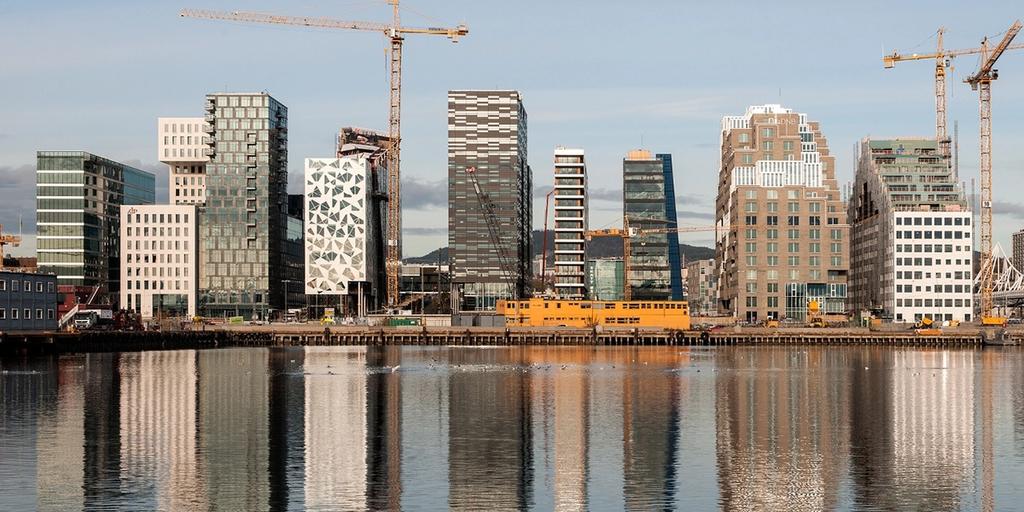
The architectural concept was developed by Norwegian firms DARK and a-lab in collaboration with Dutch practice MVRDV. Because the buildings are positioned in close proximity to one another, the ensemble resembles a barcode when viewed from a distance.
Structure
The Barcode project is a geometric system of 12 narrow yet substantial buildings, each designed by a different architectural practice. At its core is a play on geometric proportion and perception: the buildings vary in height and width. For all its boldness and visual impact, the project feels organic and sits comfortably within the broader urban vision of contemporary Oslo.
Particular attention is drawn to the building designed by a-lab, known as The Carve — a multi-storey structure of white marble with timber inserts. The building incorporates office space on the first eight floors and residential apartments on the upper floors. An open-air garden has been laid out within a striking recess, or 'void', cut through the structure. The architects' aim was to design apartments with windows on both sides, ensure ample natural light and achieve a high level of energy efficiency.
Interesting Facts
- During construction, the remains of nine ships were discovered, believed to have been built in the first half of the sixteenth century. This proved to be the largest collection of shipwrecks ever found in Norway. It is known that historically this site lay underwater, as did the rest of the Bjørvika district until around the mid-nineteenth century. These and other artefacts uncovered during the works were donated to the collection of the Norwegian Maritime Museum.
- In 2006, only one in ten Oslo residents expressed support for the planned Barcode high-rise development, yet eight years later, by 2014, more than half the city's population had come to broadly and wholeheartedly approve of the new district's design and construction.
- Phrases such as 'Norway's mini Manhattan', 'Oslo icon', 'new cultural hub' and others began to appear alongside the name 'Barcode'.
- The Barcode district has attracted the interest of photographers and filmmakers alike. The recent British thriller The Snowman (2017), an adaptation of Jo Nesbø's bestselling novel, features footage of Michael Fassbender shot right in Norway's mini Manhattan.
Astrup Fearnley Museum of Modern Art


Location
This private museum of modern art in Oslo was established with the support of the Thomas Fearnley, Heddy and Nils Astrup Foundation. It is situated virtually in the centre of Oslo in the new Tjuvholmen district, where the Aker Brygge waterfront promenade comes to an end, and draws large numbers of visitors and tourists. The district's appeal to other galleries and creative spaces has grown considerably as a result.
Architects
The building was designed by the celebrated Italian architect Renzo Piano (Renzo Piano). His portfolio includes the Centre Pompidou in Paris, the California Academy of Sciences, and a great many architecturally distinctive museums. Renzo Piano is also overseeing the renovation of GES-2 in Moscow.
Structure
Three pavilions sit beneath a shared glass roof — sail-shaped, flooded with natural light, and thoroughly Scandinavian in spirit. The roof's subtly concave form catches the eye at once and lends the museum its dynamism; its bold cantilevered overhangs shield the façade from the wind. The building speaks to its maritime surroundings on the Oslofjord: grey steel columns call to mind the masts of yachts and vessels in the nearby harbour, while silver-toned timber cladding evokes an encounter with the raw winds of the Norwegian fjords.
The site's unique character is reflected in the unusual arrangement of the pavilions — separated by water and linked by small wooden bridges. From here, the views across the Oslofjord are magnificent. Architecturally, the new museum building is regarded as one of the most outstanding museums in the world. The architect's idea was to allow visitors to immerse themselves in the world of contemporary art from both land and water. The concept of 'closeness to nature' underpins the entire project.
Points of Interest
- In 2003 the museum attracted worldwide attention when it acquired the porcelain sculpture Michael Jackson and Bubbles at a New York auction for more than 51 million Norwegian kroner. The work was created by American artist Jeff Koons.
- The museum's collection includes works in the contemporary art vein by Norwegian and American artists, as well as pieces by celebrated Chinese, Japanese and Indian masters. The collection spans works from the 1960s to the present day.
The New Munch Museum, Lambda-prosjektet

Location
In 2008, the Munch Museum was set to 'relocate' from the Tøyen district to Bjørvika — the same area that is already home to two jewels of contemporary Norwegian architecture, the Opera House and the Barcode. This forms part of a Norwegian urban planning initiative to connect Oslo's key districts with the fjord's waterfront and transform it into a vibrant public space.
Architects
By 2019, the New Munch Museum — currently under construction to a design by the Spanish architectural practice Herreros Arquitectos. It is planned to relocate 28,000 paintings, sketches, photographs and sculptures. What kind of building, then, must be worthy of housing Norway's rich Munch heritage?
Structure
The museum's design was conceived along the lines of London's Tate Modern and the Museum of Modern Art in New York. The building rests on a three-storey 'podium', above which rises the main thirteen-storey tower; the museum's principal functions are to be accommodated on the upper floors. The lower levels will house a research library, temporary exhibitions and other public spaces. The tower as a whole combines two core elements: the museum space (the 'static' part of the building) and the public space (the 'dynamic' part).
The first element comprises galleries dedicated to artworks and their conservation, along with the administrative offices.
The 'dynamic' section will extend the full height of the building, forming a vertical public space with views across the entire city. This part of the structure will be transparent, so that visitors remain in direct and constant contact with the urban landscape and the natural environment. The passages and transitions between the two parts of the tower will themselves constitute a 'journey through art'. Completion of construction is expected in 2019.
In addition to works by Munch, separate spaces are planned for exhibitions of works by Norwegian collector Rolf Stenersen and by the artists Amaldus Nielsen and Ludvig Ravensberg. The museum is set to open its doors to visitors in 2020.
Points of interest
- The height and form of the building attracted sharp criticism from residents and sections of the government. The project was even put on hold for a period before being revived in 2013.
A specially commissioned animated video was produced showing the completed project as it will appear in the future:
Nordisk Lys / Nordic Light

Oslo continues to experiment and evolve before our eyes. Earlier this year it was announced that the competition to revitalise the public space adjacent to the Central Station had been won by Norwegian practice RRA, Reiulf Ramstad Arkitekter. This will be the first phase of the Fjordporten plan to improve the area around Oslo S station.
Location
Oslo Central Station, on the boundary of the Bjørvika district.
Architects
Norwegian architectural practice Reiulf Ramstad Arkitekter is known for creating bold yet restrained architecture grounded in Scandinavian values.
Structure
The new structure combines tradition and innovation and takes the form of a tower. It consists of several square volumes housing a large number of offices, conference rooms, cultural spaces and even hotels. A covered arcade will connect the lower part of the building to the broader Oslo S precinct. According to the jury, 'this new project will enable the central station to develop as the largest reception hub and will offer travellers new spatial and qualitative possibilities'. Despite the unmistakably contemporary appearance of the future building, its underlying idea is one of a return to tradition. Timber — the cornerstone of Norway's building culture — will be used alongside modern materials: concrete and high-tech glass.
The project encompasses four principal elements: the station forecourt, which currently includes a neglected square; the lower 'cube' of the tower, intended for residential units and cultural centres; a covered arcade; and the main tower building itself. Construction is tentatively scheduled to begin by 2020.
Of course, not everyone will warm to Oslo's new architectural experiments, but that is precisely the charm of the modern city: while preserving its classical Scandinavian heritage, Oslo is unafraid to move with the times and explore new architectural forms.
If you are also interested in Scandinavian design and Norway more broadly, take a look at the article on the new design of the Norwegian krone and read about Scandinavian interiors.