Extraordinary bridges worth seeing
When travellers explore new countries, they typically head first to historic city centres to immerse themselves in the past. This article introduces 10 contemporary bridges that have become not merely city landmarks, but the very first places visitors want to see.
San Shan Bridge. China
History
In 2022, Beijing will host the Winter Olympic Games. Due to a lack of snow in the city's central area, some events will be held in its north-western district of Zhangjiakou. The old road between the two areas stretched 203 km, so a new one was planned. The Sanshan Bridge (Russian: Three Mountains) became part of that route.
Structure
The bridge was designed by the Beijing architecture studio Penda and the British engineering firm ARUP. In developing the structure, the architects drew inspiration from the Olympic rings, the surrounding mountains, and the DNA double helix.
The bridge is supported by 6 rings that connect to one another, evoking mountain peaks. The height of the "mountain peaks" is 92 metres. The total length of the bridge is 452 metres.
The architects also gave thought to pedestrians. Wide walkways run along both sides of the bridge, separated from the carriageway by shrubs and trees.
The Infinity Bridge. England
History
The Infinity Bridge is the first phase of a major project to restore bridges and embankments in the English town of Stockton-on-Tees. The new bridge was built for pedestrians and cyclists, connecting a park on the North Bank with a university campus and business park on the South Bank.
Watch a short video to see how naturally the infinity symbol fits into the quiet, unhurried atmosphere of the city in the morning.
Design
The 180-metre bridge was created by design studio Spence Associates and engineering firm Balfour Beatty. Lighting design was handled by Speirs and Major.
Its striking lighting is the bridge's defining feature. Specially designed floodlights illuminate the arches so that after dark the structure is reflected on the water's surface in the form of an infinity symbol. The blue line dividing the infinity into two halves marks the pedestrian zone.
The play of light does not stop there. The deck itself is inlaid with blue and white LED modules. When a pedestrian steps onto a module, it lights up white; the modules already passed leave a trailing wash of blue in the walker's wake.
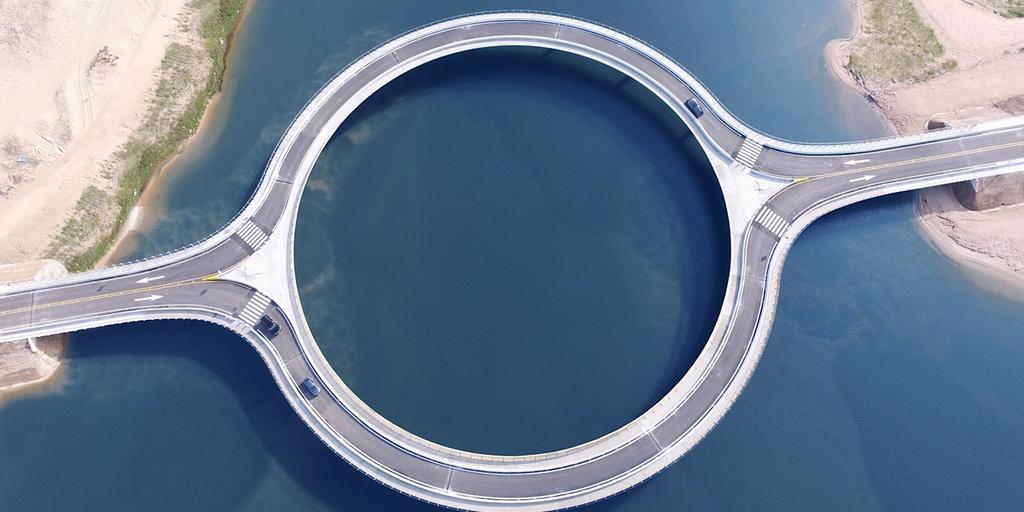
The Round Bridge. Uruguay
History
The Round Bridge is part of a new road running along the Uruguayan coast and linking several resort towns. The bridge spans the Garzón Lagoon.
Rather than erecting a speed-limit sign at one of the most scenic stretches of the road, architect Rafael Viñoly proposed building a bridge that would naturally slow traffic down — and, as an added benefit, give passengers a little more time to take in the view.
What was once a tranquil spot has been transformed since the bridge's arrival. Wakeboarders come to film spectacular footage, kayakers have made it a gathering point, local fishermen try their luck casting from its edge, and at night impromptu parties spring up nearby.
Watch a 3-minute video featuring views of the bridge and the Garzón Lagoon.
Design
Before construction began, Viñoly stated that the bridge had been designed to be as environmentally responsible as possible and would have no impact on the area's sensitive ecosystem. It soon emerged that the relatively modest structure would consume 450 tonnes of steel, 40,000 metres of tension cables and 3,500 cubic metres of concrete. The news prompted protests from environmental groups, but construction was not halted.
The Helix Bridge. Singapore
History
The Helix Bridge is a pedestrian bridge in central Singapore featuring four viewing platforms. From them, visitors can take in the city's skyscrapers, a football pitch, and the bay where laser and water shows are held. The bridge also connects two central districts of the city that are separated by the bay.
Australian architecture firm COX proposed building a pedestrian bridge just one metre from an existing road bridge. At such close proximity, the contrast between the new slender, futuristic structure and the older, heavier one becomes all the more striking.
Watch a two-minute video about the bridge featuring commentary from COX owner Michael Rayner.
Structure
The bridge rightly deserves its reputation as an engineering marvel. First, the slender and elegant 280-metre span supports 10,000 people thanks to a structure modelled on the DNA molecule. Second, its construction required five times less steel than was used for the neighbouring conventional linear bridge.
Mirrored canopies within the 'molecule' shelter pedestrians from the tropical sun, while four projecting viewing platforms offer ideal spots for taking in and photographing the city-centre panorama.
Zaragoza Bridge. Spain
History
In 2008, the Spanish city of Zaragoza hosted a World Exposition dedicated to construction on water. Specially for the occasion, Zaha Hadid designed a bridge spanning the river. It served as the first exhibit visitors passed through on their way to the exposition.
The bridge turned out to be far more than a simple pedestrian walkway. Today it houses interactive exhibition spaces and workshops focused on design, architecture and new technologies.
Structure
The centre of the 290-metre bridge gracefully touches a small island in the middle of the river — not as an aesthetic gesture, but out of necessity: without this support point, it would have been impossible to span the river with 7,000 tonnes of concrete.
In designing the bridge, Zaha Hadid drew inspiration from the ripples of the River Ebro. This is why the exterior cladding consists of triangular panels — their pattern evoked for Hadid the movement of water across a surface.
Sunlight filters atmospherically through narrow apertures that punctuate the walls and ceiling of the structure, which also provide natural ventilation.
Moses Bridge. The Netherlands
History
The site of the Moses Bridge is Fort De Roovere, an old Dutch fortification surrounded by a water-filled moat. In the 17th century it served as a defensive post during times of war.
Following the fort's restoration, its custodians faced a significant problem. Getting visitors across the moat proved difficult: it was too deep to ask tourists to wade through, yet too shallow to cross by boat.
The engineers at Ro & Ad were tasked with creating access to the fort while preserving its aesthetic integrity and historical appearance.
Structure
The engineers devised an elegant solution — they concealed the crossing by building it below the waterline of the moat. Unlike a conventional bridge, the structure is invisible from a distance and does not disrupt the view.
The structure is impressive not only visually. It is also durable and environmentally responsible. The engineers used a specialist material called Accoya®. This is modified timber that resists deterioration in aquatic environments for up to 50 years.
To prevent the 'trench' from flooding after heavy rain, engineers built two dams to regulate the water level and installed a pump to drain water from the base of the bridge. All construction work was carried out in a drained moat.
The Millau Viaduct. France
History
During holiday seasons, the route from France to Spain was always plagued by traffic jams. A new bridge was the solution. The design was taken on by French engineerMichel Virlogeux and British architectNorman Foster.
Seventeen years passed between the first drawings and the completion of the bridge. The construction team faced unstable ground, flooding in the valley where the bridge was being built, and powerful winds. In 2004, the Millau Viaduct was completed and became known as the tallest bridge in the world.
Structure
At 341 metres, the bridge stands 20 metres taller than the Eiffel Tower. The Viaduct stretches 2,460 metres in length and 32 metres in width. The total weight of the structure is 206,000 tonnes.
The Viaduct rests on seven piers. The diameter of the tallest pier at its base is 24.5 metres. Sections of the roadway were pushed across the piers using jacks controlled by satellite.
The Viaduct's roadway is as innovative as the project itself. To prevent deformation of the surface, scientists devised a new asphalt-concrete formula. The composition of the road surface took three years to develop and has been recognised as unique of its kind.
The Lucky Knot Bridge. China
History
The Lucky Knot pedestrian bridge is located in the Chinese city of Changsha. The bridge was built to serve not only a transport function but also a recreational one. It connects a park, a road and an embankment that sit at different elevations. The bridge offers a panoramic view of the river, the city and the mountain ranges. Children also use the bright, undulating structure as a playground.
Structure
The bridge is 185 metres long and 24 metres high, and is constructed entirely from steel. In designing its form, the architects at the Sino-Dutch practiceNEXT drew inspiration from the Chinese art of knotwork, in which the knot is a symbol of good fortune. The form of intertwining ribbons unites three routes into a single 'knot', making it easier for pedestrians to reach different points.
The Storseisundet Bridge. Norway
History
In 1989, Norway opened the Atlantic Road. The Storseisundet Bridge connects the mainland to the island of Averøy. Construction of the relatively modest bridge took six years due to frequent storms.
Drivers who see the bridge for the first time usually slow down, because depending on the angle it appears either unfinished or resembles an enormous ski jump. Locals, on account of its unusual curves and optical illusions, have given it the nicknames 'the drunken bridge' and 'the bridge to nowhere'.
The architects designed this form to accentuate the curves and lines of the Norwegian mountains and to capture the atmosphere of the harsh, changeable climate of the north. The architects' vision is conveyed most powerfully during storms, which are a common occurrence here.
Structure
The structure rests on two supports and stretches 259 metres in length. Its highest point reaches 25 metres. It is built from high-strength concrete that withstands constant harsh weather and the enormous waves that crash against it.
Four parking areas are provided near the bridge, where tourists arrive and drivers wait out storms.
Juscelino Kubitschek Bridge. Brazil
History
The Juscelino Kubitschek Bridge is located in Brazil's new capital, the city of Brasília. The structure is named after the 21st president, who founded the city in 1950.
The young city continues to develop at a rapid pace — its population and traffic are growing, and chronic congestion has become its principal problem. The most acute bottleneck was on the two bridges connecting the southern and central parts of the city. A third bridge was therefore built in 2001, becoming the city's widest thoroughfare.
Brazilians take great pride in the Kubitschek Bridge. It has become a favourite place for walks, guided tours are brought there, and tourist boats sail beneath it.
See the bridge from every angle in a video.
Structure
The bridge won the hearts of Brazilians not only for its striking appearance. Its arches and support elements are made of steel. Steel is not produced in Brazil, making it a costly and highly prized material among the population.
The bridge stands on four concrete piers. The roadway is supported by three steel arches. The bridge is 1,200 metres long, 24 metres wide, and the arches rise to 62 metres.
Traffic runs three lanes in each direction. Pedestrians and cyclists are allocated two 1.5-metre paths, one on each side of the bridge.
Explore a selection of remarkable architectural concepts in our articles on swimming pools and glass houses.