It seems Eileen Gray was not particularly interested in the world's attention, even though she worked all her life creating objects that became icons of product design. In her later years she was certain she had been forgotten — yet in essence, modernism had a woman's face.

"A house is not a machine for living in; it is the outward expression of its inhabitants, their broad vision of the world, their being-in-the-world, their spiritual emanation"
Eileen Gray, Irish by birth, trained as an artist in London — something that raised no eyebrows, unlike studying architecture would have done for a young woman of her time. After moving to Paris, she learned the art of lacquerwork, began designing furniture, and travelled to North Africa to study the craft of carpet weaving.
In 1913 she began exhibiting her work at the Salon des Artistes Décorateurs. Her first major client was Jacques Doucet, the celebrated couturier.
During the First World War she drove an ambulance somewhere in London. On returning to Paris, she took to riding in an open-top car — beside her sat her lover Damia, a cabaret singer, and in the back seat their pet, a black panther.
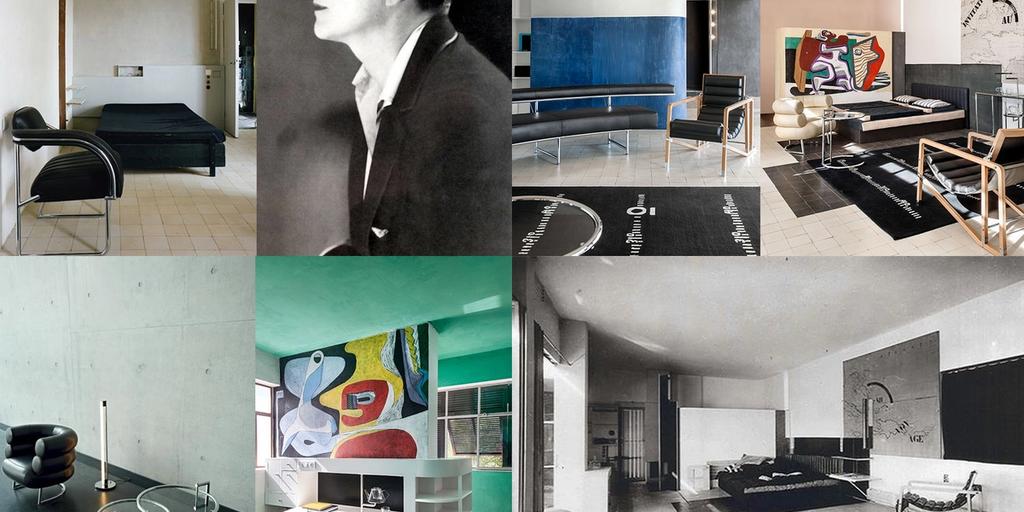
Eileen Gray worked prolifically and thought in the language of modernism while everyone else was still immersed in the intricacies of Art Deco. It took her a full five years (1917–1922) to complete the commission to design Mathieu Lévy's apartment. She created the interior from scratch, developing the architectural layout, all the furniture and the lighting scheme. It was radical — the form of her Bibendum armchair echoed a Michelin tyre, and the Pirogue chaise longue recalled a Native American canoe; it is the latter on which Eileen poses in most of the surviving photographs.
The project was written up by both The Times and The Guardian — it was a triumph, even if many saw Gray as a wealthy eccentric who had taken up design as a pastime.
That same year, 1922, she opened a gallery under the name Jean Désert. It housed a wide range of furniture made from leather, cork, wood and steel — pieces that were neither rigid nor cold, but varied and, above all, comfortable. Comfort and aesthetic integrity were Eileen's guiding principles.
The same principles informed the construction of her first house, E-1027. Together with two workers on the French Riviera, she built an exemplar of modernist aesthetics. The white, partially self-sufficient, elevated structure impresses through its countless, carefully considered and distinctive elements, executed with meticulous attention to detail. An elongated balcony runs across the tall glazed façade, from which steep steps descend to the garden. The living spaces face south, opening onto a magnificent view, while the sleeping quarters are shielded from outside observers.
"Like music, work has meaning only when love is its witness," Eileen Gray wrote in her notebook.
The house belonged to Eileen and her lover Jean Badovici. "E" is the first letter of the name Eileen, "10" is the ordinal number of the letter "J", "2" is the number of the letter "B", and "7" is that of the first letter of her surname.
"I have always loved architecture more than anything, but I never thought I would be able to pursue it"

The building became an architectural salon, but Eileen never came out to greet visitors — she was too shy. Meanwhile, guests repeatedly failed to sit down on a stool that slid away along its rails, and they called the whole thing a "mechanical ballet". On one occasion the harmony of the snow-white ship-like house was disrupted by Le Corbusier — he covered eight walls with coloured murals. Eileen did not quibble over the quality of his work; she sensed that the as-yet-unrecognised architect had declared a quiet war on her. Over the following fifteen years the area around Gray's house filled up with buildings by Le Corbusier, which later became his memorial. And in 1965 he would drown while swimming in the sea opposite E-1027.
In 1932 Eileen began building a new house, Tempe à Pailla. She never stopped working, but it seems that love had left her objects. Some of the pieces Gray designed were selling for enormous sums at the time — among them screens made of lacquered rotating panels, a new kind of object occupying the space between furniture and architecture. She declined invitations to her own openings, and on the rare occasions she did attend, she came incognito — hardly anyone knew her face. Throughout her life Eileen never joined any artistic associations or women's movements. She had been raised in a wealthy, large family and had never sought success or fame.
It was not until 1968 that Joseph Rykwert wrote about her, and his article sparked a series of retrospective exhibitions of her work — in the United Kingdom, Austria and the United States — while her pieces began appearing at auction. But Eileen was already in her nineties by then, and she knew her own worth.
She did collaborate with one furniture manufacturer: Aram Zevi reproduced three of her interior pieces. The Brick Screen, released in 2011 as a limited edition of 75, was named re-edition of the year by the British magazine Wallpaper. The original sold at Christie's for 1.3 million euros.
The auction record for a twentieth-century decorative art object was set by her dragon-embellished armchair (1917–1919). Having been part of the Yves Saint Laurent collection, it sold at auction for 28.3 million dollars. During the two years it took to create the piece, Eileen Gray applied coat after coat of lacquer and left it to dry in her own bathroom, then polished it at length and with great care.
In 1976, Gray died in her apartment at the age of 98. Shortly before her death, she burned all her letters and photographs. She can now be seen in only a handful of photographs that ever appeared in print.
"I am glad to have the opportunity to tell you that in the few days I have spent in this house, I have learnt to appreciate the rare genius that has distinguished the interior from the exterior; the rare genius that has given modern furniture and structures such a sublime, enchanting and original form," wrote Le Corbusier in 1937. This letter was the only one that Eileen did not throw into the fireplace when sorting through her archive.
It is a remarkable story — here was a person who had the freedom never to change the nature of her relationship with her own work (whether that work was a chair or a house) and to spend her entire life doing exactly as she pleased. Eileen made what she wanted, and she accomplished a great deal. She was utterly indifferent to what anyone might think of her, in her lifetime or after her death.
A film has been made about Eileen Gray and her workfilm, and it is well worth watching to learn a little more.
You can read about another woman — one of the most celebrated architects of our time —here.
Follow us on social media so you never miss new content: VKontakte, Telegram — @loskomagazine.