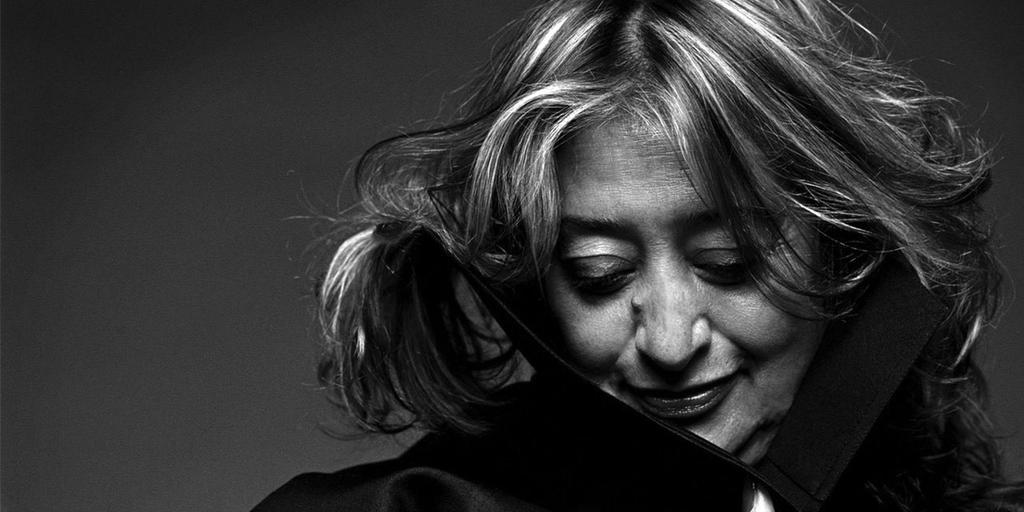
Zaha Hadid (Zaha Hadid) is one of the most celebrated architects of our time. She was the first woman to be awarded the Pritzker Architecture Prize.
Hadid was born in 1950 in Baghdad, and died in 2016 of a heart attack in Miami, leaving behind bold buildings across the world, including in Russia. She is remembered not only as an architect, but also as an artist, a designer, and simply a person of great strength and conviction.

Family, childhood, schooling
Hadid was born into an educated Iraqi family in Baghdad. Her father, Muhammad Hadid, was a leader of the Democratic Party, which sought to modernise Iraq; he had himself studied at the London School of Economics. Zaha described him as follows: 'He was a man of action and a man of ideas.' Her mother, Wajiha al-Sabunji, was educated at English and Swiss schools, a woman of sharp wit and refined taste — and a painter herself, who taught her daughter to draw.

Iraq in those years was a closed country, yet the Hadid family had the means to travel. Both of Zaha's brothers were educated in Britain — one at Oxford, the other at Cambridge. Zaha herself attended a Catholic convent school and grew up at the intersection of Western and Eastern cultures, in an Iraq where people of different races and religions lived side by side.
Baghdad during Hadid's childhood was a progressive city, shaped by modernism. On one occasion, an asymmetric mirror was bought for her room — and it made a profound impression on the young girl. She immediately set about redesigning her bedroom, and did so with such success that her cousin and aunt later asked her to renovate their rooms as well.
University
After school, in 1968, Zaha moved to Beirut, where she studied mathematics at the American University. From childhood, Hadid had dreamed of becoming an architect. In 1972, on the recommendation of her brother, she enrolled at the Architectural Association School of Architecture in London (Architectural Association School of Architecture), which at the time was run by Alvin Boyarsky, who exerted an enormous influence both on the school's development and on Hadid herself.
Hadid's architectural style was profoundly influenced by the Russian avant-garde, and by Malevich in particular
Hadid's architectural style was profoundly influenced by the Russian avant-garde, and by Malevich in particular. Her graduation project, which she titled 'Malevich's Tektonik', envisaged a residential bridge over the Thames.

Below is the interior of Zaha Hadid's London apartment, where an entire wall is taken up by a reproduction of her graduation project 'Malevich's Tektonik' (photographer: Henry Bourne).
Early career
After graduating from the School of Architecture, Zaha joined Rem Koolhaas's firm OMA. Koolhaas — a Dutch architect and theorist of deconstructivism — had been Hadid's teacher at the school. In 1979, she founded her own practice, Zaha Hadid Architects.
The first few years were difficult: Hadid's demanding character, her stubbornness and her uncompromising architectural vision alienated potential clients. The firm took on small commissions while unrealised projects accumulated, existing only on paper. For these, she received various prizes at prestigious competitions — yet none of them could be brought to life.
Then, in 1990, Hadid's studio took on a commission to design a fire station for the designer furniture manufacturer Vitra in the German town of Weil am Rhein. This building reveals particularly clearly Hadid's fascination with Malevich and Kandinsky: it looks as though it has stepped straight out of apaintingby the latter, stripped only of its vivid colours.
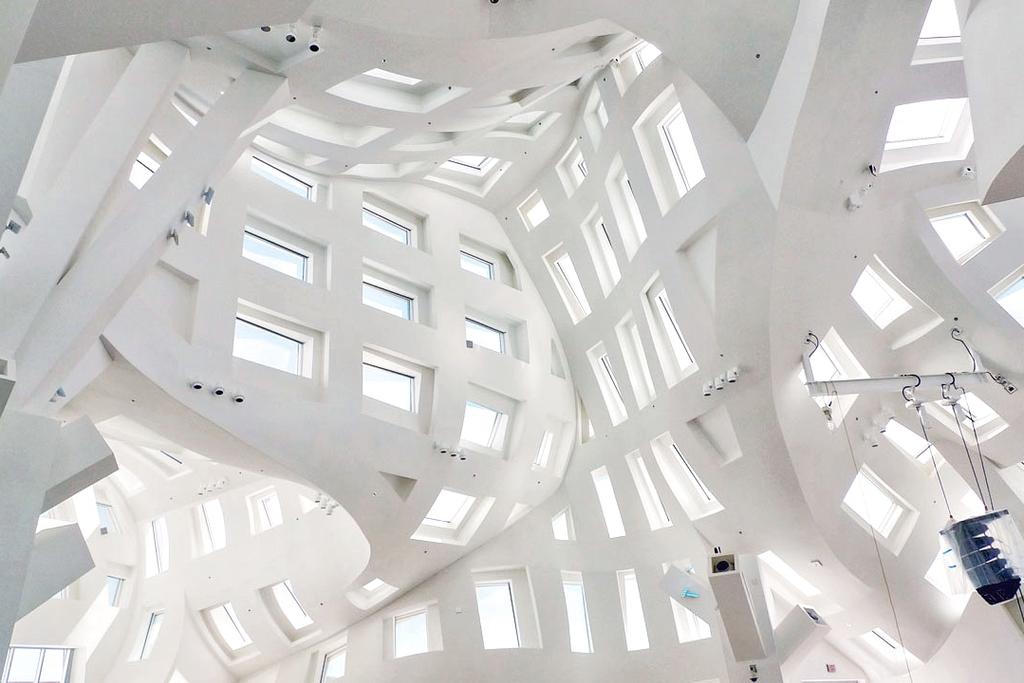
Deconstructivism gained wider recognition in 1997 with the success of the Guggenheim Museum in the northern Spanish city of Bilbao, designed byFrank Gehry. From that moment on, commissions began to flow into Hadid's studio.
A telling episode from this period of her life was the struggle to win the right to build the Opera House in Cardiff, the capital of Wales. Hadid's studio won the competition, only for the client to annul the result shortly afterwards. She won a second time, after which the project was cancelled altogether.
Success
In the early part of her career, the influence of the Russian avant-garde on Hadid's work is unmistakable. Speaking of the artists she admired, she said: "What drew me to the Russian avant-gardists was their spirit of courage, risk-taking, and innovation — their hunger for everything new and their belief in the power of invention." Over time, her work began to take on softer, more fluid forms. The evolution of her architectural style was driven by a desire to lighten her buildings, so that they would read not as heavy structures but as something light, dynamic, and at ease within their surroundings.
In 2004, at the Hermitage in St Petersburg, Hadid received the Pritzker Prize — the first woman ever to do so
In 2004, an event of enormous significance occurred in both Hadid's life and the wider architectural world. At the Hermitage in St Petersburg, she was awarded the Pritzker Prize, becoming the first woman ever to receive it. The prestigious accolade reaffirmed the importance of Hadid's contribution to architecture.
Hadid rarely used a computer in her work: she gave form to all her ideas on paper. On one occasion she set out to discover how many possible ways a single apartment could be arranged. Within a few days it became clear that the number of variants was no fewer than seven hundred. Such depth of thought and dedication is remarkable.
Notable projects
Leeza SOHO Tower, Beijing, China
The eco-conscious Leeza SOHO is a twin tower divided into two sections with an enclosed atrium between them. Zaha Hadid Architects and the Chinese company Soho China incorporated technologies into the project that significantly reduce energy consumption and pollutant emissions.
Rosenthal Center for Contemporary Art, Cincinnati, Ohio, USA
The project was commissioned in 1997 and completed in 2003. It hosts exhibitions, installations and performances. It was precisely for this project that Hadid was awarded the Pritzker Prize.
Bergisel Ski Jump, Innsbruck, Austria

Hadid replaced the old ski jump in the Austrian city of Innsbruck. The new structure was completed in 2002.
BMW Central Building, Leipzig, Germany
The building reimagines the conventional office — transforming both the form and the functions it contains into a more dynamic, engaging hub of connectivity.
Photo: Helene Binet
National Museum of 21st Century Arts / MAXXI, Rome, Italy
The museum of contemporary art opened in Rome in 2010. Romans call it "la maccheronina" — why exactly is hard to say.
Aquatics Centre, London, England
The Aquatics Centre was designed by Hadid's firm for the 2012 Olympic Games.
Photography: Hufton+Crow
Heydar Aliyev Center, Baku, Azerbaijan
Named after Azerbaijan's third president, the centre houses an auditorium, a museum, exhibition halls and administrative offices.
The futuristic Capital Hill Residence, Moscow, Russia

This house, reminiscent of a spacecraft, was built in the village of Barvikha. It was commissioned from the architect by Russian businessman Vladislav Doronin.
Central Bank of Iraq building
Hadid had long dreamed of building something in her beloved homeland. In 2011, her firm received a commission for the Central Bank of Iraq building. Sadly, the architect did not live to see its completion.
These are, of course, just a small selection of ZHA's projects. The rest can be explored in greater detail on the website of the firm.
A few more remarkable projects.


Design
Alongside her work at the firm, Hadid taught and travelled the world giving lectures. She also painted, worked on books and designed exhibitions. Yet beyond her architecture, her design work is equally impressive. Every one of these objects shares the same monumental, fluid quality as her buildings.


Here is our article on another influential and celebrated architect — Le Corbusier. Like Hadid, he was a revolutionary figure in the architecture of his time, whose ideas continue to impress and inspire us to this day.