Frank Gehry is the author of the boldest works in contemporary architecture and a laureate of the Pritzker Prize. He builds structures that draw guided tours, designs cardboard furniture, refuses to use computer software, regards the fish as the image of perfection, and gives critics the middle finger.
In this article you will find Frank Gehry's biography and fascinating facts about him. You will explore his works and discover why the architect's clients took him to court.

The Making of an Architect
Frank Gehry was born in the Canadian city of Toronto on 28 February 1929. His given name was Ephraim Owen Goldberg. His first wife later insisted he change it in response to antisemitic attacks.
As a child, Gehry spent much of his time in his father's hardware store. In the back rooms, entire cities and buildings would take shape from whatever materials the future architect could find. Metal components were, as they remain today, the principal elements of his constructions.
At seventeen, Frank moved to Los Angeles and began to consider his future profession. After finishing college he enrolled at the School of Architecture and started working at the firm of Victor Gruen (Victor Gruen). Gruen designed the first supermarket and shopping-centre buildings, which became the seeds of American consumer culture.
By the age of thirty Gehry enrolled at Harvard University, which he completed on his second attempt. After several years working for various firms, Frank travelled to Paris. There he restored French churches and, in his spare time, studied the work of Le Corbusier (Le Corbusier) and Balthasar Neumann (Balthasar Neumann).
Three years later, energised by knowledge and enthusiasm, Gehry returned to Los Angeles and opened his studio, Frank O. Gehry and Associates. He designed shops and shopping centres in the Gruen style. A few years on, the architect took a step back and, to everyone's surprise, turned his attention to furniture design.
Over four years, Frank designed furniture from corrugated cardboard. The unusual material and design caused a sensation. The pieces sold for $730 apiece, at a production cost of just $7. This success reinvigorated the architect, and he returned to architecture in search of his own distinctive style.
All the money Gehry earned from his furniture he spent on renovating his own home. The architect transformed it into an avant-garde folly. The ordinary house sprouted irregular additions made from wire mesh, corrugated fibreglass and countless timber battens, while a glass cupola was added to the roof. His neighbours feared the unusual structure would drive down their property values. After lengthy disputes, most of them sold their homes and moved away — an outcome Frank described as a satisfactory resolution to the conflict.

Around the same time, Gehry became acquainted with the Pop Art artists Robert Rauschenberg (Robert Rauschenberg), Claes Oldenburg (Claes Oldenburg) and Jasper Johns (Jasper Johns). Through his exchanges with them, Gehry began to see aesthetics differently, freeing himself from the conventions of classicism and rationalism. He found his own style and was ready to share it with the world.
At the age of 49, Frank announced himself to the world: 'I am an architect!' He won the competition to design a law school in Los Angeles, began teaching at Yale and Harvard, and finally attracted international attention.
The architect began to build across the globe, transforming the atmosphere of entire cities with a single building. Yet his creative path has never been straightforward: despite numerous awards, his projects continue to attract criticism to this day.
Frank Gehry's finest projects
Gehry's buildings are among the most recognisable of any architect working today: curving structures with distorted metallic surfaces and fractured lines. Do not look for a correspondence between a building's appearance and what lies within. Gehry deliberately severs the connection between object and meaning, believing that architecture is, above all, art and self-expression.
Vitra Design Museum, Weil am Rhein, Germany

His first architectural project outside the United States immediately commands attention: it looks as though some giant has dropped an origami sculpture in the middle of a field. The broken planes of the walls and roof, the spiral staircase and the pristine white finish all draw the eye. Gehry's ability to play with planes and forms in this way earned him the nickname 'the king of counterpoint'.
Sculpture above the Olympic Pavilion in Barcelona, Spain
The architect designed the sculpture specifically for the Olympic Games in Barcelona, where it was installed atop the Olympic Pavilion. To make the monument gleam and shimmer, Gehry chose gilded steel as his primary material.
Many people assume the architect depicted either a bird or a futuristic spacecraft. In fact, Gehry designed his favourite fish — a carp.
Minneapolis Institute of Art, Minneapolis, USA
In designing the museum, the architect made extensive use of metal for the first time. The entire cladding of the building is composed of steel tiles.
Eighteen years after construction was completed, Gehry developed an expansion plan for the museum. The architecture of the new wings will trace the arc of his development: their forms will be calmer, and their style closer to organic architecture.
The Dancing House in Prague, Czech Republic
Gehry and Czech architect Vlado Milunić designed the building as a symbol of a celebrated dancing duo of the era — Fred Astaire and Ginger Rogers. Two deformed, elongated cylinders are composed of metal mesh, glass and concrete.
The project provoked controversy among designers and critics. Prague residents called for a construction ban, citing the building's sharp contrast with the neighbouring 19th-century townhouses. Despite public opposition, Czech President Václav Havel personally approved the project.
The Solomon R. Guggenheim Museum in Bilbao, Spain
The museum has been acclaimed as the most spectacular building of its kind, and the architect Philip Johnson (Philip Johnson) called it the greatest building of our time. It was with this museum that the grand accolades — and the protracted construction sagas — that would define Gehry's career first began.
Gehry was firmly opposed to using computers. When a cardboard model was digitised, it became clear that the software was incompatible with the principles he had built into it. Standard architectural software is based on a rectangular grid. To violate the "moral principles" of architecture, as Gehry put it, he needed software of an entirely different order. Overcoming his aversion to computers, he and his team rewrote a programme originally designed for engineering fighter jets — one not tied to a rectangular grid. It was a significant step forward not only for Gehry but for the entire world of architecture.
After this long and gruelling battle with software, problems with materials arose — and, to Frank's surprise, with their unexpectedly high cost. In the end, the original budget was exceeded several times over.
Mixed-Use Complex in Düsseldorf, Germany
The commission was originally offered to Zaha Hadid, but her design was soon rejected for undisclosed reasons. Frank Gehry was invited in her place.
For the cladding, the architect chose mirror-polished stainless steel. To make the building appear even more striking, Gehry repainted the two neighbouring structures — the one to the left in white, the one to the right in red. Upon completion, the building was designated a symbol of the city.
Museum of Music in Seattle, USA
In designing the museum, Gehry drew inspiration from the guitars Jimi Hendrix smashed at the end of every concert. This is why the building looks so distinctly like something coming apart.
Inside, Gehry brought one of Hendrix's dreams to life — a performance space thirty metres high, with superb acoustics and a frieze of video projections. The space was named the Sky Church.
The centre is clad in stainless steel and aluminium in shades of purple, silver and gold.
Walt Disney Concert Hall in Los Angeles, USA
Disney's widow, Lillian, donated 50 million dollars towards the construction of the hall. An international design competition was held, and Gehry emerged the winner.
Due to the architect's resistance to computer software and ongoing problems with materials, construction lasted 15 years. The budget grew from a planned 50 million dollars to 170 million.
Today, critics agree that the result was worth the years of waiting. The hall is visually stunning and boasts superb acoustics — a detail of considerable significance, given that many architects regard Frank's projects as lacking in functionality.
Administrative building of the Novartis factory in Basel, Switzerland
The architect's most 'glassy' project. The building consists of four fully glazed volumes. Inside, the spaces flow seamlessly into one another. The only boundaries separating the office blocks are glass partitions.
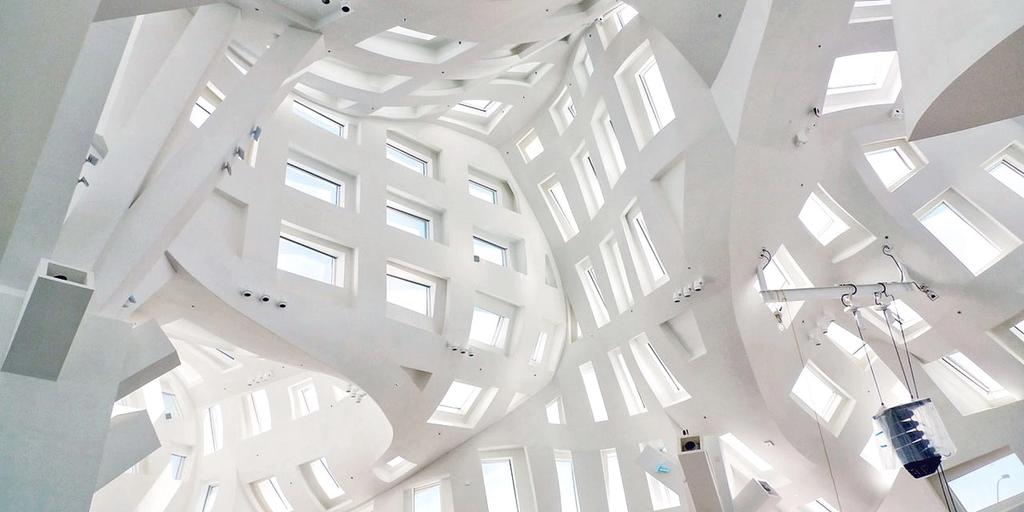
Lou Ruvo Center for Brain Health in Las Vegas, USA
The founder of the Lou Ruvo Center wanted to build a maximally unconventional building in order to draw attention to medical issues and secure sufficient funding. Frank Gehry was the perfect choice for realising that vision.
The building consists of two wings. The first resembles a stack of books and is composed of regular forms and straight lines. The second creates an impression of instability and fragility.
Biomuseo in Panama, Republic of Panama
The architect's most colourful project. The multicoloured roof symbolises the diversity of biological species. Frank noted that this is a deeply personal project for him. First, his wife is a native of Panama, and he feels a strong bond with the country. Second, Gehry considers it enormously important to try to preserve biological diversity, which grows poorer with every passing year.
The architect began developing the museum concept as far back as 1999, but due to bureaucratic and other difficulties the building did not open until 2014.
Beekman Tower in New York, USA
The building's wave-like design was inspired by the draped marble sculptures of the Italian artist Giovanni Bernini. 'That man had a gift for loading form so beautifully with folds of fabric… He was the one who inspired me when I was working on the skin of the building.'
The tower ranks 12th among the tallest residential structures in the world. In 2011 the project received the Emporis Skyscraper Award and was recognised as the most extraordinary building in New York.
It would not be a Gehry project if everything had gone smoothly. Residents of neighbouring buildings complained that sunlight reflecting off the steel panels created unbearable heat inside their apartments and raised pavement temperatures to 60 °C. In the end, the builders had to treat the most reflective steel panels by sandblasting.
Louis Vuitton Museum in Paris, France
The building is adorned with twelve glass sails with a total surface area of 13,500 sq.m. In order to meet the required flexibility and curvature specifications, a specially designed kiln had to be manufactured.
Like most of the architect's buildings, the museum had a long and eventful construction history. Gehry made changes to the design every single day until the head of Louis Vuitton, Bernard Arnault, finally lost his patience and shouted: 'Stop! Enough!' Later, environmentalists sought to ban construction of the museum on the grounds of an historic nature reserve. The city authorities rallied to Gehry's defence and the dispute with the environmentalists was resolved.

Criticism
The architect's early projects were not known for their practicality. Building owners took Gehry to court over the appearance of mould and cracks. Frozen blocks of ice would frequently fall from the unconventionally shaped roofs.
Critics reproach the architect for his preoccupation with external effect and the internal dysfunctionality of his buildings. His projects regularly exceed their budgets due to the use of complex materials and the frequent revision of already approved designs.
Despite the criticism, the 88-year-old architect continues to receive honorary awards, teach at leading American universities and design buildings of extraordinary, seemingly collapsing forms.

Frank Gehry: Interesting Facts
- Gehry was once asked: 'What would he say to critics who consider his buildings overwrought?' The architect smiled and raised his middle finger, adding: 'Let me explain something to you, guys. In this world, 98% of everything that is built and designed is pure sh*t. There is no design sensibility in it, no respect for humanity. They are terrible buildings, and that's all there is to it.'
- Frank had long dreamed of building a museum of contemporary art in Los Angeles, but the commission went to another architect. As a consolation, Gehry was given an old bus depot. Frank was to convert it into a temporary exhibition hall while the museum was being built. The architect looked the depot over and said: 'Brilliant — leave it as it is.' The temporary hall subsequently became permanent, and architectural reference books list it simply as: 'Architect: Frank Gehry.'
- Beyond furniture and buildings, the architect created a jewellery collection for Tiffany, a hat for Lady Gaga, and the bottle design for Wyborowa Exquisite vodka.
- Gehry was the first architect to voice himself on The Simpsons. In the episode 'Insane Clown Poppy' he creates a model concert hall for Springfield by crumpling a sheet of paper.
- Frank is passionate about hockey. He even tried to put together a team from his own staff. In 2004 the architect designed the trophy for the World Cup of Hockey. The design was widely criticised by the public.
Read more biographies:
- Zaha Hadid — the first woman to receive the Pritzker Prize. Like Frank Gehry's projects, her work has provoked both admiration and protest.
- Le Corbusier — the architect whose work the young Gehry studied closely.
Photography: John Reksten, Scott Gualco, Dan Levine, ArchDaily.
Follow us on social media so you never miss new content: VKontakte, Telegram — @loskomagazine.